Mary Terhune Transcript: Mystical Awakening, Kundalini, and Brahman
Summary
Mary Terhune describes a spiritual awakening in which she experienced Jesus as a light and received teachings on forgiveness, judgment, emotion, disease, aging, and identity. She reflects on the bliss and challenges that followed, and on how inner experience can shift one’s understanding of self and others.
Questions This Interview Explores
- What does it mean to forgive yourself deeply?
- How can spiritual awakening change the way we see other people?
- Can unresolved emotions and trauma affect physical well-being?
- What is the ego, and how can we recognize mistaken identity?
- Can spiritual awakening happen without prior spiritual practice?
Key takeaways
- Deep self-forgiveness grows from an inner understanding of our divine nature.
- Criticism used to blame or diminish others can reinforce separation and suffering.
- Terhune links unresolved emotional pain with disharmony in the body.
- The ego is a mistaken identification with thoughts, roles, and ideas about ourselves.
- Awakening brought Terhune a sense that all life shares a deeper unity and love.
- Spiritual awakening may arrive unpredictably; its timing remains a mystery.
Transcript
Rick: Welcome to Buddha at the Gas Pump. My name is Rick Archer. Buddha at the Gas Pump is an ongoing series of conversations with spiritually awakening people. We’ve done nearly 700 of them now over the past 14 years. If this is new to you and you’d like to watch previous ones, you’ve got your work cut out for you because there are nearly 700 of them. They’re about two hours each, but you can check out all the previous ones by going to batgap.com, B-A-T-G-A-P, and looking under the Past Interviews menu.
And while you’re at it, check out the Content Search menu. You’ll find a couple of interesting things, one of which is an AI chatbot that now incorporates all the transcripts of all the interviews—20,000 files all together. I’ve uploaded books and video transcripts and so on. It’s getting more and more interesting, and we’re just writing a guide to it, which I’ll be notifying people about pretty soon.
A lot of that work has been made possible through the assistance of volunteers. So if you’d like to volunteer to do something, primarily as a transcript proofreader, get in touch and we’ll set you up. Some people really enjoy it and have transcribed quite a few of them.
All of this is made possible through the support of appreciative listeners and viewers, so if you appreciate it and would like to help support it, there are PayPal buttons on every page of the website and a page that explains some alternatives to PayPal.
My guest today is Mary Terhune. I’m not going to read her bio because she’s a very smooth—not, I don’t know, get the right adjective here. She reads very well, and she’s written a very interesting book called Out of the Blue. I’m just going to let her introduce herself in a minute, but it’s basically an account of her spiritual experiences of awakening, revelation, and transformation over the years. It has a foreword by Raymond Moody, MD, PhD, and there’s also a really nice reading of one of the chapters by Wayne Dyer, who most of you are probably aware of.
Anyway, Mary got in touch a while back, and I really enjoyed listening to her whole book. I’m going to enjoy talking to her, and I think you will enjoy it too. So, hi, Mary. Welcome.
Mary: Thank you, Rick, for having me on your program. You wanted me to introduce myself, so here’s a little bit about my background. I trained as an RN, worked in the field for about 15 years, and went back to college. I thought I was going to become a clinical psychologist. Instead, I entered the field of massage therapy because, when I needed healing for myself, I found it so effective. I went to school and did that for three years. After that, I became a Reiki master, and after that, in the ’90s, I became a homeopath. So I’ve been on this path of healing for many, many years.
But it all began—my path really switched—in 1984, when I had a crisis, a life crisis. I lost everything that I had earned, lost all my retirement money, and found myself a single woman with an 11-year-old daughter. I was in debt and beside myself with anxiety. I felt that I had failed because I didn’t get a lawyer to protect myself.
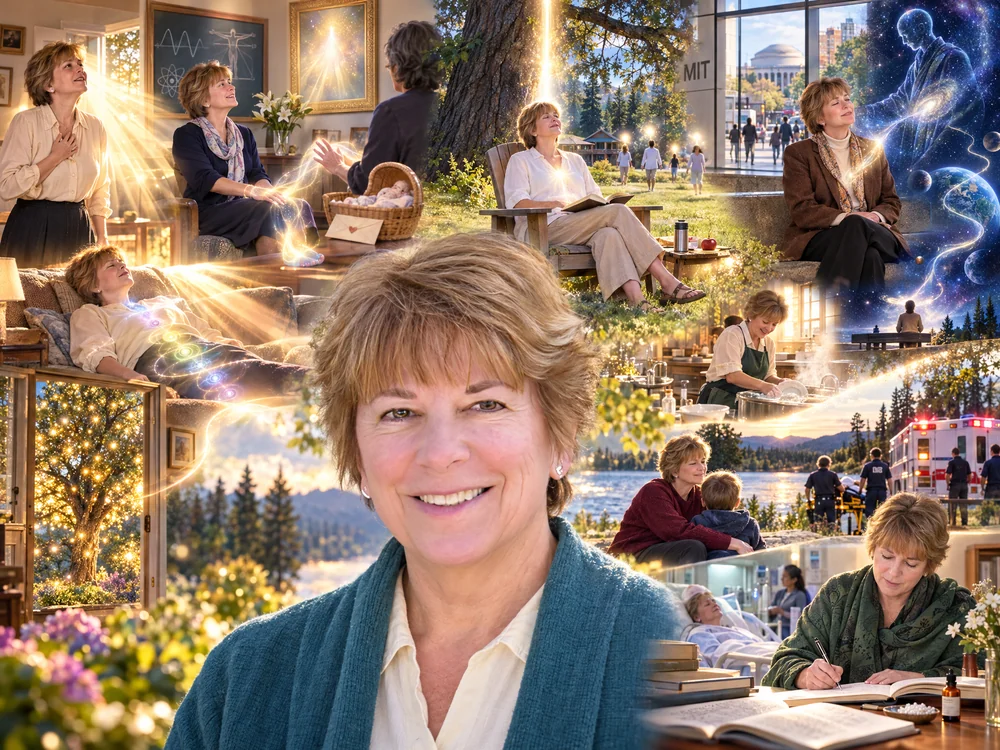
I was standing in the living room. My daughter was visiting her father at the time, and I was standing there so bereft and feeling like such a failure that I began to sob. I couldn’t think one more horrible thought about myself. My mind just could not take any more anxiety, and it just stopped. When it stopped, this space opened up, and through the window poured this light. This light began speaking to me.
Rick: The literal window of your house?
Mary: The window of my house in the living room. Meanwhile, I had no context for any of this because I didn’t know anything about spiritual paths. I didn’t know anything about spiritual teachers, nothing about yoga. I knew nothing. I was stuck in sort of the ego mind, just living life and feeling pretty miserable.
When this light entered, it began speaking to me. And when this light began speaking to me, I recognized the voice. The voice was that of the mystic Jesus. Now, some people say, “How did you know it was him?” And all I can say is, “You know when you know.” He began speaking to me, the seven revelations, and the first revelation—
Rick: My attitude is, I give everybody the benefit of the doubt, and I also take everything with a grain of salt, you know.
Mary: Yes, of course.
Rick: And the proportions vary. Sometimes it’s all salt; sometimes it’s very little salt. I really believe the thing. I’ve spoken to a number of people who’ve had interactions with what they feel to be Jesus, and, as far as I know, it very well may be Jesus. Who am I to say? He’s a busy guy, actually. He gets around. Like Gina Lake, a friend of mine, has written a whole bunch of books where Jesus has basically dictated stuff to her, and the books are really profound. So, you know, why not? But is there anything else you can say that might assuage the doubts of someone who’s a little bit more skeptical than me?
Mary: No. There’s nothing more I can say, because it has to—
Rick: I mean, if you were a Hindu, do you think you might have interpreted it as Krishna or something different?
Mary: I don’t know. I mean, in the end, I feel all these mystics belong to the world and they don’t belong to any particular religion. That was my experience with him. I was brought up a Catholic, but I had long left the dogma of it and was just living life sort of in the egoic structure. I wasn’t happy, that’s for sure.
All I can say is, when it happens to you, that’s when you know, because no one can tell you. Nobody can tell anybody anything. You have to experience these things for yourself. The first thing he spoke about was forgiveness. He said, “Now do you see that true forgiveness is self-forgiveness?” When he spoke those words, he gave me the experience of self-forgiveness.
🕊️ Past lives and spiritual development
I understood that we have to be compassionate with ourselves on this earth plane, because we all go through these tests. This life—we have karmas we have to live out, and blaming somebody else for it isn’t going to work because it’s going to make you miserable in the end. So self-forgiveness, he said, was true forgiveness. It isn’t up to us to forgive someone else or for someone to forgive me. I have to forgive myself for everything. It takes that burden off of people, just to forgive yourself for anything you have to go through in life, because it’s not an easy task on this earth to come back to your true self. I mean, you go through a lot. So he spoke about self-forgiveness, and he worked his way—
Rick: Let’s take an example of that. Let’s say there’s this guy on the news today who had killed four kids in Michigan with a gun, and he was expressing contrition and remorse for his behavior. So let’s say you’re him, and you’re going to be in jail for the rest of your life now. How would that work in terms of his inner psychology, forgiving himself? Would it be like, “All right, I was a stupid kid. I shouldn’t have done it. I’m forgiven”? Or do you think it’s really an ongoing thing that might take a lifetime of introspection and deep self-exploration to really get to the root of why he behaved that way and resolve it once and for all?
Mary: But you have to have some sort of an inner awakening to your divine nature, and by doing so, the divine nature of everyone as one. And that takes a lot. Who knows? That may happen for that person in this lifetime or a hundred lifetimes from now. That’s a very deep question.
Rick: So you think that true, thorough, deep self-forgiveness can’t really happen without some kind of inner awakening, spiritual awakening?
Mary: Yeah, you have to have some sort of inner understanding of yourself and the divine nature of things. It takes a lot of inner contemplation.
Rick: So it’s not just like an affirmation of some kind of—
Mary: It’s not a mental—it’s just not an idea, a construct. It’s an inner experience that’s very, very deep and profound.
Rick: How do you evoke that experience? Let’s say this kid in jail now—how could he do that? Would he need a spiritual teacher? Could he get it from reading books? How does it happen? Is it voluntary to have one of these things?
Who knows how it comes? I mean, grace is part of the construct of our divine nature. Who knows how that happens and how it comes? I mean, how did it happen in my life? I don’t know. Maybe it’s just time for me to wake up, you know? It’s a mystery. It is a very deep mystery.
Mary: Who knows how it comes? I mean, grace is part of the construct of our divine nature. Who knows how that happens and how it comes? I mean, how did it happen in my life? I don’t know. Maybe it’s just time for me to wake up, you know? It’s a mystery. It is a very deep mystery.
Rick: That’s an interesting point, which we can discuss more later, after you’ve gone through these seven points and everything. But the question is, can one do something to bring about the kinds of experiences that you’re going to describe today, or is it just divine grace and you’re lucky if you have them, too bad if you don’t? We can get into that.
Mary: Well, everybody has divine grace. Okay, it’s part of our construct. When it is time for it to happen for us, that’s a mystery. I don’t know. How did I wake up? I don’t know.
Rick: Well, you were doing spiritual practice. I mean, you were—
Mary: I wasn’t doing any spiritual practice.
Rick: Well, not at that point. Not in ’84, no.
Mary: No, not in ’84. I knew nothing about anything. When someone told me I’d entered a spiritual path, I had to ask them what a spiritual path was. I didn’t even know what it was. So the mystery of when it’s time for you to wake up to your inner divinity is itself a mystery. I don’t know. I just don’t know.
Rick: Do you think that past-life spiritual work tends to predispose one to have this sort of thing? Do you think of it that way?
Mary: I would say over the years that that’s true. Especially when I met my spiritual teacher and she said, “We’re coming together again to complete something,” and showed me that I had been a monk of hers in a past life.
And then when you go through these deep, deep spiritual experiences, you do have recurrences or memories of having past lives. Clearly, I had a lot of past lives, not only as a monk, but as a nun. And that comes to you as you walk your spiritual path, whatever it is. Some people have it happen to them and they remember, and some people don’t. But it’s all a divine mystery. So much is a divine mystery.
Rick: Yeah, I’ve never had any—well, a couple of things, but nothing, not much in terms of vivid recollections of past lives. But I have this deep conviction that I have had them and that I’ve probably been a spiritual seeker in many of them. Yeah.
Mary: Certainly. And then, when he told me everything I needed to know in that moment about forgiveness, he moved on to judgment. He said, “Now do you understand what judgment is all about?” Then he gave me the experience that when you judge someone else in a critical way, because we are all one, you are judging yourself.
Now, that’s a very esoteric, deep contemplation. It doesn’t mean you don’t have discernment and don’t hang around with people who bring you down. But when it comes to judgment and wasting your precious energy on criticizing others just for the sake of criticizing them, for the egoic joy of blaming other people, that is not going to help you, and it comes back at you. So—
Rick: So you mean you shouldn’t hang out on Facebook and call people idiots for voting for the other candidate?
Mary: Probably not. It’s kind of a waste of your time. It doesn’t do anything for you, you know. It doesn’t exactly—it may make you feel better in an instant, but then, you know, what does that do, really? You’re putting that out in the universe. It doesn’t have— It doesn’t mean you don’t have discernment and make good decisions for yourself that lead you to your inner, your true inner state. But—
Rick: I think some people get addicted to the… maybe it’s to the hormones that are associated with anger and negativity and so on, just like some people like to watch a lot of horror movies or they like to go on scary roller coasters because of the adrenaline or whatever. But there’s a certain biochemistry, I think, to being argumentative with people. There’s so much of that online these days. People get addicted to it.
Mary: Yeah, well, it keeps the egoic construct in place. And, you know, in the end, does that really satisfy your life? Not for me, but I can’t speak for others. But he made that clear. Then he went on to the Bible. He said, “Now do you understand how they misused my words in the Bible?” And when he said that, I felt—I could feel his sorrow in my heart. I felt it. I felt so sad that his message was understood and used against people to make them feel less than. Even speaking about this now, so many years later, it brings tears.
Rick: It does.
Mary: Yeah. And I could feel that. And that’s really all that he said about that. That was enough for me to understand never to use words like that of mystics and masters to hurt somebody else, to put somebody else down. That was very powerful in that moment.
Rick: Before you go on to the next one, let me ask you a quick question here. You mentioned that this light came in through the window and this voice started speaking to you, and you knew it to be the voice of Jesus. Was there any visual thing associated with it, or was it just a voice? Aside from the light, did you see a figure of Jesus?
Mary: Well, there was the feeling that happened inside of me as well, because he initiated—after he spoke these seven revelations, he initiated an awakening of the kundalini in my body. All the centers, I could feel all the centers spinning. I knew I had heard a little bit about Reiki prior to that, but I didn’t really know what it was. I’m like, “Oh my God, there are these centers that are awakening,” and they started spinning. So he was my first kundalini experience. He was my first kundalini master, and of course I had no context for this, except that I knew that this felt true. This was the most important thing that could ever happen to anyone. My soul knew the truth, even if I wasn’t very connected with it prior to that. But when that happens to you and you get plugged into it, you come to know yourself, or you come to know that truth.
So, as he began to speak, these centers started to awaken inside of me, and I felt this tremendous love that started to pour through me. He went on to speak about weight and emotions. Now, you can imagine, like, why is Jesus talking about weight and emotions, of all the things in the world that he would talk about? But I think it was because I was in the healing arts, and he wanted me to understand this from that point of view. He explained that the energies that are stuck here—I didn’t know a word for it then, consciousness, but I didn’t know the word consciousness then—these emotions stuck in consciousness have an impact on your physical body. You have to deal with your emotions and your mind, your feelings, because that impacts you and how your systems work.
So basically, I think that’s why he told me this. Of course, now all the chakras are spinning in my body. All of them are spinning. Not this one yet; that came later, a couple of years later.
Rick: You’re pointing to the crown chakra.
Mary: The crown chakra, not yet. But they all started spinning, and I started feeling this immense presence and love. By the way, I should add that when the light came into the room, I had to lay down because it was so powerful. I couldn’t stand up in its presence. I had to. So I was lying down on the couch as all of this was happening to me and unfolding in me.
After that, he then spoke about disease. And again, why disease? Because I was part of the healing path, and I would later understand that the reason disease happens is that we have stuck emotions. When we have stuck emotions and traumas that aren’t resolved completely, they have an impact on the physical body. I’ll talk about this later, specifically about what happened to me and my thyroid years later, and how I came to really understand this better.
So he said that disease occurred because of stuck emotions. He didn’t use the word trauma then; he said stuck emotions. Later, I would come to understand trauma, and that it has a tremendous impact on your whole being, your glandular system, your cardiovascular system, all your systems. The disease had to be resolved on that level first. I mean, the issues had to be resolved on that level first, so you didn’t end up having to experience what we call disease, which later I came to understand as disharmony.
Now, this is as much as I could understand. When he finished with that, he spoke about—and I have notes because this is a lot for me to remember—aging. And again, it’s because I was in the healing arts, and this is why he spoke about aging. I could understand that aging was really because there was so much friction in the mind, emotions, and body, and negative thoughts wear you out. They wear your system out; they wear out how everything functions properly, so your energy can’t flow completely.
So, basically, he was describing what we call stress, but it’s really the mind and emotions and thoughts, the discursive mind that’s constantly berating you, putting you down, putting others down—you know, just this negativity that’s sort of a background that seems to have a life of its own and wears you out.
And so when I understood that, he moved on to the ego. He didn’t say, “Now do you understand the ego?” He didn’t come at it from that point of view. He impressed me with this understanding that the ego is a mental construct. Later, I would call it a case of mistaken identity, but I didn’t have those words for it at that time. He just said that you’re not your thoughts, you’re not the job you do, you’re not a man or a woman, you’re not a gender; you’re beyond that.
But of course, understanding all of this was a lot for me to take in and try to assimilate. Later, I would understand that the ego is just a case of mistaken identity. You identify as a body, you identify with your thoughts, like they’re so important, and you identify with your mental constructs—your ideas of how you view the world, how you view yourself, how you view other people—and that’s the ego.
I understood that, and I understood that not only did I suffer from this, but everybody suffered in the ego construct. It gave me not only compassion for myself, but compassion for others. Basically, when that ended, that was the ending of his instructions to me. But now he was fully enlivening my kundalini, so the chakras were spinning, and I was feeling this incredible bliss, this incredible love. And I’m like, “Why didn’t anybody ever tell me about this? Nobody’s talking about this. Why? This is the most important thing in the world. How come I wasn’t told? Nobody’s told me this. How did I not know?”
At that point, he took his energy and removed a veil from my third eye. And when he removed that veil, I felt this immense love just pour from me. At that point, there was also a saying that came into my mind. The saying was, “It is easier for a camel to go through the eye of a needle than it is for a rich man to enter the Kingdom of Heaven.” When I heard that, it was impressed on me. I understood that by “rich man,” it didn’t mean riches necessarily, but it meant your thoughts, you know, holding on to constructs.
Rick: Attachments.
Mary: Weighted down with all these thoughts and ideas. And of course, taking all of this in was very difficult, but the overwhelming feeling was that there was so much love pouring out of me, and envy. I was just in absolute bliss, which was a reprieve from the anxiety that I was feeling.
At some point, he—oh, there was another song that played, and it was like, “Sweet little Jesus child, they had you born in a manger.” And that was going through me, too. “Sweet little holy child, they didn’t know who you were.” I understood that we don’t know who each other is. That child is in our heart. And when you hurt another, that’s what you’re hurting; we really are one. All of this just stirred me. Even just talking about it now really stirs me, kind of makes me tear up.
At some point, when he was finished with all these instructions and had finished awakening my kundalini—which I had no idea what would happen to me afterwards, of course—he withdrew his energy out through the window. Here I was in this state of bliss and wonder and awe. I felt like I needed to go to the backyard, open the door, and get some fresh air. So I went to the back door, opened the door, and what I saw—because he had removed something from my hair, right? Remember?—was packets of light everywhere.
I looked at the tree, and there were packets of light glimmering over it, almost like a Christmas tree. I didn’t understand then that those were photonic packets of light. That light was alive with love and omniscience. And I understood that everything that we see is created from those packets of light. There was so much love emanating that I burst into tears and said out loud, “Oh my God, this is paradise, but we have made it into something else.” I felt we had made it into a hell for each other, when really, this is paradise, if we awaken to that inside ourselves.
Something else got awakened within me, and it was poetry. I started writing poetry. I wrote a poem about this particular moment, and the kundalini. It’s very short; I’ll recite it now.
Chakra one, chakra two, chakra three and four, Up the ladder, down the ladder, can you tell me more? Chakra five, six and seven, when your consciousness is pure, You will find that Earth’s a heaven waiting at your door.
And so, I was in so much love and so much joy and bliss. So then what happened, right? Afterwards, I was working at that time in research administration at a very big Boston hospital. I had to go to work. I didn’t want to go to work. I wanted to sit like Eckhart Tolle on a park bench and watch the phantasmagoria of life. Just watch it and feel that love, and let me be in, you know, swim in this love, this amazing bliss.
But I couldn’t; I had to go to work. It was very difficult because I was supposed to be working with numbers, statistics, with work. And when I sat down to look at the papers and do the work, I couldn’t do it. I couldn’t make numbers work. I couldn’t function. I was in bliss. What can I say, you know? So it was—and I didn’t know, I didn’t have anybody to talk to. I had never heard of any of this. I didn’t know what consciousness was, of course, and I had no context for it.
But what I was left with was that I wanted to meet somebody on Earth, not just the mystic Jesus visiting me, which was fine, but I needed a teacher on Earth. I needed someone who could give me a context for this. I had no context for any of this.
Rick: Sounds like you knew some, because you knew what chakras were in order to write that poem.
Mary: Well, that’s because he awakened it in me. I mean, I had heard something about chakras. I heard it and I’m like, “What’s that anyway? Is it true that there’s light? What light? What are you talking about?” So, he gave me the full experience of it. But I had no context to understand why this light was pouring through me and out of me. Everywhere I looked, all I saw was love. When I looked at people, all I saw was love. I was in love with everybody and everything and everywhere.
I remember having to go to work, standing in an elevator going up to my office, and there were doctors standing in there. One of them was making fun of acupuncture. That’s what I remember. “Oh, that’s a bunch of nonsense, all this energy and stuff. That’s a bunch of crap,” and blah, blah, blah. He was going on and on, thinking, “If you only understood what I understood, you wouldn’t say that.”
I remember getting off the elevator and just watching people, the way they treated each other unkindly and didn’t even really notice each other. It kind of broke my heart. It’s like, “Don’t you know who you are?” Of course, I had no understanding of how to integrate all of this, and I didn’t understand why we didn’t know about it or why no one spoke of it. I had no one to talk to.
So I was thinking in my mind, “Well, maybe if I met someone who understood Einstein’s theory of relativity—energy equals mass times light—then they could help me understand this. What happened to this energy and all this light and my physical body and all of this?” So I had this in my mind. I also had in my mind, “I need to meet someone who has a clear pair of eyes. That’s what I need to meet.”
I would go to different talks by different teachers, and I would be like, “No, that’s not it. No, that’s not right.” They would say things like, “No, that’s not right. That’s not right.” Until one day, two years later, in 1986, I went to a talk at a place called Interface at the time, in Watertown, Mass. It was a panel of speakers, and they were going to be talking about energy medicine. I thought, “Yes, energy medicine! That’s up my alley. Energy. They’re going to talk about that.”
One after another stood up, and I thought, “No, that’s not right. No, that’s not right.” Until one person stood up, and the first thing he said was, “E equals mc squared, Einstein’s theory of relativity.” I thought, “That’s right! I have to talk to him.” So he turned out to be an energy healer, as he called himself. I ran up to him afterwards and said, “I have to see you. I have to make an appointment. Let’s make an appointment right now.” So I made an appointment and went to his office.
When I walked into his office, he said, “I’ll be right back. I have to go get something.” So I said, “Fine.” I noticed this picture on the wall. It was a picture of a woman. I looked into her eyes. “Those are the eyes. That’s the one.” He walked into the room, and I said, “Who is that, anyway?” So he told me her name.
Before he walked into the room, when I looked into her eyes, the picture came alive and began to speak to me. This sounds strange, but when it happens to you, it’s not so strange. She said, “We’re coming together again to complete something.” She showed me this little movie clip: I had been her monk in a past life, and for some political reason or another, we got separated, so I couldn’t complete my journey.
I had no idea who this person was when the healer walked back into the room. I said, “Who is that? Is she a monk?” And he goes, “Yes.” “She’s going to be in Boston in a few weeks. Do you want to meet her?” “Heck yes, I do.”
I had the hour-long session. Little did I know at that time, when I looked into her eyes, that I had also received another kundalini awakening, like I did from Jesus. The hour-long session, where he was using his energy and breath and moving energy and all of that, turned into a six-hour event where the most amazing experiences happened. All my meridians opened, with light pouring through, light coming out of my hands and out of my feet. I thought, “God’s here. I wonder why. I wonder what this is all about.” And then I thought, “Ah, I remember pictures of Jesus and pictures of Mary. They all have light coming out of them. Oh, this is what this light is. This is what they heal with.”
There was so much that happened at that time. He told me that this child I gave up for adoption when I was 19 and unmarried in the ’60s—and that’s what was expected of you. I was in my third year as a nurse, and there was no such thing as single mothers back then. You were expected to give your child up. This was the cultural norm, and you didn’t dare stray from that because there was no support for you.
So he said, “I’m not supposed to tell you this, but your daughter has contacted me and told me she’s not mad at you, that she loves you.” I started sobbing; he started sobbing. It was just the most amazing healing. Years later, I would be reunited with my daughter.
Rick: Do you mean esoterically, your daughter contacted him? Not—
Mary: Yes.
Rick: Psychically, or something?
Mary: Psychically. Right. He goes, “You know, I’m not supposed to tell you this, but I’m going to tell you this.” And he told me that. At the end, I mean, I was sobbing, just sobbing. He was sobbing; I was sobbing. It was like this immense healing.
I didn’t understand that that’s what happens when the kundalini is awakened powerfully: the kundalini, this spiritual energy in you, clears out all of your life issues and karmas when it gets awakened. That’s because all of that is connected with your ego structure. All of that you’ve held on to gets evaporated so that you can have this experience of your divine nature.
Rick: Yeah.
Mary: So I finally did meet the monk. The monk started talking about the ego, and I thought, “That’s just what Jesus said about the ego. Wait a minute, what’s going on here?” I thought, “This is the teacher I want to be with, because whatever she has, I want it for me.” So I didn’t look at her as an icon. I looked at her as a teacher who could help me discover something in me that I wanted so much. In the meantime—
Rick: Had her teacher died by this time, and she was kind of the main teacher?
Mary: Yes.
Rick: Okay. So you never met her teacher.
Mary: No, I never did.
Rick: Okay.
Mary: So, in the meantime, between 1984 and meeting this monk, I was having—so that was two years of waiting to meet somebody. I was having such a difficult time. Meanwhile, I graduated from my third year in massage school. I had strange interactions with people because I had so much light pouring out of me. In massage school, with my peers, I had one woman yell at me. She said, “You have so much light coming out of you, I can’t stand it.” I didn’t know what to do with that.
It was so difficult and so hard to live in this world, in this state, and I had no one to speak to about it. That just wasn’t available. “Consciousness” was not a word. And certainly, if you ever mentioned these things, they’d probably put you in a mental hospital and drug you with some drug because you’re crazy. In the meantime, here I am at work, trying to function, and I still can’t function. I have all this light pouring out of me, all this love, and I can’t function.
Eventually, the director realized something was happening here. She didn’t quite understand it, but one day she said to me, “Oh, Mary’s found the path of love.” I thought, “Oh, she feels something for me.” Although she never directly mentioned it, she reorganized the office. I was reorganized out in a nice way, so I got a little bit of money when I left.
At that point, meanwhile, all this time in my personal life, I was going through relationships like potato chips. I mean, the kundalini was so alive in me, clearing out all the karmas, all the relationships I had to go through in this life to meet the beginning and clear it out. It was like this tornado that went through my life for about eight years, clearing out my mental and emotional state, and the relationships I would get into and then leave because I knew that wasn’t right. But yet I had to be in it, because now I’m understanding, “Oh, this is karma.” But I couldn’t—it’s like you can’t. There are no shortcuts, is what I’m trying to say.
Rick: Let me ask a question here. So all these relationships are with various men that you had been with in a previous life, I think you’re implying.
Mary: It was some men and women, both.
Rick: Okay. And weren’t you kind of creating new karma? I mean, by having these relationships?
Mary: What I felt like—what it really felt like—was I was having to complete lifetimes from a past life. When I would leave, it wasn’t done with malice; it was done with understanding, and I would complete that so I wouldn’t leave it with bad, leftover stuff. It just felt like I was cleaning out.
I remember many years later, I would be told that my basic karma in this lifetime was with relationships, and then I had a lot to clear out with them. So I would just go through them, clear it out, and not leave a bad feeling, just complete it. It happened like a tornado, like my emotions were being cleared out, my issues were being cleared out, and every time I would feel better. But then again, there’d be another storm.
Rick: So, when the next one was coming, would you actually think, “All right, well, this will probably last two weeks, but I’m going to clear out stuff”?
Mary: No, no, I wasn’t that aware. I mean, let’s put it this way: I was a very codependent person, really feeling I needed to be in a relationship. I didn’t feel strong enough inside myself to not be in a relationship, because I enjoy relationships, even though for the past 18 years I haven’t. I’ve been in a relationship with just myself, because at some point that ended, and I realized, “If you’re not in a serious relationship with yourself, this is just going to continue.” And so that just stopped. It just stopped. Then I started the real, more serious inner journey.
Now, mind you, karmas play out in all kinds of ways. Usually it’s in relationships and in family systems, also in physical diseases that you have, weaknesses. That played out for me as well. But anyway, to get back to after Jesus and those two-year waiting periods, I finally was separated from the hospital and left. I had nothing left in my bank account at all.
Rick: Your actual, literal bank account?
Mary: My actual bank account.
Rick: Not your karmic bank account.
Mary: No, mine was probably a little less, but not complete, right? And there was this opportunity: I could go visit my teacher, and there was an initiation that I wanted to take to initiate deeper levels of the kundalini. In order to do this, it was going to cost me some money, and I would have to travel. I had such faith that I used up the last bit of money in my bank account. I didn’t have a job yet, but I went and did it. I spent everything.
When I got back from that meeting at a meditation center, I opened up the Boston Globe, and there was an advertisement looking for a manager for the new office at the Space Center at MIT. I had helped the director of research open up our new office while I was in the hospital, and it became very successful. I thought, I can do this. I know how to do this. I know how to open an office. It was the Center for Theoretical Geocosmoplasm of Physics. I knew how to do this; I could do that, and I could get my former boss to give me a recommendation, which she did. I went in, had the interview, and got hired.
Immediately, my bank account went from zero to something, you know? It was just this leap of faith. I had so much faith in this inner journey that I took the leap to do this. So, it was 1986 when that happened. Of course, I was going through my different life experiences and trying to integrate all of this in my being. By now, I had started reading spiritual texts like the Bhagavad Gita and the Viveka Chudamani, which is all about Brahman. I was reading these things and feeling nourished by them.
Oh, by the way, one of the side effects when Jesus awakened me was that, when I had so much light pouring through me, I didn’t need much food because the light was feeding me on some level. I lost about 10 pounds. I went from 119 to 109. I felt so full in my spirit that I didn’t need very much food. That was an interesting experience as well. But anyway—
Rick: I was going to ask, because Jesus had talked to you about weight, whether you had been overweight or something. But you said you’re only 119, which is not bad.
Mary: Nothing. So, that happened, and I really understood how, when this energy in us gets awakened, you don’t crave food as much—physical food—because your soul is being fed this amrita that pours from you. It’s quite delicious, as I can describe it: absolutely delicious amrita.
So, now it’s 1986. I met my teacher, took this initiation, and was now working at MIT. My teacher left for a couple of years. In the meantime, I was doing practices, meditating, chanting, doing selfless service, reading books, and living my life, trying to integrate all of this every day. When she returned in 1988, it was summer. It was actually July 4th, which we recognize as our liberation day right here in the United States.
I was taking a course at that time at the meditation center, basically on the ego and releasing the ego. On the third day of the course, I was sitting outside on the meditation grounds, in an Adirondack chair under this huge pine tree by myself. I was eating my lunch and being in silence. The instruction the night before was, “If you want to get rid of negativities, then repeat these words 24 hours a day, even in your sleep.” So I repeated these words 24 hours a day.
Rick: Some chant?
Mary: Some chant, very small.
Rick: Sanskrit thing or something?
Mary: Yeah. I thought, “Well, how am I going to do this in my sleep?” I thought, “Oh, I know. I’ll repeat it as I’m going to sleep, and then it’ll just repeat itself.” So I worked that out.
Here I am the next day, doing the same thing. I’m repeating these words, repeating these words. People are all around, hundreds of people, but I’m sitting by myself, and I’m trying to read this book called The Yoga Sutras of Patanjali by Alice Bailey. One sentence captivated me. It said, “At some point, at some point, the ego will have to take the back seat and let the soul lead the way.” I thought, “Yes, I want that to happen to me.” That was a defining moment.
In that moment, this powerful energy came over my head. It was the most powerful energy, and I recognized it. I’ll give it the word God, but not as a persona or as a person, but as an energy. I gave it a different name after that. This energy was so powerful. I knew what it was. It opened up my crown chakra, this crown chakra here. It went down to the kundalini, and boom, awakened that kundalini to its fullest extent.
As the kundalini awakening happened, it started to roll up inside me, up the sushumna, the central channel. You have the ida and pingala, which are duality, male and female. But when those two come together in union and go up the sushumna, a divine alchemy of light happens, and you turn into a divine being instead.
It entered up through the sushumna, through here. As it did, I could feel it rolling up the script of life as Mary. That was my experience: “Oh, it’s rolling up the script of life as Mary, rolling it up, all the issues.” I understood that, at some point, from here down, your script of your individual life is written on your chakras. All the things you’re going to go through are written there, right there. When you’ve cleared out all of that, and it’s your time, kundalini awakens and rolls up.
When it reached here, a picture of my teacher showed up. I got divine permission to enter the higher. As soon as that happened, this light of a thousand suns awakened within my crown. The words that came out, or the words that I heard and felt, were, “Aham Brahmasmi. I am Brahman, and all this is my creation.”
As I looked out, I saw something like a gossamer. It was like a gossamer covering everything. I will call it maybe Maya, or a gossamer over everything. I thought, “Ah, the world is created from that.” I knew that Brahman was my natural state and the natural state of all humanity, that this is why we’ve come to reclaim our inheritance as Brahman, the ultimate field of omniscience, divine reality.
I looked up over this building, and there was Jesus rising in a cloud with his hands up. He looked at me, rose up into the clouds, and disappeared. I thought, “Am I ascending too?” Then I thought, “Yes, I’m ascending here in this physical body.” I understood we’re here to reclaim our divinity and anchor it in this physical body, and then create the world that we live in here from that state of mind.
When I looked out, I could also see what happened as this energy opened. It was like a fire hose of light. That’s how I can describe it. It was like a fire hose—you know, a fire hose that shoots out water? Well, that’s what it was, a fire hose. It just came down and kept pouring. Then, when it got to my heart, it burst it open so that it was pouring this divine energy. The feeling of it was bliss and compassion—not compassion out of pity, but compassion because it was a natural state of being. All of that was happening all at once.
As I looked out and people walked by, I saw them from this state, and I could see their souls hovering over their heads. It was like right here. I could see the soul filtering down like a Christmas tree over them. I wanted to shout at them, “Hey, look up! Your soul is right there! Look! Look!” But I could see that they were caught in mind. They were caught in mind stuff, because I saw that too. I thought, “Don’t you know you’re God? Don’t you know? Look! Look! Look!” But I couldn’t shout it out. I couldn’t shout it out, but I felt it.
I was so elated, so blissful. Fear fled. Fear cannot go past here. Fear is part of the egoic structure.
Rick: For those who are just listening in audio, you’re pointing to your third-eye area, the makara point, it’s called, and you’re saying fear cannot go past that spot to any higher state. Right?
Mary: No, because fear is part of the dualistic state.
Rick: Right. Right.
Mary: And that is the first feeling people feel when they’re separated. How do I know that? I’ll explain that in a bit.
Rick: There’s actually a line from the Upanishads about that very thing.
Mary: Really? So, for twenty—
Rick: It just says, “Certainly all fear is born of duality.”
Mary: Yes, absolutely the truth. Here I am reclaiming my statement, like, yes, this is our natural state. Now, it’s omniscient and it’s divine and it’s blissful, but it’s our natural state. I remember the egoic state and how unnatural and hellish it was to live in it, because now I had something to compare it to. It seemed to me that we’ve bought into this egoic structure as our natural state, which is so convincing and has held you like a prisoner with no escape. Save my teacher’s grace, who else can I turn to? You know?
And so, this state, I recognize as our natural state, and that everybody, that it’s in everybody, everyone—in the beggar, in the rich person, in the terrorist, in the saint—it’s all there inside us. And it’s how you, it’s that you access it and why it’s so important to wake up to it. Because if you don’t wake up to it, and you turn to fear and hate, you will do horrible things to other people because you will see them as other and able then to easily kill them, either with words, either with actions, or literally, physically. This is why it’s so important to reclaim this state.
I understood this is why we came to Earth. This is why Earth is such an important place to be. To reclaim it here, that’s the great purpose. And later I would come to know a word called jivan mukta, which means—it’s a Sanskrit word—jivan is body and mukta is liberation, so being liberated while here in a physical body.
When I looked down at my arm as I was having this experience, I could see light pouring all around the flesh, and I understood that it was the light that was alive. The flesh had no life of its own other than this light that gave it, that enlivened it and gave it life. And the words that I was given for humanity were, the message was, “Here is your divinity, the divinity that awaits all mankind. Your soul wants full expression now. This is the presence. This is the living presence. This is living. This is real.” And that’s the message that I want everyone to know. And that is the truth. No matter what others say, this is the living truth. When it happens to you, you know it. You’re a changed person.
As I was going through that state, I was also given an understanding of the different kingdoms: the mineral kingdom, the animal kingdom, the plant kingdom, the human kingdom, and then the divine kingdom. Humans were unique because only humans ask the question, “Who am I? Why am I here?” A tree doesn’t ask it, a dog doesn’t ask it, a flower doesn’t ask it. Only humans can ask it. When you ask that question sincerely, you begin the journey to your divine nature. When you come into your divine nature, it affects the consciousness of the universe because you’re one. It’s all one universe, one consciousness, one consciousness as divinity. That’s why it’s important.
So when we rise up as humanity, rising up from human state to divine, all the other kingdoms rise up with it. And that’s what makes us so unique. And that’s what makes it so important. And that’s what makes everyone important, every single person on this planet important, because this is what they have within them, and the possibilities of that.
Now, at the end of all of this, for 20 minutes, I had signed up to do dishes in the dishroom. Huge dishroom. Many people, soap suds, machine going, crashing around, lights, you know, from the water, all the smoke and everything, you know, coming up. This is the last: I entered the dishroom, and I was still in this state. I had my gloves on, and the water and the dirty dishes, washing the dishes, and I am in bliss.
I happened to look up, and the woman across from me happened to look at the same time. She looked into my eyes and burst into tears because the state that I was feeling ignited and reminded her of the state within her, and she burst into tears. I finished my dishwashing and left the dishroom.
As I left the dishroom, someone stopped me to ask me a question. In that moment, I could feel the energy pulling me down, back, down, down, down, into separation. I was so distraught because now I was experiencing the fall from grace, and very consciously. The agony of it was so severe I wanted to sob completely, but I restrained myself from doing that, and the first feeling that I had was fear, fear, just like that. I entered back into this egoic state. It was a magnet-like pulling; it was like Maya just pulling you down. You have no—you can’t fight it, you can’t argue with it. This is your karma. You have stuff to handle, you’ve got stuff to clean out, you’ve got stuff to go through. You will see the wisdom of it at some point. And I’m like, “No! I don’t know! Absolutely not!” I was absolutely in agony.
Later on, maybe three years later, I was reading this book called the Shiva Stotravali, and in it Utpaladeva, one of, I think, a ninth-century saint, said, “When you experience it…” He gave a word for it. It’s called Vipralambha, the agony of separation. Then I understood that all the separations you go through in this life from your loves were all a mirror to that greater separation that you were really suffering from and trying to seek in each other, trying to find in each other, trying to find in relationships. And believe me, I tried myself to find that.
The days that followed, it was so difficult for me to have to deal with this and to integrate it and accept it. This took a lot of surrender on my part. And I wrote to my teacher about it, you know, “What in the, you know, what?” And she wrote back that the reason that I experienced this was because of my great faith in the Shakti. That’s why I experienced it. In other words, I had no doubt that this could happen. I didn’t have enough training to tell me it couldn’t happen. I wasn’t a scholar to read that it’s very difficult and hardly anyone ever enters this state. I had none of that in my way. So it was because I didn’t have any doubt that this could happen to me, none whatsoever, and it did happen.
Then after I wrote to my teacher, I got phone calls once a week for three weeks to tell me that this was a great experience. Now this is 1988, July—July 4th, my liberation day—and yet I had to go back. So time went on, and I had to integrate this, live my life, go to work, do the practices, find some acceptance, live my life with the knowledge that one day I’d return to my natural state, which is Brahman, our natural state, and everyone’s natural state of divine—you can call it whatever you want, but divine being.
It was now October. I was working at MIT, and during the wintertime I would meditate in a lobby in the electrical engineering building at MIT, because it had a nice big lobby. In the middle there was a door that swung around, and basically students would come through and cut through to go to the other parts of the campus. So I would meditate on a bench. I would take my lunch, meditate on the bench for a little while, and then go back to work.
Now it’s October 1988. I’m still reeling from self-realization and having to go back and live my life, not really finding anybody, even on the path, whom I would speak to about this, who could understand what the heck I was talking about. So it was a rather lonely time, a rather lonely thing, and a lot of people on a path find that it’s a rather lonely event in walking the path.
I’m sitting, and now I’m reading about a monk, a realized monk who had passed. And I knew that I would never meet him because now he was on the other side, so I was feeling kind of sad about it. And so I closed my eyes to meditate, put the book down. I thought I had to meditate, so I closed my eyes to meditate. A few moments later, my eyes still closed, I hear, “Are you ready?” And I’m like, “Oh, that’s just a student, you know, he’s bothering me. He sees I’m meditating. I’m paying no attention to him.” I hear again, “Are you ready?” “Wait a minute.”
The Monk’s Vision and the Milky Way
And so I kind of look to my left, and there’s the monk. And now I’m like, “Wait a minute, people have talked about these experiences in meditation, that they’re really half-live. You can see this person coming towards you. Oh my God, it’s true.” And so he turned and walked towards me, and as he walked towards me, he turned into the Milky Way. His energy turned into the Milky Way and entered my solar plexus.
When he entered my solar plexus, mind you, I still had my eyes closed, it made such a racket inside me: this whirling wind, this tornado, these lights and energy and, you know, conscious blowing. I could hear a locomotive of a train, and I heard bells ringing. And this energy was moving up, and some of it went down, but it was all moving up. It was so loud and so powerful and so strong, I thought my ears were going to burst. Of course, I had the thought my tympanic membranes were going to burst with this energy. It just kept coming up and up and up.
And when it reached here, I thought, “I’m leaving my body. Is that okay? Is that all right?” And he said, “Yes.” I just went with it. At some point, like in a split second, there I was in my energy body, standing next to the energy body of this monk. Now, looking at a window of light, two windows of light, one above the other. The light that was pouring from those windows was so powerful, it was such a magnetic pull that I couldn’t resist. “I’ve got to go. I’m going. I’m—wait a minute, you have a daughter. No, no, I’m going, I’m going, I’m going.”
As I went to move towards the light, he stopped me and said, “Not yet.” “Oh no, I have to go back. I don’t want to go back. I have to go back, but I have to go back. It’s like, well, how am I going to get back?” I didn’t have a physical body. It was just in my light body. I looked down, and there was this filament of light, this silver cord that somehow was attached to me around the umbilical area, and I was told that I had to follow the cord back to wherever the heck I was going. So I followed the cord, and it took all of my energy to concentrate to get back.
As I’m following this cord, it was dark, and all of a sudden the vista opens up, and now I see the solar system. I go, “Wow, I’ve been far away from wherever I was.” So now I started flying past the different planets very quickly, just amazed, you know, at the beauty of them, and coming back. And then I was like a zoom, you know, like Google Zooms, like—and so I was like that. Finally I reached Earth. I go, “Oh, I’m going to Earth.” I was like, “Oh, I’m going to North America.” I was like, “Oh, I’m going to Massachusetts. Oh, I’m going to MIT.” And now I find myself looking down at a body that’s meditating on a bench. “That’s the body you have to go back to.” “Really?” You know, I was quite happy where I was. “No, you got to go back into the body.”
I said, “Okay.” I had no connection with that body. I had no feeling about it. I didn’t know if it was a man or a woman. I just had to go back into a body, and I had to enter through the head. That’s how I came out. So I went, entered through the head. When I did, the physical body jumped, like, “Oh!” It was like your foot going into a very tight shoe. Then all of a sudden, all the mental-emotional stuff connected with this being and body flooded back, and I went, “Oh no, I have to deal with this mind? I have to deal with these thoughts? Oh no, this is terrible.”
All of a sudden, the picture of the monk showed up again. He showed up, and he goes to me, “You see, the veil is very thin between here and there, very thin.” And he disappears.
Now I’m sitting, now I’m in this physical body, sitting on the bench at MIT in the electrical engineering building, looking out on Mass Ave. and wondering if people were standing around because it was such a racket. When I opened my eyes, there was nobody there, nobody around. Then I had the thought, “Wait a minute, I didn’t have a physical body, but I could move, I could see, I could be. Wait a minute, you don’t die. Your physical body drops, but you—you’re eternal, you move on to whatever.”
Then I thought, “Wait a minute, if there’s no death, then how can you have birth?” The dualistic version of it. “Oh my God, the whole thing is not real. Oh my God, the whole thing is an illusion. You were never born, you never die. You’re an eternal being.” From that moment on, there was no such concept of death to me anymore. Death died on that day, and I no longer feared that. The thing that I wasn’t happy about was being back in a body, having to deal with the egoic constructs and living life in an environment of egoic construct. That bothered me a heck of a lot more.
Rick: Do you feel that just being itself is eternal, impersonal being, or do you feel that even with some kind of personality, some type of individuality—I mean, we don’t need to get into the fine points—is eternal? Like, you know, there’s that Gita verse: “Never a time when I was not, nor you, nor all these rulers of men, and never shall there be a time when all of us shall cease to be.” And that implies some kind of individuality being immortal, not just being itself.
Mary: No, no individuality.
Rick: You think he’s referring to being itself there?
Mary: Yes, being itself. Individuality belongs with the egoic construct. That’s all egoic construct, I can tell you that for sure.
Rick: But then that monk showed up, having died, with some kind of individuality to interact with you.
Mary: Well, you interpret it as an individuality, but it’s just an energy.
Rick: An energy that you recognize as that particular person.
Mary: But I can tell you that when I went—it’s so difficult to describe all of this, and it is very much a mystery. But I can tell you, when I experienced Aham Brahmasmi, “I am Brahman and all this is my creation,” it’s a oneness that cannot be described or understood from a mental construct or from having a physical body. It’s impossible. I can try to describe it. It’s impossible.
And no one can—I know, because I was on the other side of that—no one can tell you. No one can describe it in words that’ll make you get it. It’s an experience you have in yourself. When you’re one, it’s one. You know, we may have a physical body, but we’re not physical bodies. We may have a personality that expresses, but we’re not a personality. We may have thoughts, but we’re not thoughts. We are that which comes through and expresses in this world.
There’s no way I could convince anybody of anything, but I can tell you for sure: you don’t die. There is no such thing. And for sure, you are Brahman. We all are, all one, and you can call it whatever you want, you know, whatever you want. There’s no way, no words or ideas that I can describe that will give you, or anybody, that experience.
There’s no way I could convince anybody of anything, but I can tell you for sure: you don’t die. There is no such thing. And for sure, you are Brahman. We all are, all one, and you can call it whatever you want, you know, whatever you want. There’s no way, no words or ideas that I can describe that will give you, or anybody, that experience.
Rick: So, do you think that once that realization of Brahman is stabilized—not just something that disappears after you wash dishes—and then eventually your body dies, do you think that’s the end of any kind of experience? I mean, Brahman, it’s like the drop merges in the ocean and that’s the end of the drop once and for all? Or do you think that, like, Jesus came to you, right, and interacted with you?
Mary: We’re eternal.
Rick: Yeah, so somehow Jesus, as Jesus, was still functioning on some level, apparently, to have that interaction with you, and yet, you know, presuming he had attained Brahman.
Mary: Yeah.
Rick: So how do you reconcile that?
Mary: You know, when things filter down into this physical world, they do get filtered down. This is the only way I can describe it. I don’t know for sure, but that’s the only way my mind can kind of conjure up an explanation of it. Just like we have physical bodies on this earth—you, me, physical body—you’re not that. You’re not that. It’s just an expression on a plane called Earth that has these physical constructs for whatever reason, but we’re not the constructs. You may have a construct, but you’re not the construct.
And Jesus might come down as light, as a construct, but it’s not—it’s just a way of relating in a way in that moment. But once you’re anchored in Brahman—very few masters on this planet right now are anchored in that 24/7—but if you ever are around one, you feel it, and that state is yours. Just because you’re not accessing it doesn’t mean it’s not the same. It is the same. There is only one, and you can call it whatever you want. You can call it Christ Consciousness, you can call it Brahman, you can call it whatever you want to call it. Once you experience it, you’re like, “What?” The jig is up, you know, and, you know.
Rick: I understand “I and my Father are one,” that Jesus said, but I’m just wondering, since, as a case in point, you had this interaction with a being that seemed to be Jesus, or with an energy that seemed to be—something you identified as Jesus. So it’s just a personal curiosity of mine as to whether, once enlightenment has been attained, there’s still some functionality that can interact with people, as Jesus was interacting with you. You know, so, in some respect, one’s life goes on even though it’s not bound by individuality. But there’s still an individual expression, as if an instrument of the divine, which can play a certain role, apparently.
Mary: Yeah, and you know, I wasn’t privy to be allowed to go past those windows of light. So I can’t speak to how all of that operates. I don’t know how all that operates. It is a divine mystery of all mysteries. I don’t know, but I know for sure, for sure, we are one. I know for sure we are eternal beings. How all of that else gets worked out, I guess I don’t need to know that right now.
Rick: Find out when you find out.
Mary: Yeah, you find out when you find out. I mean, if you need to know, it is on a need-to-know basis.
Rick: It’s just a curiosity. It’s a theme that comes up from time to time.
Mary: Yeah, I mean, the mind wants to make sense of it. The mind wants to make sense of something that is beyond the mind. The mind is an instrument, and it’s a beautiful instrument, but it’s limited in terms of all of that. Then, when you’re in beingness, you can use the mind as an instrument, as a tool. You can use it for that. And thoughts, you can use thoughts as a tool.
But, you know, when my mind stopped and Jesus entered, it’s because I was in between thoughts. And so that space in between thoughts, that’s the state of divinity. The space in between breaths is the state of divinity, your divine nature. So that’s that space that’s not empty; it’s filled with—it’s the no-thing. This is as much as I’ve been given to know, which is quite a bit, but the rest is, you know, trying to understand it from the mind. The questions are interesting, but I don’t think there are answers, or it can be very satisfactory in the end.
Rick: Yeah, it’s just a hypothetical speculation.
Mary: Yeah, which is kind of fun to banter around.
Rick: Yeah, yeah. Well, a lot of traditions say, “Well, you just merge—the drop merges into the ocean. That’s the end of any individuation or personal experience once enlightenment has been attained and the body dies.” But then you have all these people having Jesus come to them and Ramana Maharishi coming to visit and all this stuff. How do you reconcile those two ideas?
Mary: Because there are other states of being and consciousness that are in other places in this gigantic cosmic universe. There are other places that I haven’t been invited to.
Rick: “In my Father’s house, there are many mansions.”
Mary: Yes, so I haven’t been invited there to check that out.
Rick: Not yet, but…
Mary: Not yet. I mean, eventually, you know. We’ll find out, but…
Rick: Okay. That’s just a little curiosity of mine. It comes up from time to time in these interviews. It’s one of those little things I chew on over the years, you know.
Mary: Well, I mean, I think it’s a great contemplation, because the more you focus on contemplating it, in asking the questions, the more the answer is in the question and gets revealed.
Rick: Yeah.
Mary: Yeah. So I think that’s very worthwhile. That’s called contemplation. I mean, when I was reading that line from the Yoga Sutras—you have to let the ego take the back seat and let the soul drive the vehicle—I thought, “I want that to happen to me. I wonder what that would be like.” That was a question, and it was my time to get an answer. You know, and I got a big-time answer.
Rick: Yeah. You know, there’s something you mentioned a little while back about when you had that Brahman experience, and the world seemed to be like this sheen or this thin veneer on Brahman. There’s actually a term for that in the Yoga Sutras, which is lesha vidya, which means “faint remains of ignorance.” It’s said that you have to have those faint remains of ignorance in order to function in the world; otherwise, you wouldn’t recognize the world and wouldn’t be able to feed yourself or do anything.
But, you know, presumably there’s the possibility of living in that state permanently, but still having enough of a cognition of a world, however ephemeral it may seem, to be able to function normally and drive cars and do all the stuff we have to do.
Mary: Or do the dishes. I mean, I could still do the dishes and appreciate the construct of this beautiful world. I could still do that, but I was… be in the world, but not of the world. That’s it right there: be in the world, but not of the world.
So it’s all here, and it’s astonishing and amazing, and I’m just not the same from having known all this, having experienced it, having been given sort of the understanding and the experiences. When they happen to you, then you know.
Rick: I would say that you and some people are wired to have these kinds of experiences. People shouldn’t feel envious if they’re not having them, you know, because some people can mature into a very nice, highly enlightened state without having all these, you know, flashy experiences, if we want to call them flashy.
Mary: Yeah, I mean, this happened all spontaneously for me. I was just an ignorant kid born in New Jersey. I mean, that’s pretty bland. That’s pretty normal. And, you know, why it came to me, I don’t know. I guess one can only conjure up that maybe from a past life I’ve done all this work, and all the blah, blah, blah, blah, blah—but who knows? In reality, I don’t know.
Rick: Well, you know, you get what you need. And some people need experiences like this. It’s important for them to have experiences like this. Yeah. And certainly everyone would like to have experiences like this, but I’m just trying to emphasize that if you’re not having experiences like this, those who are listening, don’t feel bad about it.
Mary: No, absolutely not.
Rick: Get onto a good spiritual practice and path and just keep on truckin’.
Mary: And know that it’s true. Just know that it’s true and be curious. Just be curious.
Rick: Seek and you shall find.
Mary: Yeah, and knock, and the door will be opened. But, you know, for me, it came from that moment of crisis with Jesus. The words that I said out loud—I didn’t share this—the words that I said out loud in that moment before Jesus entered were, “Please, God, just let me die. I can’t take this anymore.”
Rick: Because you’re so broke and miserable.
Mary: I was so broke and miserable. I didn’t realize “let me die” was the death, the beginning of the death of the egoic structure. That’s the real death that occurs. And it’s painful and difficult. And anybody who’s on this earth at this time, you know, it’s amazing that you’re here, and you should feel—whatever you’re doing in the world—know that it’s important. I don’t care what you’re doing. I don’t care if you’re washing dishes. It’s all very important because you are carrying with you the Holy Grail. You carry the Holy Grail in you. I don’t care if you’re depressed, if you’re anxious, if you’re happy, if you’re sad, if you’re lonely, if you’ve got a great relationship: you carry the Holy Grail within you. Everyone does.
Rick: Everybody’s got it on their minds these days, you know, with the wars in Ukraine and Israel-Gaza and so on. And, you know, it’s interesting to contemplate those in light of experiences like yours and think, for God’s sake, these people are fighting and killing each other, and here they are, these divine beings, not recognizing their divinity and just beating the hell out of each other.
Mary: This is why it’s important to wake up. And this is why anybody who hears this, you’ve already begun the process. If you’re hearing this, you’re already in it.
Rick: Yeah, it is significant.
Mary: It’s already happening.
Rick: If you’re even aware that such a thing is possible, that’s a big step.
Mary: Well, yes, that’s your consciousness saying, “I want to know itself.”
Rick: Yeah. Yep.
Mary: You know, so if you even hear this, you’re already on the path.
Rick: Yeah.
Mary: Because I didn’t know any of this. I never heard these words before my spontaneous awakening. And, you know, the reason I wrote the book, Out of the Blue, was because I went through a lot of karma, including physical karma. In 2006, I died of a major heart attack. In fact, it was the widow-maker, with the main artery shut down.
I happened to be with my grandson at the time. We were at a lake, very close to the house that I lived in with my daughter at the time. I felt really sick. I didn’t realize what was happening to me. I felt this vice in my back and thought maybe I had food poisoning. I started to feel nauseous, so I picked up the phone. Because I had my grandson with me, I called my daughter and said, “Look, I think I have to go to the hospital. I think I have food poisoning.”
She called our neighbor, a good friend who was an EMT and in charge of all the ambulances in the area. She told him, “I think my mother’s sick with food poisoning.” He somehow intuitively knew it was a heart attack. He called up the ambulances in the area to come to me because he was in charge of them.
She got to me along with the police. The ambulance got there like two seconds later. I got into the ambulance, and I was slipping away. I was slipping away from this life, and the window of light showed up as I was dying. I didn’t realize I was dying of a heart attack, by the way. The window of light showed up, and I thought, “Oh, it’s God again. I guess everything’s okay.”
I could hear them say, “We’re losing her.” I completely went into the void. I had no consciousness then. That ambulance met up with another ambulance on the way that had critical-care equipment in it, and they transferred me into that one. My friend and neighbor, Ben, drove that ambulance to the hospital, calling the cardiologist on the way because he had all these contacts, saying this was the situation and to be ready to receive me.
When we got to the ambulance entrance at the emergency room, I went into cardiac arrest. He grabbed the paddles and shocked me back, which I have no memory of, although he said I did try to punch him. He wheeled me in and said to the cardiologist, “You better not let her die because she’s a good friend of mine.” I said, “Well, what did he say?” And he goes, “He didn’t say anything, he just smiled.”
They saved my life, and I lived through all of that miraculously. I was in the intensive care unit for three days, completely unconscious, and I woke up to my daughter and some friends—my daughter and, I think, her husband—repeating the mantra to me to wake me up. The mantra she was repeating was a very common mantra called Om Namah Shivaya. Most people know this mantra. I woke up to her saying those words. They were the first words I heard.
Then I had a tube in and everything, and I was trying to get free from being tied down. I was saying the word “Nicholas.” I was worried about my grandson, and she said, “Don’t worry, he’s fine, he’s fine.” I slipped back in, and finally I did wake up on the third day.
Her Grandson’s Message About Consciousness
The reason I decided to write this book—it took me a year to recover—was because in 2000, when my grandson was one month old, I had a dream. I walked over to the crib. He was lying on his back, and he was emanating all this light. He said, “God is consciousness. I am consciousness. Everything is consciousness. The people need to know. I’m glad you’re here with me, Mary. I like the name Mary.”
Rick: Nice.
Mary: And so—
Rick: Well, I better write a book because I might die again.
Mary: Well, exactly. I thought, “Oh my God, I don’t know if I’m going to live much longer. I have to write down these experiences.” And I did write the book and self-published it. Six years later, it made its way to Wayne Dyer. He read the chapter on self-realization and said it was the best explanation of self-realization he’d ever heard. He invited me to his Divine Love Seminar, and then he had Hay House publish the book.
Unfortunately, Wayne died three months before the book came out. He died in August; it came out in November. Because he was the one promoting the book, there was no one at Hay House to promote it, so it just kind of died on the shelves. I finally got the publishing rights back about six years later, so I’ve been looking for a publisher to republish it. So that’s what happened with the book, but it did get published.
At any rate, the thing I also want to talk about is what happened to me about 14 years after my Jesus experience.
Rick: Okay, we have a few questions that came in from listeners. Do you want to do those, or do you want to tell us first?
Mary: Sure, let’s do that.
Rick: Okay, we’ll do that, and then we’ll come back to this. Okay, so here we go. I’m going to put my glasses on. The first question is from Rin Esser from Turkey: “Is initiation necessary for experiencing deeper states of consciousness? I read and I joined satsangs for many years now, and I don’t see any change in me.”
Mary: Great question. I don’t know how to answer that. I know I needed a teacher. I don’t know what other souls need, but that’s what I needed. And it wasn’t that I was aware of what I was seeking, other than I wanted to find a pair of eyes. I’m not even sure that I called it a spiritual teacher, but it just came to me. It just happened.
So I would say, just keep doing your practices, and if you’re seeking a teacher, ask. Ask, “I want to find someone who can help me.” Maybe that will work. I don’t know; that’s how it happened to me, but I have no formula. You’re already on a path, and whatever comes will come to you, what’s supposed to come to you. And know that you carry the grail within you, and it’s there.
Rick: And I would add: find yourself a spiritual practice, some form of meditation. This is my own recommendation. Find something that seems to work for you. And “work” means it should actually be enjoyable; it shouldn’t be a chore. You should actually look forward to doing it, you know, twice a day or whatever. And if you don’t find it enjoyable and you don’t want to do it, then look around a little bit more, because there are things out there that you will enjoy and that you will easily do regularly.
I mean, I’ve been meditating regularly for 55 years, and you’ll benefit from it. So don’t just read books and listen to YouTube videos. You’ve got to do some practice. Yeah.
Mary: Yeah, that’s great. Great.
Rick: Okay. Another question. This is from Satvik S.: “Is it just an experience for you, or are you in that state all the time now?”
Mary: I wish I were in the state of Brahman all the time.
Rick: You must be in some… I mean, obviously you’re a different person than you were 50 years ago.
Mary: Yes. Well, I’m aware. I’m aware that I’m not in the state of Brahman. I’m aware that I am in the state of egoic structure. However, that’s not what I focus on. I focus on my thoughts every day, from moment to moment, remembering the true state, just remembering that within me. Just remembering it, that practice of remembering.
I’m not in that state of union, but I know that that is my natural state, for sure, and I do my best to do practices and to function in this state of egoic issues without being too reactive to the world.
Rick: Do you feel a fair degree of contentment all the time?
Mary: Yes, yes, I do.
Rick: So you’re not thinking, “Oh my God, I’m not in this state of union.”
Mary: No, no, no. I do feel this. You know, life goes up and down, and we all have challenges, but I don’t stray far from that state. I don’t stray far from it, but I’m very aware that I’m not in that state. But maybe I’m here just to talk about it, you know?
Rick: Yeah, it’s good to be real and humble about it. Question three.
Mary: Thank you. Thank you for that question.
Rick: Yeah, this is from the same guy: “If there is not individuality, then how did you differentiate between you and the monk?”
Mary: Um, you mean which—
Rick: I think it’s kind of like what I was asking you before. He’s saying, if there is no individuality, how did you know that “I am”—this monk, who is some being, is talking to me, who is some other being?
Yeah, yeah. This is so hard to understand. It’s kind of what we were going around about. If you listen to that again, you identify—you’re not identifying as a separate individual, and you realize that other people aren’t separate individuals. But on this Earth, on this plane, we have these constructs called bodies. When you realize your oneness, you’re interacting with people from a state of oneness rather than just looking at their body and interacting that way with them. So there is, yes, this is a creation, and we have it. You’re in the world, but not of the world. And the more you’re—you know, we kind of went through this, but that’s the best way I can explain it.
I think the wave-and-ocean analogy would be handy here because the wave can say, “Okay, I’m this wave, and I see that wave over there, but hey, we’re the same ocean. So we’re fundamentally just one, and yet we have a wavy nature. I seem to be functioning as this wave, and you’re functioning as that wave, but we’re really the same.”
Mary: But when you interact with people, if the other person is interacting on that level where you know you’re Brahman, interacting with Brahman, you feel that state. You feel that state very much. Very much so, you do feel that. And it’s delightful, it’s joyful. And you try to be helpful then in the world, you know.
Rick: There’s another verse in the Gita which says, “Contact with Brahman is infinite joy.”
Mary: It is. It is infinite joy, I can tell you that much. It’s infinite, and it’s ever new. It’s just unfolding. It’s like this: “Woo, woo, woo, woo, woo.” It’s like that. It’s wonderful.
Rick: Okay, one more question from the same fellow, Satvik S. You know, you were referring earlier to a kind of a gap between thoughts and a gap between breaths. And he’s asking, “Well, how can you be in that gap between breaths or thoughts? How do you get there?”
Mary: Well, it’s a state.
Rick: State, right.
Mary: It’s a state. It’s a state of Brahman, is what it is. It’s a state of full realization, a state of the now. So there is no past or future. There’s just…
Rick: I guess he’s saying, “Sounds good to me. How do I do it?” That’s what he’s asking.
Mary: Focus on the space between your breaths. Focus on the space between your thoughts and let that space broaden a little bit.
Rick: Yeah, you know, that word turiya, I’m sure you’re familiar with, means “fourth.” It’s kind of said that turiya is glimpsed in the gaps between waking, dreaming, and sleeping; between thoughts; between breaths. But eventually it becomes a continuum that is there as you go through the cycles of waking, dreaming, sleeping, breathing, thinking, or whatever. It just underlies everything.
You can almost think of it like a tone, where maybe initially the tone just comes as a beep: “Beep.” But eventually it becomes a continual tone—“beeeee”—though it’s not really a tone. I’m using that as an analogy. And you don’t actually have to pay attention; you don’t even have to remind yourself that the tone is going all the time. In fact, it becomes kind of in the background, and you’re going about your activities. But if you care to, you could always check: “Oh yeah, the tone’s still there.” I’m using the tone as an analogy or metaphor for consciousness, or Brahman, if you will.
It becomes an abiding continuum, but it’s not like, “Blam!” in your face all the time, where you can’t function. It’s just a sort of foundation or background in the midst of whatever else you’re doing. Okay, so you were going to tell us something earlier, and then I did the questions. So now we can go back to what you were going to tell us.
Mary: So the next crisis in my life that changed me was…
Rick: Never a dull moment, huh?
Mary: Never a dull moment in this life, or in anybody’s life, really. And I was diagnosed with that, and then I was given an autoimmune disease, and I was given a drug to take for it.
Rick: What does it do to you? Does it make you sleep all the time?
Mary: Yeah, you start gaining weight, you don’t feel energetic, you feel really weak, your mind is not clear, and you just feel tired. You’re going up the stairs and you can hardly breathe. It’s just that kind of experience. I was also losing my eyebrows, and I thought I needed to go to a dermatologist because I was losing them. Like, why am I losing my eyebrows? That’s another symptom. So I go to the dermatologist, and she says, “Have you ever been tested for your thyroid? That’s a thyroid issue.” I might have Hashimoto’s. So I got tested for Hashimoto’s, and sure enough, I did. They gave me the typical drug, Synthroid, and when I took it, it made me so sick and I felt even worse. So I thought, I need to find a different way. I have to find something else that’s going to work for me because this isn’t working.
I said a deep prayer. “Look, Brahman, teacher, whatever, I know you know the answer to what I need, and I know by now that this lack of function has an emotional component to it because Jesus told me about disease a long time ago, and that if things get stuck in your mind, emotions still show up in your physical body as a disease, we’ll call it that.” So I knew by then, and I said, “I want to understand what’s going on behind this, and I want a cure.”
The very next day, I go to work and tell this to my colleague. She turns around, hands me a flyer, and says, “Ah, then you’re going to need homeopathic medicine.” I’m like, “Homeopathic? What the heck is that?” I knew from the energy that was shown to me that this was the answer. I asked the question; this is the answer. Okay, follow the answer.
Pick up the phone—we still had rotary dials—and I called a practitioner and said, “I have to see you. I want to see you.” She said, “I’m going to send you some forms. You fill them out, and then meet me at such-and-such a time.” So I filled out the forms. She’s a registered nurse, by the way, and a homeopath. The forms included a timeline of all the “never well since” events in my life, from in utero, when my mother was pregnant with me, throughout my life. The significant events, like, you know, the traumas: you lost your dog, you had to move, I had this and whatever. I got a divorce, I got married and it was worse, you know, whatever the “never well since” events in your life were—a car accident, whatever.
So I did that, and I called my mother up because she was still alive at that time. I said, “I have a question for you. Did anything significant happen to you when you were pregnant with me?” She said, “Yes, as a matter of fact, when I was eight months pregnant with you, my mother, who was my very best friend and support in this world, died, and I never got over it.” I thought, “Okay, thanks.”
I showed the homeopath this whole timeline and did the interview. It was the most enlightening experience as I looked at all the “never well since” events in my life. They all involved relationships, failed relationships. I could never find the right partner. It always ended up in a mess. You know, it was just a mess.
She said to me, “What is the worst thing that ever happened to you?” I said, “My mother left when I was 11 years old.” Another—there’s that mother loss again, right? And then she said, “Do you have any recurrent dreams?” I said, “Yes, I’ve always had this dream of the ocean coming over me, and just as I was about to hit—” I would have anxiety, and I was like, “Oh my God!” You know, it was always a recurrent dream.
Then she gave me a remedy to take, and I took it. I remember standing in the kitchen, looking out the window. I took a teaspoon of the remedy in my mouth, and as soon as I did, my consciousness went out into the void. In the void, I saw this twinkling little light like a star, and I thought, “Oh, that’s where my energy’s stuck.” Then I saw another twinkling light. “Oh, that’s the remedy. It looks like the same thing as this. This looks like this.” And it went like this, and it exploded, and I went flying back into my body. I went, “Oh my God, that’s ‘like cures like.’ That’s how homeopathy works. It works on the level of consciousness where you’re stuck mentally and emotionally, and that’s how it works.” Oh my God, it was like this download of understanding. I have to study this because I see how important it is to myself and for my family.
When I asked her about the remedy, I read about it in the book written by Catherine Coulter called Portraits of Homeopathic Medicines: The Psychophysical Analysis of Selected Constitutional Types. I read about this remedy, and the remedy was Nat Mur. Nat Mur is table salt, but homeopathic remedies are not herbal medicine. When that salt is so highly diluted, you can think of it as moving on a continuum from material into the essence of consciousness, the non-material. So it’s this continuum. You highly dilute it and highly dilute it until there are no more molecules that you can see from it, but it still exists on a data level and an informational level.
Nat Mur was the remedy, and it is the law that is innate within us, which is “like cures like.” I asked her about the remedy, and I read about it. The remedy has a stuck emotional mind to it that says—they call it a delusion or a fixed idea—and the fixed idea or delusion of Nat Mur is “the mother is dead.” I went, “Oh my God, that’s what happened.”
That was a grief remedy about relationships. When my mother was pregnant with me, her grief was imprinted upon me: “The mother is dead.” That has to do with relationships, whether the mother is dead physically or the nurturing is dead. So I was imprinted with that. When I came out of the womb, I kept repeating the lack of personal relationship throughout my life. They were not nurturing, and I could never get free from it. We can call it karma, okay, until I took the remedy and it started to unwind this samskara, this thought and emotion that was layered upon me—this deep grief that I held for 56 years.
That’s when I found homeopathy. When I took the remedy that night, I had a dream. In the dream, I met someone who was sort of like a representative of all my failed relationships. We kind of sorted it out: “I’m sorry.” “Yeah, it was just a misunderstanding.” “Oh, yeah, I understand. It’s okay. We’re friends.” And I had the dream. So I was beginning my healing, and from that time on, I never had that recurrent dream of the ocean. The ocean is emotions, being overwhelmed by these emotions. So I never had that happen again.
I began my healing path. As I took the remedy over time, these emotions of past grief about relationships would come up. I would sob and sob it out. I would cry it out, and I’d feel so much better and so much lighter. So you could say that homeopathic medicine, almost on a consciousness level, helps to remove the samskaras, in the way that kundalini does, and to restore inner harmony.
I didn’t take Synthroid anymore. I did find a natural pig substitute called Armour Thyroid. I started taking that, and over the years I needed less and less of it. So now I may take one in a week, and I don’t even know if I need that. It just cleared out this whole grief and the way I held grief, and all of this, you know. So that was the clearing of all this karma. You could say that, on a higher level, the most esoteric level of homeopathic medicine, it helps to remove samskaras so that you can freely flow, and restores inner harmony on a mental and emotional level, so that you can experience your Divine nature in an unimpeded way, in an easier way.
I went on to study it, and it cured me of bronchitis. I had recurring bronchitis, and it cleared that out, which has to do with the lungs, and the lungs have to do with grief. I cleared out all the bronchitis. I cleared out my constant problem with colds and all of that. So began my journey into homeopathic medicine, which I later found out was once part of our medical system in the United States. I went back to school with the doctor, an MD, who I trained with for three years, along with 88 other people.
Homeopathic medicine was once part of our medical system in the United States. I had no idea. It was taught in our hospitals. It was taught in our medical schools. What happened? What could have happened? I found out, and there was even a monument dedicated to Dr. Samuel Hahnemann, the father of homeopathic medicine. He’s the only doctor who has a monument to him to this day in Washington, D.C., at Scott Circle, a mile and a half from the White House. It was dedicated June 21, 1900, by President McKinley and the Houses of Congress, to him as the great medical reformer of the 19th century.
It was so popular then because it was so well used in the prevention and cure of communicable diseases. This is how it became so popular. It was in our institutions, it was used, and we had doctors and hospitals across the United States at that time. And I’m thinking, how in the world did this knowledge get lost? How did we lose this knowledge? How is it possible we could lose this knowledge?
I came to understand that Rockefeller Sr. loved homeopathy, actually, and he used it. He had two homeopathic physicians for himself and his family. He liked it, but he also owned Standard Oil. At this point, they learned that they could create synthetic petrochemical drugs using this synthetic oil, right? So you could create synthetic petrochemical drugs that would mimic what comes from nature.
He decided—he told his son, he was a philanthropist—so he told his son, “I want you to give equal amounts to homeopathic medicine, but I also want it for our drugs, because now, if we could create synthetic drugs, we could patent them and charge a lot of money, and nobody could take the information. But homeopathic drugs, you can’t patent because they’re from nature. There’s no particular patent on them.” He wanted both, but the son decided, “No, we’re just going to get rid of that because then we’ll just be able to have our synthetic petrochemical drugs and we won’t have any competition.” They got it out of the hospitals, they got it out of there, and they told doctors, “If you try to use homeopathic medicine anymore, we’re going to take away your license.” So that’s how we removed it.
Then they basically said, “Well, there’s nothing scientific about it. You can’t prove it.” Well, this is a hundred years ago. Of course, the science then was just in the material realm. We’re on the precipice now of a renaissance, not only in the system of medicine, but in all the systems. We’re in big, huge paradigm shifts.
Just think: the only difference with homeopathy is that if you take homeopathic medicine and the material and start breaking it down, diluting it and diluting it, it goes into a data level—you can call it a consciousness level. But we cut it off here so that we’re only in the physical body, pushing around chemicals and stuff, and we forgot this part. Now we’re waking up to this part to reclaim it, because we have to have both.
We need trauma medicine. I’ve used it. I still use it. We need homeopathic medicine. Homeopathic medicine is prevention and cure. Trauma medicine is to save your life and to fix you up if you need surgery. I’ve used it; it saved my life. We need both.
If you look at it as a duality, trauma medicine is the masculine principle and homeopathy is the feminine principle. If you bring them together, you have an amazing system of medicine. I’ve used both, and the more you wake up to realize your consciousness—and as Jesus said, it all starts here. It has to be resolved here; otherwise, it’s going to show up here. As I say, you need both. So I live in both; I use both. There comes our balance.
Just like it’s time to wake up from the egoic structure to our divinity, right? So we’re in this incredible renaissance. This is an amazing renaissance now. And I actually have a quote from Joseph Campbell that I want to sort of end with.
Rick: Let me ask you before you read that: did your eyebrows grow back?
Mary: A little bit.
Rick: Those are penciled most of the year.
Mary: Yeah, a little. I still have some.
Rick: I still have a very similar thing. I hardly have any eyebrows. Irene pencils eyebrows on me before interviews. But I don’t have any other symptoms. I have tons of energy.
Mary: That’s just aging, then, you know. That’s just a natural aging process.
Rick: I was wondering if maybe I had Hashimoto’s or something.
Mary: Well, you don’t have any symptoms.
Rick: I feel just fine, you know.
Mary: Yeah, you don’t have any symptoms.
Rick: Right.
Mary: But, so, we’re in the renaissance of the souls. That’s what we’re in the midst of. And as we come into our divine nature, using and understanding consciousness as the underpinning of everything, we will create systems that reflect that while we also have a physical world, you know. You have to know and have discernment about when to use both. So, Joseph Campbell—I just came across this today—said, “The dark night of the soul comes just before revelation, when everything is lost and all seems darkness, then comes the new life and all that is needed.” This is the precipice we are on now. So, this is the good news. We’re in the midst of it.
The dark night of the soul comes just before revelation, when everything is lost and all seems darkness, then comes the new life and all that is needed.
Rick: Yeah. I think about that all the time. We could have a whole interview about that because I feel we’re on the precipice of something huge. I think it’s not necessarily going to be a real smooth ride as we transition into it. A lot of people aren’t going to make it, but hang on to your—I was going to say, hang on to your hat or your seat or something. But actually, more useful information or advice would be: hold on to yourself. I mean, know thyself, and that’ll be the best prophylactic for making it through smoothly.
Mary: Yes, this is true. Yeah, that’s true, Rick.
Rick: Okay, Mary, well, this has been a fascinating discussion. You’re a great conversationalist. Your book, again, is Out of the Blue, and it is in print, right? I mean, you found a publisher.
Mary: I haven’t found a publisher yet.
Rick: Can people get it on Amazon or something?
Mary: Some people can get some copies on Amazon. It probably costs—they’re charging you more for it now—but I would love another publisher to come along and maybe scoop it up.
Rick: Have you tried some of the standard ones, like Sounds True or New Harbinger?
Mary: I have tried, but it’s so difficult unless you have somebody. Wayne Dyer was the one who found how important it was to him. So, you kind of have to find someone who’s already in it and can sort of help you along.
Rick: We’ll talk about that. I have contacts at a few publishers. Maybe we can talk about that. Maybe something will happen.
Mary: It’s a pleasure talking with you, Rick. It really is so much fun to talk about these things, and it’s joyful, actually.
Rick: It is, isn’t it? Nothing I’d rather do.
Mary: Yeah, me too.
Rick: Pretty much.
Mary: Yeah, thank you so much.
Rick: Oh, you’re welcome. And thanks to those who’ve been listening or watching.
Mary: Yeah, thank you.
Rick: There are a couple hundred of them on our live call today, and there will be thousands in the coming weeks. Go ahead, what were you going to say?
Mary: If people want to contact me and learn more about homeopathy, you can book a session with me on my website. It’s Conversations with Mary on my website, which is marytruhune.com. You can book either a homeopathic session with me, and I can explain it and maybe give you some remedies you might be interested in for prevention of colds and flus. Also, if you want to talk about spiritual matters, you can do that too. Or all of it. Or all of it.
Rick: Yeah. And I’ll have links to all that on your BatGap page so people can just click on that link. My next interview was with a friend named David Doyle. I’ve never met him in person, but we’ve been in touch for a few years. His primary path seems to have been Qigong, and he has some pretty profound realizations too, kind of not too far unlike some of the things Mary has been describing. He seems like a really interesting guy. I think it’ll be a fascinating conversation, as was this one.
Mary: Great. Thanks.
Rick: All right, well, thanks, Mary, and thanks to those who’ve been listening or watching. We’ll see you for the next one.
Mary: Thank you. Bye.
Rick: Bye. [MUSIC PLAYING]
 Apple Podcasts
 Spotify
 YouTube