Etta D. Jackson Transcript: Soul Memory, the Aquarian Age, and Consciousness in Governance
Summary
The discussion explores Etta Jackson’s experience of receiving guidance through light and how that guidance led her to write about choice and the divine feminine. It also considers whether spiritual insight can serve humanity and inform practical change.
Questions This Interview Explores
- How can someone distinguish spiritual guidance from ordinary thoughts?
- What might it mean to experience God as light?
- How can spiritual experiences shape a person’s work and sense of purpose?
- What is the divine feminine, and how does it relate to the divine?
Key takeaways
- Jackson describes guidance as a quiet, wordless knowing rather than an audible voice.
- She says trust in that guidance helped her act even when its purpose was not yet clear.
- She presents the divine feminine as an aspect of the divine that deserves recognition.
- Spiritual development, she argues, can have practical consequences for humanity.
Transcript
Rick: Welcome to Buddha at the Gas Pump. My name is Rick Archer. Buddha at the Gas Pump is an ongoing series of conversations with spiritually awakening people. We’ve done nearly 700 of them now, and if this is new to you and you’d like to check out previous ones, go to batgap.com, B-A-T-G-A-P, then look under the Past Interviews menu.
This program is made possible through the support of appreciative listeners and viewers, so if you appreciate it and would like to help support it, there are PayPal buttons on the website and a page about alternatives to PayPal. Lately, I’ve been plugging the idea of putting out a call for volunteers to help proofread transcripts of all these interviews. There are a number of reasons why this is useful, but one of them is that I recently discovered that YouTube translates subtitles into a hundred languages. So it’s important that the subtitles be accurate to begin with. I’m also putting up transcripts on the website itself, so if you’d like to help with that, please get in touch.
As you know, YouTube favors channels and videos that people like or subscribe to. The way their algorithm works, the more likes and subscribes a channel or video gets, the more YouTube spreads it around. So if you feel like doing those things, please do.
Okay, my guest today is Dr. Etta D. Jackson. Etta was born in Kingston, Jamaica, and migrated to the U.S. as a student in 1965. For 25 years, she worked in education and retired in 1994 to travel. She has authored four books: Understanding Your Choice, Unveiling the Secrets of the Feminine Principle, The Role of Consciousness in Governance, and The Idea That Is the United States of America: Its Occult Foundation.
She founded an international nonprofit organization, the Institute for Conscious Global Change, in 2007 to assist the U.N. and member states in eradicating extreme poverty through development. The Institute for Conscious Global Change, or ICGC, is in special consultative status with the Economic and Social Council of the United Nations. Etta holds a B.A. in biology, M.S. degrees in guidance and counseling, and in administrative leadership and supervision. She holds a Ph.D. in leadership and change from Antioch University. She has one daughter and one grandson. So, welcome, Etta.
Etta: Thank you, Rick. Thank you for inviting me.
Rick: Yeah, good to have you here.
Etta: Your audience.
Rick: Yeah, I was telling you before we started that Irene asked me to check out a few people to see which one we should invite next. She was looking for a woman in particular, so I listened to three or four different audios of potential women guests, and yours kind of stood out. I thought, well, she’s really interesting and articulate, and she has an interesting personal story. I also haven’t talked about a lot of the things she talks about on BatGap before. So I thought I’d like to interview her. Here we are.
Etta: Great. Thank you very much. As I was saying before we started, I too wondered why you invited me, because I thought your path was more mystical. But then I thought to myself, this is perfect, because this is the kind of conversation I think we should be having, and I would like to have. So I was really happy that you extended the invitation for us to have this conversation.
Rick: Good. Well, to me, mysticism has the connotation of being kind of exclusive and rare, and something that special people somehow in history have experienced. My attitude is that whatever mysticism involves is really the birthright of everyone, and everyone can have such experiences and develop higher states of consciousness and all. Those things are not woo-woo and needn’t be esoteric, and in fact, such development has very practical implications for our world. It could actually be pivotal in the ultimate solution to many of the problems that beset us these days.
Etta: Yes, absolutely. My work is more occult, and, as I was saying earlier, I always use the phrase, “I came to the planet,” because in my memory I always felt that I came here consciously. That was a decision I made to come here. I remember telling my mom when I was very young, “I came here to help with the liberation of humanity,” not understanding, of course, what that meant, but just on a soul level. Even as a child, that was always what I felt.
It has also been interesting to me to watch how that unfolded, because as a child, you say these things because they’re just in you, but you have no conscious understanding of what they mean. For me, it began to take form when, as I told you, I was enveloped by this golden-white light as a child.
Rick: Yeah, talk about that, because I’ve heard you say that, but the people listening haven’t really heard about that yet.
Etta: Yes, well, it’s like a tube of light, and it’s golden-white. It sort of overshadows me, and that’s how I have been guided or communicated with. There’s no audible voice; it’s just an imprint of the light in my cells.
Rick: Is that there all the time, like even right now, or does it come and go?
Etta: No, especially when certain information needs to be communicated to me. This light would overshadow me, and the information would be integrated into my cells as unknowing. So when the light says such and such, I don’t think, “It’s an if or maybe.” I know that this is it. This is what the light says. Yes, it’s true; it’s absolute. So I never question it.
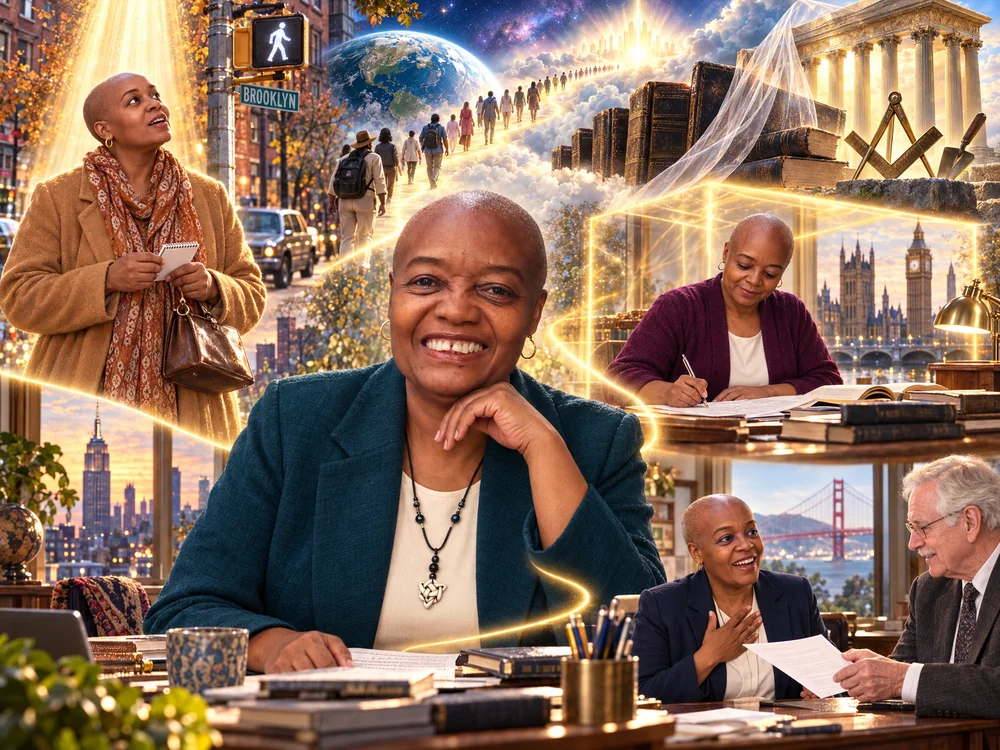
This continued throughout my life. In 1975—you can guess my age—I was in New York, living in Brooklyn and standing at a stoplight. The light enveloped me again and this time said to me, “Write this title down. It’s the title of a book that you will write.” So I went into my pocketbook, got out my little notepad, and wrote down the title that was given to me: Understanding Your Choice.
I thought it was such an abstract title. I said to myself, “Understanding Your Choice, what is that?” I couldn’t conceptualize what I could be writing about, and I’d never written at that level, writing a book. So I thought that was kind of way out, and I actually looked up at the light and said, “Are you kidding me?”
Rick: Does the light have a sense of humor?
Etta: So I said, “Are you kidding?” I really thought that this was a mistake, to be honest. Of course, it wasn’t, but it just seemed like a mistake because I didn’t know what “Understanding Your Choice” meant.
Rick: Did you have any idea what this light was, and do you have any idea now, or is it just something that happens and you’ve never really—
Etta: No. I have always known who we call God to be the light. So when I am in contact with this light, or this light overshadows me, I know it’s God.
Rick: Do you feel like it’s an emissary of God, like an angel or something like that?
Etta: No, it’s God. For me, God is light.
Rick: Okay, good.
Etta: You know, some people might see God as a man with a beard and all of that. I know God as the light. And that light is both male and female. There’s no differentiation. It’s not masculine or feminine. No, it’s the light, and there’s God, and it’s the all. That’s how I have always understood the light to be.
Rick: Okay.
Etta: So I wrote it down, as I always follow my directives. I wrote it down and, as I said, looked up and said, “You’re kidding me. You have the wrong person, because I’m not a writer. I don’t know what ‘Understanding Your Choice’ means.” So I wrote it down, put it in my pocketbook, and just went on my way, because I thought they’d realize they had made a mistake and we’d correct it over time.
But every five to ten years, a title would pop up in my mind again, and I would say the same thing: “You have the wrong person. It’s not me.” That continued. I was 29 at the time when I got it. In 2000, I had left New York by then, come back, and was living temporarily in Harlem, New York, if you’re familiar with the city.
Rick: Oh, yeah. I grew up in Connecticut, so I used to go in.
Etta: Okay, oh yes, so you know New York. A friend of mine was going to Kenya. At that time, there was the AIDS crisis in Kenya, and she had worked for the Peace Corps. She was also a sociologist, and she was appointed to go to Kenya to help the Kenyan government with the AIDS crisis. She needed somebody to stay in her apartment for three months.
When I got that email, I knew that was me, because I kept feeling that spirit was pulling me back to New York. So I wrote her and said, “I’ll take your apartment for three months,” because I went on a 10-year walkabout, so I really had no apartment anywhere. That’s another part of the story, where spirit had told me to give up everything, but anyhow. So I took the apartment because I knew I should be the one staying in her apartment for those three months.
Rick: Three years or three months?
Etta: Three months, I’m sorry. Yes, three months. So I’m in her apartment, and after about a month—or, I mean, sorry, a week or two—the light again said to me, “This time, it is now time to write the book.” At first, I said, “What book?” because, of course, it had been 25 years. But then I quickly remembered, “Ah, that book.” For the first time in 25 years, I wasn’t arguing anymore. I had got the message that I was to write this book, and it was beginning to be clear to me what understanding your choice might mean.
Rick: Can you convey to us the subjective experience of having these instructions from the light? Is it like an actual audible voice, as if someone were speaking, or just an intuitive impulse?
Etta: Yeah, as I said before, it’s not audible.
Rick: Okay.
Etta: It’s like this light just imprints this information.
Rick: And you just know it?
Etta: It’s a knowing, in fact. Yeah, so that’s how it works. The light said, “It’s now time to write the book,” and I was at that place. I really feel that it took those 25 years for me to come into the understanding of what understanding your choice meant, and why, by then, I was no longer arguing.
By that time, I had also belonged to an esoteric order, which kind of revived the memory that I came in with. So I had a better platform on which to begin writing this book. What was interesting was that the room I was staying in in the apartment had a computer all set up. On the bookshelf in the living room was a book titled How to Write a Book.
Rick: Okay.
Etta: My spirit was saying, “Okay, I’m removing all of your excuses. Here it is.” So that’s how it began. I began writing Understanding Your Choice, and I wrote chapter one there. Toward the end of writing chapter one, the light said to me, “You have to write the rest, the remainder of the book, in London.”
The instructions were that the book was supposed to be written in a more academic format, with an index, bibliography, references, and so on. There were all these esoteric libraries in London that I needed to use. But in retrospect, I also feel that the place itself—England, the U.K.—was where this book needed to have been written, not just because of the libraries. Libraries happen to be there, too. I know there are libraries all over, but there’s a concentration of libraries in London.
Rick: Did you know that, or was that something the light knew and therefore told you to go there?
Etta: I had been in London before, on that 10-year walkabout that I just mentioned, in 1993. I was told that I was to give up everything that I owned, and I was going to be sent around the world. I wouldn’t know why I was there, but when I got there, I would know why. And that’s exactly what happened. Of course, my family thought that I had lost my mind, you know, because I’ve had this relationship with the light all my life. I trust the light, because I know that when the light says, “This is what you need to do,” I know that I’m good, I’m safe. So I’ve never had any fear that whenever the light gave me instructions about anything, I needed to be afraid. So I did exactly that.
I had been in London, but not for a lot of time. I had lived in Bristol and stayed in Suffolk and Cornwall, so I knew England. When I was told to go to London, it was not a new place, and I had been to London before. But I didn’t know about the concentration of libraries in London, which I found out. So that’s how it began. I went to London. I have a friend who had gone to high school with me in Jamaica. So I called her up and said, “You know, I need to come and write this book in London. Can I hang out at your house for a couple of months?” And she said, “Come on,” you know, and that’s how it happened.
So during the writing of this book, Rick, it was just such a profound experience. There was a cube of intense golden light that enveloped me throughout the writing of that book.
Rick: Wow.
The Golden Light’s Role in Writing the Book
Etta: Intense golden light. It’s like that light was making sure that every chapter, every paragraph, every sentence was correctly placed. I always felt that the book was constituted by that golden light, making sure that it had the right vibratory frequency by placing each paragraph, each sentence correctly. I was told that it would emit a certain frequency, even if people didn’t understand the content of the book. Because of the vibration that constituted it, people would be impacted by it, even if they didn’t cognitively understand all of it.
So that is how this first book was written. Toward the end of writing that first book, the light said, “You have two other books to write,” and gave me the titles of the books. Of course, after 25 years of arguing, I wasn’t going to argue anymore about these other books I was going to have to write, so I just accepted that. And so I completed Understanding Your Choice.
This interesting thing happened. When I completed the book Understanding Your Choice, the light said, “The book needs a preface, but there’s only one person on the planet who can write that preface, and his name is Dr. Eugene Whitworth.” Now, when you hear extreme statements like that—“You’re the only person on the planet who can write this preface”—your eyebrow goes up, and I thought to myself, “How could that be?”
Rick: And you probably hadn’t ever heard of the guy, right?
Etta: I had heard of him. So I’m going to tell you the backstory. When I was living in New York, I taught in the New York City public school system, and I had a very good friend who one day said to me, “Etta, you know, there is this Dr. Eric Butterworth, who I’d heard of, who comes to Avery Fisher Hall every Sunday morning and gives these lectures, you know, New Age lectures, and I think we should go together.” So I would meet her at Avery Fisher Hall at Lincoln Center every Sunday morning to hear Dr. Eric Butterworth.
Outside Avery Fisher Hall was this table, and on the table were books by New Age authors that they were selling. There was this book by Dr. Eugene Whitworth called The Nine Faces of Christ, with the subtitle A Quest for Initiation. I was instantly drawn to that book. I bought it, took it home, and read it from cover to cover.
So when the light said to me that Dr. Whitworth was the person who had to write the preface, I did know of him, but I didn’t know this man. In my mind, I’m saying, “How am I going to just write this man and say, ‘Could you write the preface to my book?’” But I always know that when the light says what it says, it knows what it’s doing. It seems strange to me, but okay, if that’s what you say, then somehow, somewhere, it should happen, because it always does. But I had no idea.
I came back from London, and I was in Southern California, in Mission Viejo, at this friend’s house. We had gone to Thailand many years prior, and she had her friend come over to the house. The friend brought another friend, and that friend said, “I am here at a workshop given by Dr. Whitworth in Laguna Beach.” I said, “Dr. Whitworth?” So I thought, “Okay, now I’m beginning to see this connection.” I said to her, “I wrote this book, and would love it if Dr. Whitworth would write the preface for it.”
Well, Rick, what I was expecting from her was, “Lady, Dr. Whitworth doesn’t know you. Why would he write the preface to your book?” But interestingly, she didn’t say that. She said to me, “I live in Chicago.” And, of course, by the way, Dr. Whitworth lives in San Francisco. So she lived in Chicago, but she was down for the workshop in Laguna Beach. She said, “When I go back to Chicago, I will write Dr. Whitworth and tell him that I met you, and ask him if he would write the preface to your book.”
So she did, and I kind of thought she would just forget about this woman, you know, this crazy lady wanting a preface from Dr. Whitworth. But I heard back from her a week later. She wrote Dr. Whitworth, told him about me, and he wrote her and said, “Tell her I want to know everything about her, and I want her to send me the synopsis of all the chapters of the book.” So I sent her my CD, and I sent her a synopsis of all seven chapters of the book. She sent it to him, and he wrote her back and said, “Tell her I want to read the manuscript.” So I sent her the manuscript, and she sent it to him.
I said, “Tell him that in two weeks, I am going to call him to ask him”—after reading the manuscript, of course—“if he would write the preface.” So by then, two weeks later, I was back in London, and I called Dr. Whitworth. I said, “Dr. Whitworth, this is Etta Jackson,” and before I could say anything else, he said, “Kid, what a contribution you’re about to make to humanity.”
Rick: Oh, cool.
Etta: I know, and I was like, “Wow.” So I said, “Dr. Whitworth, coming from you, that’s a great compliment.” And he said, “And I don’t give them out lightly, either.” He said, “When are you coming back to the United States?” And I said, “I don’t know.” He said, “When you come, I want you to come and see me so I can buy you a Puffy Burger.”
Rick: What’s a Puffy Burger?
I was going to ask, yeah.
Etta: So he said, “When you come, you will find out.” Well, he never did commit to writing the preface, and I was not going to pressure him into doing so either, so I just kind of left it.
But as the universe would have it, I’m back in the United States, and I got an email from my—or a phone call from my older sister saying that this aunt we have in San Francisco, who, by the way, was actually the same age as Dr. Whitworth, wasn’t doing well and would like for me to go and visit her.
I called Dr. Whitworth and I said, “I have an aunt in San Francisco that I need to come up and see, and it would be good to meet you.” Still not asking him anything more about the preface. So he said, “Of course, would love to see you.” So we arranged it, and I got to his office.
So I walked in. He has this office downtown in San Francisco, and he’s there behind this desk, this tall white man, and his wife was standing there. Before I could sit down, he hands me the page and he says, “Here is the preface to your book.” And I—wow, I was so excited.
Then he said, “Sit down. I have a story to tell you.” And I’m wondering, what story could he be wanting to tell me? And he began the story, Rick, by saying, “Many, many, many, many, many, many, many, many, many, many years ago.” He was saying the “many, many”—it sounded like 46 years ago.
He said, “The boys upstairs told him that there’s a book to be written that contains seven chapters. They told me what the content of the book would be, and they told me that I could not write this book, but that someone would come along who would write this book.” He says, “When I read your manuscript, I knew this was the book.”
When I read your manuscript, I knew this was the book.
You can imagine I almost fell off the chair. And what was so profound about this story is seeing this man, whom I’m just meeting, and realizing that, in my mind, 46 years ago he had been holding this vision for this book to come into manifestation. And so I just thought, wow, this is interesting. He’s white, I’m Black, I’m short, he’s tall. And here you talk about the pairs of opposites. And here it is that we had had this relationship all these many, many, many, many years ago.
And I understood then also, later, that one of the reasons I think the lady didn’t ask me, “Lady, who are you, and why would Dr. Whitworth want to write a preface for your book?”—because I heard that he had been holding this vision for this book to come into manifestation, and anyone he knew who was writing a spiritual book, he would ask to see it. And so he had been looking for this book all these years. And so that’s why I think she wasn’t surprised when I asked her about it, or didn’t dismiss me, rather.
And so he said to me that, just like his book, he wrote it, but it took a while for it to go out into the public because it wasn’t time yet. He says, “That’s also true for yours—not yet.” And I said, “That’s exactly what I was told by the light: ‘Not yet,’ because humanity was not ready for this kind of information.”
And, you know, I knew the time would come. I also knew that he was waiting to meet me to have this conversation about the book, and that he would make his transition. It’s almost like one of those things he needed to do before he made his transition. He needed to meet me to tell me the story. And I was just—and I have been awed by it.
I had forgotten it over the years, but over the past few weeks, I’ve thought about it and actually went back and read the preface. And it is just so right on. And you see that, you know, we’re all one and that we have connections with one another far beyond what we can imagine.
And so that was it. So the other piece that I thought was rather interesting is that after I wrote the book and got the preface, I reached out to this lady who was a literary agent to ask her to try to promote the book. And I never heard back from her. She wouldn’t respond to me. And then one day she said, “Because I don’t understand the book.”
And at first I thought, “Oh my God, do I have to write this book all over? Because she doesn’t understand it. You know, what does that mean?” So when I need to meditate, I walk. I left the house and went walking so that I could find out: What is this? Do I have to write this book all over again?
As I was walking, I heard this voice that we have come to associate with Nostradamus. And I heard this voice coming out of me: “The book remains, the book explained.” I turned around, walked back home, went to my computer, and in one sitting wrote the author’s note. And when I did that, I knew the book was completed.
🛤️ The books and the journey of return
And so these have been the interesting things about, you know, this first book. And of course, after that, I started writing the other two, Unveiling the Secrets of the Feminine Principle. That was really about helping humanity to understand: Who is the feminine? Who is the divine feminine? She is, in fact, the third aspect of the divine triad, the divine mother, the Holy Spirit that people have been waiting for. It is she, and she’s saying, “I am unveiling myself. It is now time for you to know who I really am as the creative principle of the universe.” And that’s what that book is about.
And then the third book, of course—all titles were given to me—The Role of Consciousness in Governance, to help us understand that all governments below are an imperfect reflection of the governance above, and that everything here was put in place for the development of society, for the establishment of the rule of law, and to understand how this government below reflects the government above.
And so I was asked—this was my remit, as I understood it—to take this body of ancient knowledge and make it available to humanity in the simplest form possible. And that is what I hope I did in these three volumes.
The fourth book is actually chapter eight of my third book, but I thought that that chapter needed to be expanded on a little bit and made more accessible. So I made it into an e-book, and then finally a paperback is available also. It’s to help us understand the role of the United States, why the United States was established, and the purpose for which it was established—not only for America, but for the world, because it has an integral role. And it was created to bring light to the world.
And I know that people might say, “Light to the world with all the things that it’s doing.” But one of the other things—in that same regard—one of the things that I was told by the light in writing Understanding Your Choice was that the book should be couched in the story of the Prodigal Son.
The Prodigal Son as a Metaphor for Humanity’s Journey
Like the Prodigal Son who left home—those who know this story—and it’s a symbolic story. It’s really not a religious story. It’s really one of the most esoteric stories that transcends religion and cultures. It’s about us. We came here. Just like the Prodigal Son left home and came into the far country, so did humanity come to this planet.
And so one of the other points of the Prodigal Son that the light wanted me to emphasize was that the Prodigal Son was not thrown out of the father’s house. He made a choice. Again, Understanding Your Choice. He made a choice. He knew that he could not expand if he were to stay in this cloistered environment. Here he was in the palace, had all access, everything he needed, servants and everything. He wasn’t stretched as a human being.
He came to the realization that, if I am to become more, if I am to realize who I really am, I need to get out of this cloistered environment, this secure environment, and go out into the distant lands to meet my brothers and sisters so I can know myself.
And that was the—and in the same way, humanity came to this distant land we call Earth, the farthest reaches of the galaxy, to have an experience that we could not have otherwise. And so that’s the analogy that he wanted me to make to the story of the Prodigal Son and our own collective and individual journey.
As you know, there’s no way you can know more if you ever stay mentally and physically in the same place and never go out from that place. So that’s the story that he wanted me to convey in this book.
And at some point, as in the story of the Prodigal Son, after he had spent all the money that his father had given him and had sort of gone to the lowest possible level of his life, the story says he came to himself. And esoterically, that place that one comes to in oneself is at that Scorpio place. You know about the chakras, that there’s a return of that energy in the body, and that is the going home.
And just like on a planetary level, humanity is on the path of return now that we’re at the end of the Piscean Age, the Prodigal Son came to that place in himself where he says, “I now must return to my father’s house.”
And unlike, you know, the Christian story that felt that he had done wrong and he was going to be punished by the father, there was no such thing. The father was always looking down the road, you know, waiting for his son to come back home, because the father, who was a wise man, knew that the information he would gather going out into the far country would only expand him.
So the father was always looking for him, and he’d look down the street one day, and there he was coming back home. And he ran to meet him and actually put a cloak around him and escorted him home. And as the story goes, he was elevated. There were these two sons: the older stayed at home and the younger went into the far country. And he was elevated above the son that remained because of the consciousness he had gained through the experiences he had had, having gone out and experienced life to the depths of, you know, the experiences, as the story went.
So the light wanted me to convey that story: that there’s no condemnation, that we’re here to have experiences so that those experiences would expand us as human beings, and that we’d come back into a knowing of who we are as not just humans, but also God.
So the light wanted me to convey that story: that there’s no condemnation, that we’re here to have experiences so that those experiences would expand us as human beings, and that we’d come back into a knowing of who we are as not just humans, but also God.
And that was one of the essential points of Understanding Your Choice, to help humanity understand that we’re here having an experience that we couldn’t otherwise have anywhere else. And we’re on an experiment, and we chose. And why the title Understanding Your Choice? Because I was also told that toward the end of the Piscean Age, humanity would be in turmoil, trying to understand what’s going on.
Because, as we know, we’re at this change point in our evolution. We’re at the end of the Piscean Age, the mystical age, and we’re now on the path of return, moving into the age of occultism, you know, which is another part of this conversation.
And so they told me that at this point humanity would be in a lot of turmoil, trying to figure out what’s going on, what’s happening. All these changes are taking place. And they wanted me to write the books to put context to people’s experiences.
You know, we hear astrologers say this is happening and mediums say that is happening, whatever. They wanted the books to help contextualize the experiences that we’re having—that they’re not willy-nilly, and it’s not because there’s some force trying to destroy you, but there’s a context.
And the context says that we chose to come here to be part of an experiment. We chose to do this. And if you understand the context of the choice that you made, then the experiences that you have would have more meaning. That would make more sense.
It’s like a woman giving birth. The midwife knows exactly all the stages of the birthing process, so when the mother is going through all these different changes, she doesn’t get excited and thrown off because she knows that this takes place, and then this happens, and then that happens, and that’s the process.
And so this is part of what the books were to be written for, so that humanity, when they see these things or hear about these things, have a context for what’s happening, so that they’re not frightened and, you know, petrified and scared. So that was why they also wanted me to wait until humanity was at a point where they could intellectually understand and not just respond from an emotional perspective.
Rick: Good. Well, there’s a lot to unpack in all that, and we have about an hour and a half in which to unpack it. So maybe a couple of questions to get you started. I deduce from your comments about the prodigal son that we’re all prodigal sons and daughters, and that we’ve all chosen to come here. As rough as life may sometimes be, there is a valuable lesson in it. None of us are doomed to ultimate failure. We’re learning, and in many cases that learning process is difficult. But ultimately, in the end, it will prove to have been necessary and valuable.
Etta: Absolutely.
Rick: Yeah. So you’re welcome to elaborate on that. But also, in the process of elaborating, perhaps you could define occultism versus mysticism. How do you define those two words?
Etta: Okay.
Rick: And what’s the significance of that in the whole larger context of what you’re offering?
Etta: And I hope people don’t get offended by this, but I remember after I—I remember the light saying to me that I should write, that I should explain—I think it’s chapter two, I can’t remember now—really explaining how I explain that mysticism is like 11th grade and occultism is 12th grade. The Age of Pisces is the age of mysticism that we’re ending. And we’re now moving into the Age of Occultism.
Interestingly, a couple of minutes before the show, I went to my library and looked at this book. It’s called The Light of the Soul. There is this statement here on page 47 that says, “The mystic must eventually become the occultist. The head qualities and the heart qualities must be equally developed, for both are equally divine.” When I read it, I said, “Wow, it’s almost like the spirit sent me to the library, picked up that book, and opened it to the page.” And there it was. I knew that you follow more mystical paths.
Occultism as Veiled Knowledge
In my book, I talk about this being the next step up: occultism. I know for many people, the term “occultism” means something else. I was talking with a friend recently, and she said, “I always thought that occultism is about Ouija boards and all those dark forces.” I said, “The definition of occult is veiled knowledge. That’s what it means.” She said, “Are you kidding me? That’s what it is?” I said, “Yes, that’s it. It’s not all those dark ideas that you have in your head.”
Part of it is that the heart and the mind must be fused. There is no way that you can surrender your mind. It also speaks to the fact that there is no separation. There is no this or that; it’s always this and that, because everything is part of one whole.
So we’re moving now out of the Age of Mysticism into the Age of Occultism. And why is the information that I am bringing to the public timely? Mysticism tends to be more of a feeling: “I feel God.” Now you must know God. It’s no longer a feeling; it’s a knowing. So occultism is the knower. This information is meant to help walk you through mysticism into occultism and help you better understand that.
I think that’s also why I was asked to write the books in a more academic format, so that it’s not just what Etta is saying. There are all these references to this work, so that you can go and research for yourself, because you must use your mind. It’s only when the mind and the heart are fused together that you can achieve enlightenment—real truth.
I think that’s also why I was asked to write the books in a more academic format, so that it’s not just what Etta is saying. There are all these references to this work, so that you can go and research for yourself, because you must use your mind. It’s only when the mind and the heart are fused together that you can achieve enlightenment—real truth.
I have also looked at my books after I finished reading them and realized that they’re all about initiation. In different forms, it’s there, but they’re all about initiation. So I hope that answered the question about mysticism and occultism. We are on a path. We’re on a path of return.
The Age of Pisces oversaw the coming in of bodies and the development of the physical, emotional, and mental bodies, in preparation for your soul to be able to dwell within. But it has to have a vehicle. The personality vehicle consists of the physical, emotional, and mental bodies. Those bodies have to be prepared so that you can house your spirit, so that God can dwell in man on Earth. This Earth is supposed to be spiritualized. But in order for that to happen, the vehicle must be prepared.
Raising Your Vibration to Realize the God-Man
You must lift yourself up. Spirit is not going to come all the way down. You have to do some of the lifting and get yourself to a certain place, so your vibration is able to accommodate the frequency of that higher vibration that you want to house in your body. Then you become God-man, God and man, because that’s who you really are. You are in this physical dimension to realize that, to see them separated out mentally, and then to be able to bring them back together consciously as a whole.
You must lift yourself up. Spirit is not going to come all the way down. You have to do some of the lifting and get yourself to a certain place, so your vibration is able to accommodate the frequency of that higher vibration that you want to house in your body. Then you become God-man, God and man, because that’s who you really are. You are in this physical dimension to realize that, to see them separated out mentally, and then to be able to bring them back together consciously as a whole.
Rick: Sure. The body is the temple of the soul.
Etta: Absolutely.
Rick: So, you know, we hear about the Christian mystics, such as St. Teresa of Avila, St. John of the Cross, and many others. There are obviously mystics in every tradition: South American shamans, Indian yogis, Tibetan yogis, and so on and so forth. My understanding of them was always that these are people who had deep spiritual experience. It wasn’t just philosophizing or imagination. They were definitely cognizing deeper levels of reality and embodying them, but they were considered rare and unusual souls, not your average person. The average person generally hasn’t aspired to that kind of thing or considered it possible for them.
Etta: But I also believe and know this,
Rick: in all of those traditions, there’s occultism. It might not be expressed to the public, because I was brought up a Catholic, but that’s a very occult order—I mean, institution. They might not divulge much of what they know to the public. It seems more like they go to the priests and tell them their woes. But there is occultism in all of the ancient religions. I’m saying that now, in a much more overt and conscious way, we’re going to see the veils removed from many of these ancient religions, even those that are expressed as mystical. They’ll begin to see that there is, in fact, much deeper knowledge in all of those religions.
Yeah, so for instance—
Etta: They’re not separated from—yeah, there’s no—
Rick: Yeah, so maybe as an instance, and you can tell me if this clarifies the point you’re making: these days we have the internet, and all this knowledge is spreading around. You can hear lectures on the Upanishads and other esoteric scriptures that, at a certain stage, you had to join an ashram and serve the guru for X number of years before you would be allowed to hear that kind of knowledge. Now it’s just there on YouTube.
Etta: Yes.
Rick: So do you kind of—is this an example of what you’re talking about?
Etta: Absolutely.
Rick: This hidden knowledge is becoming public.
Etta: Yeah, because the Piscean Age was about developing the mental and emotional bodies. There’s a certain kind of information, or levels of information, that you’re not able to integrate when you’re a vehicle. You don’t have the capacity to understand certain levels of knowledge. More and more—and this is why, as you’re saying, this information is now becoming public knowledge—because we now, as Pisces has so ably done, have developed and matured the physical, emotional, and mental bodies to the point where many more people in humanity have the capacity to understand this level of information.
And why is the veil being removed? It is being removed because humanity is now capable. It’s just like how you wouldn’t teach calculus to a 10-year-old—not because he won’t have the capacity to understand calculus in the future, but because at that age, he does not yet have the capacity to understand that level of knowledge. That’s all it is. It’s not good or bad, wrong or right. It’s a continuum; it’s an evolution for development.
Rick: Yeah, and Jesus said, “Don’t cast your pearls before swine.” Basically, don’t give out stuff to people that they can’t understand, because they’ll misunderstand it and turn again and rend you.
Etta: Exactly, exactly.
Rick: Yeah, and of course, these days everything is just being propagated everywhere on the internet. I can think of examples where people misinterpret some of these higher teachings, and it turns into something that actually damages their lives instead of enhancing them.
Etta: Absolutely.
Rick: But I guess that’s the way it is, because you can’t really filter it so that only certain people can see something if you’re going to put it on the internet.
Etta: Yeah, but then the whole world cannot stop for the few.
Rick: Yeah.
Etta: I read somewhere a statement that was made over a hundred years ago: toward the end of the Piscean Age, 67% of humanity would develop the capacity to move into the Aquarian Age, and 33% wouldn’t. There’s also the understanding that many souls are here who are new, and they have to go through the process of understanding what Earth is. They came here purposely to understand this Earth experiment, and they will not have developed the capacity to transition into the Aquarian Age. So we just need to bless them, understand that they have their path to travel, and allow them to move through this process as they’re able.
Rick: Are you implying that there will be a lot of death?
Etta: There will be a lot of death.
Rick: The population will be sort of diminished.
Interesting.
Etta: It’s interesting that you say that. Pisces oversaw the coming in of bodies, large numbers of bodies, and Aquarius will oversee the quality of bodies. So there will be a number of souls that will leave because the coming vibration is not something they can handle. They will not have the capacity to handle this level of vibration that’s coming in for the Aquarian Age. And so it’s merciful.
Rick: Yeah, I’ve often wondered about that. And of course, certain Christian sects think that they’re the chosen ones and everybody else is going to get lifted up and everybody else is going to be destroyed or whatever. So everybody wants to be in the end group. But in this context, I’ve often wondered, because I’m the kind of person who has long felt that the world is going to undergo a huge change, and that there are a lot of things that are very entrenched—economic systems, business systems, all kinds of things, even religious institutions—that wouldn’t really fit well in a more enlightened age. Somehow or other, they’re either going to have to be transformed or destroyed.
Etta: Or transformed, yeah.
Rick: Yeah.
Etta: Yeah, and that’s true. That’s why I was saying that for many souls who just can’t accommodate this new frequency that’s coming in, leaving the planet is really merciful for them. We think about death as being so cruel, in many cases, but it can be of great mercy for souls to transition, because it would be more painful to be in a body where you’re tormented by a frequency of energy that’s so disruptive to everything you’re capable of understanding.
Rick: Well, as the Gita puts it, “Certain indeed is death for the born, and certain is birth for the dead.” So I think we’ve all been through it many times.
Etta: Yes, yes, yes, we have. Yeah.
Rick: Yeah. And there are much worse things that can happen to you than dying.
Etta: No, and there’s really no death as such. We transition. Yeah.
Rick: Yeah, it’s like changing clothes in a way, just a little bit more inconvenient.
Etta: Yes, yeah. But those souls also chose to come in. It’s everybody’s life path, and as unfair as it might appear, in fact, we all signed up for this journey.
Rick: Yeah. What would you say about, let’s say, someone who’s listening and says, “Really? I mean, people chose to go through the Holocaust, or they chose to be born in Sudan, where everybody’s starving to death? Why would somebody choose something like that? What are they learning from that?”
Etta: But you don’t choose that. That’s why, when you come in, you forget.
Rick: You forget that you chose, but apparently you did choose that kind of fate.
Etta: You chose, but in coming in, we begin to lose our memory.
Rick: Right.
Etta: And then we’re in, because—
Rick: And why is that? Why do you lose your memory?
Etta: If I remember that I was all of that, right? And I chose to come in to go through the suffering, and I still have this conscious memory that life is wonderful on the other side and none of this is true, how tormenting would that be?
Rick: Yeah, it’d be worse.
Etta: And also, you could not give your full attention to the experience that you have. I talk about this in my books. In order for you to have a complete experience in matter, you have to not know that there is something else. You have to go through it, knowing that this is all, so that your body—because we came here to feel—and then the mind can make meaning out of that experience. If you always remember that what you’re experiencing is just a stage, and this is all mocked up, then the experience cannot be as authentic as it needs to be. That experience needs to be integrated into yourselves as knowledge. Then you make meaning out of it as you start to come out of the darkness.
Rick: Yeah. I had a very bright young friend who, all of his life—I didn’t know him all of his life, so his parents said that all of his life—kept saying, “I don’t belong here. This is not my true home, and I really should check out.” And they were saying, “No, no, stay. We love you, you’re our son.” We became good friends. Then, around the time I was starting Batgap, about 13 or 14 years ago, he was about 25 years old, and he killed himself. He had this very—he had been saying to people, “I don’t…” He just kept saying it, and he was really a bright guy, very intelligent, very spiritual. I thought it was the wrong choice. I mean, I think that—and perhaps—but I tell the story to emphasize the point you’re making, which is that if we had this clear recollection that we don’t belong here, we might be tempted to check out, and then we wouldn’t really learn the lessons we came here to learn.
Etta: Yeah, and there are many of these young people. I used to be a guidance counselor, and I used to have my office filled with these young people sitting on the floor, and we’d have these wonderful conversations. Because here are these brilliant souls who came in to help us transition into the next stage, but they’re new to this, and it’s harsh. You come here from this place where you know what your experience is like, and it’s nothing like where you came from. That’s why we need older souls to help these young people. Listen to them. They’re the ones who are going to help us into the new age. They come in with information that will need to take us to the next step, but they also need orientation.
And I think there’s a reason why Aquarius is ruled by both Saturn, the old, and Uranus, the new. So here we have these polar opposites again, and the older people, with their knowledge and wisdom, need to take these young people under their wings and help them orient to life on planet Earth and what it’s about. Again, this information will better help these young people to understand: yes, you came in because there’s this fantastic thing happening, as awful as it appears. There’s this wonderful transition—this transformation taking place on this planet—and you chose to come here to be a part of it, to experience it. It might be only for 25 years that this soul needed to be on this planet to experience this, but he left with information that he never would have had had he not come here. You know, so it’s all part of the dance.
Rick: Yeah, and I think by the same token, older people need to recognize that the younger people you’re referring to might have something that they—the older people—don’t have. You know that line from Dylan? What is it? “Mothers and fathers across the land, don’t criticize what you can’t understand. Your sons and daughters are beyond your command, for the old road is rapidly aging.” Get out of the—what is it? “Get out of the new, get out of the new one if you can’t lend a hand, for the times they are changing.”
Etta: That’s exactly it. I surround myself with young people because I know they have something to teach me, and I have something to teach them. When you enter into a relationship with them with that mutual respect—that they are here to teach you just as much as you’re here to teach them—I think it becomes a wonderful relationship, and everybody benefits.
Rick: Yeah.
Etta: So I agree totally.
Rick: And, you know, these days there are all these culture wars, and Ron DeSantis is hooting and hollering about everybody being woke. There are a lot of people who are very uncomfortable with a lot of the changes that are taking place. So there’s this kind of polarity or tension between those who want it to be the good old way and those who are just breaking out of the shackles and doing things differently.
Etta: And I think because things are moving so rapidly, those who cannot keep up with the change want things to remain as they have been, which cannot be. That’s why I listen to Ron DeSantis and just understand that he’s playing the role, but that cannot be, because the planet is going in a different direction. He’s where he is and wants to stay there. But, my friend, sorry, it’s not going to be. So I suspect that he won’t be in that position for long.
Rick: I hope not. Or someone worse.
Etta: No. (laughing)
Learning from difficult experiences
Rick: So again, we have a fair amount of time here, and we want to really get into the nitty-gritty of your books more. So we’re kind of doing that, I guess, as we speak, but I want to make sure that by the end of this conversation, you feel you’ve had a chance to really hit on the main points you’ve tried to convey in your books. I’ll leave it to you to guide us in the order in which you want to unveil these points.
Etta: Yeah. Well, I talk about that. One of the other things about these books is that they’re not self-help books. They’re books that—and I always say they’re not for the curious. They’re for people who are really serious about wanting to have a deeper understanding of who they are, where they came from, why they’re here, and what their destiny is. I’ve laid that out. So I think I’ve done my remit. The information is there.
It’s really about the questions I just cited: Who am I? Where did I come from? What am I doing here? And where am I going? In the three books, I attempt to go deep into who we are as part of this vast universe, and to show that we are much more than we think we are, and to help take us back home. Again, like the prodigal son, going back home to her godhood. I talk about understanding that you are both God and man. You are a God-man. I know that for many people, it’s offensive even to say that, but that’s who you are.
Again, it took a while. I was told that people are not ready yet, because you need to be mature enough emotionally and mentally to be able to look at my works and read them and say, “Hmm, let me ponder this,” instead of emotionally rejecting them because this is not something you were taught. I hope people will take the time to look at the information on Amazon. I think on my website, too, I go through a synopsis of each of the chapters in my books, so you can get an idea of what each chapter is about and a sense of what this is about.
As I said earlier, after I finished writing the books, I also came to see that they’re all about initiation. How do we make our journey home? In the second book, Unveiling the Secrets of the Feminine Principle, I talk about this German lad. There is a treatise written back in 1610 in Europe called the Fama Fraternitatis. It’s another story of the prodigal son. In this work, written back then, there was a German lad of high nobility, like the prodigal son, who had access, money, and all of that. Then one day he said to himself, “I now recognize how poor I am. In spite of all this physical wealth, I am spiritually poor.” And that initiated his journey to Jerusalem.
The term Jerusalem is symbolic. It’s not the Jerusalem that—it’s a symbolic place called the abode of peace. All of us are on our way to Jerusalem. On his journey to Jerusalem, the German lad had to pass through all of these cities in the desert: Saudi Arabia, Damascus, Syria, and all of these places. They’re symbolic because at each one of these places, something happens within the individual. He learned something. He tarried in Egypt. Egypt is symbolically known as the place of bondage and illusion. All of these experiences are what each one of us needs on our journey to Jerusalem, because we’re all going there.
I’m hoping that people will take the time to really understand the symbolisms, because, again, the Age of Aquarius is the age of symbolisms. That is also why you need to be emotionally and mentally mature enough. Our educational system was designed to help us develop the ability to reason logically, rationally, and objectively, so that you can read this information now. I can now see myself in the German lad or the prodigal son.
In the third book, The Role of Consciousness in Governance, I go into masonry quite a bit. I talk about this thing that many people have termed evil and repulsive, and how those people are doing horrible things. In that context, I also want people to realize that when we chose to come here, we chose to grow within the context of the pairs of opposites: good and evil, light and dark, the above and the below, the within and without. That’s what we chose to do. We needed to experience both for wisdom to be gained.
I know people become very upset about the fact that they have to experience things that are unpleasant. But I say, “Well, welcome to the experience that you chose to be a part of,” because that’s what it is. Again, that’s why I was given these books to write: to put context to people’s experiences. You want to know, “How can I say I know all the things? How can I say I’m God, but I only know the things over here that I like, and I don’t want to experience those other things?” Your soul knows that this is what you came here to do. So your soul creates these experiences of both light and dark, because they’re two sides of the same coin.
In Solomon’s temple, we have these two temples, one black and one white. In the middle, we have the hermit wearing a cloak of gray, because he had reconciled the pairs of opposites—not white, not black, but gray, because gray is a symbol of wisdom. In the Bible, it says, “Do not curse the darkness,” because all darkness is veiled light. So when we have an experience that we don’t like, instead of saying, “Why did this happen to me?” ask your soul, “What do I need to understand from this experience?” That’s a different question. As the ancients say, if you ask the right questions, you’ll get the right answer. You have to develop the ability to ask the right questions. Then you will get the answer that you need.
When we have an experience that we don’t like, instead of saying, “Why did this happen to me?” ask your soul, “What do I need to understand from this experience?”
We are all here to grow in wisdom, understanding, and knowledge. That can’t happen if we keep cursing one half of our experiences, just like how we curse women. We’re a vital part. We can call that darkness. But, again, all of my works are to help you understand the oneness of all things.
Rick: Do you think that a wise or enlightened person, however you define that—such as Jesus or any of the great saints and seers—has reconciled light and darkness? Have they managed to encompass and engulf the pairs of opposites within their being, within their consciousness? But do you think that means they will be found behaving in both good and bad ways? Or do you associate saintliness—all positive, good behavior—with the highest wisdom or enlightenment?
Etta: Is it just good behavior and bad behavior in your question? We came here to have experiences, and what you color as a bad experience or a good experience allows you to stay in that space. If I have experiences, whatever they are, they all have the same outcome: I know more, I understand more. And now I know—not because I’ve had this experience and that experience, but because I’m now able to make sense out of both experiences. What did the so-called dark experience teach me that this wonderful experience over here never did?
Rick: But that’s on the journey. If there’s an end to the journey or a higher state, let me be more explicit. There have been a number of spiritual teachers who came from the East, supposedly enlightened, who turned out to be sexually abusing their young female students and things like that. Some people excuse that as some kind of crazy wisdom. Others think it’s reprehensible and that they must not have been enlightened.
Etta: Yeah, no. It’s such an interesting dance, because at the same time, you’re here to develop the ability to discriminate, to be able to look at this person who’s presenting information to you and telling you who they are. I should have the ability to look at and listen to what you’re saying, gathering my data. I work with geospatial information. I’m always gathering data. Then you analyze the data and make good decisions based on it, because we’re always gathering data, whether we’re conscious of it or not.
Part of it is the development of our own ability to discriminate. I mean being able to look at things and weigh them based on data and facts, or being able to look at something and say, “Is this something that I want for me or not?” These situations are presented in our lives to give us the ability—to allow us the ability—to discriminate, to develop our own ability to reason, to say, “No, this is not what I want.”
If this is what your soul needs for evolution—and I know that’s difficult for many people: “How could your soul want this for you?”—you see, we’re thinking as humans and not as gods. In this space, what you call this horrible thing: do I need to have a sexual experience that communicates or informs me with information that I need as a soul to develop? What do I need in my portfolio as a soul on this planet, coming in and wanting to experience what Earth is about? Maybe in the next incarnation, I say, “No, I recognize you for who you are. I know that you’re a sex addict or whoever you are, and I don’t want that in my experience. It doesn’t serve me, because I can recognize that this is not for me.”
Rick: Yeah. So are you saying that a teacher, a spiritual teacher who is behaving that way, has some kind of cosmic justification because they’re setting up a situation in which their students will learn discrimination? Or are you saying that this person is actually ethically compromised and has not reached the highest level of spiritual mastery?
Etta: Yeah, it’s all of it together. When you enter into a relationship with anybody, so many things are happening at so many levels simultaneously. Whatever the soul knows that individual needs in that experience, that is what is going to come out of it. We all have an oversoul that guides our journey through this experience. Because a soul doesn’t think in the way humans think, the interpretation of what you experience is different, depending on the level of consciousness you’re operating at.
Rick: Yeah.
Etta: It’s very intertwined. I know that it might seem like a cop-out, but it’s not. We want to believe that everything is linear, that it’s black and white, and it’s not true.
Rick: Yeah. Well, I guess I’ll just belabor this point a little bit more, and then we’ll switch to some other stuff. Some questions have come in.
Etta: Okay.
Rick: But I mean, I grant you that everybody learns from everything. People in the Holocaust learned from that experience. But that doesn’t mean Hitler is somebody we should emulate or respect or anything. He played a role—not a role I would want to play.
Many people become disillusioned with spirituality, even these days, because it’s so common for spiritual teachers whom people had revered or respected to end up with feet of clay, so to speak, and to be discovered abusing their position as a spiritual leader. It really freaks people out and confuses them. In many cases, their supporters make excuses: “Oh, he was just conferring blessings upon you,” or whatever.
Etta: Yeah, yeah. And again, when you learn how to identify people for where they are, it’s like—I talk about another thing, and the reason why the books needed to be held back: this notion that God, who we call God, and who we call the devil are two sides of the same coin. That’s a difficult concept for people, but there’s no separation.
Rick: I get that, yeah. I mean, if it’s all God, if God is omnipresent—
Etta: It’s all God. And if we’re saying that, then logically, what are we saying?
Rick: Yeah. I mean, if it’s not all God, then God is not omnipresent by definition.
Etta: Absolutely.
Rick: And there are big holes in God here and there.
Etta: That’s a logical conclusion, right?
Rick: Yeah, yeah.
Etta: So we can’t hold these two opposing ideas at the same time. Yeah, it is or it isn’t. So this is also, again, that paradox that you just talked about with the gurus. And why we’re also moving out of the age of mysticism into the age of occultism, where you’re able, instead of trusting and feeling, “This is my teacher.” I write in my book that we’re moving from a horizontal relationship with who we call teachers to a vertical relationship. Your soul is your real teacher, not anybody else, because they’re going through their own transformation. They might be at a different place, but this is now the relationship that needs to be established, where you allow your soul to reveal to you the knowledge that is in yourselves, actually, because all of it is in yours. You’ve had lifetimes and lifetimes of knowledge that you’ve taken from one incarnation to another.
And then there’s the other aspect, Rick, of when we look at, “Oh, look at what this one is doing and that one is doing.” We’re talking about this incarnation. We’re not looking from the 3,000-foot perspective, where you see the bigger picture and all the lifetimes and what you did and what relationships you had with all of these people and stuff. So when we begin to talk about “This one is bad and this one is good,” you know…
Rick: Yeah, well, it’s more nuanced than that. I mean, nobody’s black and white, you know? Everybody’s a mixed bag.
Etta: No. Yes.
Rick: But I guess proportions vary, you know?
Etta: Yes. So it’s all of those factors that have to be taken into account when we’re talking about this. And why, again, I’m pushing my books. But yes, I am, because—
Rick: That’s okay. Push them away.
Etta: Yes, I want you to read them because I think that I have answered the remit that was given to me to take this body of knowledge. I remember after I got the information to write the books, I was walking down the street one day, and the light said to me, “Remember when you used to teach math, how the kids used to say to you, ‘Miss Jackson, for the first time, I understand this mathematical concept,’ because you make it relatable? You have to show them that they use math in everything they do. They wake up at a certain time, they walk so many feet or miles to school, they eat so many ounces of food. Math was a part of everything they did, but they never saw it. It was this abstract thing that only brilliant people could handle.”
And so what the light said to me was, “I want you to take this body of knowledge and do to it what you did with math to those students. Break it down in a way that…” And of course, it can only be broken down so far, and that’s why you need to be mentally and emotionally capable of reading the material and saying, “Now this makes more sense to me.” And I hope that—and this is my gift to humanity. This is part of what I came here to do. And I hope I did a good job.
Rick: Yeah. Your books are deep. I mean, you really have to put on your thinking cap and understand what you’re saying when you read them. Let me ask you a few questions that have come in, and you can use these as springboards for bringing out more points about your book. Don’t let them throw you off track, okay? So this is from Gilberto Pinenich from New York: “Could you please explain how this is an experiment?”
Etta: How?
Rick: I think he means that this—being here in this life—is that what you gather from the question?
Etta: Because we’re all—we all first—and I’ll explain it this way. For one, just like I talked about the prodigal son leaving home and going into a far country, we decided that we wanted to come to this planet because this is a unique experience that’s taking place on planet Earth.
And we also came, just like the prodigal son who says, “I have to leave home in this pristine environment and go out to meet my brothers and sisters from distant lands,” because he knew that the experiences he would have meeting all these different people from all these different places, different cultures, different languages, would expand his knowledge of who he is. And that’s the reason planet Earth has beings, life forms from all these different star systems in the galaxy, that chose to come to be a part of this experiment on planet Earth, because it’s unique.
How can we—and I also use the analogy of New York. New York is a place where every kindred tongue, every nation in the world is represented. I was saying to somebody the other day that one of those electronic boards in New York said 800 different languages are spoken in New York every day. That’s an experiment in itself. How can all these different people from all these different places, just like all these different life forms from all these different star systems, come and live in this place called Earth?
And remember that you and I are one. After we have been immersed in matter and forgotten who we are, how can we wake up out of that dream and say, “Ah, you are my brother after all,” even though I look different from you? Not what I look like, but who I am: I and you are one. We have the same divine mother. We have the same divine father. It’s that awakening that allows you to come into that knowledge consciously: that you and I are one.
And remember that you and I are one. After we have been immersed in matter and forgotten who we are, how can we wake up out of that dream and say, “Ah, you are my brother after all,” even though I look different from you? Not what I look like, but who I am: I and you are one. We have the same divine mother. We have the same divine father. It’s that awakening that allows you to come into that knowledge consciously: that you and I are one.
And that’s what will break down the wars and the famine and the poverty. When we begin to move away, like the ancients say, from what things look like, and instead be able to see into and recognize the oneness that connects all of us. And so that’s the big experiment that we’re on here: people from different cultures, different star systems, different experiences, recognizing that in spite of all the external differences, there is this core thing that connects all of us together. And it’s in that awakening that you realize that that is, in fact, what it is, and that we are one. And that’s when peace will reign.
Rick: And I don’t think all these differences are an impediment to the realization of oneness. In fact, I think the realization of oneness on more of a mass scale isn’t going to homogenize us all. I think it will actually perhaps enrich the diversity, just the way you have the rainforest, where it’s so fertile and you have so much diversity of animals and plants and everything.
Etta: Exactly. This is God, and this is also God, and that is God, and that is God. Everything, as different as it looks, is all God.
Yeah.
Rick: Okay, let me ask you another question that came in. This is from Emil Picard in Santa Monica: “What would you say to someone who doesn’t feel they belong on this earth, where they’ve ended up working in soul-crushing, mundane jobs for which they’re overqualified and overeducated? The struggle can seem so harrowing, although I do look at life as a spiritual journey where even mundane jobs can provide some material for my writing.”
Etta: You know, I’ve also said many times, say to your soul, “I think I’m done with this experience, this current experience. I think I’m ready.” And I think also being able to formulate that question as, instead of “Why am I here?”: “I think I’m done. What else is there for me to learn from this experience? Why am I still here?” Because in my soul, I feel that I have completed it. If there’s something else that’s keeping me here, why I’m still here, please make it known to me so that I can move on to an experience that is more in alignment with what I want to do, what I feel I need to be doing.
And it will happen. I think that sometimes people feel that if they speak to their soul, they’re not heard. But trust me, just speak it. Be clear and firm about what it is that you want, and the desire of your soul will be answered. I know that from my experience.
Rick: Yeah. Also, as George Harrison sang, “All Things Must Pass.” And I know in my own life, I’ve gone from doing really interesting, inspiring things—teaching and lecturing to large groups—to literally shoveling cow manure for a summer. When I first started BatGap, I was doing search engine optimization, which involves sitting at the computer all day doing really picky, nitty-gritty kinds of stuff. And then that just gradually—
Etta: Fade away.
Rick: Fade away and shifted into this. So we’re never going to be stuck in anything perpetually.
Etta: Yeah.
Rick: Hang on, Irene is saying, “If you work in a button factory, you can listen to spiritual stuff.” Yeah, well, it’s funny she should say that, because our video editor, who is a wonderful person, when she first got in touch with us, she was working at a place called the Busy Beaver Button Factory, putting together those little political buttons that people pin on their shirts, stuff like that. She was making $11 an hour or something, but listening to spiritual stuff like BatGap while she was doing that.
Etta: Yes.
Rick: And now one thing has led to the next, and her life has completely changed. She has a nice house that’s no longer in a dangerous part of Chicago. So things change. People shouldn’t be too discouraged if they…
Etta: Yeah, and give intent to what you want to do.
Rick: Yes, yes.
Etta: Be an example. Yeah, clear intent for, you know…
Rick: Yeah, and like you were saying with the light telling you things, I mean, most people don’t have that kind of an explicit message coming from light, but I do believe that the universe is intelligent and that it hears us, so to speak.
Etta: Absolutely.
Rick: It knows our innermost heart and our intentions, and life can rearrange itself in surprising ways if we really desire it.
Etta: Absolutely. The intent has to be there, and the desire has to be strong enough.
Rick: Yeah.
Etta: And it’s also for the development of the individual, to help you understand how you make things happen, because you’re creating your life all the time.
Rick: Yeah, and you could also say—I mean, there’s a phrase that some people say, which is “deserve, then desire.” And I think you can increase your deserving ability by working on your spiritual development, and things come more readily to you as you evolve.
Etta: Yeah.
Rick: Yeah.
Etta: But again, Rick, I feel that when you contextualize your life within the context of having made a decision to come here, even that place that seems so boring and uneventful—you know, that this is part of the journey and life path that I chose—you don’t have to let it dictate how you feel about yourself and your life.
Right. Like you said, my life is very different from how it was 20 or 30 years ago. I live in a studio apartment here in New York, and I remember when I came here, I said, “I’m not staying here more than a year.” But I felt this ley line running through the apartment, and I realized that—
Rick: A ley line, L-E-Y?
Etta: L-E-Y.
Rick: Right.
Etta: Yes, a line of energy running through this apartment, and it became clear to me I needed to be here. I could probably, you know, I have all the degrees and whatever, and I could be making hundreds of thousands of dollars a year and living in this fancy place. But what I recognize is that this is where the work that I need to do is. I need to stay on this line, and this line runs through this apartment, this studio apartment. So it’s not about a fancy place. You see, if you come here to serve humanity and this is part of your work, this is where it is. So what I did was just decorate it and make it really nice so that I can be here.
I used to travel a lot, you know, through the UN, and I was saying this to my friends. I said, “I think the reason I decorated my apartment was because Britt knew that I was gonna stay here. I wasn’t gonna be traveling much.” But, you know, again, it’s always how you think about things that really determines things, because our minds really create our reality, doesn’t it? So it’s not always what it looks like.
Rick: Yeah, good. Okay, this is a question that’ll bring us back to your books. This is from someone named Rita, who would like to know which of your books you would recommend starting with.
Etta: You know, people ask me that a lot. And I say, “Allow whichever one pulls you in to be the first.” Of course, Understanding Your Choice is my first book, but I don’t think you have to read them in that order. I was told all of my books were gonna be made into movies and that the second one should go first. So usually when people ask, because I was told the second one should go first, and then I realized lately it’s really in relationship to the movies.
Rick: Was that The Feminine Principle or Governance?
Etta: Yeah, Unveiling the Secrets of the Feminine Principle.
Rick: Okay.
Etta: Yes. So I would say whichever one pulls you in. But I think Understanding Your Choice really helps you contextualize what is happening, especially now. It helps you make sense, especially because there’s so much turmoil taking place. We’re at the end of a 2,100-year age of Pisces. It’s come to an end. And we’re also simultaneously at the end of a cosmic year of Pisces, roughly 25,920, or 26,000 years. So we’re at the end of two huge cycles.
The upheaval that we are experiencing, both physically—the Earth itself and our physical bodies—and in the emotional bodies of the planet, and/or individual emotional and mental bodies, is because of that. We’re moving into a new energy, a new period, a new consciousness, a new understanding of who we are. And so, again, when I was given the books to write, I was told that because of this upheaval, Understanding Your Choice will really help contextualize the challenges that people are having. So in that regard, then, I would say Understanding Your Choice.
Rick: Okay, good. That answers your question. In my case, I started with The Role of Consciousness in Governance, because I’m interested in world affairs and things like that. I’m kind of a news junkie. But I try to fathom the deeper significance of it all, because, like you, I feel like there’s this huge shift taking place. And I’m wondering how more day-to-day events fit into that bigger picture.
Etta: Yes.
Rick: And I really do—
Etta: And to that—
Rick: Go ahead, yeah, go ahead.
Etta: Sorry. In that regard, as I look at—we all watch what’s happening, or are watching what’s happening in Washington, DC, right? January 6th and Trump being president and stuff. And I know that when I talk about this, sometimes people get a little bit angry with me, but all of it is playing out exactly as it should. And again, if you understand the context, first of all, it’s about light and dark. It’s about the evolution of consciousness, also understanding the United States and why I also wanted that book on the idea that is the United States of America to be more available. Because if you understood the foundation on which the United States was established, and you were able to see—not just look at, but look into—what is happening, you’ll see all of it being played out. The United States was founded on Masonic principles. That’s a fact.
🕊️ Masonry, governance, and spiritual development
Rick: Explain that a bit, because, I mean, I’d heard of Masons, but I just thought of it as a bunch of guys wearing funny hats and meeting in a lodge.
Etta: Which is not—yeah. And a lot of people associate Masonry with that, these men who run around. So there is outer Masonry and inner Masonry. There’s an inner lodge, and many of the members are—almost all of them—members of the outer lodge, which is really more a social organization with spiritual symbolisms. But there’s an inner lodge, and the inner lodge is the real lodge. These are real, conscious, evolved human beings who are not members of the outer organization. And there is the inner lodge that really actually orchestrates the events that take place on the planet.
Rick: And when did this start? Is this some eternal thing, or did it start a thousand years ago?
Etta: Oh, yes, from the very beginning. There’s always been the inner lodge.
Rick: Okay.
Etta: And the inner lodge is made up of initiates. You know, you’ve heard of St. Germain.
Rick: Right, so you’re talking about ascended masters and that kind of thing.
Etta: Yes, that’s the real lodge. That’s the inner lodge.
Rick: Mm-hmm.
Etta: That people are not aware of. And so in my book, The Role of Consciousness in Governance, I go into detail about what the inner lodge really is, how it’s constituted, how it works, and how it’s playing out in the affairs of every country. And America is especially established to really externalize what the inner lodge is. But just like the prodigal son who went into a far country, America went into the far country also. We all went into the far country, but we must be on the path of return. And America must come back to what it was seeded to do.
Rick: Do you think it will, or is it like—
Etta: It must.
Rick: It could go either way?
Etta: It must.
Rick: Yeah?
Etta: Yeah. I say to people all the time, I came here to help with this, and I didn’t come here on a failed mission. (Both laughing.)
Rick: Confident, yeah. Sometimes you wonder, the way things are going, you think, are we gonna even have a country anymore after a while?
Etta: But again, if you understand the steps, like I was saying to you about a mother giving birth, for the mother going through the process for the first time, it’s like, “Oh my God, this is death. Everything is chaos. The water is breaking. I’m having pain,” and all of that. But to the trained midwife, what she sees is something completely different.
Rick: Yeah.
Etta: She sees a process, and there’s order to it. And that’s why, again, the information in the book will help you understand that what you’re seeing—like the ancients always said, “Nothing is ever what it appears to be.” And that’s a fact.
Rick: The arc of the moral universe is long, but it bends towards justice.
Etta: Always does. Always does.
Rick: Martin Luther King.
Etta: And when you’re able to see with your inner eye, you’ll see it.
Rick: Yeah.
Etta: That’s what I’m hoping: that by reading these books, you’ll get to see what this construct of this planet is and what the plan is. And you’ll see that it’s moving very systematically and orderly toward this evolution of consciousness and the enlightenment of humanity.
Rick: I share your optimism in my heart of hearts. I’m concerned about how chaotic the transition may be and all, but I do feel that all is well and wisely put and is being divinely orchestrated.
Etta: It is. It is. Contrary to appearances.
Rick: Right. Which is good to—I mean, maybe it’s a belief for people, maybe it’s a knowledge, but even as a belief, it’s a good thing to have because it can lighten your load a bit. I mean, if you just feel like everything is just chaos and doesn’t make any sense and we’re going to hell in a handbasket, it can be very depressing.
Etta: Yes, it can be. And again, that’s why I was told, “Not yet, but now.”
Rick: Yeah.
Etta: Yeah. And I think that’s why I’m talking to you, Rick.
Rick: Yeah, it’ll help. So what more? We have maybe, I don’t know, 20 minutes, 25 minutes. What important things have you not had a chance to say? I want you to come away from this feeling like, okay, I really got out the main points I wanted to.
Etta: Well, what can I say?
Rick: Let’s go back to the Mason thing, okay? You mentioned that the US was—well, I didn’t mean to interrupt you, but I’m giving you a little help here.
Etta: Yes, no problem.
Rick: You mentioned that the US was founded on the principle of Masonry and that many of the founding fathers were Masons. And so if that is the case, and Masonry is as high a thing as you have indicated, with some sort of divine representation, then these guys were divinely inspired. Just as you had a light telling you, “You’ve got to write this book,” one would like to think that many of them were guided from above—even though many of them were slaveholders and not such nice guys by our current standards—they did come out with some brilliant things.
Etta: Yes, and so, understanding—thanks for that—this body of knowledge called Masonry was given to humanity. You know, like when you’re going on a journey, your mother says, “Here is a guide for how to make your way back. This is what this experience is gonna be.” And this is what Masonry really is.
And I also told you originally that it took 25 years for me to write the book. I joined an esoteric order in 1986.
Rick: Masonry or something else?
Etta: It wasn’t Masonry. It’s called the Builders of the Adytum.
Rick: Okay.
Etta: It’s a fantastic order. Saint Germain actually appeared to the founder of the order and transcribed the information. There are lessons that are given, and people contact me; I can give them the website. It’s really b-o-t-a.org. That’s the website, but it’s a fantastic order.
And I also think that the reason why it took 25 years is because of the information that—and for me, it was not like the first time I knew about this, because, like I said, from a child, intuitively, even when I was going to church, I knew that. I used to tell my mother, “There’s much more to this story than these books.” And I just gradually walked out of church. Church has its place, but I knew that there was a higher order of things.
When I joined the order, it was almost like I was brought back into a physical school to kind of refresh my memory on what I knew a long time ago, what I came in with. The Builders of the Adytum, that’s the name of the esoteric order, really takes you through step by step. And I really would recommend that to anybody who really wants to get deeply into the ancient mysteries in a very finite way, to understand.
Rick: I’ll put a link to it on your Batgap page.
Etta: Okay.
Rick: Yeah.
Etta: Yeah, okay. So it’s a higher order, a Masonic kind of order, but you will get to understand. And it’s not that you’re separated by gender, that only men can join. The age of Aquarius is the age of the brotherhood of mankind, not of men, you know? And so here we’re moving into this age where we get to understand what Masonry really is. It’s about brotherhood. But Masonry also helps you to move through the planet in an orderly way. The profession of Masonry is very precise. You have a rule, you have a shovel. You’re actually building your personality, the temple. This is what you’re constructing, and that’s what Masonry—true Masonry, not the social organization—is. True Masonry helps you build this personality vehicle so that you can have a house where your spirit can dwell. That’s what Masonry really is.
And if you really understand true Masonry, not the social one, this is what it will help you do, in a very precise way, as Masonry is. You can’t just put two feet there, three feet there, and kind of hope that everything will fit together. It’s very precise. And this is what Spirit says: “It’s not just what I feel. I feel good, so I’m enlightened.” No, you’re not. There is precision to the process of your enlightenment. And Masonry, true Masonry, takes you through that. And like I said, BOTA is a fantastic order that will help you through that process.
Rick: BOTA.org.
Etta: Yeah, www.BOTA.org. Yeah.
Rick: Okay, great.
Etta: Yes.
Rick: So, like, if you’re involved in that, or in your own case, do you have a regular spiritual practice? You know, do you do it for, I don’t know, half an hour, twice a day, or something like that?
Etta: Yes. Well, there are lessons, right? And you get the lessons and their instructions, and nobody’s telling you what to do. Also, these books are meant for you to develop your own relationship with yourself. The lessons are guides to your inner—to contact your inner teacher. Because this is now the time when I don’t need a guru anymore. Pisces has made sure that I have developed my mental and emotional capacities so that I can think for myself. I can look at information, and I don’t need the guru and the teacher to interpret this information for me anymore. I am now capable, thank you very much, of doing that for myself. And this is what the age of Aquarius offers. That’s why it’s the age of Aquatism. This is where you come to know, because the memory of who you are in all the cells of your body is awakened.
The lessons are meant to trigger that memory in your cells into conscious remembering of who you are as both God and man. So, you know, I recommend it highly.
Rick: That’s good. I would suggest—and it would have been interesting in your comments—that thinking for oneself shouldn’t necessarily mean just rejecting all mainstream knowledge and information and scientific knowledge and stuff like that. Because a lot of times you hear people saying that these days. They say, “Well, I’m thinking for myself now, so I don’t care what… I mean, I think the Earth is flat. I don’t care what NASA says. They’re lying to us.”
Etta: But that is supposing that this is God and this is not God, and that’s not true. Everything is, right? Science, sociology, religion—all of it is part of the one life. And I think the big thing that will come out of this is removing the separation in our minds of this is God, this is not God, whatever. It’s all God. And this is what the Masons talk about: God is defined in Masonry as height and depth and breadth and length. It’s everything that’s contained.
Rick: Totality, right?
Etta: Yes. And so it’s the separation in our minds that allows us to decide, “Okay, they’re saying this,” or “This couldn’t be.” And this is, again, your ability to look at information, the data, and make sense and meaning out of it. This is your job: make sense out of it, because it does make sense. Even though it might look disconnected, disjointed, and not connected, they are. And if you look deeply enough, you’ll see the connection, because it’s there, because God is one. There is no such thing as them and us, or that and that. It’s “and,” not “or.” And that is the challenge. This is the growth of this Aquarian Age. This is a promise of the Aquarian Age: that you’ll come to see that and know it to be a fact.
Rick: Yeah. So I guess one way of putting it is, if you look deeply enough, as you just said, you get down to a level at which everything is unified.
Etta: Mm-hmm. And you’ll see the connection.
Rick: Yeah, it’s like this analogy: Let’s say there’s a bicycle wheel with spokes coming out. If you’re out on one of the spokes, then all the other spokes seem disconnected. Everything’s disconnected. But if you’re at the hub, then you’re kind of—
Etta: Yes, you know that I connect on—
Rick: Yeah, you connect everything. Everything radiates from your essential nature.
Etta: Absolutely. Yes, yes. And this is what we are being challenged to be able to see. And it takes discipline. It takes mental and emotional discipline to be able to see that.
Rick: Yeah.
Etta: To see is to understand and to be unveiled.
Rick: Right. And would you also say, as part of that discipline, the habit of not jumping to the assumption that you’re just taking things lightly, not being cocksure of yourself and not being riddled with doubts, but at the same time being willing to continue to reexamine and question the way a scientist would?
Etta: Absolutely. Inquiry.
Rick: Yeah.
Etta: Inquiry into everything. I remember years ago, when I used to live in Milwaukee, I used to go down by the lake a lot. Being a water sign myself, I just love the water anyway. I’d sit by the water and just look into it and say, “Open me up and let me know. Open me up and let me know.” And it’s amazing, Rick, how much information can come to you when you’re willing to empty yourself.
There is a key in the Tarot, Key Five, called the Hierophant. The Hierophant is symbolically the soul. Kneeling at the feet of the Hierophant are these two acolytes. One represents the mind, and the other represents the heart, emotions and the mind. They’re kneeling at the feet of the Hierophant in humility. Conversely, you can stand with your knees straight, unbending and unyielding: “This is what I know, this is it, and nobody can tell me differently.” Or you can take the posture of the acolytes, kneeling at the feet of the Hierophant, and say, “I am now ready.”
Just like the prodigal son, you have to come to a place where you are broken of your egotism, your know-it-all attitude, or whatever. And you’re ready, because the Hierophant, as I said, represents your soul. “I’m ready to learn from you.” You have to bring yourself to that place where you can kneel in humility at the feet of your soul and say, “I am now ready to learn from you.” Then amazing things happen. But it’s a journey again, and you have to make a decision within yourself.
There’s so much to the title, Understanding Your Choice. Over the years, I’ve thought about it in so many ways: always understanding your choice. It’s a choice that you make. You can kneel in humility at the feet of your soul and ask for information, ask for your soul to reveal to you the mystery of your own life. Or you can stand resolute and obstinate, determined that you know it all and don’t need to hear anything more, and you will stay in ignorance. So it’s a choice, always a choice.
You can kneel in humility at the feet of your soul and ask for information, ask for your soul to reveal to you the mystery of your own life.
Rick: Yeah. Okay, so obviously we’ve just scratched the surface. There’s so much in your books, and we couldn’t possibly get into all the details. But if people’s curiosity has been piqued by what we’ve been saying today, then they can start delving into them. Do you have any other way of interacting with people besides your books? Do you do Zoom meetings or anything like that?
Etta: No. Interestingly, I was lying in bed three months ago, and Spirit said to me, “You need to do a podcast.”
Rick: Oh, there you go.
Etta: So I went online and saw this guy, and I reached out to him and said, “Can I appear on your podcast?” And he said, “Yes.” I was really so pleasantly surprised to see the responses that came back from that interview. Out of that, some other people have reached out to me. So I asked myself, “Should I appear on podcasts, or should I do my own podcast?” And I think it could be a mix of both. Initially, appearing on your show, for example, is a good way for people to hear about my books and hear me talk about them. But I could also see myself eventually doing a podcast of my own. So that is something I’ve been thinking about.
Right now, I’m in the middle of a lot of UN work. I’ve been going back and forth in my mind: “Oh my God, am I going to be able to do a podcast with all of what’s developing at the UN and stuff?” But I know it will work itself out. Initially, at this point, I think it’s nice to be invited to talk about this information, and I welcome that. Thank you again for inviting me to share.
Rick: Sure. And if you do decide to start one, get in touch with me, because I could give you some tips.
Etta: Oh my gosh, thank you very much. I definitely will be reaching out.
Rick: Yeah, because I’ve seen people start them and thought, “No, you could be having much more impact by doing such and such.” Like, I just want—
Etta: Oh, wow.
Rick: Yeah, so anyway, get in touch with me.
Etta: Awesome. Thank you so much. For that offer, I will be contacting you.
Rick: All right, thanks, Etta. It’s been great spending time with you and having read and listened to your books. I mostly listened while I was riding my bike or walking in the woods and stuff. That’s what I do. But it was a nice way to do that.
Etta: Yes. No, I go walking when I need to.
Rick: Yeah.
Etta: Yeah.
Rick: Me too.
Etta: So much information comes.
Rick: Yeah, so for those who’ve been listening or watching, this is an ongoing series, as you probably know. There’s an upcoming interviews page on Batgap where we announce the ones that are scheduled. Etta will have a page for her interview, as I do for each one. There I’ll have links to her books, her website, and the organization you mentioned. And feel free in the future, if you write a new book or want to change what I have written on that page, just let me know, and I’ll change it or add a book.
Etta: Okay, okay.
Rick: Yeah.
Etta: Thank you. Oh my gosh, this was wonderful.
Rick: Good. Well, I really enjoyed it too. Thanks so much for spending this time with me, and thanks to those who’ve been listening or watching.
Etta: Yeah, and you’ll be hearing from me.
Rick: Good, all right. Keep up the good work.
Etta: All the best. Thank you very much. Thank you.
Rick: All righty, bye-bye.
Etta: Bye-bye. (upbeat music) (upbeat music)
 Apple Podcasts
 Spotify
 YouTube