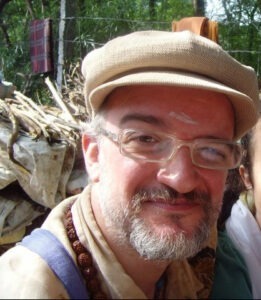
Zenji Transcript: Self-Inquiry, Awareness, and Pure Existence
Key Takeaways
- Early spiritual intuition can be present before it is understood or valued.
- Personal trauma can crack open protective shells and deepen the search for truth.
- Love can serve as an entry point that eventually leads toward deeper realization.
- A true teaching often resonates through presence more than through words.
- Different teachers resonate with different people, so the path is not one-size-fits-all.
Questions This Interview Explores
- How can childhood spiritual intuition be recognized and followed later in life?
- How can personal suffering and trauma become part of spiritual awakening?
- How do love and truth relate on the spiritual path?
- How can a seeker recognize a teacher or teaching that truly resonates?
Full transcript, edited for readability
Rick: Welcome to Buddha at the Gas Pump. My name is Rick Archer and my guest this week is Zenji. Zenji is a disciple of Mooji, who was a disciple of Papaji, who was a disciple of Ramana Maharshi. If that’s not enough alliteration for you, today happens to be Zenji’s birthday. So, happy birthday Zenji.
Zenji: Thank you very much, Rick. It’s my pleasure to be here today with you.
Rick: And the way this got set up was that Zenji was trying to organize for an interview with Mooji. And Mooji said, “Why don’t you do it?” And so Zenji told me this and I said, “Okay, we’ll do it.” And unlike most of my interviews, I don’t know as much about you as I know about some of the people. Because usually I listen to people’s audios or YouTube things for a week or so before I interview them. And I suppose I should have done more homework and listened to more Mooji before this, but I didn’t do that either. So we’re just going to fly by the seat of our pants and hear your story. But judging from the email you sent me, it’s an interesting one.
Zenji: Oh really? You know, I didn’t… You see, first of all I would like to say is that I’m happy… I’ve never spoken like this before. So, I haven’t any homework done, you know.
Rick: That’s okay. My only homework perhaps is that I’ve taken somehow inside the message that Mooji so willingly shares, that kind of struck me right from the moment that I first met him. There was something that really hit me somewhere, that was somehow striking at something that I had not heard before.
Right.
Zenji: And it was with some simplicity. And so, you see I’m already maybe going right into that.
Rick: That’s okay.
Zenji: Because I’m not sure how much my history is important, because from my own experience I know that sometimes the mind has a tendency to compare. And we take notes on these things and we think, “Oh yeah, this happened to him, and this and that happened.” And then there is a checklist, and then we think if something is not checked off, then somehow we are not qualified.
“Sometimes the mind has a tendency to compare.”
🕊️ Early Spiritual Inclinations
Rick: Well, you know, if a person only listens to one interview, they might do that. But what I find is people listen to a lot of them, and they discover that everybody’s story is different. And they pick up sort of bits and pieces in different stories that they might be able to relate to personally. But I think in this day and age, when there are so many people out there teaching, and even non-teachers like yourself, who are just sort of speaking from their experience, people are kind of getting the idea that obviously they don’t… just because this guy happened to be drinking a glass of orange juice when he awakened, they don’t have to go out and corner the market on orange juice.
It’s going to be different for different people.
Zenji: Yeah, sure, sure.
Rick: So, what I find in doing these interviews is that there are kind of two themes or threads. There is the personal history of the stuff the person went through. And some people aren’t interested in that at all. Some people find that fascinating, and they want to hear it. And they kind of like give me hell if I don’t ask that of people. And other people, they just want to hear what knowledge the guy has to say. So I usually like to do both, and the ratio may shift according to whom I am speaking with. But you do have an interesting background. I mean, you started out as a kid, wanting to know God, and considering becoming a priest, and things like that.
So it might be worth kind of sketching through that.
Zenji: It’s an interesting thing, because a lot of those things actually I only remember because I spoke with my wife, like what would I write, like a little bit, because I had absolutely no idea what I could put down. And without her help, those points would not have emerged. So what I am trying to point to here is that actually there is somehow memory. What we pick from memory, or what comes, it’s almost arbitrary.
Rick: You just pick out little bits and pieces.
Zenji: Exactly, so we cannot really, I mean the story itself is kind of like, in a way I could have said something completely different, but it’s true. It is something that I have somehow, I don’t know, out of nowhere came this, I was kind of fascinated by priesthood or something, or like when I went to church, I somehow liked, I don’t know, I would celebrate at home Mass sometimes, like I would do what the priest would do, even though the priest himself was not really somebody I liked.
Rick: So you are talking about your boyhood interest in religion, and doing what the priests were doing, and so on. So there is some kind of incentive in you.
Zenji: Yeah, it’s something, that was not something, I just came spontaneously like this, I don’t know where it came from, and I am just also reminded of an earlier experience that struck me, that only reoccurred to me again after going to satsang, when the spiritual search maybe intensified more, and that was like when I was very young, I don’t know how old I was, but very young, before school age, you know, spontaneous contemplation that what I am doesn’t age. You see, every year we celebrate birthdays, like today is again, they say that I am 45, but somehow what I knew myself as, didn’t get any older, somehow.
And I remember I told my brother that, we were sitting on the staircase, I was telling him that. Somehow like an image like this is in my mind.
“What I am doesn’t age.”
Rick: So you had a sense of that, that level of your life that wasn’t changing, even though your young body was growing.
Zenji: A sense of, shall we say, maybe a sense of existence, a sense of, I mean actually today I would say the “I am”, something was intuitively recognized, maybe as a ground zero or something.
Rick: Yeah, you kind of tuned into it.
Zenji: That was tuned into, without, it just spontaneously arose like this.
Rick: Did you remember that as you continued to grow, or did you sort of forget it?
Zenji: You see, here is what happens, despite that, you see, the significance of that was not recognized, because somehow, maybe this intuitive experience is there. But then, my life was pretty much, the life was lived very much like everyone else, pursuing also worldly endeavors, because this is what I have been, I have accepted basically what I have thought.
Rick: It is what people do.
Zenji: You know, you go, not to put anything down, of course you go pursue education, and career perhaps, but actually even here, I kind of really wanted to go to university to study, so that I could join a priesthood, you know, but somehow, the financial circumstances in my home, even though we are a middle class family, and there is money, it is not like we are poor or something, but somehow, there was not, there wasn’t really, it didn’t feel, because my brother, he was already supported by my parents to go to school, so myself, I went on to go and pursue a career in first typesetting, and then later on in publishing.
But still, even though I veered off, in the back of my mind, I was always thinking, how could I get back on track with that, somehow like this. And this pretty much went on, it was pretty much in the back of my mind, until perhaps my early twenties, that is when I went to college, to pursue middle management career in printing, and that is when really, that kind of fell away. After that, the priesthood idea completely dropped away, but then somehow it was more like, now going abroad, it was more like this.
And then eventually, this childhood dream of coming to America also came about, where I feel the blessing of that was also that, that is where really, I felt the opportunity came to me really to explore, because it was a completely new environment, you know, a completely different culture, you know, and so many questions came for me, because it was so different from what I was brought up in.
Rick: You came to New York, right?
Zenji: To New York, yes. And I was fascinated in all that, and then the idea came again to pursue, you know, university degree again, like maybe philosophy and psychology, that was something that started to come as an interest, but I couldn’t really afford the tuition fees, but that night, one of those evenings when I was studying the course material at various universities in New York, I walked past some road, a different road than I had ever gone before, but home. I lived in Manhattan at the time, and I came across this school of practical philosophy. And the school of practical philosophy is a school that primarily, I mean, they primarily offer the teachings of Shankaracharya, Advaita Vedanta.
And I was struck by that, actually the first week, the question was, “Who am I?” Somehow, I don’t know, it was, “Oh, this sounds right, this is great, I can do this.” So I went to this school, and every week some discourse was given, and then we would apply this practically in our lives. We would observe, our instruction was to observe what we have heard in class, say the teaching or something, how we see that apply in our own lives.
Rick: Not sure that’s the way Shankara went about it, but it sounds like an interesting thing.
Zenji: Yeah, that’s how they did that. And the thing was, that every week I came back, I really had nothing to report. I mean, somehow I felt I couldn’t observe anything. Actually I was convinced that somehow the observing faculty doesn’t work properly with me, because everyone else in the class had all these insights to report, and I was like, “No, it’s nothing.” But anyway, I went on, stayed there for three years at the school. After three years you also were initiated into meditation, and it’s transcendental meditation. So I don’t know what the connection is with Maharishi Yogi.
Rick: That’s interesting that the school of practical philosophy, which is not part of the TM movement, would have been having people … Did they instruct you in transcendental meditation right there at that school, or did they send you over to the TM center to learn it?
Zenji: No, they instructed you in the school.
Rick: I wonder if it was really TM, but maybe it was. Maybe in fact that school was started by some TM teacher.
Zenji: I know that when I was initiated into this, there was some process.
Rick: Pooja.
Zenji: Pooja, yeah, and there were saints from India, but you know, even if they had mentioned the name, it was like for me, because India was completely foreign to me. So I had whatever name you would mention, I had absolutely … It didn’t stick, you know. But anyway, I started out, the first month, meditation, great, very good. I was happy, but then after that, I had like say one month, meditation was very good, but then it got worse, worse and worse, and so much was like war inside.
Rick: In what way did it get worse?
Zenji: The experiences got worse, there was not like a …
Rick: It wasn’t enjoyable anymore.
Zenji: It was not enjoyable, like this. And somehow, at one point I felt compelled to leave. I felt it was not the right thing for me. Detour into psychotherapy, where I felt maybe I needed to explore something in that way, which eventually also kind of let me, because I discovered then that some people were talking about the self, something deeper, and all that, and slowly, somehow this is how I came to hear of Papaji’s teaching through Eli Jackson Bear and Gangaji, on a New York radio show of somebody who is a psychologist, or social worker, that’s how I kind of, how psychology is somehow connected to the spiritual, or should we say, to Advaita again.
Yeah, so many years of that, maybe 5 years or something, also Stuart Schwartz was one of my…
Rick: So 5 years you were like going to Gangaji things?
Zenji: I don’t know how long, maybe 2 or 3 years. OK, I left the School of Practical Philosophy in 1998, so it was in 2001 when 9/11 happened. It was really, I was deeply hurt inside, because it was such a shocking event.
Rick: Yeah, were you living in downtown Manhattan?
Zenji: Yeah, I was working on 23rd Street, which you saw the towers very clearly, and the magnitude of that, I mean, I was for months really, I would say right from the beginning, something was very vulnerable and hurt inside.
Rick: Yeah, I mean it shook up the whole nation, but I’ve heard it said that there was a huge sort of post-traumatic stress thing among New Yorkers, who were right there, there was a big spike in attendance at psychotherapy sessions and things like that.
Zenji: Yes, and so for myself, I have to say, it also is because somehow I felt that Advaita, for myself, even when I heard and when I listened to Gangaji speak about these things, they had kind of a very good, and Eli also, they had a very good way of making sense of that event as well. Which most people…
Rick: Oh really? They sort of commented on the 9/11 thing?
Zenji: Yeah, I’ve heard them do that, but perhaps to say, yes, because in a way, there are forces, somehow, forces of mind, that work also, that work here as well, that we know ourselves, where who doesn’t know that maybe at some point we were so angry that we wanted to strike somebody or something, or if something doesn’t go our way, all those things, those emotional responses, we are all somehow familiar with that. At one point or another we have had, maybe had an experience or something.
Rick: So were they commiserating with the hijackers and suggesting that their frustration had built to a level that motivated them to…
Zenji: No, not so much that, it’s more like actually, we understand these kind of events when we actually understand ourselves, when we see actually how our own mind works. As we identify with mind, ego mind, there is a way in which there is that kind of mechanism, the way we say that, that wants to protect itself, there is a certain protection with that. And when we see life very much from that narrow view of, and here we could go into this, like the egoic identity, which we really believe is the truth, we don’t even question that, it is just a very strong experience somehow.
Somehow, this somehow, where we have a sense that we need to defend ourselves, or that life doesn’t give us what we need, and we need to maybe use aggression to kind of better ourselves, and stuff like this. Somehow like these kind of forces…
Rick: Yeah, so there is a way you can extrapolate it from your own experience and multiply it a thousand times, and then maybe you’d be flying airplanes into buildings too. It sounds like a…
Zenji: I’m not sure if that was what they were trying to say, but for me, at the time I have to say…
Rick: Helped you come to terms with it.
Zenji: I could see that it is a good thing to… because the tendency is always to kind of point the finger outside. We are very quick to see the faults of others, but when an event of this magnitude occurs, perhaps there is also some self-reflection. For myself I could only say, I saw it in myself that somehow this event was so shocking, also the walls I had built around myself, how I protected what I have to say, what I thought myself to be. At this point there was no insight into the truth, no conscious insight into that. For me I felt I was a person, an individual, one among millions, and I am at the mercy of the elements, or something like this.
Rick: You felt isolated.
Zenji: Isolated, and you know actually, up to this point very much, even though I had felt like being a very warm person, so to speak, but I was afraid of hugging people. But somehow when this event happened, something crumbled inside, and there was more vulnerability, and also more, like, something, also old trauma actually, this is what I had mentioned, like trauma from the past emerged, and something inside you knew that it was good, that this needed to be faced, that somehow I felt also more alive.
“Something crumbled inside, and there was more vulnerability.”
Rick: Right, interesting. And somehow through, actually it was, I mean, I said to you, I spoke a little bit in my email to you about myself, it was really like this, that I was even looking forward to trauma, like another traumatic event in my life, because it felt like it was something freeing in that, I don’t know.
It kind of woke you up, broke your shells.
Zenji: Yes, something, because it was there anyway, and now it would emerge, and I could really face, something could face whatever I had been trying, what had been hidden, and somehow I think what we hide, what we kind of lock away, we may not see it, we may not know about it, but it kind of occupies energy somehow perhaps. So because maybe it requires a lot of energy to keep something away from you.
Rick: Yeah, yeah, good point.
❤️ Looking for Love
Zenji: And so this sort of shock of 9/11 kind of shook you up, broke your shell, opened you up.
And then that’s when … now you see, I was not at that time consciously really looking for truth, you see, really what I was looking for at that time was love. Even though you were listening to Gangaji and all that stuff, you felt like you weren’t, I mean looking back on that, you felt like you weren’t looking for the essence of what she was saying, you were looking for love.
Or say like this, in my mind’s view, I was looking for love, and actually looking to whatever I felt was missing in life, I was looking for this. And love was actually something that was the highest on the list.
Rick: You mean personal love, like marriage, or do you mean just love in general?
Zenji: For me actually, I didn’t have a good idea about this, but I would say love was for me also, that I would be able to share that, so that means a person as well. Meaning like, yes, you see, this is how it is, there was desire for that, the desire for a personal love, or like having a relationship was there, was very strong, or strong enough, and truth was very abstract, what does that mean? Looking for truth, I mean the opportunity that existed, or that exists for a human being to find truth, I had absolutely no idea what that meant at the time. I mean today I know, actually today I feel that is the highest, the highest because I think also, when you say truth, so abstract, who wants truth?
Rick: I mean, to most people that means some set of beliefs, I read this in a book and therefore it is the truth, and you should believe it too.
Zenji: Yes, so like love was something that was meaningful to me.
Rick: Yes, you could relate to that.
Zenji: So the potential is much bigger, but what really seemed compelling to me at the time was, when I heard these things about, “You are this love you are looking for.” You see, “Oh, it’s already here, wonderful, it’s great, so I don’t need to look outside of myself.” So maybe like this, but you see, I was still very limited view, limited, it’s good, somehow it got the foot in the door, so to speak. Today I realize that it is still limited, but it was at the time what brought me into, maybe a deeper truth pushed me into this, and the mind was negotiating, like you see, you can get some love here, you know.
“You are this love you are looking for.”
Rick: Well, it’s kind of an interesting point in a way, because a lot of people, a lot of teachers these days, they speak from sort of a high perspective, a realized perspective, and they often sort of give advice which pertains to their level of experience, but it doesn’t necessarily acknowledge that people may have some steps or stages of experience to go through before they reach that level as well. In fact, a lot of people say, “Well, there are no levels, there are no progressive stages, therefore just sort of stop your search and realize you’re that.” And that may be a little abstract for some people.
In your case, you felt a need for love, and that served as a stepping stone to the next thing, and the next thing.
Zenji: Yes, I mean, now today I know, yes, because you see, even what I’m saying right now, is still very much, I’m talking to you very much from that perspective, what I identified as at the time, as a person. And I think what happens is that the teachers you’ve mentioned, because they actually, they won’t want to entertain this, because ultimately, you see the absolute truth is beyond that.
You see, it’s like, yes, let me just say, this was a stepping stone for me, and then somehow, after a few years, somehow I had the privilege and the honor, the great fortune I would say, to meet Mooji in the US, and that was in Boston first, and then he came to New York, Washington DC, Philadelphia even, and I had, like he was there for three weeks, that was in 2006, and right from the beginning, even before meeting him, because we organized this, we received the DVD, and I should also say that at some point, two years before meeting Mooji, an intense love for Papaji arose, and I wanted to meet Papaji, but I knew, the mind knew, we cannot really meet him in person, because he had already passed on, but he had DVD recordings, so I can get those.
So I had ordered a bunch of DVDs, and watched them every night, like the Aum Shanti series, which are highly prized among devotees and disciples of his, and wonderful, I was so happy in the evening, after work I would put the DVD in, and for two hours satsang.
Rick: Nice.
Zenji: Yeah, like this. And two years after this love affair happened with Papaji, I had the great fortune to meet him in Mooji. This was actually what it was for me, I didn’t expect that, but when I met him in Boston, that time in 2006, in October 2006, I knew, “Papaji, I am meeting Papaji.” It was like, “How is that? He looks differently, physically?” It’s not that, it’s something, it’s a force, an energetic force, something, maybe you can call it consciousness, something was there that was what I knew Papaji as from my experience on DVD. And I recognized, I mean there was immediately, what I felt, what I saw, is not Mooji as the body, but as the presence.
It’s almost like his, in that time the experience was then given, that I felt what I saw him as, and what I see him as, I am putting this into the past, but even today like this, what I see is, it’s almost like this, there is an energetic field, a vibration, and the body is a projection. Yes, there is a body that walks around, but it’s more like a projection actually. It looks more like a beam, it doesn’t look as real as the energetic force of his being. And right there, and that’s what I fell in love with, and also that’s really what I then also felt only to honor in myself.
And somehow through his association, the mind could not really, whatever he said, a lot of the time the mind would actually not, would be completely, you know it’s not present, I couldn’t hear what he said. The words, it’s like there was complete stillness, it’s almost like no mind, I could say no mind.
“There is an energetic field, a vibration, and the body is a projection.”
Rick: In other words, you were so absorbed in or tuned into that energetic field, that the words were like ripples on the surface, and you were deep in the ocean.
Zenji: Yes, there were some maybe the words, but they couldn’t be scanned, they couldn’t be identified as this word and that word, that was also just an energy, and actually it couldn’t even be considered to be different from the consciousness. And maybe if I had to say, it was more like, perhaps even like a laser light, that I felt really also kind of tuning here, you know. And I felt somehow, I don’t know.
Rick: It brings up an interesting point, you know, because Gangaji and Eli, they were with Papaji, and you spent time with them, but when you met Mooji there was that resonance, and it’s sort of like different people resonate with different teachers, and I think that’s maybe why we need so many teachers, is that one teacher isn’t going to resonate the same way with everybody. So you get a whole lot of them, and then each one has those people with whom they resonate.
Zenji: Yeah, that’s what I’ve heard said, yes. Definitely also I have to say, case in point, yes, this was my experience, because there is definitely great resonance and love from Mooji.
Rick: That’s great.
Zenji: So you see, and that goes a long way, because then you really take, somehow maybe, it’s just also spontaneously, the message is also taken in, somehow. Yeah, I couldn’t keep… See, there is nothing I did in that sense, that for the resonance to happen, it’s just somehow I was brought into, with a good fortune, I was brought into his company, and somehow like this, it unfolded like this.
Rick: No, I know what you mean, and I’ve heard stories like that too, where it’s just by virtue of the sort of attunement with the teacher, that one begins to resonate on the same level as the teacher, and that energetic field you referred to, gets enlivened in you, by virtue of the fact that it’s so lively in him, and that you have this connection with him, just like tuning forks, you strike one tuning fork and the other one starts to ring, because of that, the proximity and the resonance between them.
✨ Self-Inquiry and the Sense of “I Am”
Zenji: Now, what is it that I’ve discovered through Mooji? It’s actually, you see, that all of us, we know that we exist. You know, this everybody, nobody debates this, nobody fights any wars over this, you know, like this, everybody is in agreement that they exist. And this is, to look for that, that is responsible for the conviction that we exist. It’s already present, nothing that we create, that is what we can look for. In our search for truth, it is to look for that, which gives us this, shall we say, conviction, you know? And that is the opportunity every human being has, to look for that. And to look for that is not looking outside, but it is turning the attention inwardly.
“To look for that is not looking outside, but it is turning the attention inwardly.”
Rick: So a person might say, if a person heard you say that for the first time, they might say, “Well, wait a minute, you just said we all know we exist, and we are supposed to look for that? What more is there to look for? I exist!”
Zenji: Yes, yes, actually, that’s a good point, because we don’t really look for that, because we think that is not important knowledge, so to speak.
Rick: Well, we think it’s obvious, you know.
Zenji: Yes, it is obvious.
Rick: If you come up to some guy at a bus stop and say, “Do you exist?” He will think you are crazy.
Zenji: Yes, it’s true, but I wasn’t perhaps very clear in it. Really it is that what we can look for here is, we have ideas what it is that, as what we exist.
Rick: Right.
Zenji: So actually we exist, but that existence is equated with “I am a person”.
Rick: Yeah, or “I am a body”.
Zenji: “I am a body”, yes, actually this is even better.
Rick: “And when this body dies, I might not exist anymore.”
Zenji: Exactly, this is actually the common view, and it is backed up by our experience, because we experience it this way, because somehow the zero point of existence is kind of there, everything is somehow around the body, the body hurts, it’s like this. We have a sense somehow, very strongly our sense of self is associated with the body.
And so of course, it feels obvious, but to now actually question this, maybe it feels obvious because it is fueled by our belief also, we believe that also, and somehow the belief in that idea, this is somehow how the consciousness that we are works, the power of the consciousness fueled by belief, kind of brings out the experience, it’s almost like a projection, the light of the consciousness, belief in an idea, kind of gives us the feeling of what we believe, kind of like whatever it is, I like actually the way Mooji says it, “We are perceiving what we are conceiving”. We are perceiving what we are conceiving, meaning it’s already…
“We are perceiving what we are conceiving.”
Rick: So we interpret the world, we perceive the world according to our interpretation, according to our beliefs, according to our conditioning and so on. So how does this relate to your experience? It’s kind of an abstract point that you are making, but you are obviously bringing it up for a reason. Is it because in your own experience somehow you came to this realization?
Zenji: Yes, that ultimately everything that we know, like even the body, actually we are aware of that, you see, we are perceiving the body, we perceive everything we are perceiving, and yet something must be behind or earlier than that to perceive that, so we cannot be what we are perceiving.
Rick: We could say the perceiver or something.
Zenji: Perceiver, yes. Something is there, perceiver, let’s say that, or an experiencer that experiences. This body also is an experience.
Rick: Same idea.
Zenji: If you really put it down, we know of the body because somehow there is an experience of that.
Rick: Yes, we can see it, smell it, touch it, feel it.
Zenji: Exactly, and there are sensations, like this. But there is something that is earlier than that, which now we can look, we can scan our being, and that’s when I say that the intention drawn inwards, to scan the field of consciousness, so to speak, or the experiential realm, for whatever we scan there, it’s an experience, isn’t it? Whatever, maybe sensations, thoughts, whatever, but then the experiencer, can the experiencer be an experience? Can the experiencer have form?
Rick: Can the experiencer experience itself?
Zenji: What I am saying is, is the experiencer itself, does it have form?
Rick: Or is it formless?
Zenji: Yes, because just to say, the form, because anything that you pick up, say even like looking for the experiencer, or this idea of who am I, what is to look inside, like scanning, isn’t it that anything that I pick up, maybe sensation, a thought, a feeling, whatever, I cannot be, because I am perceiving that.
Rick: Yes, there is a trinity there of perceiver, mechanics of perception, and object of perception, and obviously who is it that is the perceiver of all these things, through the mechanics of the senses, that’s what you are getting at.
Zenji: It’s really to, yes, it’s really to also, how to say it, I mean yes, when that scanning takes place inside, inwardly, you ultimately must come to recognize that anything that you can enumerate, anything that you can say this and that, somehow it has quality, it has quality, it is something that can measure, it is for that reason an object of mind, you could say.
Rick: Right, or an object of perception.
Zenji: an object of perception
Rick: Sure.
Zenji: But then we can look what is it, is the perceiver of these objects, also an object.
Rick: Good question, if it is, then who is perceiving that?
Zenji: Yes, but it is really like this, it is not even, because it is not so much a Russian doll kind of situation, because really, somehow, I don’t know how to say, but it is like this, that basically, somehow, you reject everything that has form, everything that you can know, and somehow you arrive at this place, which is the pure I am.
“You reject everything that has form, everything that you can know, and somehow you arrive at this place, which is the pure I am.”
Rick: And so is this a process you actually went through, under Mooji’s tutelage, you systematically rejected all the objects?
Zenji: It is like, shall we say, if you want to say process, it is called self-inquiry.
Rick: OK.
Zenji: First of all, we say this, perhaps the first thing to say is that we are already what we are seeking for, we are already the self, or whatever name it is, we are God, and we are whatever it is that we are searching for, that is already here now. But, it may not be our experience, our life may reflect a different situation, our life may be like that we are a person.
Rick: Yeah, we may understand intellectually that we are what we are seeking for, but our nitty-gritty day-to-day experience may not be of that nature.
Zenji: Yes, so this is now to say, alright, we will start there. If one believes to be a person, we will examine that. We will start from that point, whatever it is that makes the person, usually it is like some kind of experience, it may be something in the life, there is maybe a certain quality, it is not always true also, because we may not always live like a person, but there are certain things that come, conditioning, or maybe certain events in life, where there is some tightness coming in, and we can examine now, we can have a look, and actually it would be to zoom in, to actually see, isn’t that what the person is made out of? What is it made of? It is something that is perceived.
Like the quality of experiences which the person knows, which seems to be something that is identified with, there is identification with that, that can be looked on. We cannot know this without the perceiver.
Rick: So what I am gathering from what you are saying is that you are trying to describe a technique or a process of self-inquiry that you have been taught by Mooji, right? Is that what you are doing? I mean, you are sort of… because this could sound a little abstract, but you are sort of saying that this is a procedure you went through in order to arrive at the sort of essential nature of who you are.
Zenji: Yes, I don’t like so much calling it a procedure, because Mooji not at all advises any…
Rick: Procedure.
Zenji: …procedure, process.
Rick: Well, does he advocate self-inquiry?
Zenji: Self-inquiry, yes.
Rick: Well, isn’t that a procedure? What would you call it if not a procedure?
Zenji: It is, because you see, this procedure sounds a little bit off-putting. It is really, it is kind of looking… It is…
Rick: It’s an approach?
Zenji: No, no, I don’t want to be too much with the words, but what I am trying to say is it can be swift, you know, it doesn’t need to… there is not really a long drawn-out process about it.
Rick: So procedure implies it might take a long time or something.
Zenji: Yes, and that’s why I am kind of trying to just clarify, because really it is… Yes, I don’t know how to…
Rick: What I am trying to focus on actually, what I am trying to focus on is what you know from your own experience, and I presume that in trying to describe this you are alluding to something that you yourself have gone through, and you are trying to sort of… I mean, people can listen to tapes of Mooji probably and hear a more clear description of what you are trying to say, but what I am interested in is what you have discovered, and also we can talk about how you discovered it, but on what basis… what is the authority behind which you are describing this, we don’t want to call it procedure, but this process or something.
I presume you are saying that you engaged in something like this and it resulted in a discovery for you.
Zenji: Yes, perhaps to say is like, whatever we want to call it, this insight that has come to me through the grace of Mooji is that one morning I woke up and it was completely clear to me what he says, that awakening is not an event.
“Awakening is not an event.”
Rick: Right.
Zenji: What he meant to say is that awakening which you are looking for, self-realization or liberation, that is already present with us, it is already here now. And what dawned on me one morning, you see I don’t know, it seems to happen that when I wake up in the morning, sometimes insights come like this, you know, it seems like this, and it was, “Yes, my God, look, even the suffering that I have known in life, you see, I couldn’t have known about it if there wasn’t awareness.”
Rick: Sure.
Zenji: See, awareness must be there first before any suffering could be mentioned. So that must be, and that must be first.
Rick: And of course you could have understood that intellectually 10 years ago or whatever, but there was a moment where it kind of hit you in the gut more.
Zenji: Yeah, it was intuitive recognition, the significance of that, what it meant. It meant that my focus on the life story, no matter, the mind seems to always be, always focus so much on the negative also, because it wants to kind of erase that, we only want to enlarge maybe the positive aspects of our experiences. And so, but you see, for even those negative experiences that there was an intention here to transcend them, maybe to erase them actually, that meant to erase them. Sure. You see, even that, those couldn’t be known if there wasn’t awareness. So awareness is the greater.
Rick: Greater?
Zenji: Meaning it is the bigger power.
Rick: Yeah, it’s like the common denominator of all experiences.
Zenji: Without awareness, nothing exists. Zilch, yep. So basically what then became clear to me is like, attention given to experiences is futile, because they have absolutely no power without awareness. So rather than putting attention onto experiences, is to put attention back on awareness. That by which actually everything else can even only exist. So this was basically the insight that was one.
“Without awareness, nothing exists. Zilch, yep.”
Rick: And you had probably actually heard that said a hundred times over the years, but somehow not until that morning did it really hit you in the head.
Zenji: Yes, and what happens is, you see, this is why intellectual understanding is not enough.
Rick: Yeah, yeah.
Zenji: It may sound right, but unless it is really, unless it kind of, I don’t know, until it becomes flesh and blood or something.
Rick: Yeah, there is some level of experiential realization that is very different than the intellectual understanding. And that is a point worth emphasizing, I think, because there is a lot of people who go to a lot of talks, read a lot of books, they get very good at talking about these intellectual understandings. And I have mentioned this saying in almost every interview recently, but there is a Tibetan proverb which says, “Don’t mistake understanding for realization.” And the second part of it is, “Don’t mistake realization for liberation.” But I think there is a lot of people around mistaking understanding for realization.
Zenji: I mean, yes, it is not enough intellectual. And also I know for myself that when I first heard Mooji say that awakening is not an event, I can be honest with you, I didn’t know what that meant. I was intrigued and I was excited to learn about that. Even though a lot of stillness was already present with me, but it was somehow I felt manufactured. There was still a mind very much, there was something controlling it, I felt.
Rick: Really? I mean, didn’t it persist even under chaotic circumstances? Let’s say you were in a subway station or something, wasn’t there that sense of stillness there in the midst of the chaos, or did you lose it?
Zenji: That was initially, I mean, the coming and going of experiences, yes. But you see, experiences come and go, and that’s why what struck me really, and this is really the emphasis is not to, it’s really, you see, what struck me right from the beginning meeting Mooji is that, it’s like, don’t worry about experiences, don’t put any attention on that.
Rick: On specific experiences?
Zenji: Yeah, I mean, all experiences come and go.
Rick: Sure they do, but that energetic field that you picked up on when you met Mooji, that doesn’t come and go?
Zenji: That doesn’t come and go, and yet, no, no, no, actually it does come and go as well. Actually, you see, the “I am” also comes and goes.
Rick: So what ultimately does not come and go?
Zenji: Exactly, this is the question. Because you see, even the “I am” comes and goes, because when you go to bed at night, you lose everything, yes, absolutely, you have no body consciousness, no mind, even the sense of existence also vanishes, but something remains, something remains in a very subtle way perhaps, which, because some knowledge is still present with you when you rise up the next morning, as waking state kicks in again, the “I am” rises and then everything else can come, you know, with “I am”, also personal identification can come, and then other, and world.
Rick: And of course, some people say that awareness is actually, when it’s really awake enough, is maintained throughout sleep, so the body goes to sleep, mind goes to sleep, senses go to sleep, but pure awareness persists 24/7. That can be a level of …
Zenji: Yeah, I mean, that is, awareness doesn’t come and go. But you see, we are putting a word to it, you know.
Rick: Well, we have to in order to talk about it.
Zenji: We are putting a word to it, but yes, this awareness doesn’t come and go, and this is our experience, but maybe perhaps we have not put, we haven’t examined that also, because we don’t, we have a tendency, really I think it boils down to that, you know, life itself already, if you are open, already teaches us the truth, so to speak, because the problem of deep sleep, already, like a lot of ideas that we have about ourselves, they cannot really be sustained anymore, because if you really believe that I am a body, if that is the center of my existence, the body, if we examine the deep sleep, we all would admit that during some period of time we have no body consciousness, and there is also no thinking, no thoughts, you know.
So then, but still, we wouldn’t say that we are dead, we died, you know.
Rick: No, obviously we didn’t.
Zenji: But yet, you see, death is somehow very much related, it is very much, the idea of it is that the body goes, you know. The body disappears, so in a sense, what we are fearing, the death we fear, is, I mean actually, every night when we go to bed, people actually don’t take, people take sleeping pills that they have a good night’s sleep, so they can forget about body and mind. Nobody is there saying, “Oh, I want to stay awake pill, you know, I want to stay awake pill.”
Rick: Well, there are those kind of pills too, but…
Zenji: I didn’t know about that.
Rick: Sure, yeah, uppers and downers, you know. But let me ask you this, you know, Mooji said that awakening is not an event, right? But, you know, there are awake people who can say, like, take Adyashanti for example, I was just listening to some tapes of him, he talked about a couple of very significant awakenings that took place for him, age of 25 and I think 31 or something, and he could probably tell you what date those happened on, if he happened to mark it on the calendar.
So in that sense, it seems like an event, but of course, what everybody says when they realize it is, “Oh, well this has really been here all along, you know, I am just recognizing…” So in that sense, it is not something new that has started, it is something that has always been there and now it is just being recognized, perhaps for the first time. So in your own case, was there some point of recognition like that? Well, you mentioned that morning when you realized, you know, was that it, the big “E”? Or have there been some other realizations that have come along which deepened or clarified that initial awakening?
Zenji: Yes, you see, it is not so much that awakening happens and then that’s it, you know. Really, because we are talking about waking up to the infinite, and the way we are using this word “infinite”, meaning it would be very strange if you wake up and that’s it. So it is quite natural that it would be a deepening or that there is a maturing or something. But you see, the emphasis needs to be placed that this maturing happens, this maturing, there is a backdrop to that which is unchanging awareness.
“There is a backdrop to that which is unchanging awareness.”
Rick: Very good. I am glad you are making that point, because a lot of people identify so much with that unchanging awareness that they de-emphasize or even deny the significance of the maturing that can still continue to happen in the more manifest expression.
Zenji: Because actually, what has to be said, what is this about is actually that the mind is again absorbed in its source, which is the awareness. So meaning like, that and for some reason, so the spiritual journey so to speak, for the mind to come home, but it doesn’t mean that we are not already the self or the awareness. But however, it is for the mind to kind of shed the beliefs into the untrue. Meaning it is like, you see, mind is nothing wrong with it, mind is useful, because that is actually, I would say, the faculty by which this perception, or the world, or this can be utilized, even like to work with computers.
You see there is a great power in that also, you know, we are not about to erase that, but where mind really is not helpful, or I say, is kind of producing an adverse outcome, it is like when mind is allowed to suggest, to whisper to us who we are. Meaning that you say, “Oh yes, you are a person.”
Rick: It gives you false ideas.
Zenji: Because mind is then, what happens is that we are, the consciousness is limited somehow. The potential is limited.
Rick: Well, you know, you have heard the word “maya” of course.
Zenji: Yes, maya, yeah.
Rick: You know, it comes from a couple of Sanskrit roots meaning “which not”. So maya is “that which is not”. And you know, often the word maya is used to just suggest that the whole world is an illusion. But what it really means of course is that it is an illusion for you, because you are laying on all sorts of conceptions and beliefs and notions and misperceptions that cause you to misinterpret or misperceive it as something which it actually is not. But what you are just sort of saying is that if you can strip away all that and get down to that which actually is, then you are no longer deluded.
Zenji: Yes, what happens is like basically first, you know, I like actually, I think Shankara, Shankaracharya said that, but I have heard it through Ramana, is that the world is not real.
Rick: The world is Brahman.
Zenji: Or like this, but I also heard like the world is not real. Only the self is real.
Rick: Right.
Zenji: The world is the self.
Rick: Yes.
Zenji: See, that makes no sense. See, first you say the world is not real, then you say only the self is real, and then the world is the self. Now, it just seems to contradict the first statement. But what it means is that, yes, the world, the way we perceive it, the ideas we have about the world, you see, we are not seeing as things are. There is an overlay of our own ideas, our own concepts, you know, things are like this and this, somehow what we want to believe, it very much shapes our perception. And this is what we call the world.
And then it says, OK, no, this is not true because everything that we perceive, the world in that sense, what you perceive, is only possible through the power of awareness, which is the self, awareness self, which is basically the fundamental essence, which is beyond manifest, it is not manifest, it is intuitively recognized through the sense of “I am”, it is actually intuitively known, but it is not something that you can grasp, you cannot really hold it. The “I am”, you see, “I am” as consciousness, it still has a vibration to it.
So, this is why it said also the joy, the love, you are love, you are joy, you are all these things, because it is natural to the being, it is natural to the being, so there is something like this there, but also experience, but also “I am” is an experience, it is like somehow some kind of presence, but then even that one is aware of, even the sense of “I am”, the sense of existence, we can speak about “I exist”, because we perceive it, we are aware of that.
So something, now, something is beyond that, we call it awareness, but ultimately it is only a word to point to something that is really, you know, that is considered “it is”, that is real, and then from that point everything else can come, it is also there, world doesn’t disappear, but then one sees the world as it truly is, as an expression arising out of this.
Rick: Yeah, I get the sense when I hear you speaking, that you are not just parroting philosophy that you have heard from Mooji and other sources, you speak, it seems, with a certain degree of confidence, and there is a good deal of this lively in your own experience, and you are speaking from that, is that correct?
Zenji: If you have to ask, then probably I am not doing a good job.
Rick: No, you are doing okay, I am just affirming it.
Zenji: No, it is true, it is true.
Rick: Because I could give a pretty good rap when I was 18 years old, having read a bunch of Zen books, I could sit there and riff for a while about reality, but looking back at that, I didn’t know what the heck I was talking about. But I sense that there is a certain degree of spiritual maturity that has evolved or dawned in you, and that is enabling you to speak, not merely from conjecture or philosophizing, but from the heart, from the gut, from experience.
Zenji: Yes, I mean, you see intellectual philosophy, I mean to just intellectualize about it wouldn’t really be why I wouldn’t want to be on the interview today, because I don’t think I would do any… I mean I would not be truthful to speak like this, and that wouldn’t be right.
Rick: Yeah, so the reason I brought it up is just to affirm that, in case people are listening or wondering, just that I am getting the sense that the seeking, doubting, questioning Gen Z of 15 years ago has sort of evolved or matured into someone who has a certain confidence in what he is saying, and that is beautiful. I mean you might also say, might you, that the sense of seeking, which might have kind of gnawed at you back in the old days, a lot of teachers say, “Give up seeking.” In my experience what happens is, if you have really found, then you no longer seek, and that is how you give up seeking.
Zenji: That is true. Actually that is… I mean we have sometimes, I know with Mooji we sometimes have these conversations, and he says sometimes it is somehow like, “Give up the search, it could be premature.” Because sometimes it is misunderstood. Because “give up the search” really is like, it was probably said to somebody who… It is like to say, very similar like this, first it is affirmed that we are already the self. That is how we start out. And then we explore what is responsible that we don’t know this. So you see still we are making exploration.
But to say we are already the self and then not explore, it would be like, you see, I think “give up the search” that is not meant to mean not to take responsibility, not to follow the heart. If the urge in the heart is there to explore these questions, then of course one pursues that. But the seeking at some point, actually I am reminded of how Mooji says, “Let the seeking drop away by itself.”
“Let the seeking drop away by itself.”
Rick: Beautiful, I like that. And not give it up prematurely. And I think in a related point is that one can very well have actually given up the search in the sense that we are talking about, having really, the seeking has dropped away, and yet one can still be fascinated with all this stuff, going to satsangs and reading books and all that, but it is done in a different sense. It is not like, “Oh my God, I have got to discover what is really being said here, find something new.” It is more like icing on the cake, it is like an enrichment, an enhancement, would you agree with that?
Zenji: Actually how I would say this is like, in my own case, I don’t see that… you see the maturing takes place. There is something like, once you discover this beautiful self, somehow it is, maybe there is something that honors that as well. And it is somehow, you see, a tendency of mind still comes. It is not like, so it is really ongoing, so meaning the opportunity is always there to discover what is real and what is not. Somehow it becomes like really one… it is almost like one is… it is like to understand mind, the workings of the mind, and to see, to become the master of the mind, to always look for the… whenever the limitation rises, because it is not like this that we come to…
I mean for myself I have to say at this point, challenges do come, you know, where I have to check in, what is happening here, am I drawn to… am I associating, am I aligning myself with mind? But it is not, I think at this point, I would say, it is not so much seeking what is not known, but rather to affirm, to defend what has been conquered, to defend what has been recognized. Because you see the mind can always come and stir things up. But to kind of like to check in and see, alright, but what voice is speaking here, what is happening? Because it is not even only the voice, it is like even our actions, I feel our actions in life can come from a limited mental…
I mean from identification. Identity, perhaps I would say, is like putting the zero mark of who I am into experience, I am pushing the zero mark in the experience. Behind that there is nothing. The source of who I am is in that experience, I as a person, I am the body idea, functioning, so I am operating like this. The identity can come, but when it comes, one can check in, to see, alright, is that however not what I am perceiving? It’s not an obsession So you see, it is like always, it is looking, it is checking out.
Rick: And it becomes kind of second nature to do that. I mean an analogy that might illustrate what you are saying is, once you have learned how to ride a bicycle, it is pretty automatic, it is second nature, you don’t think about how to balance or anything, but you do have to constantly correct and make adjustments, and steer this way, and something could cause you to almost lose your balance. So even though it is kind of automatic, there is this sort of balancing process that continues, does that help at all, or is that inappropriate?
Zenji: Yes, and that only again to say, this balancing process, if you want to use that, is for the mind, it establishes itself again in the soul.
Rick: Is it sort of getting off track, and then you can sort of check in as you say, and get back into …
Zenji: Yeah, when consciousness again associates more with the belief of being body and mind, it can be quickly corrected, it is like a checking in. And this is also important to stress, because what I sometimes feel is when somebody has had an awakening, it can be that, that becomes a memory, say when an event like this happens, when mind again asserts itself in some sense, we can, when we don’t look, because like self-inquiry then, meaning checking in, it is not really a process, but it is like really to just see, who is observing this? Who is this “I” that is observing?
And so, sometimes what happens is that people just dismiss the experience, it is almost like a mental rejection of that, which leaves you only in mind again. Really it is, one has to really take it, meaning like, “Okay, my experience right now is that I am a person.” And so, even it doesn’t matter that yesterday I discovered, or a moment earlier I knew to have been the self, in the moment that person, the personal identity is there, and is strongly associated with, again one can check in to see, but who is experiencing this? Who is the experiencer of this?
To go to the experiencer, to the source, and also establish that this experiencer doesn’t have form, because for as long as it has form, it is not the true experiencer, it is not the awareness that we are talking about, it is not the awareness that is the essence of existence. But you see, this is just like this, it is like very quick like this, but what tends to happen is that, or sometimes it can happen that mind rises, identification rises with mind, or with the content of mind, and then it says, “Oh, but I know I am not that.” But you see what it is, it is like a mental rejection of the experience. Not to check in to see, it is like mind on top of mind.
Rick: I see, yeah.
Zenji: Mind on top of mind, that’s why actually every time one has to come back to the source, one has to find the source again. That’s how one affirms. It is not so much like just to reject.
Rick: Right, and have you found that the longer you have done this, the more kind of automatic it is, and also the less the mind tends to deviate?
Zenji: Yeah, sure, it is something that becomes easier, because it becomes second nature.
Rick: Second nature, yeah.
Zenji: Second nature, as you say, even though it is our first nature, we are doing the second nature.
Rick: And really, don’t you also find that having become established in this to such an extent, it is pretty much there under all circumstances, even though it might be a little bit diminished at times by something, but if you notice, there it is, even in the midst of this intense experience you might be having.
Zenji: You see, when something like this, as you described, when something, the waves are coming and going, that is an experience. And who I am, who you are, is not an experience.
Rick: No, but it is a continuum also, whereas experiences are temporary, who we are ultimately is a continuum.
Zenji: If, I know what you are saying, because I feel what you are saying is, sometimes, you see, maybe there is a certain joy there, and sometimes it is diminished a little bit, or something. Maybe there is a certain, because there may be something we call bliss, or joy…
Rick: Yeah, but those are experiences.
Zenji: These are experiences. So we may be compelled to say, “Ok, today I feel a little less bliss, or less… maybe there is a little bit more, whatever the feeling, like roughness or something like this. And… Well, that is going to happen. Yes, but if I take reading on that for myself, if I say, “Alright, today something is not right”, because, you see, then I am actually, what that means is, this is identity, I identify with the waves that appear.
Rick: Yeah, but what I am suggesting is that, you know, that recognition you had as a boy, that “I do not age”, you know, that sort of pointed at a dimension, or an element, or something that we have been talking about as the Self, or as being, or as pure existence. And that pure… now, you know, 40 years later, that pure existence may have been realized to the extent that, despite the waves on the surface of the ocean, despite the ups and downs of “rough this day, blissful that day”, that oceanhood status, that pure existence status, that continues, you know, “For men may come and men may go, but I go on forever”, that kind of thing.
Zenji: OK, yeah, I haven’t really… I usually don’t pay too much attention to it, I do sometimes, yes, what happens is that maybe, certain… the quality of my experiences may be in a certain way that are not as pleasing, you know, perhaps, but…
Rick: But even when they are…
Zenji: If identity arises with that, then you check in again, you know, I check in. So, yeah, I can only say like this. So it’s like… Yeah, I cannot say more right now.
Rick: OK, no problem. I’m just kind of pointing you towards or suggesting that… I mean, let’s talk about Mooji for a second. I don’t imagine that Mooji has to keep checking in so much in order to re-establish his self-realization or his, you know, the pure awareness that’s lively in him. And, you know, to whatever extent, we have grown in the same way. And so I was just kind of…
what I was alluding to is just that, you know, maybe that’s what you’re noticing also, that, you know, without even having to check in or regardless of whether you feel, you know, smooth or rough or blissful or depressed or whatever, that underlying that and as a continuum, there is, you know, this self-awareness without needing to do anything. It’s not dependent on anything, it’s not caused by anything, it’s like the foundation of life.
Zenji: Yes, that’s true. And yet when identity comes, which can happen…
Rick: It can get obscured.
Zenji: Then, in that moment, the feeling is… You see, because this is why awareness, the knowledge of awareness is kind of eclipsed, it’s because strong identity is there. So that’s why I have to say, identity, to speak truthfully, still also arises for me.
Rick: OK, no problem.
Zenji: So, in those moments when identity comes, the feeling is, you know, being at square one perhaps, but I know, you see, it’s about then for me to check in.
Rick: Sure, and I would suggest that it’s never a 100%. You know, I don’t think that pure awareness or pure existence can ever be obliterated by… Well, maybe it can be extreme, but it’s always there.
Zenji: It is, it is always there. When identity arises, you see, that is the nature of identity. This is identity is to… seemingly the knowledge of the underlying awareness, or sometimes the word substratum is used, somehow, you see, even identity, that which we call identity, meaning like an experience of some kind, with which there is some history, there is somehow like, “Oh, it’s me, this is so me”, or whatever, like this, this is also observed, you see. So when it is strong, when identity is strong, actually even like this, that we can speak like this, that identity arises, means you are not 100% identity, because there is awareness of that.
Rick: Yeah, exactly, that is kind of what I was getting at in a way, that you are not so gripped by it as to be completely oblivious, you know, that there is still that witness or that recognition, that can actually kind of say, “Okay, wait a minute, what is this? Let’s check in.” Like that. Well, that’s good, that’s good. Well, I think my dog is telling me that it is almost time to end this interview. We are going to be going some place, but this has been enjoyable. We have covered, I think, a lot of ground.
Zenji: Okay.
Rick: Yeah. So let me just wrap it up by once again wishing you a happy birthday. Thank you very much. It is very auspicious that I got to talk to you on your birthday.
Zenji: Lovely, yeah. I am very happy.
Rick: And please give my regards to Mooji, whom I have never met, but I would love to meet him someday and even to interview him someday, if he is feeling up to it. Thank you. Yeah. And for those listening or watching, I just want to conclude by saying that this interview is part of an ongoing series. And if you would like to listen to more of them, go to www.batgap.com, which is an acronym for Buddha the Gas Pump. And there you will see this one and all the others. And you can sign up to be notified by email every time a new one gets put up. You can subscribe to a podcast if you like to listen to this sort of thing when you are commuting to work.
There are little discussion groups that spring up with each interview, where people sort of chat about what was discussed. So you can do that too. So thanks for watching or listening. Thank you again, Zenji. I almost said Mooji. You are really tuning into the guy.
Zenji: So next, and now you have also called me Papaji.
Rick: Yeah, yeah. Thank you, Ramana. And we will see everybody next time. Thanks for watching. [music]
 Apple Podcasts
 Spotify
 YouTube