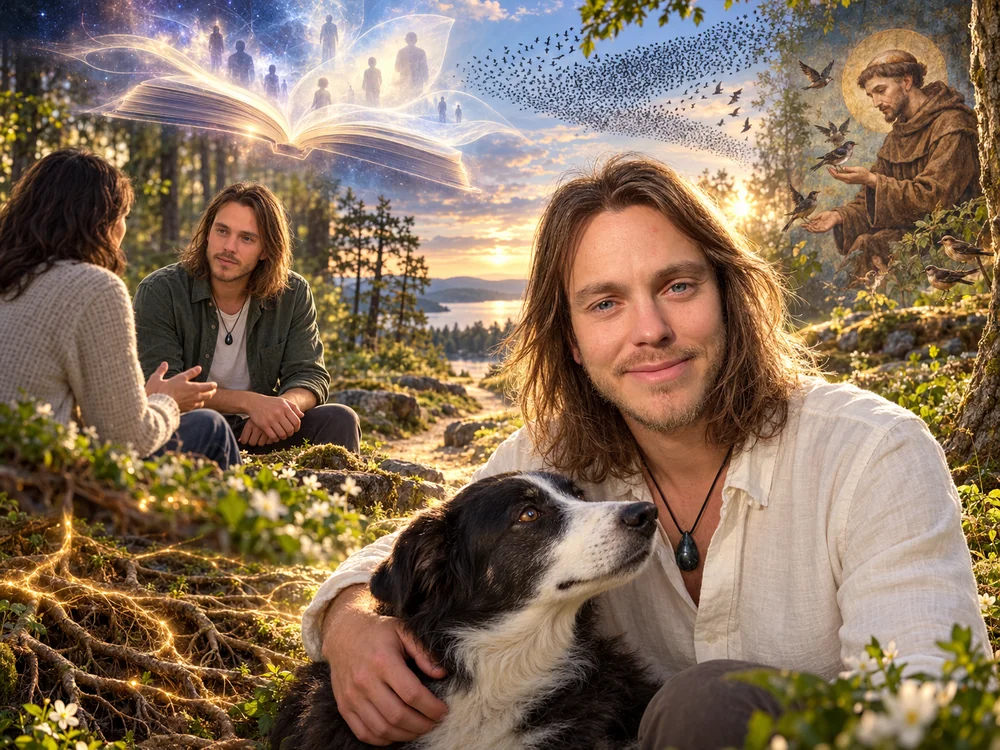
Lucas Bergendahl Transcript: Telepathy, Past Lives, and Soul Therapy
Summary
Lucas describes how an intense spiritual opening brought back childhood perceptions of past lives, spirits, and other people’s thoughts. He discusses helping people explore recurring patterns while staying discerning, setting boundaries, and avoiding the use of unusual abilities for attention or status.
Questions This Interview Explores
- How can unusual spiritual perceptions be managed without becoming overwhelming?
- How can exploring past lives help reveal patterns that contribute to present-day suffering?
- How can someone distinguish spiritual insight from imagination or ego?
- How should spiritual abilities be used responsibly when helping others?
Key takeaways
- Unusual perceptions may need boundaries so they open only when useful rather than becoming constant and overwhelming.
- Exploring past lives is most useful when it clarifies a present-day pattern, not when it builds an impressive identity.
- Insight should be questioned continually; a compelling impression is not automatically true.
- Helping someone means bringing attention back to their own patterns rather than placing all the focus on another person.
- Spiritual abilities carry responsibility and should not be used to seek popularity or affirmation.
Transcript
Rick: Welcome to Buddha at the Gas Pump. I’m Rick Archer. My guest today is Lucas Bergendahl, and here’s a brief bio of
Lucas: “Four years ago, I experienced an awakening that opened up different worlds and granted me access to the Akasha through telepathy, leading to a higher state of consciousness. Since then, I have dedicated my time to integrating this experience and helping others identify past influences that hinder the realization of their soul’s full presence. I also assist animals through telepathy. I conduct workshops on esoteric teachings gathered since my awakening, providing keys to help people find their way home.” And more about Lucas in a minute—or more with Lucas in a minute. A couple of housekeeping points. Let’s see, you might want to visit the website if you haven’t been there, if you’re just watching this on YouTube: batgap.com. There are all kinds of things there that you won’t find on the YouTube channel.
One of them is an AI chatbot called the BatGapBot, which has better conversations than you might have with ChatGPT, Copilot, or one of those other AIs. There’s also a donate button. There is one on YouTube now, too; it’s a new thing called “Thanks,” I think. This program is made possible through the support of appreciative listeners and viewers, so if you appreciate it and would like to help support it, you could donate through PayPal on the BatGap website—or through the little button on YouTube, or through various other means, which you’ll see on the donation page on BatGap. Okay, enough of that. Welcome, Lucas.
Thank you. Thank you, Rick.
Rick: Good to have you here. Lucas and I had a conversation earlier in the week, and he’s one of these people I kind of feel like I know, you know? I think you’ll get that feeling too. He’s easy to know and kind of a kindred soul, I think, to all of us. So, you’re—
Lucas: Yes. Yes.
Rick: That’s good. And let’s do a little bit of chronological bio first. So, how old were you when you first—well, actually, I remember hearing you say that when you were a kid, you had perceptions of things that you just assumed everyone had, but you later discovered they didn’t. So, what were you like as a little kid?
Lucas: How I was as a little kid is a story from my parents, because I cannot remember it myself.
Rick: Right, me neither. (laughs)
Lucas: Yeah, I have a few moments I can remember, but I think what’s easiest for me to explain is my latest awakening, because that leads to how I was as a kid, if that’s okay. I’ll go that way.
Rick: Yeah, sure. Yep.
Lucas: Because after I dropped out of school, I tried very much to fit into society, figuring out what to do with life and trying to be successful at this work or that work, or figuring out what to do. The more I tried to seek success, the more I found this empty hole inside of me. At one point, I just completely burned out and went into a depression for a year, where I only slept two hours a night.
Then, one day, my parents came to me and said, “You know what, Lucas? There’s something we have to tell you. We have to tell you something from when you were a child.” They started to tell me how I often talked about past lives—my own past lives—when I was sitting and playing with my toys. I apparently said to my mom, “Mom, now I know how I died in my past life,” and then I told the entire story and such. That was more like a daily routine: I often spoke about past lives, what would happen in the future, or spirits when someone in the family had left the body. I would wake up in the middle of the night, just watching the spirits and such.
My parents had a lot of these stories. They often saw that there was something in me that was awakened to these worlds. The more I tried to fit into society, the more I opened up an emptiness inside myself that kind of drained me. So that’s how I was as a kid. I was able to see my past lives, and I was sometimes able to get glimpses of what would happen in the future, which I told my parents—things like having a little brother, something more classic like that, but also seeing spirits. That also made me afraid of the darkness when I was a kid. So, yeah, there were a lot of hindrances when trying to fit into the world, when you saw spirits, too, right?
Rick: Yeah, a lot of so-called spiritual people have a hard time fitting into the world. They go through a struggle when they’re younger. In fact, you have a picture of Saint Francis behind you. I don’t know if you’ve ever seen the movie Brother Sun, Sister Moon about Saint Francis. He came back from the Crusades, and he was a sort of macho guy. Then he got really sick, and he came out of that and had this huge transformation. His father wanted him to work in the family clothing business or whatever it was. In the movie, at least, he took off all his clothes and threw them around and just wandered off. Yeah, he just said, “I can’t make it in this world. I can’t fit in.”
Lucas: Yeah, that’s true. Somehow, I’m trying to fit in a little bit more still, but I’m not walking around naked in the street.
Rick: Yeah, well, if you did, you’d get a nice, cozy jail cell to sleep in.
Lucas: So, no, I’m actually—one of the things I’m very dedicated to today is helping people who also have openings, because there are so many people who have these kinds of openings, and it’s so hard to fit into society. It’s about finding the balance, right? Because some people have an [unclear], even though they’re very awakened and have these open abilities and such. So, it’s actually one of the things I’m really trying to be of service with, because I know how devastating it can be if you don’t know what’s within you and you don’t know how to react to what’s within you.
Rick: Yeah.
Lucas: Like, externally. Yeah.
Rick: There’s probably a lot of people watching today who feel that way. Incidentally, I didn’t mention in the beginning that you’re in Denmark; you’re Danish, in case people are wondering about your accent. So, how do you help such people?
Lucas: That’s very difficult. I don’t—that’s the thing with the way I work. I don’t have a formula for what I do. People sometimes call it soul therapy. I don’t really have a name for it, but basically, I’m trying to find the truth within them that they are not able to see themselves. I know that sounds very normal or something, but that’s my go-to point, and then every session or every meeting I have with someone goes in different directions.
But there are, of course, these fundamental parts that I’m using of myself. As you mentioned, I’m using telepathy, and I’m using my opening to the Akasha and also my opening to past lives, which I have today, to help these people see what’s blocking them, what’s causing suffering.
Rick: I actually figured you were going to say that it’s different for different people, which makes sense. You obviously wouldn’t do the same thing with everybody. So, can you think of a typical session that you had recently or whenever, and just give us a sense of how that went and what your experience was with the person? Maybe what you saw in a subtler way about them, and what transformation, if any, they underwent?
Lucas: Yeah, recently I had a client who came to me. She had seen one of my past interviews and felt that kind of call. She didn’t know why she had come. So, I sat with her, and she said, “I don’t know why I’m here, but I just feel like I need to have that session with you.”
For me, it’s like I have to see the entire book of the soul’s incarnation to figure out, “Okay, where is the chapter where something happened that we need to look into today?” That helps me figure out what’s blocking them. It’s not like I see a book, but that’s the best symbol. It’s very subtle out there, so it’s very hard to say. It’s kind of like I scroll, like you have the book and you scroll in, and I’m like, “Okay, there’s something here. I feel—okay, let’s look into that.”
I basically read her without her saying anything: how she had problems in her relationship and how she was no longer together with her husband. She was trying to seek love from others at the same time. And why that happened—because in her mind, she didn’t know what was happening. She didn’t see that there was something in that causing her suffering. She just came to me because she said, “I feel a call. I don’t know what it is.” Of course, she had suffering, but she didn’t know what it was. Then I kind of guided her into seeing what it was, and we went into, “Okay, what is this about?”
One of the things I really try to do is always pull the energy back, so it’s about what’s within you and never about the other person. That can be very triggering for a lot of people, because sometimes it’s easy to put it on others. But I’m really trying to figure out: What is the karmic pattern that’s blocking you from seeing the truth within yourself in this situation—the truth that kind of sets you free? That’s my belief: when we see the truth, become conscious of it, accept it, and embody it, it can set us free.
How past-life impressions arise
Rick: Okay, I have a couple of questions about that. I can think of a dozen questions, but the first one is: when did you start picking up on people’s past lives?
Lucas: I became conscious of it about four years ago, in my awakening. I had a moment, an experience where all these kinds of abilities came back to me, because they had been suppressed for a long time.
Rick: They came back to you from previous lives or from your childhood?
Lucas: From my childhood. Yeah, from my childhood, but also more strongly. I guess it’s stronger than in my childhood. It feels like that, at least, because—
Rick: And even your childhood, you could say, came from previous lives. You probably had this stuff developed back then.
Lucas: Yeah, I believe so, because I know I’ve worked with it in past lives. Also, one of the first things I saw was a story of my soul’s own incarnation into this world. So, yeah, I believe that when we’re born with these abilities, it’s because the soul has already unlocked them in a past life.
Rick: Yeah. And a general principle we could state here is that everybody comes into this life at a certain level of evolution, which is pretty much the level of evolution at which they left the last life. You kind of pick up where you left off.
Lucas: Yeah, yeah, exactly. Exactly. Yeah, exactly. And that’s also why—that’s actually exactly how I use this with the past lives. In the beginning, it was very hard for me to see. When this opened within those three days, I started to just—I was walking on the street and saw a man and how he jumped out of a house in a past life, or how he raped or murdered someone. I saw these kinds of things just walking on the street, seeing people.
Rick: Wow. Was it constant, and therefore really kind of overwhelming? Or just occasionally a flash?
Lucas: It was constant in a way. If I walked with my dog, I could meet 20 people. I didn’t see it with all 20, but maybe five or 10 of them, something like that.
Rick: You’d get some image of them jumping out of a window or something?
Lucas: Yeah, exactly. And I also had that when the telepathic ability opened, I got people’s thoughts, too—whether they were suicidal or what they were thinking about. Often, it was very, very dark, what people are walking around thinking about, right? So I took a lot of time to really isolate myself and figure out how I could—
Rick: Shut it down.
Lucas: Shut it down, so it would only be open when it was needed.
Rick: And so, did you accomplish that?
Lucas: Yeah, I did. Yeah, it was a very intense half a year where I felt like a lot of joy and a lot of light in life kind of vanished for a long time, because it felt—
Rick: You’re picking up on all this stuff, yeah.
Lucas: Yeah, it was very intense, very overwhelming, and there was all the dark stuff. But I went deep, and within half a year, I learned how to only open up when people needed it—not even when they asked me. I also figured out that when people, friends, or other seekers who had heard about this met me somewhere, they’d say, “Can you tell me something about that?” I’m not doing it that way. It’s only if people come to me and they really need help—not even when they ask me. I’m not opening up for fun.
Rick: Yeah, it’s not a party game.
Lucas: No.
Rick: You’d be a popular guy. Yeah.
Lucas: Well, yeah, that’s the thing, right? I had to make a choice when I saw that I could become very popular. I could feed the part of myself that seeks affirmation and such, and I needed to drop that, too, and say, “That’s not the path I want to go. I want to go this way.”
Rick: Yeah, I was thinking about that. Maybe it was after our conversation the other day, and maybe you and I actually talked about it. Yeah, we did, because we talked about the story of Jesus after his 40 days and 40 nights in the desert, being tempted by the devil, so to speak, and told that he could be famous and do all this stuff if he got in league with the devil. And Jesus, I think that might have been the point where he said, “Get thee behind me, Satan.” He didn’t fall for it.
But obviously, I can think of examples of people who had some kind of spiritual awakening and some kind of powers that were very attractive to people, and they abused them. They ended up using them as a tool for getting a lot of sex or taking advantage of people in different ways. To me, that’s a pitfall on the spiritual path, which results in a person’s huge downfall, something they’ve got to make amends for, perhaps over many lives, lifetimes later on.
Yeah, because you have a big responsibility when you open up to other people’s energies. And it can really break my heart today to see that the more you unveil the illusion and see the truth, and the more layers you see, the more I’ve done that, the more I actually see that there aren’t many healers out there who aren’t serving illusions, or serving an unconscious pattern, I could say.
Lucas: Yeah, because you have a big responsibility when you open up to other people’s energies. And it can really break my heart today to see that the more you unveil the illusion and see the truth, and the more layers you see, the more I’ve done that, the more I actually see that there aren’t many healers out there who aren’t serving illusions, or serving an unconscious pattern, I could say.
I think the first part of my experience with this was my own kind of trip, where I needed to figure things out. We can go into that later, because there was also some—I was tempted, and the darkness tested me, too. It came physically and with voices and such, really trying to break me. But I don’t know if we should go into that. Do you want to go into that?
Rick: Well, we want to go into all those things. We just have to do it in a way that makes sure we remember them all. Right now, we’re still on that lady you had the session with.
Lucas: Oh, yeah.
Rick: Having trouble. So, I had asked you about when you first realized you could see past lives. I think the next question I’d like to ask is: What is the experience like for you of seeing a past life? Maybe you could compare it to something people are familiar with. Is it like a dream, where you have a dream and visualize somebody’s life? Obviously, it would be a waking dream, because you’re not asleep. Is it primarily visual? Does it involve all the senses? And how concrete is it? Or is it really subtle and vague, like an intuition?
Lucas: It’s very different. There are many different ways I use it. Sometimes I use it consciously if someone sits with me. I know I have a client at three o’clock today, and we sit together, so then I open myself up. Sometimes things also come to me in my dreams, or even in my knowing that there’s something I have to tell one of my students or someone in my family. So, it works in very different ways.
But I think what you’re also asking is how it comes to me when I sit with people for my work. It actually comes through impressions, through emotions. I feel those things within myself, through my sensitivity, and when I go in and feel them, I see a storyline, a happening.
Rick: It starts with the feeling, but then it also becomes visual.
Lucas: Yeah, it can become visual. I don’t really use the visual anymore because it’s not really necessary. But I did for a long time. I kind of shut it off because there was no reason for it anymore, and it was a bit of a distraction from being present in the moment.
Rick: Yeah.
Lucas: I trained myself to know what happened in that past lifetime. For example, with the woman we talked about, she felt that she had cheated on her husband in another lifetime. Through that, she developed a self-destructive pattern where she said, “I would never deserve someone again. I will never deserve love again.” She gave birth to that emotion in that past life, and it was still running in her mind, like a voice saying, “I don’t deserve this.”
I think many people know this, but in her specific karmic pattern, it was that emotion she needed to go in and heal—the voice. That emotion is what I feel in my body. When I feel it, I know what happened and experience how that emotion was born and how it’s still running today.
Rick: Do you sometimes pick up on a series of lives for a person?
Lucas: Yeah, yeah.
Rick: Like you might say, “Oh, I was a murderer, but then in my next life I was a doctor helping people to atone for having been a murderer.” Do you sort of get a whole storyline going over many lives?
Lucas: Yeah, I often try to narrow it down to 10 lifetimes.
Rick: Wow, even that’s a lot.
Lucas: Yeah, but it’s not like I see the entire life, right? For me, it’s just about figuring out what karmic pattern is blocking you from feeling more free right now.
Rick: Right.
Lucas: If I see, for example, that the woman had that in another lifetime, I walk into the next lifetime, or tap into it, to see how it affected that lifetime. How did it affect that lifetime? I’m jumping around to see that karmic pattern, tracing how it unfolded in different lifetimes. So, I don’t go into other stuff. I don’t go into stories about who she was, whether she was a priest or queen or something. I don’t care about that, because it’s not important.
That’s one of the things I realized myself, because many of my clients have also been people who heard they had past lives where they were someone very special, and then the ego starts to go into that. It’s not always polite when I have to sit and say, “I don’t see that.”
Rick: Yeah. Was it you I was talking to? I was talking to somebody, and he was saying it’s amazing how many people thought they were Cleopatra.
Lucas: Yeah, I’ve had 30 of them.
Rick: Talk about multiple personality disorder. Cleopatra was a crowded body.
Lucas: That’s one of the things that really drains me, because people often come to me saying, “I was this important person. I was this important person.” And I get it, because if we’re sitting in deep suffering, it’s very nice for the mind and emotions to feel like, “In a past life I was very important. Maybe I don’t feel that important in this one, but I can rest in that.” But it just keeps holding us in pain, and it’s kind of hard to break the illusion—to be the dream crusher in that, right? But, yeah.
Rick: Yeah.
Lucas: Yeah.
Rick: Interesting. Well, I guess Emerson or Thoreau said, “Most men live lives of quiet desperation.” A lot of people feel their lives are kind of mundane and boring and humdrum, and it’s kind of a kick to think you might have been Mark Twain or Cleopatra or Napoleon or whatever.
Discerning impressions from imagination
But obviously, this leads to an interesting question: How do you discern between fantasy and reality? I think this is something you yourself must have to deal with, because I’ve heard you talk about Atlantis and living on other star systems and all that. Have you sometimes thought or realized that something you were thinking was actually just your imagination, and maybe it’s not true after all? Is that something you have to keep an eye out for, to make sure you don’t do that?
Lucas: Yeah, I keep my eye out all the time. It’s like a full-time lifestyle. That’s also what I teach my students: You cannot conclude anything you see. Everything that I’ve said in my past, I cannot sit here today and say it’s 100% the truth. I can only always do my best to see if it’s the truth.
I always question myself and feel into it: Is there a part of me that somehow feels this is not fully aligned? If there’s just 1% of that, I dive into it. Of course, sometimes it happens that I’ve seen something and thought, “Well, this might not be fully true.” I’m more careful when I sit here, for example, in an interview, because I know that’s going to follow me. But if I sit with a friend or something, I’m not as careful. I can be, but you know what I mean.
I’m more careful about what I say in interviews. I’ve really dived into it to see, okay, there’s no part of me that feels any sort of disturbance or disharmony, because that’s how it comes to me. If there’s a part of my ego, part of my personality, that wants to say something, that’s how I know it’s part of my imagination. So, it’s like a full-time job to always question everything that comes, because things come down all the time. My entire daily life just comes down, right? So, I have to filter through it.
Rick: That’s really good, and I’m glad to hear you say that, because I know people, and I’ve interviewed people, who don’t seem to be able to distinguish between reality and fantasy, or between imagination and something that might be true. They kind of—I remember this one guy who lived in Sedona. Anything that popped into his head, and he had a good imagination, he assumed to be true, and he was just kind of making stuff up. Some of the stuff I knew, historically and factually, was absolutely untrue.
So, what purpose does that serve? It’s just kind of one—And the whole New Age world is full of all kinds of fascinating stuff, but we don’t—It’s like, as someone put it, “Hostess Twinkies for the mind.” I don’t know if you have Hostess Twinkies in Denmark, but they’re snack foods that are really tasty but have absolutely no nutritional value.
Lucas: Yeah, yeah, that’s it. That’s a perfect symbol. Yeah. No, that’s true. It’s true. And I also see how what was your truth at one point—like, the more you dive in and the more you seek within to find the truth within yourself, you also realize that things you said a couple of years ago may have been true at that point, but now you’ve hit a new layer where that thing doesn’t fully resonate with you anymore, if you know what I mean.
Rick: Yeah, that’s good. I don’t know if you’ve ever heard of Aldous Huxley, but he was a philosopher and all, and he said an interesting thing about the scientific revolution. He said that the greatest innovation of the scientific revolution was not the steam engine or the accurate clocks or anything like that. It was the development of the working hypothesis, because we came out of an age, the Middle Ages, where all kinds of religious dogma were considered to be true, and you could be killed if you questioned them.
Treating Spiritual Claims as Working Hypotheses
And so the scientific revolution gave people the liberty to question everything. Any idea could be a working hypothesis. That’s kind of the way I do it myself. If somebody tells me they see angels or that beings exist on the Pleiades or whatever, I think, “Okay, that’s an interesting working hypothesis. Let’s see how much evidence we can find for it.” Maybe we can, maybe we can’t, but I’m not going to absolutely believe it or absolutely reject it.
Different things have different degrees of evidence and different degrees of credibility. If somebody tells me the Earth is flat, sorry, I really don’t think it is. But if they say alien beings have been visiting the Earth, yeah, there seems to be a lot of evidence for that. So it’s kind of a matter of living your life around what you can really know through experience rather than just imagining things.
Lucas: Yeah, I agree. For example, one of the things I’ve realized—if I could use an example—is that often when I get these things, especially when it’s something where I feel, “Okay, this could be on the edge,” when we talk about past civilizations or something, I’m trying to be very careful with what I say because I don’t want to feed into the entire thing you mentioned. I cannot remember the name, but that beautiful symbol you use with that dessert thing.
Rick: The working hypothesis?
Lucas: No, the candy—
Rick: Oh, the Hostess Twinkie.
Lucas: Yeah, exactly. I don’t want to feed that, so I’m trying to be very careful with that. One of the things I realized, for example, was that when I remembered some past lives where I could see there was evidence behind it somehow, I knew how that felt in my body. So I was trying to be very cautious about how the different impressions that came from customers felt in my body.
Suddenly I realized, “Okay, there’s a path that feels this way, there’s a path that feels that way.” With this way, I might be more cautious; with that way, I’m still cautious, but I know this kind of feeling, and there might be more resonance with it. So I dive into that.
One of the things I realized, for example, was that there are different kinds of civilizations of Atlantis. One of the things that came to me was that what’s important for me to know is not to feed into this and that about this or that. But more than that, to understand that there was a part in Atlantean times when they were more in a dreamy state than they were in a waking state, like the waking state we sit in today and feel that we’re in. It was more like consciousness was flowing, and the cosmos was flowing with everything.
For me, the message was to spread that. I didn’t fully share that until I realized there were also saints from the East who often said that you are closer to the truth when you’re actually sleeping. So I started trying to find other kinds of evidence that someone said the same thing before I take it out, if that makes sense.
Rick: Well, that makes a lot of sense, and I have long debates with skeptical and atheistic friends about this kind of thing. Speaking of Aldous Huxley, there’s the idea of the perennial philosophy, where people all over the world, in different cultures that had no way of communicating with each other, came up with similar ideas about the nature of reality and things like that. And it kind of lends credence to their theories or philosophies. People are actually cognizing this kind of thing in every culture, in every age. I don’t know, I guess that’s just an example. But yeah.
Lucas: And I cannot sit here and say that I have seen the full truth, right? I mean, people need to resonate with what I say. And if they don’t resonate, just drop it. Don’t spend time on it. That’s one of the things that I also got confirmation of. I’ve always felt like that, and people can be very intimidated when they sit with me, because some people might ask questions. Also, when I’m with some friends privately and they ask me questions, often I answer, but people can be very intimidated and say, “How do you know that?” And I’m like, “Well, you don’t have to believe it. Just drop it if you don’t believe it.”
I’m not sitting here saying that this is the truth and you have to follow it, because I don’t believe that. I believe there are so many perceptions of life, and I feel like I’m just still a student of that. I don’t know anything. The more I realize stuff, the more I realize that I don’t know anything.
I’m not sitting here saying that this is the truth and you have to follow it, because I don’t believe that. I believe there are so many perceptions of life, and I feel like I’m just still a student of that. I don’t know anything. The more I realize stuff, the more I realize that I don’t know anything.
Rick: That’s a great attitude. I think that might be what the Zen people meant by beginner’s mind. No matter how advanced you are, it’s actually good to have beginner’s mind.
Lucas: Yeah, it makes sense.
Rick: To have the attitude of a beginner. Yeah. Because it’s true, I mean, relative to what could possibly be known, nobody—I mean, nobody has more than a tiny fraction.
Lucas: Yeah, yeah, exactly, exactly. And it’s beautiful.
Rick: In any field, like science. Albert Einstein probably would admit that he’s at the base of the mountain in terms of what could ultimately be known.
Lucas: Yeah, yeah. And it’s beautiful, right? It’s beautiful that we can actually find the different puzzles. And even when we feel like we have put it all together, we take that break, and suddenly we have the puzzle. Then we realize that puzzle is only a break to another one, and that’s how it keeps going.
Rick: Yeah.
Lucas: It’s beautiful.
Rick: It makes life interesting.
Lucas: Yeah, it does.
Atlantis and the meaning of its stories
Rick: Well, let’s take Atlantis as an example. Obviously, we’ve heard a lot about Atlantis. Annie Besant and the Theosophical Society and all kinds of people have been talking about it for a long time, and I guess there are myths going back to ancient civilizations talking about it. For me, that’s one of those things where, I don’t know, it’s an interesting working hypothesis. Maybe it’s all just myth, or maybe there actually was such a place, and there will eventually be some kind of archaeological or geological discovery that will confirm it, or at least lend evidence to it. What’s your thinking on that? You’ve had subjective experiences about it. I’ve heard you say things about it, but where was it supposed to be, and when was it supposed to end?
Lucas: So I think I want to start by saying that I actually agree with you: it’s not really important to me whether it happened or didn’t happen. It’s more like, when it comes to me this way, there’s a message that we should use today, right? What if it didn’t happen? Honestly, I don’t even care, because what happened in the past—and this is why it’s also not so good for my business of doing past-life stuff—I don’t care about the past anymore, because I don’t believe that the past exists anymore.
Rick: Right.
Lucas: But at the same time, I get these kinds of messages, like there’s something happening in the past that you can use today to help people get deeper into the now, to be most soaked into the now. So, as I see it— I just wanted to say that. But as I see it, Atlantis had three different kinds of civilizations, like there were different timelines.
Rick: Now, wait a minute. Is what you’re about to say all coming from something you have cognized, or something you read, or what?
Lucas: No, no. I haven’t. I am not a good reader.
Rick: Okay, so you didn’t read about this. This is something that came to you?
Lucas: Yes, subjectively, exactly. When I get something, I try to find it in books to get confirmation, but I don’t always know where to search, right? So I have a lot of books, and sometimes I sit here and there, and of course I still read to learn, too. That’s very important to me, but I’m not a big reader. So I haven’t read anything about this.
Rick: I should try the BatGap bot. Ask it your questions.
Lucas: We’ll do that. We’ll do that.
Rick: Keep going.
Telepathy and the Three Timelines of Atlantis
Lucas: Perfect. The thing that I saw was that there were three different timelines of Atlantis. And I saw this because of the way I use telepathy. It’s not only for me communicating with a dog or a horse or another human being. Actually, telepathy is the connection between the soul and the human, right? Because there’s a consciousness and there’s a consciousness, and between two souls there’s a consciousness and a consciousness. The thing that relates those two is telepathy. It’s like a communication, a bond, you could say.
When I was shown these things, it was like I was being taught. It was like I had the opening during these three days, and everything opened. Then I went to school, I went to class to learn all these things. What I saw was that there were three different civilizations of Atlantis. This was important for understanding the development of the human being, like how the chakras were developed, because the different chakras have different kinds of telepathic vibrations to use in different kinds of healing techniques and different kinds of ways to communicate with the cosmos, if that makes sense. So, I don’t know if it’s too—
Rick: So far, so good. Yeah, keep going.
Lucas: So, as I saw it, there were three different stages of Atlantis. There was one a long time ago when the soul started to take a physical form. That was like what we call—I don’t know what the English word for that is. It’s not instincts. It’s like self-preservation. What do you call it, when animals also reproduce again and again? It’s a little bit like instincts. I don’t know the English word, actually.
Rick: Well, that’s a good word. Okay. Souls started to take a physical form, and I guess you’re saying, in other words, that souls prior to that were existing as souls without a physical form, but they wanted to incarnate, embody, in order to be able to function in a more material realm or something.
Yes, and the first thing that kind of evolved was these instincts. It was like this plasmic thing, from being in the ether to being plasmic before manifesting in the physical. The first thing that got involved was the consciousness of the instincts in that physical being.
Lucas: Yes, and the first thing that kind of evolved was these instincts. It was like this plasmic thing, from being in the ether to being plasmic before manifesting in the physical. The first thing that got involved was the consciousness of the instincts in that physical being.
I saw this to understand how the instincts work, because it was important for me to understand how important it is to follow the instincts today: what to follow and what not to follow. It’s like a compass. The soul, if we should use that term, is out in the cosmos, out in the ether, and it’s communicating down to the body, saying, “You have to go this way to come home, because right now you’re trapped, you’re lost. You have to go this way.” There’s a part of the instincts that helps you follow that way. We’re very disconnected from the instincts today because of the way we live.
Rick: Intuition is another good word here.
Lucas: Yeah, yeah. But I don’t use that word for this, for another reason, because we’ll come to that. I see different kinds of telepathy, like I said. The instincts are kind of associated with the solar plexus chakra, when we talk about chakras. I saw this to understand that if I start to understand the consciousness of my solar plexus chakra, I can start to follow the instincts that show me, from something in the cosmos, which way to go. And that’s what I do today.
It’s also what you can call spontaneously living, right? It’s not like I jump off a cliff if I feel my instincts telling me to. It’s not like that, but there’s a very delicate part of the instincts that actually shows you the way back. I say “the way back” because I believe that today we’re just confused, but we already know everything. We just need to realize it again. That’s why I say it’s like a way back, like remembering. But at the same time, the cosmos always evolves. So that’s the paradox, but I hope you know what I mean.
That was like the first civilization, but I saw three different kinds of civilizations of Atlantis. My intention in sharing this now is to help people understand that I saw this development of the human being, with its different kinds of energy forms, and to use that to help people find their way back. That’s why, when I sit and talk about my sessions, I talk about that past life. That’s very conditioned, because many things happen. I don’t speak with the person about where I sit and have telepathic communication with the energy system and the chakras to start to awaken this, if that makes sense.
Rick: I’m not entirely clear on the last point you made, but keep going and keep explaining, and it’ll get better.
Lucas: So that’s why, when I share this with people and do sessions with them, I talk about the past life, the trauma, the identification, and these karmic blockages. But at the same time, as I sit and speak about that, I use a telepathic connection to talk with the energy system, the being, and the different chakras. Because I believe that all the chakras in a person, as I see it, have their own kind of vibration, right?
Rick: I see. So you’re picking up on two sources of knowledge. One is that you’re tuning into some past lives, and the other is that you’re tuning into maybe their subtle body, the different energy centers in the body, which they might not even be aware of.
Another thing I’ve heard people say is that the dweller in the body—anybody’s body—is actually just a tiny subset of the total soul, and that our full potential as a soul couldn’t possibly even be contained in this body. That reminds me of that line from Star Wars where Obi-Wan Kenobi said to Darth Vader, “If you strike me down, I shall become more powerful than you can possibly imagine.”
Lucas: Yes.
Rick: Yeah, so you’re kind of a… I don’t want to put words in your mouth, but you’re sort of tuning into this higher soul, or higher self, or larger reality of what the person is than they themselves realize.
Lucas: Yes. And I believe that’s why these beautiful kinds of miracles happen in the sessions. Like this woman I shared with you: she just broke down completely and said, “I’ve spent 40 years trying psychotherapy, trying this and that, and you spent one hour and healed me. What did you do?” And I said, “I didn’t do anything. Something in you opened.” I cannot force an opening. I can just invite it. But if the person is ready, it happens. So I didn’t do it. It’s not me. It’s actually you who did it, right? That’s very important for me to remember, and also to always share that I’m not doing anything. I’m inviting something, but it only happens when the person is ready.
Rick: Yeah, you’re a catalyst.
Lucas: Yeah.
Rick: You know how a catalyst works. It facilitates the chemical reaction without—
Lucas: Yeah.
Rick: —without interfering with it or something. It just enables it to happen in a way that it otherwise wouldn’t.
Exactly. And this is how I use telepathy. I use it for the cosmic consciousness and the cosmic being, the subtle body, to open. But people get freaked out because sometimes I see people who are afraid to come close to me because they feel like, “Oh, he’s reading my mind.”
Lucas: Exactly. And this is how I use telepathy. I use it for the cosmic consciousness and the cosmic being, the subtle body, to open. But people get freaked out because sometimes I see people who are afraid to come close to me because they feel like, “Oh, he’s reading my mind.”
Rick: Like, “She’s going to hear all my dirty thoughts.”
Lucas: Yeah, exactly. Sometimes, when I’ve been traveling and doing workshops, some people from the workshops come to introduce their kid to me. The mother says, “This is the guy who does telepathy,” and the kid is standing behind the mother saying, “I don’t want him to read my mind.”
Rick: I think people can do that kind of thing. I was seeing Amma one time, Amma the so-called hugging saint, and I was sitting with a friend about 30 feet away from her, off to one side. She was sitting on the couch doing her thing, music was playing, and she was hugging all these people and everything. I started telling this friend something I really shouldn’t have started to tell him, and she just turned and stared at me like, “Cut it out.” I said, “Okay,” and stopped telling the guy. But wow!
✨ Telepathy, intuition, and the shared field of consciousness
Lucas: But that’s actually—if we can go a little into that—now that we’ve talked about instincts and intuition, I want to say that for me, intuition is a little bit different from the instincts. One of my practices, so to speak, is that I believe telepathy is designed by the cosmic being. It’s a consciousness that connects to consciousness, right? A soul, a human, and a dog: there’s a consciousness that connects all these kinds of things like a web, and that makes us able to relate to each other and communicate not only physically, using the voice, but also emotionally and intuitively.
For example, when I devote myself, I’m like Saint Francis, who said, “Lord, make me an instrument of thy peace.” I devote myself to that consciousness and say, “I don’t know what I need to do,” and then I just follow it. So I’m not reading people’s minds. But very often, what I say makes people say, “Oh my God, I thought further about that,” and then they say, “You read my mind.” I say, “No, I don’t. This is intuitive telepathy for me,” because intuition is between two souls when they relate to each other.
I don’t know what’s happening up here, on the soul level. I’m in the physical, but if I connect to this, I’m in the flow with the cosmic; I’m in the cosmic flow. So what those people might think about, I can also think about, but it’s not necessarily that I know they’re thinking about this. For me, that’s working with intuition, if that makes sense. It’s following the cosmic flow. It’s not my intuition; it just happens through me, and I’m just following it. Does that make sense?
Rick: Yeah. And it reminds me of trees. I have this book—I think it’s called The Wisdom of Trees—that Pamela Wilson sent me. She’s been on BatGap a couple of times. There’s this whole thing about how, I think it’s called the mycelium or something, there’s this whole network of fungi under the ground that’s like the internet for trees. All this information gets passed through it.
If there’s some kind of infestation of beetles that are going to hurt the trees, the word spreads around the forest, and the trees can maybe develop some kind of chemical to repel the beetles. Or if there’s a drought, or all kinds of other things like that, they actually have this network of communication. And so do we, in terms of our collective consciousness, as Carl Jung put it, or at some deep level at which we’re actually all the same person, right? Therefore, telepathy is probably mediated through that deep underlying field.
Lucas: Yeah, exactly. And that’s also what many spiritual teachers say: your thoughts are not yours; they just happen through you. But we somehow intend to personalize them. The more we personalize them, the further away we get from telepathy, because we’re not connected to that; we go into our own little bubble.
That also means that when I go through a process myself, when there’s trauma, grief, or something, and I know that I’m identifying even more with the thoughts and the personality and all these kinds of things, I have to close off to that. Then I don’t know if it’s the cosmic flow coming through me; it’s probably my own kind of things that I have to cleanse out and purify again.
Letting Thoughts Flow Without Identifying With Them
That’s the part where the thoughts that come to you are a cosmic flow, but the more we identify with them, the further away we get from being with that flow somehow. The thoughts still come, that’s what I’ve realized, but if you don’t identify with them, you can actually use them for a way better purpose. You don’t have to figure stuff out.
Rick: Yeah. So, in other words, another way of putting it: if the wave realizes that it’s really the ocean and is essentially one with all the other waves, even though they appear different on the surface, then—I’m not sure what the utility of that would be—but at least it’s a more realistic vision of what’s going on, instead of the wave thinking, “Okay, I’m this isolated wave, and I’m completely separate from that wave over there and that wave over there.” They’re not, and that’s not the reality.
No, exactly. And that’s actually why, for me, when I go through a process and feel like I’m being tested, losing faith, and all these kinds of things, it’s about going back to this connection with the telepathic cosmic consciousness, to feel like I’m going back to the flow. Then I’m not trying to figure stuff out by myself, because the more I do that, the more I separate and believe I’m just the wave.
Lucas: No, exactly. And that’s actually why, for me, when I go through a process and feel like I’m being tested, losing faith, and all these kinds of things, it’s about going back to this connection with the telepathic cosmic consciousness, to feel like I’m going back to the flow. Then I’m not trying to figure stuff out by myself, because the more I do that, the more I separate and believe I’m just the wave.
Rick: Yeah.
Not just the wave, right? So I’m trying to get back to that sometimes. And I’ve realized that I don’t need to figure stuff out about traumas, and I don’t need to figure stuff out. I don’t need to figure anything out. I just need to let that flow happen, because it purifies itself. And that’s pretty beautiful, actually.
Lucas: Not just the wave, right? So I’m trying to get back to that sometimes. And I’ve realized that I don’t need to figure stuff out about traumas, and I don’t need to figure stuff out. I don’t need to figure anything out. I just need to let that flow happen, because it purifies itself. And that’s pretty beautiful, actually.
Rick: Are you aware of the work of Rupert Sheldrake?
He’s been on BatGap. He’s this British scientist who has been studying what he calls morphogenetic fields, and how there’s a kind of different field for different species, and a kind of more universal field for everything, and things like that. He gives examples of how certain ideas will crop up independently for different people. For instance, Sir Isaac Newton developed calculus, but some other guy developed calculus at the same time without collaborating with Newton. There have been other things like that.
He wrote a book called Dogs That Know When Their Owners Are Coming Home. He actually studied this very carefully: the owner would do something very unpredictable and take a taxi or show up at their… And then they would observe the dog, and the dog would be waiting at the door. It would get up and go as soon as the owner was intending to come home. Even with our dog, if we even think that we maybe should take a walk, the dog will come running down the hall, right?
Lucas: You have to be aware of what you’re thinking, because if you just think about it and you’re not doing it, you’re going to disappoint the dog, right?
Rick: Exactly. Irene gets upset with me if I even say the word “walk” or give any kind of hint, because if we’re not actually going to do it, the dog will be very disappointed. We have a very psychic dog. You’d like it.
Lucas: Yeah, and they are great teachers. My dog was also very psychic. He was the one who really taught me about telepathy from one being to another, because he picked up immediately on what I was thinking, no matter what it was. So I feel I really have to be aware of what I’m thinking, because I don’t want to hurt him or harm him and such. So that was like a great Zen teacher, I could say.
Rick: And he knows how to spell, too. He’s afraid of flies because I think he’s afraid of the fly swatter. We get it out to swat the fly, so then we started spelling it F-L-Y. But then he picked up on that. We can’t even say F-L-Y anymore. So now we call it Hank. “Hey, Hank’s in the house.”
Lucas: Yeah, and that’s exactly it, because the beauty of this is that there’s so much to learn from animals. They don’t have that kind of “I” idea, like the personality, the ego, I want to call it now. I know there are many animal therapists and also other telepathy people out there who say that animals have an ego. I don’t believe so, because I don’t see an animal that says, “I am sad.” Sadness just happens in them. They just feel; they don’t say, “I am happy.” Happiness just happens in them. So for me, there isn’t an “I” that identifies with it. It just happens. That’s the flow.
When you are in that flow, you pick up the impressions of others, too, right? Because we all have that kind of emotional body. We all have the subtle body, the aura field that radiates out what we think and what we feel. It’s like a radio station, and they’re just so open that, for example, when you say F-L-I—
Rick: F-L-Y.
Lucas: Yeah, yeah, yeah. You think about the fly, which means that that impression goes straight in. It doesn’t matter what you say, because they pick up what you sense, think, hear, and feel, right?
Rick: Yeah.
Lucas: And they learn the words to put it into. So that’s a beautiful example.
Rick: Yeah, it’s funny you brought up the radio station, because I was just thinking that it’s a good analogy for what you’ve been describing. The radio doesn’t create the music. The radio is just a medium, or an interface with the electromagnetic field, which other radios can also access and express as the same music—or different music if they’re on a different frequency.
So I think what you were saying in the last few minutes is that your ability to do this stuff isn’t really your ability. It’s more like you’re just an instrument. Again, “Lord, make me an instrument of thy peace.” You’re just an instrument for this, and with that orientation, you have the right intentions and motivations. If you began to appropriate it, like, “Oh, I’m special,” then you’d get in trouble.
Lucas: Yes, exactly. Because, as I see it, it’s not special to be telepathic. Like I said, we all have it. There’s a consciousness—your consciousness, my consciousness—that connects us; that’s the telepathic bond. Which means that I’m not special because I pick up on it. We all pick up on it. I’ve just focused on maybe learning to feel it even more, but we all pick up on telepathic impressions all the time. That’s sad.
Rick: Yeah. You can see how there could be civilizations—perhaps there have been—in which people don’t need to talk out loud because they’re so tuned in that, like a couple who’s been married for so many years, they can sort of pick up on each other’s thoughts, but even more developed. You might imagine there are species who don’t even have vocal cords because they’re just so good at telepathy. That’s the way they function.
Lucas: Yeah, exactly. And I believe there are many, many species out in space that don’t need voices because they’re so profound in this; they don’t need to talk. They’re just in communication with each other. And I also believe there are beings on this Earth that do the same. If you look at the way some birds dance with each other in these big groups, right?
Rick: Oh, the starlings. It’s called a murmuration of starlings, where thousands of them all move in synchrony. Scientists actually don’t quite know how they do that.
Lucas: Exactly. That’s what I call telepathy. Yeah.
Rick: Yeah, interesting. I was thinking, we were talking earlier about Atlantis and things like that, and whether it’s a myth. Recently, a friend was telling me about Joseph Campbell’s The Power of Myth series. I had known about it, but I’ve never actually sat down and watched it. I want to make a point of watching it. He was a friend of George Lucas, actually, and it was a lot of inspiration for the Star Wars series.
But in a way, it almost doesn’t matter whether something really happened or whether it’s just a myth, because it can have the same value for society either way.
Lucas: Yeah, exactly. When I began to get this from Atlantis, I felt like if people didn’t believe me, I took it very personally in the beginning. But I learned within a couple of years that, because I knew this myself, it doesn’t really matter if it happened or didn’t happen. The message that comes with it is what’s important, because it’s something we need to use today. It doesn’t really matter if it happened or not.
Honestly, there’s too much curiosity that dwells upon the past in ancient civilizations. I understand, because it’s also like finding our way back to being more in flow and such. But it’s just like you said: it doesn’t always serve us best to dwell too much in the past.
Rick: Or the future, or the future?
Lucas: Yeah, exactly.
Rick: Hmm.
Lucas: I believe that’s the separation. It’s like the full separation we have from being with the one beloved—that’s what I call the Cosmos, and what people would call God, too. I believe the more we understand that separation, the more we realize… because it’s easy to sit mentally and say, “Well, the past doesn’t exist, and the future doesn’t exist,” right? But fully experiencing that is another thing. First, we need to kind of drop the seeking of these two things, right? And that’s very hard for the person to do. The personality really wants to hold on to it.
Rick: Yeah, which is not to say we can’t learn from the past, right? Someone said, “Those who forget the past, or don’t learn from history, are doomed to repeat it.” So obviously, we can learn what is a good thing to do and what’s not a good thing to do based upon what people in the past have done. So I don’t think that’s what you’re saying, right?
Lucas: No, no, no. I mean more in the way of what I felt in the past, or how sometimes we hold on to the past too much. That’s what I mean.
Rick: Oh, like—
Lucas: Like the unconscious patterns, to bring them into consciousness.
Rick: Yeah. Like if we lament over our childhood and what our parents did, and that kind of thing, and just keep obsessing about that when we’re 50 or 60 years old.
Lucas: Yeah, exactly, exactly. I’ve seen that with many people. They go to breathwork every week, and they go to Ayahuasca ten times a year to heal the same trauma. They hold on to that past so much that they kind of feed it again. They feed the same trauma by trying to heal it.
Rick: Because you put your attention on it, and that to which you put your attention grows stronger in your life, right?
Lucas: Yeah, exactly. So that’s what I mean. I totally believe—and I do this with myself all the time—that I should reflect upon the past to see unconscious patterns. I also reflect upon the things that I see, and we can learn from history and from all these things. So I believe that’s important, but it’s embodied into this moment, right?
Working with trauma and the mind
Rick: Okay, so if dwelling on past situations only reinforces them and isn’t really the best way of resolving such traumas, what is the best way, or the most efficient way?
Lucas: Can you repeat that?
Rick: Yeah. If dwelling—let’s say you go to a psychotherapist or something, and you’re talking about all your childhood issues and things like that, and you go on for years, like that lady said she’d been to a therapist for years and never gotten anywhere, and perhaps actually reinforced things—if that’s really an inefficient way of going about it, what is a more ideal way of resolving past traumas? Because we do carry them; they do lodge in our systems.
Emotions, Feelings, and Thoughts in Trauma Work
Lucas: Yeah. So, of course, I believe that trauma—the energy, as I see it—is inside the body, right? There is an energy, so of course it can help to do some kind of work for that. But one of the things I want to say is that, for me, there’s a difference between emotions, feelings, and thoughts. I see that as one of the things I use in my workshops, too: emotions are like waves. They come in waves, whereas thoughts and feelings have an energy pattern like a circle.
What I used to say is that you’re running on a hamster wheel. The more you think about it, the more you’re just running around, noticing the same thing. What I realized with myself was that the more I see myself as an experience—to know that… Let me say it this way: I realized how many incarnations I’ve had, which means that we all have. This little incarnation we have right now is just like a blink of an eye.
Rick: Right.
Lucas: And it’s over.
Rick: Right.
Lucas: And then we have a new one: How important is this incarnation? It’s not that important. That’s what I realized. So why would I spend time dwelling on something that will somehow already be forgotten in the next one? Then I know, okay, we have the next one. That’s why I say I work with 10 past lives. It’s just 10 blinks of an eye. It’s not that much from the perspective where I see it. So why would I spend so much time trying to figure it out?
Instead, I see myself as an experience. I see myself as a soul having an experience, like an experiment, too, you know? So instead of trying to figure out the content of the trauma, for example, I’m more interested in the mechanics of the mind. I’m starting to notice, “Oh, now I’m going this way.” There’s a part of my personality that goes this way, and a part of it that goes this way. Every time I do this, I actually go into the faith of just giving it to the divine: whenever it’s ready to be taken, just take it.
I know it’s very easy to say it this way. And of course, every situation is a little bit different. But that’s the main practice for me. I’m not trying to figure it out with the mind, because then I’m nourishing it. I’m looking into it and feeling it, and through the feeling I’m finding the place where I feel I’m ready to give it over. If I’m not ready to give it over, that’s fine. We cannot rip it off, right? It’s like ripping off the mold of a snake before it’s ready. It happens when it happens. That’s my faith. When it’s ready, it will drop.
Rick: Yeah. Well, it’s funny you said that it’s easy for you to say. You said something like that, or maybe I was just thinking that. But there’s a difference between a description and a prescription. So you can describe how you operate, how you function, but then, if you’re going to be a teacher of some kind, how do you empower or enable other people to achieve the same perspective? Maybe they need meditation, maybe they need some techniques, maybe they need this, that, or the other thing. They can’t just copy your way of thinking without being in your state of consciousness.
Lucas: Yeah, this is why my work will increasingly involve having more students whom I can initiate into my cosmic consciousness, the opening I have.
Rick: How can you initiate them? How can you impart it or convey it, you know?
Lucas: Yeah, it’s a way of being part of their daily life, with the things they go through. I see the human body as a filter through the cosmos. So what I see is a student coming to me, and that student—it’s like an apprenticeship, right? It’s not like you take a course in one week and then you’re initiated or something. It’s like I’m part of the flow of your life, and through that we see what kind of tests the cosmos and the universe put you through, to see how a situation can help you purify your filter even more.
The more purified the filter is, the more I’ve experienced that what doesn’t serve you anymore will drop when it drops. I see that even every feeling has its own intelligence, right? What I’ve discovered is that even that feeling doesn’t want to hold on. It’s not like it wants to hold on, you know? I’m not talking about the thought now. I’m talking about the emotional trauma that happened. That has its own intelligence.
I believe everything has its own intelligence. The stone has its own intelligence. The water—of course, the water. We have scientific proof of that today. But I also believe that feelings have intelligence, because that’s what I see, that’s what I feel, and that’s what I work with. I don’t believe or see that even feelings want to feel stuck there. I believe that everything is always seeking freedom, liberation. So it’s about cooperating with that.
I believe everything has its own intelligence. The stone has its own intelligence. The water—of course, the water. We have scientific proof of that today. But I also believe that feelings have intelligence, because that’s what I see, that’s what I feel, and that’s what I work with. I don’t believe or see that even feelings want to feel stuck there. I believe that everything is always seeking freedom, liberation. So it’s about cooperating with that.
Of course, it’s about giving love to everything. That sounds very easy and like a cliché. But it’s more about helping people open up to themselves, to that which they need to open up to through the cosmos, so they can be a filter. Then things are taken when they don’t serve them anymore. Often these traumas are also what lock us and keep us from being fully open to these kinds of abilities, because if we use them from a traumatic point of view, we don’t know whether we’re serving illusions or the truth, right?
Rick: Yeah. Your statement, “The feeling has its own intelligence”—some people have experienced that they are actually possessed, in a way, by things. They don’t realize it until the thing comes out or releases, and then they realize that there was some kind of entity occupying at least part of their makeup. There might be many entities, and they have to be purified or purged.
That’s one way of looking at it. It can be looked at in other ways, like just neurophysiologically or something. But what do you think about that? I guess you could say, if that is true, think about Jesus in the Bible, releasing or casting out demons. The demons are clinging, holding on, but you ultimately get the impression they’re happy to be cast out, because it was a miserable existence being a demon, tormenting or occupying somebody.
Lucas: Yeah, this is a big question, and for that we need to go deeper into the entire game of darkness, so to speak. We can go that way. I would love to go that way.
Rick: Yeah, let’s get into it.
Darkness, entities, and liberation
Lucas: For me, I try to separate darkness from evilness. I see these as two different things. I try to conceptualize it this way so the mind can understand it better. I see darkness as lower entities of a lower consciousness that doesn’t know better.
Rick: Right.
Lucas: So, for example, when these kinds of entities—like this feeling—come into you, they often come through the astral plane, because the astral plane is where feelings get manifested. Through our astral body, these feelings pop in, and in the mind we start to identify with them. This is why astral travel is something we need to be careful with. That’s also why we need to be careful with the planets and what we’re doing, because we don’t know what we open ourselves up to, and we get stuff down. Even when we feel good right after, you don’t know what’s going to happen in the next life because you’ve put something in.
I’m very harsh about that because I’ve seen so much of this, and it breaks my heart that people don’t actually know what they’re doing. But these kinds of things are like lower-consciousness entities; they’re still serving the light, if we should use that concept. They just don’t know better. If one conscious being is here and another one is up here, this conscious being cannot see the one up here, because if it could see it, it would be up here, right?
That feeling feeds on what it knows. If it feeds on jealousy, anger, or something, that’s what it knows. It just needs to preserve itself, the same way we do. We need food, love, this and that, whatever we need. These entities only know one thing to feed on, and that’s what they activate in us, right? But that doesn’t mean they serve the bad in us. Sometimes they don’t even want to be there. They just have to exist. They have to feed themselves, to nourish themselves.
When they do this, the next step for them might be another feeling that’s a little more high-vibrant, or whatever we should call it. Suddenly, it evolves, right? So I don’t see darkness as being bad. I just see it as a lower consciousness that needs to be enlightened, if that makes sense.
When they do this, the next step for them might be another feeling that’s a little more high-vibrant, or whatever we should call it. Suddenly, it evolves, right? So I don’t see darkness as being bad. I just see it as a lower consciousness that needs to be enlightened, if that makes sense.
Yeah. They’re trapped in the role. I’m reminded again—I think of Star Wars today for some reason—but when Darth Vader was finally killed, he was—I guess it was Luke who actually killed him in a fight. I don’t know. But anyway, he finally broke free of his Darth Vader role and realized his original consciousness, and was grateful for being liberated that way.
Rick: Yeah. They’re trapped in the role. I’m reminded again—I think of Star Wars today for some reason—but when Darth Vader was finally killed, he was—I guess it was Luke who actually killed him in a fight. I don’t know. But anyway, he finally broke free of his Darth Vader role and realized his original consciousness, and was grateful for being liberated that way.
Lucas: Exactly. And this is why I think—I can share this now; I haven’t shared it before—but I’ve also done something that would look like exorcism in today’s society. I would not call it exorcism, because people judge it and understand it as the devil, and people feel so bad about it. That’s not how I see it.
I see a feeling that completely corrupts the person in the moment. Sometimes, if I can pick up that frequency, I can use a telepathic connection to communicate with it, and then it pops up. I’m not skilled enough to do it every time. That would be amazing, but I’m not that skilled, and I’m not sure it’s my path either.
What I realize is that often, when it pops up, the person is sometimes asleep, and sometimes they can’t even remember it. Sometimes they can remember it. It’s very different, depending on where they are themselves. But it comes up because it also wants to be set free. So it’s actually like a cooperation. That’s why I can’t call it exorcism in the usual sense. But it’s a little bit the same, because something like an entity leaves the body, and it doesn’t feel good in the moment. It does feel good afterwards.
Rick: Yeah, afterwards. Can that be dangerous for you, locking horns with these entities?
Lucas: Not this one. This is very calm because they don’t have any bad intention. When we talk about evilness, it’s different. Then I need to be much more aware.
Rick: Yeah.
Lucas: Because evilness is that which is conscious but just chooses another way.
Rick: Yeah. When you think about it, anything that’s negative or evil, any person or being playing a negative role, it’s not their ultimate destiny. Therefore, it’s not ultimately what they really want to be doing. They’re just kind of in it at that time. As Jesus said, “Forgive them, Father, for they know not what they do.” You wouldn’t want to be one of the guys nailing him to the cross, or a guard in a Nazi death camp. But people have kind of gotten stuck in these dark destinies, dark roles, and ultimately everyone needs to be liberated from all such things and rise to their full height of possibility.
Lucas: Yeah, and that’s exactly where things like traumas and these kinds of wounds can really call upon bad energy that just sucks the life out of you, if I should use that dramatic phrase. But at the same time, we should not judge what is evil, because let’s be honest: most of us have had troubles in our lives where we’ve had an argument with someone, maybe an ex-lover or a friend, and it never really got healed.
So that person might see you now as someone who was manipulative or narcissistic or something. And you’ll maybe see that person the same way. Who’s right in this?
Rick: Right.
Lucas: There are two different perceptions, seeing the same kind of reality in the middle. Who’s actually right? So we can never know what evilness actually is, right? I mean, look at what happened with Jesus. People thought that he was evil, right? And we’ve seen that with many masters afterwards. Many have been executed for the same.
Rick: Yeah.
Lucas: Yeah.
👁️ Future visions and cycles of change
Rick: Okay, change of topic. We’ve talked about cognizing the past, and you cognizing past lives and all that stuff. Do you ever have future visions, like feelings about what might be happening in the next several decades or whatever?
Lucas: Yeah, but I have a lot of those, and I’m very careful about talking about them because I know the future is always in movement. I’m not one of those who use it to talk about the future. I don’t believe in that. It’s very, very rare that I do it because if I say something, people might cling to it, and I don’t want that. They might cling to something that I see, but I could see it wrong, or maybe it just changes because something happens and the future changes.
So I’m very cautious about talking about that. But yeah, I have the visions, and I have many of them.
Rick: Yeah. A lot of people seem to feel, and a lot of ancient traditions have said, that we might be heading into some very dark times, difficult times. A lot of people might die, whether because of climate change or plagues or whatever. But if we get through all that, there’ll be a very bright future, some kind of new age of enlightenment or something. Does that concur in general with your vision?
Lucas: Yeah, it actually does. It began when I had that opening. I said, “Oh my God, this world is going to a very dark place now. It’s not going to be easier right now.” And I felt so hopeless until I realized we just have to dive very deep so we can come up on the other side.
That’s why I don’t resonate with all these kinds of challenges that say some galactic federation will come and save us three months from now or something. I’m like, we have to go, we have to dive deep. And honestly, somehow, the deeper we go, the more we can also grow the other way.
Right? It’s like the Native Americans speak about the tree: the deeper the roots are, the taller the tree can be. Mystics also talk about how the deeper you go into your unconsciousness, the more consciousness can grow. They’re different concepts, but they’re talking about the same truth. I see the same thing: we are going to a very, very tough place, but I believe it’s for the greater good. Right now, it’s about centering in the heart and being humble.
Rick: Yeah, interesting. My feeling is that the more spirituality can be infused into the collective consciousness, the less difficult it will have to be.
Lucas: Yeah, I agree. I agree. Right now, we see that the spirit of spirituality kind of burst up, especially in the hippie times, right? We came out of the suppression, and then suddenly this beautiful kind of love and peace and harmony was about to come. Now there’s this pattern of commercialized spirituality, where it’s not so much about actually meeting yourself. It’s more about feeding the personality in some ways.
But again, if you see it from a higher perspective, which I always try to do, I just see it as a phase. It’s a phase, and it just has to happen, because the spirit—the spiritual entity, if I could say it that way, though it’s not the best way to say it—also has to evolve down here with all the human beings. We have to integrate and process it. Of course, the ego needs to take a little ride with that, too, and feel good and special, with clothes and all the malice, and being the best in the data and all these kinds of things, right?
Rick: This question may be outside your expertise, but it relates to what we’re talking about. Do you feel that there have to be cycles? Obviously, there are cycles, so maybe there have to be. But very often, after a big war, everything gets better again. After World War II, Germany and Japan became close allies. It was a horrible thing to go through, but now those countries don’t seem inclined to behave that way anymore. Do you have any thoughts about that perspective?
Lucas: Yeah, I think—I actually want to bring it back to ancient civilizations again, just a little bit. One of the things I see is that when a group of conscious people reaches a very high, enlightened state, it can’t stay like that. It has to drop again. We saw that with Atlantis, if we talk about Atlantis this way.
But I also saw it in one of these openings I had. Again, we can call it a story, whatever; it’s not important. It’s more about what’s behind it. I saw a temple way back in the East, where they used sexuality through tantra in a very pure and beautiful way, which actually liberated a lot of souls and enlightened a lot of souls. But suddenly, it’s like every peak—when there’s a very strong light at one point, the darkness comes and goes over the light again. Sometimes those things happen.
So I see that everything is a cycle. It’s the same with religions, as I see it. When someone experiences the divine, God, whatever we want to call it, that’s not something you can just mentally understand. It’s an experience. So, say you see a snake, and the snake is the symbol of God. Then you have a prophet, Jesus, a saint, or someone who experienced that snake. Then suddenly, that snake goes out to spread that experience to other beings, so they can experience the snake themselves.
But when the body of that saint drops, what you have left is the mold, right? Somehow, the followers of that saint don’t have the snake to experience; they have the mold of the snake, which is not the full experience. Suddenly, this starts to roll, and then new illusions start to come.
This is also how I see the world today, because it’s a polarity, right? This entire universe is a polarity. When something really good happens, something really bad also has to happen. Joy and happiness, joy and sadness, are only for the mind to judge whether something is good or bad. But both things happen, right? Both things happen.
It’s the same, for example, when I’ve had past lovers or past friends and they started to put me on a pedestal. I said, “Please take me off it. Please take me off it, because I know if you put me up here, at one point you have to put me down here.” It’s the polarity of life. Maybe not in this life, but then another lifetime, and I don’t want that. So please just take me off it.
Rick: Yeah, well, I think this metaphor of the snake you just used refers to the loss and revival of knowledge, or how a saint comes and there’s a huge surge of enlightenment. Then he dies, and after a couple of centuries, people are being persecuted in the name of that teaching, or it’s just gotten totally warped and distorted.
It’s kind of like knowledge crumbles on the hard rocks of ignorance, and it happens to whole societies as well as religious or spiritual revivals. It just keeps going in cycles. But perhaps growth is accomplished through cycles. You can’t just have, like you’re saying, the positive all the time.
Lucas: No, exactly. Going back to the myth of Icarus, right? It’s like trying to go to the sun, and the wings melt off. We need the cycles, and we see that in the seasons also, right? In most places, at least, we need both, and that’s very important, I believe.
That’s also why I know that the further I come out to feel the beautiful divine things, which I cannot even explain in words—there are a lot of things I cannot explain, but I know when these things have happened to me—I just know, okay, there’s a cycle now where I have to go as deep as possible, and I need not to judge that, but just embrace it. It can be very hard sometimes, but yeah, I believe so, 100 percent.
Past lives, animal souls, and compassion
Rick: Interesting. Shadow work. A couple of questions came in. Here’s one from Natalie Butler in London. She said, “I have been told twice that this is my first human life and that there are a few others here from the same place as me. I wonder where I would normally reside or incarnate.” That’s her question.
Lucas: Yeah, so what’s the question about?
Rick: Well, your guess is as good as mine. She’s saying this is her first human life, and I guess she’s wondering, if this is her first human life, where has she been for her other ones? Was she an animal? Was she on another planet? That kind of thing. Irene says, “How would he know?”
Lucas: Of course, I’m not going to go into the individual, if that’s okay, because that takes too much. I’d rather focus on the flow of the conversation.
Rick: Yeah, the principle of it.
Lucas: Yeah, of course. I also see that new souls come down, but I have to admit that it’s not many souls that come down at this time, what we could also call the Kali Yuga. Many of the souls came before that, because it can be very overwhelming to come down in the middle of that as a soul and take form without having the experiences before. But those experiences can also come from many different layers of this.
Let me just say that I don’t see it as though you were an animal the last time, because I see that they have another kind of soul. At the end, it’s the same soul, I know, but animals have soul groups. They drop down in a group where there’s a bigger soul, and that soul has maybe a hundred drops, which are the animals. They have a totally different game. And therefore—
Rick: Like those birds we were talking about: they could, in a sense, be one big soul.
Lucas: Yes, exactly.
Rick: Or a school of fish or something like that. Perfect example.
Lucas: Yeah. And therefore, I see it as a big lie when they say out there that your grandfather can be the bee or the worm. But I also have to say I understand why it’s being said, because it creates humility in people to think about what they do with animals. So I get the game, but from my cosmic point of view, I don’t see it as true. Of course, it’s possible; it happens that you can incarnate, but it’s not something that really happens.
Rick: Well, if every worm eventually became a human, we’d have a math problem. There are probably thousands of worms in our yard, but there are only two humans on this property. And that’s true of the whole Earth. If you count all the mosquitoes and the butterflies and everything else, there would have to be some kind of conglomeration. If those things have individual souls, they’d have to somehow conglomerate, join together in a mass, to form the soul of a higher being, because the higher beings just aren’t as numerous as the insects and whatnot and the fish.
Lucas: Exactly. And that’s, I think, important to remember: there is a difference, and not all souls have the same experience. It’s not only the human experience that’s very beneficial. All experiences on Earth are very beneficial, and that’s also why we should be humble toward all beings, because there’s something to learn from all of them. They all have a specific soul that comes with a certain kind of delicate wisdom, right?
And so, yeah, of course it’s possible that it’s her first lifetime. I would say I don’t really see that very often—not before the Kali Yuga, at least—because many souls say, “We need some time before that.” Often, if you meet these kinds of souls, they could be people with very heavy autism or something, where all the different worlds are very open and the senses are very—it’s very hard to be in a physical body.
Rick: Because they haven’t had much practice at it.
Lucas: Yeah, exactly. Normally—but it’s possible. But I also have to say, and again, I’m not going to talk about this personalized question, so I’m not saying if it happened for her or anything—but there are also many psychics out there who are saying this to people. I’ve had many, many people say it’s their first lifetime.
Rick: The psychics have told them that?
Lucas: Yeah, as life readers, saying, “Well, this is your first lifetime.”
Rick: How would they know, really? Yeah.
Lucas: Yeah, exactly, right? You cannot say that, because maybe you just couldn’t see them, right?
Rick: You’re saying it’s like the Cleopatra thing. One person was probably Cleopatra, and probably people having been born for the very first time as a human is kind of a rare thing, not as common as psychics would have you believe.
Lucas: Yeah, but I see many people who believe it’s their first incarnation, especially when they hear it from someone, because many past-life people say it out there. But you can also feel it yourself. There is something to dive into there, because that can also be a karmic pattern that creates an illusion from your past to look into. This can be very, very interesting to look into, because you can open up to a new kind of value from your soul that has been blocked by a pattern that tells you, “Well, this is my first.” There’s something you might not see, and if you go in and look at it, you can open up to beauty for yourself.
Rick: Yeah. You say you’ve remembered a lot of your own past lives. If you had to apply percentages, what percent were human? What percent were on some other star system or whatever? Can you actually answer a question like that?
Lucas: No.
Rick: Okay. You don’t have to, then.
Lucas: When I had the opening, many of the past lives I know today came to me. I haven’t been curious about the rest, because I know that if something comes to me, it’s because I need it. And if I don’t need it—
Rick: It won’t come. Yeah.
Lucas: Yeah. So, I haven’t dived into it. It’s not my priority. I’d rather—
Rick: It’s a Hostess Twinkie.
Lucas: Yeah, exactly.
Rick: Okay, let’s do another question here. This one is from Rita Sponenberg from Pennsylvania. A lot of this conversation is reminding me of the interview with David Spangler from years ago. David Spangler was one of the founders of the Findhorn place up in Scotland, who had all kinds of subtle perception of fairies and elves and subtle beings. The negative entities, okay, she’s elaborating on that conversation—the negative entities just needing to survive. He used the analogy of the sewage in his lake, the trees, when he was whacking the ferns and picking up on their reactions. Okay, that’s all she wrote, but she’s just reminded of—
So, basically, this is a guy, and I’ve interviewed a number of such people, who from an early age was able to have subtle perceptions and see all kinds of things that people don’t ordinarily see. And it’s been the nature of his whole life. That’s why he was instrumental in the Findhorn community. Yeah, I don’t know if you have any comments on what you just said or what?
Lucas: No, not really. Nothing really pops up to me.
Rick: Well, it’s interesting about, you know, whacking trees. I mean, do you—
Lucas: Yeah, can you elaborate on that? Because I don’t feel—
Rick: Maybe he was chopping a tree or something like that and feeling the pain, or—ferns, I guess he was cutting some ferns. Do you find it difficult to navigate life sometimes because you feel the pain? You don’t want to step on a bug on the sidewalk because—
Lucas: Yes. Yeah.
Rick: Yeah.
Lucas: I think I can very easily say that when I opened up to other beings in this way, I stopped eating anything from animals, because I could not deal with that pain. It was not possible for me to be with that pain anymore. I had actually stopped eating meat before that, but I could not eat anything from animals because it was too painful.
I needed to figure out, like, what’s up with the plants? How is this working? How does the spirit work with this? It took me a while to realize that the plants are also here to serve us in some ways. Right now, we’re not at that point, but if there’s one thing I could share about how I look at the future—and I’m pretty sure about this one—it’s that we’ll come to a place of consciousness where we don’t have to take a whole thing and kill it, right? So, we don’t have to take a carrot or something where we take the entire being, but maybe we pick oranges from an orange tree where the tree still lives, so to speak.
Rick: You’re saying our food sources would be fruit and things that don’t kill the whole plant when we take some food from it.
Lucas: Yeah, but we’re not there yet. So, as I see it—and again, this is my truth; if people don’t resonate with it, take it or leave it—I saw that there was a new kind of opening in consciousness that happened around the 1800s, where we kind of learned not to need to kill animals. Before that, maybe we needed it to survive and such, but we came to a place where we didn’t need it anymore. Therefore, it’s not supposed to happen anymore in the same way. But we’re still not at a place where we can drop all the vegetables, so we can still eat carrots and such. It’s like we take it in steps, so to speak. That’s how I see it.
As I see it, one of the last steps—we can talk about the last step—might be just breathing air or catching sunlight, right? But before that, while still eating, I see it as we only take—we only borrow, so to speak. We don’t take a full living being. We only take that which still lives. So, we don’t take a full being, yeah.
Rick: Yeah, yeah. Don’t try living on sunlight just yet.
Lucas: No.
Rick: Especially in Denmark in the winter.
Lucas: No, that would be a bad idea.
Rick: And of course, even some meat-eating civilizations like the Native Americans were not wasteful, as I understand it. They were reverential when they had to kill a buffalo or something for food. They just killed what they needed. The white men built railroads, and they would cross the West, stop the train, and people would just shoot buffalo from the train and then keep on going. It was supposed to be fun, and the Native Americans naturally thought we were insane—and they were right in that regard.
Lucas: Exactly. And that’s also one of the things people often say to me: “Well, what about the Native Americans, because they kind of killed animals?” And I’m saying, “Well, the Native Americans, in my perception, had a very strong bond to Mother Earth and to all the animals. They probably knew how to do it. I don’t know it, so I’m not doing it.” That’s how I feel.
Rick: They didn’t do it for kicks. They didn’t do it for sport.
Lucas: No, exactly. It was a whole ritual and all these kinds of things. I’m not saying there aren’t places where that’s needed anymore. That’s not up to me to decide. But, yeah, it’s just how I see it: there’s a consciousness that develops where we kind of stop taking from others, and at one point we’ll also stop taking from plants and only borrow. Yes, to be in full harmony, full balance.
Rick: Yeah. I mean, obviously, there are realms of creation where this is already true. I don’t mean physical planets, but astral and celestial realms where people probably—I’m speculating here, and you can say what you think—don’t need to eat physical stuff in order to kill anything or in order to survive. And maybe if you’re on a gross planet like the Earth, there will always be the need for something of that nature in order to survive, just because it’s such a dense realm.
Lucas: Yeah, yeah, exactly, exactly. I agree with you, and it’s the consciousness growing. I just see that we’re going that way, getting closer and closer to a place where we don’t need to eat, but we’re not there.
Rick: So, don’t try to be a breatharian.
Lucas: I just see it like it’s—yeah.
Rick: Yeah. So, what are some other things that we could talk about that I haven’t thought to ask, that you would like to talk about? Aspects of your experience, aspects of what you do with people, or— Oh, another question has come in. Have you sent it yet? Yeah. Oh, let me check. Irene said— And you can be thinking about other things we can talk about while I check this question here. Oh, yes. Question three, Peter Falck from Italy: What do you believe is your first responsibility here on this planet?
Lucas: That’s a great question. I believe—what I’ve come to, at least until now—is that the cosmic consciousness I’ve opened up to is something that needs to be conceptualized, in the same way that you see other people with an opening where they kind of create a concept, like you see with Rudolf Steiner or someone else. It comes to me that my opening needs to be conceptualized for the future.
Rick: Meaning you have to build a structure of knowledge about it? You have to be able to explain it, write a book or something like that?
Lucas: Because my opening came in a way where I didn’t know what kind of words to use for all these kinds of things. I needed to study words to understand what it is that I’m seeing, feeling, and knowing out there, and to understand what kind of words can somehow describe it from one human being to another, so the mind can understand it.
I’ve fought this for a very long time, because I tried to stay very humble and wondered why I should be someone who created this. But I’ve come very recently to know that the more I try to judge my path by not realizing that there is something that needs to come out of this, the more I’m just putting myself in suffering, because it’s not about me. It’s about the fact that I have the opening to help people find their way back. So that’s my biggest responsibility in this lifetime.
Rick: Yeah, yeah. Okay, so let me just elaborate on what you just said. You want to codify the knowledge or write it down or record it in some way that can be conveyed to other people and thereby enable them to benefit from it. And I presume that even with someone like Rudolf Steiner, whom you mentioned, or others, it won’t just be a matter of reading a philosophy, because we have a lot of those. It’ll be something that people can take into their lives and maybe practice in some way that will bring about a transformation on a deeper level than mere intellectual understanding could do.
Lucas: Yeah, exactly. It’s like somehow a bridge between the knowledge and experiencing it or embodying it, because that’s what I basically do with the telepathy. I have the Akasha where the knowledge comes, but through the telepathy, I experience it and get to transform through that experience. So, exactly, that’s very well elaborated. It’s bringing the things together and somehow making that into a legacy. I don’t know exactly how to do it yet, because it might require some help. I have some students who are already working on it. Of course, what we’re talking about here is only a little surface of what it actually possesses, or what it contains. I don’t know what to call it, but yeah.
Rick: Yeah. Okay, so this knowledge—let’s say, if you were to write a book or a series of books or something—would there be a lot in those books that isn’t already in other books that have been written throughout the ages?
Lucas: No, because somehow everything speaks about the same thing, just with different words, right?
Rick: Nothing new under the sun.
Lucas: Nothing new under the sun, and it will be the same here. I just need to find a new concept for the truth that I found, and I keep diving deeper into that experience I had of feeling that Divine presence. It’s the same as with the saints and the prophets. I’m not saying I’m a saint or a prophet. I don’t mean it like that, but it’s that kind of opening. I somehow need to conceptualize it so the mind can understand. But it’s not something special or the first time on earth or anything. It’s the same as you can find in many other books. It’s just maybe different wording and a different kind of setup, with experiences, practices, knowledge, and such.
Rick: Yeah. Yeah, no, I think that’s really good. I mean, I don’t think any spiritual teacher who ever walked the earth invented anything new. In fact, even before there were human beings on Earth, there were probably spiritual teachers throughout the universe saying the same thing. But there’s a reason why people keep coming and having these insights, because it needs—only a new seed can yield a new crop. It needs a fresh sort of infusion over and over and over again in every generation. I’m just putting what you just said into my own words to make sure I’m on the same page, but you feel this calling to get it in writing and perhaps systematize it so that as many people as possible can benefit from it.
Lucas: Yes. That’s the word I was looking for. Thank you for finding it. I couldn’t find that one. Yeah, that’s exactly how I feel. I sensed two years ago that I would start stepping away more from being a healer and more into being a teacher. It just came to me, and I thought, okay. I didn’t know why, actually, because I felt like the healing was about to grow, and there was flow. I thought, okay, so now I have to go down, just as I’m about to grow? But it started to go down again. After I got that, the flow wasn’t the same anymore. At the same time, I started having students and all these kinds of things, and it opened up to me that this is the path I have to go on. I have to systematize something that people can follow exactly.
One of my visions is to have a book or a series of books, or something, that can help people, but also to have a center, or maybe a few centers in the world, where people can come and retreat and learn more about this, like a little community somehow.
Rick: Yeah, that’s nice. And you can do all that stuff. You have plenty of time. You’re only 29. You’re about 45 years younger than me or something like that, so you have plenty of time to do all this stuff. Of course, you never know. We all might die tomorrow, but that would be okay, too. It’s all like that in the cosmic scheme of things. But yeah, I’m inspired by what you’re saying and what you’re doing, and it’ll be interesting to see. I probably won’t be around to see all of it, but I think you’re going to make a nice contribution to the world. You already are. The thing about being a healer versus what you’re now feeling called to do is that you can only heal so many people. Not that they don’t need healing, but it’s kind of limited. If you can provide something that can reach a much larger number of people, then they can heal themselves with that.
Lucas: Yeah, exactly. And the big change for me is that I’ve known this for a long time, but I’ve kind of battled it because I was afraid it was a spiritual ego or something, right? But when I was walking around in India last time, earlier this year, I was walking, and suddenly this sadhu, this holy man, stopped me and said, “You’re special. Come here and sit with me.” And then he…
Rick: Give me a few rupees and I’ll tell you how special you are.
Lucas: Well, he didn’t ask for rupees. He just sat, and he said, “You have to come back every day, every night, because I need to tell you stuff. It’s a crime, actually, the way that you don’t take responsibility upon the opening of your house.” I didn’t say anything to him. He just said, “Right now you’re helping one-to-one person.” Then he used himself as an example and said that when he began, he went out to the jungle and meditated for two years. Afterwards, people built a temple at that place in the jungle. He used that as a symbol for me to understand that there is a legacy that has to happen. It’s not one-to-one sessions, right? When someone just stopped me and said that, I felt like, “Okay, maybe it’s time that I take it a little more seriously.”
Rick: Yeah, no, that’s interesting. And you never want to lose that one-to-one feeling, either, because it’s a kind of balancing act between broad reach and never losing the personal feeling for individuals. I’ve seen teachers who have a huge following come to believe that individuals are dispensable. It’s like the ends justify the means, and it doesn’t matter if this person is discarded or used for their money or whatever. So there just has to be that intimate, personal love and compassion, as if the person were your partner, even though you might be with thousands of people.
Lucas: Yeah. And it’s actually one of the reasons why, when I feel, for example, that right now I have to step way more into having students—more students who can take over the legacy and do the healing and such—I kind of attach myself to my students because I get so involved in their lives. I care about them. So, if they drop me, I actually get hurt. I’m not neutral in it. I’m not like, “Okay, then, just a new one.” It’s not how it is, because there’s an energetic exchange with my students, which means I really feel them. When that happens, of course, I also feel sad if they have to leave or something, right? So, in some ways, it would be easier to focus only on one-to-one sessions. I’m still going to have one-to-one sessions. People can still reach out to me, and I’m still going to do that, but apparently my focus has to go the other way. That’s something I have to prepare for, you know?
Rick: Yeah. And it might take a while. We’ll see what the extent of your range of influence is. Different people have different ranges, and sometimes a real small gathering can actually be more impactful than a huge thing. Ramana Maharshi just sat there on his couch with a few people staring at him, and it was a relatively small setup. But look at the impact he had. It’s still rippling throughout the world.
Lucas: Exactly, exactly. And there are a couple of parts of me that would love that, because I’m not sure how it would turn out for me if it were a huge, huge gathering with too many people. I like to feel the pulse with people, too. That’s how I work with it. And I would also love to still have a private life, where I can be with a brotherhood and such. So, I’m not necessarily attached to it having to be something big at all. Yeah.
Rick: Another thing that happens is that when it does become big, all of a sudden you have all these administrative hassles and monetary considerations, and beautiful women kind of coming at you, and you kind of have a target on your chest. A lot of spiritual teachers who’ve had big organizations have fallen prey to that. They’ve gotten caught up in the money and the women and all that stuff, even if they were monks who came out of India—especially if they were monks who came out of India. [Laughter] So it’s kind of like the bigger it gets, the more challenging it becomes. I know Adyashanti, for instance, recently retired from teaching, and somehow or other it really took a toll on him. I don’t think it was entirely a health thing. He was experiencing a lot of pain, and the pain was very traumatic, and he ended up retiring from it. There are always going to be temptations.
You just always have to be careful. Like you were saying at the very beginning of this conversation, you always have to be self-scrutinizing and making sure that you’re being true to yourself and true to the truth and things like that.
Lucas: And I actually feel like I’ve already been tested, or trained toward this, because I’ve experienced going out in the world and traveling to do my workshops. I felt like a huge gathering already happened, and the women became very interested in me, and you can see there’s a lot of money in it. So I’ve already learned from that moment not in the way of thousands and thousands, right, but still enough to see, okay, there is something here. I understand the difference between following the path and just letting these things be, come and go—not that they just happen, but that it’s not something with you, and you should not go into it. It just happens. So I feel like I’ve already been trained in some ways for this, actually.
Rick: And it’s funny, because you might actually have been a spiritual teacher in past lives. You might remember some such lives. Do you remember such lives, and how did it go? Did you fall in some instances or get tormented, persecuted, or all that stuff?
Lucas: Yeah. The short version is that the first thing I saw was the past 700 years, where I had definitely basically just been hunted down and executed.
Rick: Yeah, there you go.
Lucas: Yeah. And so that was pretty, pretty overwhelming to see. But I also saw the one where I actually fell into myself and left my wife and two kids to seek spiritual fame. That’s the one that taught me today, because when I remembered that one, I got a taste of what it would feel like to follow fame or all these kinds of things, and it doesn’t taste good to me. It doesn’t taste good to me. I remember how it was in that lifetime. I don’t want that.
Rick: Yeah, well, maybe all that stuff made a strong enough impression that you won’t be tempted anymore.
Lucas: That’s how it feels. That’s how it feels, at least. Yes.
Closing and ways to connect
Rick: Yeah. Interesting. Okay, so we’re just about up with our time, but I’d be happy to talk a few more minutes if there’s something you want to say.
Lucas: Two hours just went, huh? Yeah. Beautiful. I think I want to share where I am right now in my life. Like I said, I’m opening up to take more students in and spend more time on that, because I also feel like if I can contribute by helping people open up, even more people can be helped out there.
Rick: And how are you going to do that? Do they have to come to Denmark? Are you going to set up Zoom calls or what?
Lucas: No, they don’t have to come to Denmark. Basically, we figure out where they are in their life and how often we have to talk. There are monthly teachings, and there’s guidance. We text and stay in communication every week, and often we’re working through what’s happening with a bunch of individual students. It’s a big work, yeah, but it’s what I’ve been called to do, so that’s what I’m going to do, no questions asked. I’m opening up to that.
At the same time, I’m also in a place right now where, while I’m doing that, before I systematize all this—which will be pretty big work—I’m very open to coming out into the world and doing workshops to help people with these things, to help them become enlightened, that I’m able to help with at least.
Rick: So somebody listening to this—let’s say they live in, I won’t say Pittsburgh, because you’ve already done that, but Sedona or Boulder or any place, London or Italy or whatever—they could get in touch with you, and maybe you could set something up. You would go there and do your thing?
Lucas: I will do workshops, and I will do healings. Yes. Yeah, for sure. I’m in a place right now where I’m free and capable of doing these things, and I just want to use that in a way that’s more in service. So everywhere it’s needed, I’m open to talking with people about it if they feel a call for it. Yes.
Rick: Good. And so, I’ll be linking to your website. Do you want me to actually put—do you have a website now?
Lucas: No, I don’t.
Rick: Oh.
Lucas: Because I deleted it. I changed it, and I’m not sure if I should have a new one yet, because it’s like—
Rick: Well, you have to have a way of getting in touch with you. I could link to your Facebook page. I could put your email address on your BatGap page, if you want, or—
Lucas: Yeah, the email address. Otherwise, right now I’ve just focused on my Instagram, because there are too many places where people contact me. Honestly, some technologies are very weird with me. There are many emails that don’t go through, and when I had an email, there were many problems. So I’m trying not to have too many platforms.
Rick: Yeah, okay. So we’ll talk about that afterwards, and I’ll link to you however you want. Ten years from now, it might be a completely different thing. So if I’m still around, which I hope to be, I’ll change it on your BatGap page. Maybe we’ll be doing another interview by then.
Lucas: Yeah, we can talk about it.
Rick: I’ll be interviewing Sri Sri Lucas G.
Lucas: Yeah, I can easily create a webpage where people can reach me. Yes.
Rick: All right, so people who are listening to this can just look at your page on BatGap, and whatever means we determine for them to contact you, they’ll find there.
Lucas: Yes.
Rick: Yeah. Okay, good. All righty, well, thanks, Lucas. I’ve really enjoyed this. I’ve enjoyed getting to know you. I feel, like I said in the beginning, that I already know you in a weird way. I just kind of have a feeling of affinity with you, as I’m sure a lot of people do. And we’ll be in touch, and I look forward to seeing what you do with your gift.
Lucas: Yeah, thank you, Rick. It’s been an honor for me also, and a pleasure to be here with you, because I really resonate with your perception of life and spirituality. I believe it’s very important to meet those people so we can have this beautiful flow together and contribute to the healing of everyone. So I’m grateful, too, and I’m happy to be here. Yeah, thank you for it. Thank you for the opportunity.
Rick: Oh, you’re most welcome. It’s just an opportunity for me also.
Lucas: Yeah, so—
Rick: All righty.
[Music]
 Apple Podcasts
 Spotify
 YouTube