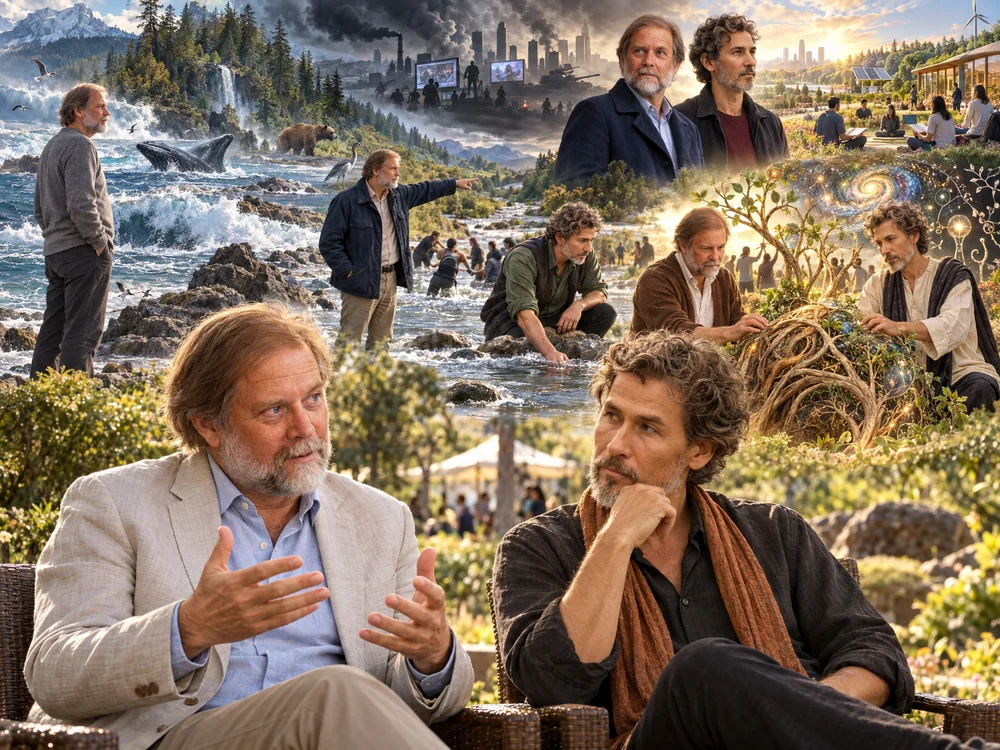
David Loy and Igor Kufayev Transcript: Nonduality, Climate Crisis, and Social Transformation
David Loy, with Igor Kufayev interview
Rough draft
Non-speech: [Music]
Rick Archer: Welcome to Buddha at the Gas Pump. My name is Rick Archer and we’re going to do a rather unusual interview today in the sense that, number one, we’re outdoors in a beautiful place, California, instead of my little home office with the cat and the dog and all that that usually participate in my interviews. And number two, this is a very spontaneous interview. My main guest here is David Loy, PhD, and Igor Kufayev, whom I’ve interviewed twice, is going to participate in the discussion. Igor and I both found David’s presentation here at the Science and Nonduality Conference in California to be fascinating. He discussed spiritual ecology with Llewellyn Vaughan-Lee. And so Igor had the thought to have a little conversation with David and put it on tape. Let me explain who David is. He is a Zen teacher. He was the Besl Family Chair Professor of Ethics and Religion and Society at Xavier University in Cincinnati from 2006 to 2010. His books include Nonduality, a Study in Comparative Philosophy. He’s an authorized teacher in the Sanbo Kyodan lineage of Zen Buddhism, where he completed formal koan training under Zen Master Yamada Koun Roshi. And he told me that he had spent 20 years in Japan doing this study. So I’ve wanted to interview David since I met him here at last year’s conference, and so it’s kind of expeditious or auspicious that this all came together as it did. So thank you very much, and thank you, David, for doing this.
David Loy: Thank you, Rick. Good to be here with you and to be a part of this.
Rick Archer: I thought we might start by just having you lay out for us what really lights your fire these days, and perhaps in terms of spiritual ecology. And I’m sure that will stimulate a discussion that we’ll easily fill up an interesting hour with.
David Loy: Sure. Well, as we all know, we’re in some trouble, right? We have an ecological crisis as well as a number of other ones. And this isn’t only a matter of climate change, but also things like species extinction, massive extinction events and overpopulation and so forth. And a really important question is, so what’s the relationship of this crisis? How do we respond to it? How do non-dualists respond to it? On the one hand, we have a conference like this one here in San Rafael, the Science and Non-Duality Conference, where we’re trying to understand the confluence of what science has to say about neuropsychology and so forth, and also bring in these great non-dualist traditions. But where’s the intersection? And the reason this is a really important issue is that what sometimes happens is that the way non-duality is understood, it actually ends up kind of rationalizing a certain sort of passivity. What I mean by that is, if you use the metaphor, for example, of, say, sea and waves or ocean and waves, if each of us is a wave, so often non-duality is understood as a matter of experiencing the ground, the sea, the water. And the understanding, therefore, is if I can touch, if I can realize that ground, that quiet place within me, where there’s no need to go anywhere, that doesn’t get better, doesn’t get worse, then there’s a kind of liberation involved with that. I think Igor talked about the witness stage, as it’s sometimes called. But the problem with this is the danger is that one is tempted then to think that that’s all you have to do, to sort of reside there. And so it seems to leave the world, the ecological situation, just free to deteriorate and break down further. So, important question, does non-duality really imply a kind of indifference to what’s going on, not only ecologically but economically and the social world? And as I see it, I mean, my main perspective is Buddhism. And I see this as part of a larger problem with westernized Buddhism, because as Buddhism comes to the West, there’s this interaction. It’s not only that Buddhism changes the modern world, but the modern world is changing Buddhism. And the danger is that what happens in effect is that Buddhist technologies of meditation, techniques can be extracted from the larger spiritual path and actually used to make you a more efficient consumer, stockbroker, sniper, whatever. Samurai. Yeah, well, which shows that there was some of the same problem in Japan, for example. Yeah, there’s this interesting Slovenian philosopher, quite important, Slavoj Žižek, who said that as far as he can see, Buddhism is the perfect ideology for 21st century consumerism. You know, it gives you time out from the rat race, you know, this frantic pace of life that we’re all in. And it allows you to step out of it for a while and sort of recharge and find some peace of mind, but then in a way that enables you to go back into the system. And what I would say is, from my perspective, that’s still dualistic. It’s still making a distinction. It’s still reinforcing what I think is the fundamental problem, which is the sense of a separate self, the feeling that there’s a me inside that’s separate from the rest of the world outside, and that I can pursue the well-being of this me quite apart from what’s going on on the outside. So in terms of that metaphor, the famous metaphor of sea and waves, we have to realize the sea is always taking form as waves. In Zen terminology, it’s not just that form is emptiness, but that emptiness takes form. You know, we don’t find the ground really apart from this world. This world isn’t just an illusion. This is the form, the constructed manifest way in which this ground takes form and transforms. And to love the ground is to love the forms with which it manifests, especially at this really critical time in history when collectively we are doing so much to destroy and damage it.
Rick Archer: It’s interesting. I have friends who’ve been meditating for decades, some of whom I would consider highly awakened, and yet they have political and economic philosophies that don’t seem to me to be at all compassionate or to reflect any sort of awareness of the essential oneness of everything. And I don’t know how they can do that. It puzzles me.
David Loy: Well, there really does seem to be a kind of compartmentalization, which I think happens often. It often happens even with spiritual teachers who sometimes do very immoral or unethical things. One way to say it is it’s not that we are awakened, but there is something in us that can become awakened. But just because that’s awakened doesn’t mean everything else about us is awakened.
Rick Archer: It hasn’t necessarily percolated into our relative structures.
David Loy: Exactly. Yeah. To me, the great challenge of our time as East and West come together is to see the non-duality between personal transformation and social transformation. I mean, we know, of course, that Asian forms, Indian, East Asian forms of personal transformation have emphasized the individual. And since that’s been happening in non-democratic societies, that’s what they’ve had to focus on. But now we come into contact with a modern world largely informed by the West, where I think the highest ideal is something that comes out of the Abrahamic tradition, social justice. Combine the Hebrew prophets with what the Greeks realized about democracy, the fact that we can transform our society if we want. And I think that’s at the heart of what we’ve been able to create today, not only democracy, but human rights, women’s rights, anti-slavery, civil rights. I mean, this development of justice, right, which is more institutionally focused. I think now we’re at a time when we can see the necessity of bringing the two of these together. We can see the limitations of either one by itself. And one way to say that is simply we’re talking about two types of freedom that need each other, right? The individual freedom, freedom from our own greed, ill will and delusion that traditions like Buddhism and Hinduism are working, focusing on, but also the kind of institutional freedoms that the Western tradition traditionally focuses on. And we need both. As Gary Snyder, he put it wonderfully exactly 50 years ago. He said that the mercy of the West has been social revolution. The mercy of the East is insight into the basic self/void or realizing the emptiness of the self. And he ended by saying we need both.
Rick Archer: Feel free to reach for the mic, Igor, anytime you’re ready to say something. So do you see that as a kind of a direction that’s taking place in contemporary non-dual and spiritual circles? Is there an integration taking place or is it really in a very fledgling stage and needs a whole lot of shepherding along to become significant?
David Loy: It’s a very good point. Just speaking in terms of socially engaged Buddhism, which is what I’m most familiar with, in certain ways it’s a victim of its own success in that certain types of social engagement, especially what we might call service, helping homeless people, hospice work, prison work, this is generally accepted and has become very important. And it’s wonderful. But on the other edge of the spectrum, I mean, we not only need to help homeless people, but we need to ask why in
Rick Archer: the richest
David Loy: country, exactly, and why are they increasing in a country that is by far the richest that’s ever existed?
Rick Archer: Yeah, why do we have the largest per capita prison population of any country in the world?
David Loy: Exactly, exactly. Another way of saying it is we’re often, the engaged Buddhists are busy sort of fishing people out of the river, floating by in the river, but there comes a point when you start to ask, well, who’s pushing them in around the bend?
Rick Archer: Yeah, yeah, very good point. Of course, a lot of times we feel powerless. There’s just the forces of the world are so huge and the corporations and governmental forces and so on. And here we are, this handful of so-called spiritual people. And you feel like, well, what can you really do aside from just focus on this little prison project or this little homeless project or something, but it’s a drop in the bucket. And global warming is this massive thing. We’re at 390 or 400 parts per million of CO2 in the atmosphere, which is unprecedented in tens of thousands of years. We shouldn’t have gone any higher than 280, and yet we’re totally in uncharted territory. And what’s that going to mean 20 or 30 years down the line? And, you know, a lot of people get a little bit discouraged and begin to feel that it’s a lost cause. And, you know, I might as well just, you know, make sure I don’t reincarnate again because it’s going to be hellish around here next time.
David Loy: This is exactly where I think spirituality is so important, you know, because, well, for example, in Buddhism, we have this archetype that’s called the Bodhisattva. And the mythology is a little off, I think. It’s the idea that somebody can be awakened and be on the verge of sort of disappearing from this world altogether, but they choose to stick around and help the rest of us. I think this misses the point. I think, in fact, the Bodhisattva ideal has a lot more to do with the fact that as we begin to wake up and realize that we’re not separate from the world, and this is my this is sort of my definition of waking up, realize that I’m not inside looking out at a world separate from me, as we realize that we’re non-dual with the world, then that doesn’t in itself necessarily get rid of these old self-centered habits and ways of thinking and acting. And what the task of the Bodhisattva is then is to start transforming one’s motivations, one’s way of living in the world, so that instead of asking, you know, I’m separate and how can I get what I want or what I think I need out of the world, we start to turn that around and we ask, OK, if I am the world, if I’m one of the countless ways in which all of this is coming together, then this is my body. This is who this is what I really am. What can I do, given my situation, the kind of person that I am? What can I do to make it a better place? And clearly we’re now in a critical situation where I think the Earth is calling upon all of us to be Bodhisattvas. But I didn’t actually get to what I think is so distinctive about the Bodhisattva thing. You’re exactly right. We tend to feel overwhelmed. The problems are so huge. But in the Buddhist tradition, at least, the Bodhisattva classically takes a vow to help all living beings in the universe wake up. Whoa. Big job. You know, it’s like a big universe. So, you know, you don’t hold your breath, right? You can say it’s more constructing the meaning of your life, sort of meaning, basing the meaning of your life. And so you’re working in a certain kind of direction. Well, think about it. I mean, if somebody has taken that vow, are they going to be put off by the fact that climate change is pretty tough or we have a really corrupt political system or a self-destructive economic system? And not only that, but so often social activism tends to burn itself out. You know, you get out there, you have this goal oriented and it just doesn’t work out the way you hope it will. And so you get frustrated. But the whole point of the Bodhisattva path is that Bodhisattvas are working on both sides at the same. You see, because you’re working on your own, deepening your own awakening, even as you’re also going out in the world and trying to make, you know, reform structures, the kind of activism we need. The two sustain each other and the two really become, as I see it, two parts of the same spiritual path.
Rick Archer: Yeah. It would also seem to me that if you’re really sort of worthy of using the term Bodhisattva, however loosely, you know, with regard to yourself, then by that time you perceive yourself as being much more than an individual poor little guy who can’t do very much. You are the creative force that’s, you know, breathing in these trees and that’s giving rise to this whole universe. And so that, its very nature is to keep doing, to keep promoting the evolution of all beings in the universe. I mean, that’s presumably why the universe came into existence. You know, and so if that’s your primary identification, then it’s kind of a, you know, done deal, slam dunk. That’s your driving force.
David Loy: But the only thing I’d add to that, if I understand you right, there’s a little bit of a danger there that I hear sometimes expressed, that people say, “Well, I’m not a Bodhisattva. That’s far away from me. So I’ve got to keep focusing on my own awakening.” And to some extent that’s true, of course. I mean, the spiritual path, we start on our own personal transformation, definitely. But some people seem to think, “I’m going to ignore the rest of the world until I’m really so deeply enlightened.” And that kind of self-preoccupation, I think, is actually reinforcing the fundamental problem. Whereas I think we need to constantly engage with the world in whatever way we can, integrating whatever it is that we’ve realized, and integrating whatever ways that we ourselves have been transformed up to that point. So it’s a reciprocal process, that the constant lessening of self-preoccupation that happens when we’re engaged in the world is a very, very important part of this personal awakening that we’re talking about. So I don’t want to separate them.
Rick Archer: What I’m suggesting is that it’s becoming more and more common to encounter individuals whose genuine experience is that the world is my body. The oneness is there such that there’s as much… I am not just this individual at all. This is an instrument through which life is being lived, but I am essentially the soul in the tree, in the grass, in the mountains. I am everything, and it’s all within me. And so from that, not just as a kind of a nice philosophical concept, but as a living, breathing experience, that is becoming more and more commonplace. Such individuals really are… and they’re not individuals, the terminology trips you up. Such people really are that bodhisattva consciousness that is infusing evolutionary juice into the world, and thereby helping, hopefully, to transform it. I think Igor is ready to say something.
Igor Kufayev: I feel like, perhaps, would be the… to bringing this beautiful unfoldment that David just sort of shared with us, is that what I feel personally is that what is lacking in the contemporary spiritual dialogue is the very fact that we are molding our environment, we’re molding the world we live in, literally, literally, by the way we perceive that world. And the modern science, modern science, speaks of that phenomenon more than ever. The whole paradigm that we found ourselves in, the whole predicament that this global civilization is now found itself, is that it became the civilization of the consumers. But how did it all become the civilization of consumers? Because the objectivity of the world, what was put, was put as the main, main reason for existence. The world became, since the world was reduced to this one grand machine, empty of any consciousness…
Rick Archer: Source of resources.
Igor Kufayev: Source of resources. The earth was viewed as the object. Everything that was inside the earth was viewed as further objects. And to the degree that we actually started to treat people, ourselves, animals, all the species, trees, everything, our environment, as objects. Where does that reductionistic view come from? And this is very important to understand that spiritual dialogue is not separate from what is happening today, what is happening today in the, let’s say, overall arena of discussion of how do we proceed from here. This is what you’ve addressed with Llewellyn during the discussion yesterday. Yes, precisely, you’ve touched upon these topics that if we do not incorporate that, if we do not make that part of the spiritual dialogue, then we continue to perpetuate that kind of separation, that spiritual evolution is somehow, chiefly belongs to the existential domain of our existence. And what we do out in the world is entirely different matter. As you said, Buddhism became a very perfect refuge where you use Buddhism as a sort of like a rejuvenative place where you can dive back into the world of consumerism. Self-help. Self-help, exactly. So the once great tradition of transformation of consciousness is being now utilized for the same very needs that we’re trying to transform and trying to move away from. So it seems to me that solving the problems on the level of the problems is not going to do anymore. We have to introduce the third factor. We have to go, as you said, not saving those who drown down the river, but we have to go behind the bend and see how did they end up being in that river in the first place. And it seems to me that the reason why we ended up finding ourselves drowning at the moment, drowning in not finding solutions, you know, we’re trying, the whole world is like trying to find the answer to that perplexing dilemma. Some voices are gravitating towards almost painting a very bleak picture. And, you know, on the other side, the optimist who’s saying that it will all somehow take care of itself. And where does that position find each and every of us individually within the heart? And this is why I believe personally that the attitudes, the prevailing attitude that somehow, somehow, the perception of the world is independent from the way we perceive it, is an erroneous understanding. It is, the world is as we see it, as Rishi Vashishta said, the world is as we perceive it. So, in other words, in other words, we mold the world with sum total of our perception of it. So, if we perceive the world as pure object, we are forming that morphological crystallized structure of objective universe, where there is everything, everything can be reduced to just that very level. And we find ourselves caught in that objective universe of unrelated matter. When on the other hand, when on the other hand scientists are now openly confirming the experiences of mystics, spiritually awakened people, that what once believed to be matter or object suddenly becomes a field of possibility, suddenly becomes the vibrating field of energy. This is particles versus waves. So, when our perception of the world changes, with that change, we change the world, because we perceive the world differently. And this is where I want to place an emphasis and this is why I would like a certain dialogue to be opened up. Many great spiritual leaders, many great masters have spoken of the importance of the way we kick this universe. Every thought, every emotion, every feeling we have has an impact on a greater whole, because the size here does not matter. Sometimes you hear, well, but what can I do? I’m a small little individual in this whole cosmic game of whatever you call it, you know. Caught in the wheel of samsara. And yet, and yet, at the same time scientists tell us that because of this law of non-locality, the grain of sand contains the entirety of the universe. Then to speak of something small versus big is irrelevant. Every, every feeling and every thought counts. And this is where I feel is that corner, that bend of the river where we fall into that place where we then need to be rescued. Once our perception changes, then we start forming and we start, not actually start, the word start is irrelevant. Instantaneously we are making and creating another reality. We’re creating reality through the way we perceive reality differently, because that is interdependent. This is how, you know, how little I understand of modern science, this is how that works. This is the observer effect. So it’s like literally the world is no longer solid, the world is no longer crystallized matter. The world suddenly becomes increasingly imbibed with infinite possibilities. So we find ourselves in that place in time where we can actually have a quantum leap from the place of like, again going back to that discussion which gave birth to this one. The one that you had with Llewellyn is that actually when something is dying, something is being born simultaneously. So this process of dying of the civilization and dying of this system of values that outlive themselves, we are in the process when we’re witnessing this a new birth. And we have to be very tuned, we have to be intuitively acute, we have to be literally, literally hear the whispers of our innermost heart of what is that new that is in a budding state.
Rick Archer: A new story?
Igor Kufayev: Why not? A new story. And we are the sculptors, we are the moulders, we are the ones, you know, we’re creating that social sculpture. We’re creating a new, let’s say, model of interacting. So that we don’t solve problems, we don’t go around plastering the wounds of the earth, the wounds of the world. Earth can heal itself, you know, like this great power that is embedded in that absolutely conscious of itself, beautiful, living, pulsating eco-organism. But what we can do, we can willingly participate in that process. And this is what I feel is very much, this is why I felt it’s like the messages that you were conveying yesterday in that dialogue, in that panel. Is that it’s so timely because when people feel that existential quest for self, let’s say, in whatever way you call it, enlightenment, you know, emancipation. It’s not removing oneself from the world and allowing the world to take care of itself. This is the greatest delusion. Because, because, if two, three people saying that, there is an army of those who follow way before they reach that state, way before they reach that state of emancipation. And they are withdrawing themselves, so to speak, from that very important partaking. They basically, they live neither in a state where they transcend it, let’s say, the gross aspects of reality and abide in their essential nature. It’s just they’ve created this kind of attitude, a mood. And by not fully understanding this engagement in the world, like what you have beautifully spoken about as the real role of the bodhisattva, they become, they become, literally they withdrew from the world. It’s like the annihilation, it’s like the story of India of the past thousand years. That completely India became the subject of many foreign invasions precisely because of misunderstanding of the whole notion of illusion, maya. Because the world was negated as it’s not real, why to bother? Well, that’s, you know,
David Loy: another way to express or what you’re saying or a large part of it is the need for a new story. You know, we perceive the world and we act in the world in the way that we do because of our stories about it. And you could even say the world is made up of our stories.
Igor Kufayev: Absolutely.
David Loy: And the problem is, well, first of all, it’s fascinating that suddenly in the last year or so, this is what everyone seems to be working toward, the realization that the old story, which is really, you know, behind, I think, the ecological crisis and the economic crisis, behind a lot of the other breakdowns. We also have a story crisis because if we believe that the universe is simply a bunch of dead matter and that we’re just accidental forms of that matter that have no meaning, we’re here just formed for a little while and then we dissolve and there’s no meaning, there’s nothing, there’s no continuity, nothing. Then truly this has extraordinary implications for how we live both individually and also collectively in terms of what we do to the earth. The new story is getting quite fascinating. The old one, I think, if you look at what’s really motivating, say, our economic system now, I don’t think it’s Adam Smith’s invisible hand, that’s the old capitalist rationalization. I think it has a lot more to do with social Darwinism, you know.
Rick Archer: Survival of the fittest and every man for himself.
David Loy: Right. Which isn’t what Darwin himself taught, right? But as God disappeared and Darwin refuted the last good argument for God, the idea of the argument from design. I mean, once you have evolution, you don’t need God to create all the species, you see, in any simple way. But because God was the source of meaning and value, when God disappears, you’ve got a kind of ethical void. And what leaps into the void? Well, a kind of social Darwinist ethic that I think is still prevalent today. We don’t call it social Darwinism. We call it, it’s Ayn Rand or somebody like that. But in Buddhist terms, it’s a rationalization for greed, aggression, and the delusion of a separate self, you see. Whereas what we’re finding now, it’s really exciting. New studies in cosmology and evolution, a lot of people are working for this new universe story where we understand the universe as an organic living whole that’s self-organizing. And what it really seems to be, it seems to me, is that the basic stuff isn’t even matter or energy. But it’s like fundamentally it’s creativity, constantly taking different forms, transforming, complexifying, gaining higher consciousness, until you get to human beings where it seems to me something very special happens. And this is an important point because you have a dialogue between the old people who think God put us here to control and use everything else versus some biologists and deep ecologists who would say, you know, we’re no different than any other species. But I wonder if they both miss the point that with human beings, what we have is new forms of the creative process. That is to say, we’re creatures that create. With us, new types of creativity become possible. And to say it another way, in our meditation practice, when we learn to disidentify with everything, this also is what enables us to wake up and identify with the whole cosmos and to take the well-being of the whole cosmos as the meaning of our lives, again, both individually and collectively. This is huge. I mean, this is a much more… I mean, first of all, we’re not some accidental form of dead matter. We, with us, the universe…
Igor Kufayev: Or the logical progression of evolution. It’s not an accidental evolution as it’s like the Darwinist theory. It’s just the system becomes more complex and complex. And suddenly we are…
Rick Archer: Until the universe becomes aware of itself, which is one way we can understand it.
Igor Kufayev: Exactly. And I just wanted to… sort of to… echoing of what you just said, it’s precisely what I meant by the perception of reality, because that’s what you call the creative process. Because that’s what is given to us. And you can, in a way, one can interpret the words of Old Testament, is that the Adam was put in the garden to take care of that garden. Because it was in the Adam’s capacity. It is in the capacity of the human being. It is in the capacity of the human nervous system, human creativity, because it’s absolutely identical. Identical with the greater cosmos. Because some of these presenters from the scientific background showed us that man stands right in the middle of the greatest in terms of the size…
David Loy: Humans.
Igor Kufayev: Humans, yeah. Well, it’s an old… the human stands in the middle.
David Loy: I think this is his second language.
Igor Kufayev: And the smallest. So that… so that in a way that this is the, you know, the great… the great Adam Kadmon, you know, the Purusha of the Upanishad. The Purusha in the form of the human. So this in a way that like that’s what I meant and then you’ve took it further in terms of the creative process. Like, let’s say, nothing is devoid of consciousness. Everything is consciousness. The tree is consciousness. The piece of rock, as I was saying earlier, that the granite slab has consciousness. And if you zoom in to it and you carry on zooming in, then that inert dense matter will eventually go on the level when everything is dances. There’s, you know, there’s nothing in the universe even on that level is absolutely inert. Everything is relatively inert to something else. So in human being, liveliness brought to its utmost. In human being, this is where the full world of basically this whole creation rejoices. And we forget that. We forget that a human being is indeed unique. And that precisely in my view what places us in the position of responsibility. Not in that kind of like patronizing responsibility that we’ve been so far exercising over the rest of the, let’s say, species and the earth itself where we’ve been sharing the place. But I’m talking about the responsibility from the greater sense. From that what from, you know, from the responsibility that we are the creative beings with the capacity to literally, literally make anything possible. The tree is just witnessing silently there. And that’s what makes us unique.
David Loy: One of the important things about the Adam and Eve story that really stands out for me is that God made man or as we now say humans in his own image. Does that mean that God has two eyes and a vertical nose? No, I mean, if God is a metaphor for the creative process, it means that, you know, with us, we embody that creative principle in a way that no other created being does. Which is gives us, of course, very special responsibility. But how wonderful it is to realize that the same creative process that creates a galaxy, the same creative stuff that creates a rose bush or a rock or this tree is also creating our thoughts and our words right now. That this gives us the kind of non-duality, the kind of new story that I think we’re going to need if we’re going to give life a meaning. And we can see how this is a way of explaining that it’s with us that the cosmos creates meaning and also creates responsibility for itself. And so, I mean, we’re all talking about this story. It’s really, really exciting, the potentialities built into it. Sorry, I’ve…
Rick Archer: No, it’s all right. I love that. And you know what you were saying about Darwin kind of taking God out of the equation. Maybe he took the old-fashioned concept of God. And so, if we just kind of look a little bit more closely, you know, God hasn’t gone anywhere. And as you so beautifully put it, every single particle of creation is brimming with intelligence. And if you look at anything closely enough, you know, look at a single cell under a microscope, holy mackerel, that’s not just a lot of little billiard balls running into each other randomly. There is some incredibly intelligent orchestration taking place there that is beyond our limited comprehension. And every single particle, the trillions of cells, even within our immediate view here, are just saturated with that intelligence. But as you’ve been saying, we as human beings are somehow an even more developed expression of that. We’re able to sort of channel it more intentionally and fully than a blade of grass. So we’re more influential, which kind of gets me to something Igor was saying, which gets us back to the point of, you know, should we feel hopeless because the powers that seem to be destroying the earth seem so vast and we seem so puny. You know, if you go to a subtler level, you have more power. The chemical level is more powerful. If you release the energy in a lump of coal, it’s a lot more powerful than the lump itself, you know, if you burn the coal. Or if you went to the atomic level of the coal, you know, a single lump could probably power an entire city if that were the substance they used to create that kind of nuclear power. So at subtler levels, and as physicists tell us, you know, the amount of energy on some level in our pinky exceeds, you know, and it’s just vast—inconceivable. It exceeds the amount of energy in the entire manifest universe. So we have a kind of the principle of the fulcrum going on here, where, you know, a great big seemingly immovable rock, what are we going to do? But if we have a fulcrum, we can actually move the rock. So being able to function from a subtler level of awareness gives us an influence that we wouldn’t have if we were just trapped at the surface. And so, you know, spiritual “people” need not lament. They will and have and are having a powerful influence in the world, creating a new reality, as Igor puts it, by perceiving a deeper reality. They are actually manifesting that reality. But I don’t think that absolves them from action at all levels. It’s not like you can just sit on your butt and meditate and you think, “Okay, the world is going to change.” There needs to be a more, for most people anyway, some should probably do that because it’s their nature, but for most people to really have an impact, you need to kind of be at that deep level at which nothing ever happened and also express it to the best of your ability. Everyone’s heard of Amma, the Hugging Saint, and she has all these tremendous humanitarian projects that she does, huge stuff. And relentless, inexhaustible, it just keeps happening. And at one point one of her Swamis asked her, “Amma, what more can we do for the world?” And she said, “What world?” So she’s fully appreciative of the fact that on some level there is no world, and yet brimming with compassion for the world that we all appear to live in and doing everything she can with every ounce of her strength to make it better.
David Loy: Einstein was quite uncomfortable with quantum mechanics, famously, because he found the unpredictability, the indeterminacy principle really uncomfortable. It seems strange, but I wonder if he missed the point here, that as a physicist he was looking for regularities that he could make into laws, and I wonder if we can say that at the quantum level this is a manifestation of this creativity, which can’t be predicted, can’t be completely controlled, that that’s part of the process, just like geneticists know that our DNA varies and mutates at a pretty constant rate. That is to say…
Igor Kufayev: In a way that’s exactly what I meant with the perception of reality, because when Rick made the comment, I did not mean that just perceiving reality as in terms of yourself, realized self. What I meant is exactly what you’re just saying, that it is exactly that conscious perception…
David Loy: Changes reality.
Igor Kufayev: Yes, that’s what…
David Loy: Creates a new world.
Igor Kufayev: Exactly. From that place, because our creativity is not passive, it’s always active.
David Loy: And that a new story…
Igor Kufayev: Exactly, that’s when we weave a new story, that’s exactly when we reintroduce new mythology or we create the new story, which our children and grandchildren will live. Not very non-dual, I know, but that’s how I feel.
David Loy: But of course the challenge now is that we can understand who we are and our role in the universe in this new way, but we’re challenged by the fact that this is a new story still struggling to be born and that the social-economic world is largely determined by the old story and that we’re at a point in our social evolution where there’s lots of resistance to the change. And again, I think spirituality has a lot to say. It can give us insight into the fact that of course the fundamental resistance here comes from the delusion of separate self. Not only the hyper-individualism and narcissism of so much of American life, but also the way that this ego becomes collectivized and institutionalized. So one of the things I’ve tried to point out is how Buddhism talks a lot about these three poisons, greed, ill-will, delusion. Today they seem to be taking institutionalized form. Our economic system is really institutionalized. I mean, if greed is you never have enough, isn’t that our economic system? Likewise, our militarism, institutionalized aggression, our media as institutionalized delusion to control our way of thinking, to keep us in this old paradigm, to keep us consuming, pursuing that as the way to be happy. So it’s
Igor Kufayev: keeping the old story, rotating the old story, keeping us within that old story. And this is specifically media, because like literally the military and everything, because the Goebbels, one of the four most important Nazi members, he said that once you have control of media, that’s it. You have total control. That’s the only control you need. You need to have control of the media, and that will by itself control the collective consciousness. And this is exactly where the new story comes into being. This is exactly the new story. This is exactly when we introduce, when we weave in the fabric of our existence, when we no longer, no longer participants, or willing participants in that play which outplayed itself.
Rick Archer: Well, you know, when your gestation period is over and you’re ready to be born, there’s not much that either you or your mother can do to stop it. And I think, I choose to be optimistic, maybe I’m naive, but I have a feeling that there’s an inexorable force moving in the world that as powerful and intractable as these undesirable situations may be, I think that ultimately their days are numbered, and that people who kind of think along the lines that we’ve been discussing should feel encouraged, and should just keep their chins up and do whatever they can do to further all this along, both in terms of their own development and whatever they can contribute to the world. And I feel like we’re going to see a brighter day, perhaps well within our lifetimes. I think we’re almost out of camera memory, but is there anything you’d like to kind of conclude with?
David Loy: Well, your final remarks reminded me of something the English writer H. G. Wells said, that history is a race between education and catastrophe. And I think, you know, that’s very wise, especially education in the broad sense, such as the sort of non-dualist traditions are trying to encourage. And the important thing, it seems to me, is that in recent years both sides are speeding up. So, you know, there’s definitely a change of consciousness happening, but also the crisis is there, and our spiritual traditions have to understand the implication of what we’ve been saying, that the ecological crisis is also a spiritual crisis.
Rick Archer: And perhaps the speeding up of the spiritual is nature’s way, or that cosmic creative intelligence’s way, of counterbalancing the dire, the severity of the problems that have been increasing. It’s like, because nature abhors an imbalance, you know, and so it’s rising to meet that challenge. And may the better man win, and we know which one’s better. Better human win. So I think we’re about out of camera memory, so if we can, if I have time to do so, let’s wrap it up. You’ve been listening to a rather different episode of Buddha at the Gas Pump. If you’d like to see more of these interviews, go to batgap.com, where there’s an ever-growing collection of them. And if you’d like to be notified of new ones, there’s a place to sign up for an email notification. I’ll be linking to David Loy’s website from batgap.com, and if he has any books on Amazon, I’ll link to those. And of course, I already link and will link again to Igor’s website, so that you can get in touch with these folks, if you’d like to further the dialogue. So thanks for listening or watching, and our next interview, depending on which order we put these up in, will be Francis Lucille. I’ll be speaking to him tomorrow morning. Thanks.
Non-speech: [Music]
 Apple Podcasts
 Spotify
 YouTube