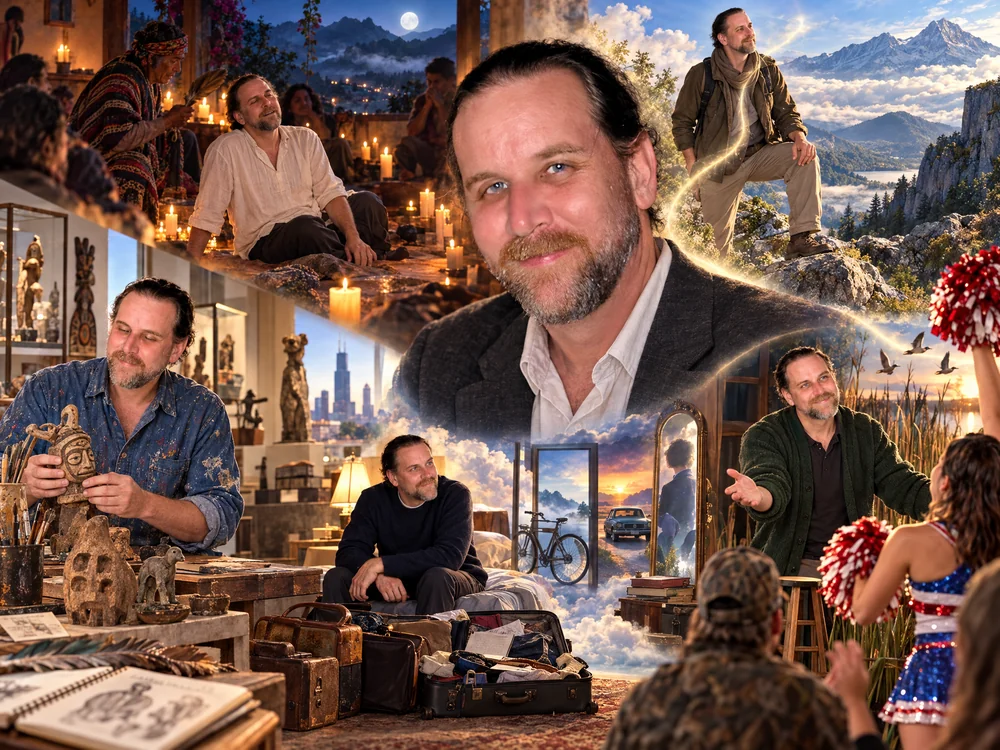
Tom Crockett Transcript: Shamanism, Dreamwork, and Enlightenment
Rough draft
Non-speech: [BLANK_AUDIO] [BLANK_AUDIO]
Rick Archer: Hi, I’m Rick Archer, and my guest today is Tom Crockett. Welcome, Tom.
Tom Crockett: Welcome, thank you for having me here.
Rick Archer: Any distant relation to Davy?
Tom Crockett: Matter of fact, he’s a great, great, great grand uncle.
Rick Archer: Very cool.
Non-speech: [LAUGH]
Tom Crockett: We go way back here in Virginia.
Rick Archer: Yeah, I have a friend that I attended the Science and Nonduality Conference with, it’s the grandnephew of Harry Houdini. So I kept threatening to lock him in the car trunk and see if he could get out.
Tom Crockett: I dare you to get out, I dare you.
Non-speech: [LAUGH]
Rick Archer: Good, well speaking of the S.A.N.D. Conference, I first became aware of you at that conference. I hadn’t really known about you before that. And I saw this nice brochure that you had put together about your presentation with Scott Kiloby and Jeff Foster. And so I read that and I thought, definitely wanna attend this presentation, cuz it was kind of very up my alley in terms of the sort of stuff that I find myself questioning and talking to people about in these interviews. I think there’s a need for a growing up or maturation in the sort of non-dual world that I see happening, actually. Just yesterday I got an email from Mandi Solk, who I had interviewed a year or two ago. And at that time she was saying, there is no person, there’s nothing to do, and all this. And yesterday she said, boy, have I changed. [LAUGH] I said, I realize there’s a whole lot to do, and I’ve gone through big transformations since we last talked. So I’m gonna interview Mandi again. But I walked into your interview about five minutes late after it started, and I was immediately captivated by what you were saying. And your slide presentation was very humorous and informative. So I wanna talk about that stuff with you. But it’s kinda nice to start with a little bit of a biographical sketch of the person, cuz otherwise the listeners don’t know who it is we’re talking to here, and what are your credentials for saying whatever we’re gonna say, and so on. So perhaps we could go back a little bit to just maybe a chronological biographical sketch of how you ended up where you are today, in terms of your spiritual orientation to life.
Tom Crockett: Of course, you’re assuming I know who you’re talking to today.
Rick Archer: Yeah, right.
Tom Crockett: [LAUGH] Would be a prerequisite for my explaining who you’re listening to.
Rick Archer: Yeah, well, on that one, I would suggest that there’s always more to know, and greater depth and clarity to be discovered.
Tom Crockett: Yeah, gosh, I’m gonna have the deer caught in the headlights looking at this, cuz in some ways, I’m not really sure where to start.
Rick Archer: Well, let me prime the pump a little bit. For instance, I read your entire book, cover to cover. And in the epilogue, actually, you talked about how you’d studied shamanism, you’d had experiences with ayahuasca and mushrooms. You made references to Buddhism that made it sound like you had been a practitioner. You have done a lot of dream work, studying or analyzing dreams. You have been counseling people, presumably with dream work and maybe other things. So I kind of got little snapshots of various things you’ve been interested in, but it didn’t really present a complete picture necessarily, if that’s possible.
Tom Crockett: I think probably the complete picture, or as complete a picture as I’ve been, probably for most of my adult life, if not parts of my childhood, I’ve actually been very interested in this question of why we suffer. Why we feel the things we feel kind of in this realm. And the first thing I discovered was not non-duality or emptiness teachings. The first thing I probably discovered were traditional indigenous wisdom teachings. And that path of spirituality, I actually have a master of fine art degree from the School of the Art Institute of Chicago. And I went there in the early 80s after four years in the Navy. And what I realized after getting a bachelor’s degree and a master’s degree in art was that I really wanted to be untrained. Which you can’t go back. You can’t go back and be untrained, but I was actually much more interested in the collections in places like the Field Museum of indigenous artifacts and objects. And so I began to say, well, I can’t be untrained, but maybe I can look untrained. And actually began to create objects, artifacts that looked for all intents and purposes like traditional spiritual paraphernalia or objects from other cultures. And then in order to sell those or show those in galleries, I created the culture that went with them. And created the stories that went with them. And kind of tongue in cheek, but also it was a kind of exploration for me. And people would buy these things with my little made up story about my little made up culture and then would come back to me and say, you know I gave this to a friend in the hospital and you said this was a healing. You know, this was a healing object. And it really worked. And I went, well, it wasn’t supposed to, really.
Non-speech: [LAUGH]
Tom Crockett: I’m not a shaman. I’m not any of those things. But it led me to study, to want to know why those things might work. And that led me to a long exploration into shamanism and indigenous wisdom teachings and plant spirit medicine, things like that. And then through whatever evolution process I experienced in my own life, it began to feel like I could make a difference for someone in the short term. I could do something that would have an impact on their pain or suffering in the short term, but it would always come back. And that always coming back, that always circling back made me feel like, okay, this is just rearranging the deck chairs on the Titanic. There’s gotta be something deeper, more profound than this. And that led me probably most directly to emptiness teachings, oneness teachings, non-duality. I don’t know if that’s a coherent story.
Rick Archer: It is. I mean, it’s a very concise one. I’m sure there were all kinds of adventures along the way with ayahuasca and mushrooms and all that stuff, which you’re welcome to talk about if you feel it’s relevant, but it’s a nice little synopsis.
Tom Crockett: I think probably more than anything else, the mushrooms, which were done in Mexico, up in Huautla, in the mountains, with a traditional healer who’s basically dedicated his life to working with these things in ceremony, in a sacred container, was pretty profound for me, because it really gave me a glimpse of the territory. It gave me a sense of where I was heading. And after having been a meditator most of my life and having had little glimpses into that state of ultimate freedom, emptiness, connectedness at the same time, the mushrooms sort of did it in a way that, I don’t know, probably stayed with me more profoundly.
Rick Archer: Any particular experience you can elaborate on?
Tom Crockett: Probably, I mean, my first experience with mushrooms was with a group of people, and honestly, I was such an egoically inflated being going into this ceremony, that I thought, what I’m going to do is be a journalist here. I’m going to actually take the mushrooms, given to me by the shaman who decides how much you’re supposed to have, and I’m going to have a partial, cool experience while being enough of a journalist to be able to write this story as I go, and I remember in the ceremony, there’s a lot of preparation. Then you take the mushrooms, and then they gradually begin to blow out candles in the room until it becomes dark. And they said, we encourage you to lay down. And I said, I’m not laying down, I’m going to sit up in a chair, because I’m only going to have a partial experience. This is going to be under my control. And I remember thinking, at some point, it was almost like Pac-Man. Like the mushrooms were gobbling up every trace of ego that I had left, and my little scared ego was trying to hide out in different places of my body, going, no, no, I can get away from this. I can still hold on and be me, be who I thought I was. It won’t affect me. And then literally just like sinking from the chair to the floor. And probably the most profound experience from the mushrooms was a recognition that at some point, I began to sob. I began to cry. I felt an incredible sadness that was both personal and impersonal. It was not so much my sadness, it was, because I had nothing, I wasn’t triggered by anything that I was feeling sad about, except every sad thing in my life, up to that point. But it was like sticking your toe in the ocean of sadness. Like it’s this huge ocean of emotion. And I was just feeling it. And everybody in the room was sobbing. And then at some point, we all began laughing. And it was, and again, it came from nothing, no sonic trigger, no programming. The songs the healer was singing were in Mazatec, which you can’t even, you have to have a Spanish translator and then into an English for any of us would have understood what he was saying. But it was then humor. And then it was like these full body orgasms where you were just going, God, these wave after wave. But again, it wasn’t me, it wasn’t mine. I didn’t own this. It was, and to the extent that I wanted to cling to it, every so often the healer would go, he would let us do, go through these waves of emotion and then say, tranquilo, tranquilo. Calm, calm down, come back. Like, let it go now, let it go. And I think that was pretty profound in my teaching and my work with other people about, to the extent that we cling to identities, the extent that we cling to these emotions that we have, that’s where suffering comes from. Cuz they’re meant to move. We’re meant to feel them. It’s not like we’re meant to feel nothing. And that’s not, I don’t believe that’s the goal of enlightenment or awakening or awareness that we get to bypass all feeling. You know, you started out by talking about the friend who said, boy, have I changed, you know, in the past year. And I think there’s, for me, like nothing more profound than the simple line, you know, first there is a mountain, then there is no mountain, then there is. And I think, you know, to a large extent, the non-dual community is filled with a lot of people who are at the, then there is no mountain stage. And it’s just a stage.
Rick Archer: Yeah. We’re gonna go into the whole non-dual thing at length, so I could ask you a question about that now, but I think I’ll put that off cuz I, I, it’ll probably form a major portion of this discussion. So that was very interesting. I’m glad I had you tell that story. I imagine a lot of people who listen to it are thinking, hmm, I think I’ll go to Mexico and take some mushrooms. This, this sounds good. Is that the kind of thing you would still recommend, or is it, you know, really kind of a reckless thing to do in some respects?
Tom Crockett: I think what’s hard is that a lot of people, a lot of people have had experiences with mushrooms. And, you know, what they describe is a very, you know, a very cool, you know, mind-altering experience. But when you know, for a number of years, I would lead groups to Mexico. And I worked with a, a depth psychologist who lived in Mexico City and had a retreat center in Oaxaca. And we would spend, you know, we would go for ten, eight to ten days at a time. And the first four or five of those days was altering diet. It was doing sweat lodges. It was cleansing. It was doing intense sessions of dream work to uncover why are you even taking these mushrooms, because they’re meant to be a cleansing, healing experience. Right. You’re, it’s meant to, it’s not meant to be a recreational cool experience.
Rick Archer: Right.
Tom Crockett: And so we would prepare for it. We would go up and basically turn ourselves over to a healer, to someone who’d spent their life learning the ceremonies and, and how to work with these, and who takes the mushrooms almost, you know, every day, every time they do ceremony, they take the mushrooms as well. And yet are capable of not losing themselves in the experience, but guiding you through the experience. And one of the things that was funny about the experience was that the healer, our names were too strange for him. You know, Western names were too strange for him, so he gave us numbers. You know, and you know, so there was numero uno and numero dos, and I was number two. I was numero dos. And every so often, you know, what I most wanted was to be left alone, floating in the, you know, pool of infinite cosmic consciousness. And you know, just, oh my God, just leave me here. This is bliss. This is, ah, this is amazing. And I would hear from far away, numero uno, si, numero dos, numero dos. And I would go, “No, I don’t even want to answer.” And then I would hear other people in the group say, “Tom, you’ve got to say something.” But his whole point was no one gets left behind.
Rick Archer: Yeah. So he was afraid that people might get so checked out that they would lose connection with this world or something, and it could be dangerous or some such thing?
Tom Crockett: Well, not so much dangerous, but he had a job to do. And his job was to cleanse you, to clear you of blockages and things like that. And you know, unless you stayed and kept up in a way with the process, in other words, if you got lost in that floating in that cosmic consciousness, I don’t think I ever would have had the experience of the emotional flow moving through me that wasn’t me, that for so much of my life I had claimed as me. You know, my identity is my emotions. My identity is everything I feel, and how I feel about everything I feel. That’s who I am. But if I hadn’t had the experience, if I had stayed floating in this, you know, I would have had this amazing, blissful experience to talk about, but I wouldn’t have had the, you know, “Okay, this is you and it’s not you.” Yeah. Interesting. And I had no conversation with him. I didn’t know at that time; that’s what I needed to know. But apparently that’s what, you know, and I would have lost that if I had been able to do just what I wanted to do. So that comes back to the question, you know, should you just go to Mexico and take some mushrooms? If you can have a kind of experience in a container like that, I think it can be profound, but it’s a harder thing to find that kind of experience.
Rick Archer: Yeah, I mean, you just call up the Mexican Tourism Bureau and say, “Hey, I want to go take mushrooms,” and they give you some pointers? Is it even legal?
Tom Crockett: As a matter of fact, it’s not legal, but, you know, it starts after dark, and we were in a house up in Huautla in the mountains, and probably about midnight, there’s a banging on the gate, and it’s the local police, who know where these things are going on. And they, you know, the owner goes down and he gives them a little money, and they say, “Is everything okay?” And he says, “Yeah, everything’s okay.” Because what they really want is no trouble. They don’t want tourists coming up and being ripped off or killed or something like that by unscrupulous people. And so they’re kind of making these rounds. They know completely well what’s going on in there, and technically it’s illegal, but they also know that this is what the people do up there.
Rick Archer: And is this a part of Mexico where the cartels aren’t very active or something?
Tom Crockett: Yeah, there’s not a whole lot of money in mushrooms.
Rick Archer: Right.
Tom Crockett: Yeah. So, there wasn’t — I actually stopped leading trips for a couple of reasons, but one of the reasons was that it was just getting kind of dicey to travel in Mexico.
Rick Archer: And so what kind of lasting effect did this have on you?
Tom Crockett: I think it gave me a sense — you know, I had said before, having spent so much time learning techniques, learning techniques and processes, that it kind of took me to a place of what’s deeper than techniques and processes.
Rick Archer: You had been, what, studying Buddhism and getting those kinds of techniques?
Tom Crockett: Buddhism and shamanism, meditation, techniques for altering consciousness, but techniques for moving energy, techniques for studying dreams, understanding what dreams mean in someone’s life, and had spent a lot of time doing the kind of work of understanding the content of dreams. And it actually took me — I kind of went back and said, “Maybe it isn’t the content of the dreams. Maybe it’s the phenomenon of dreaming that is really what’s important here. Maybe it’s the dialogue between the egoic, what we call waking self, and the deep, dreamless sleep or the kind of non-dual self. Maybe the act of dreaming, maybe the phenomenon of dreams, the fact that in a dream you can dream as yourself and be conscious of this is me. You can also glance in a mirror and realize this is not me, this is an old woman, or I’m an animal now. So you can dream as something other than you, and you can also dream as this — you can dream as though you’re watching a movie. We’ve all had those different kinds of experiences of dreaming, and we can move seamlessly back and forth through those things. So the phenomenon of dreaming becomes a pointing out instruction to waking up, to really waking up. You can talk about the fact that things in dreams become — like you can be riding a bike and all of a sudden you’re driving a car. There was no transition between riding a bike and driving a car, and for a moment, a flash, there’s kind of like a, “Huh.” But you don’t stop the dream, you don’t go, “Wait a minute, stop.” You don’t stop the dream, you incorporate that new information and now you’re driving a car. Well, you know, so often I think what causes suffering for us is when we have this kind of script or story that we think should be happening, and something different happens, and we say to life, “Stop. Stop moving. Stop. Wait. This isn’t how it should go.” And we suffer. You know, and that’s what — in dreams you don’t do that. In dreams you simply go, “Okay, this is what’s arising now. How do I address what’s arising now?” You look at nightmares, you look at dreams of frustration, inability to — like you’re someplace and you’re trying to find your way back.
Rick Archer: Right, like the class that you’re supposed to be attending in high school and you realize that you’ve been forgetting it all semester long and you’re running around the halls looking for it.
Tom Crockett: Exactly. And for me, a classic anxiety dream is packing. Like I’m always about to catch a plane and I’m in a hotel and I’ve got to pack a suitcase and suddenly I’ve got like stuff, trunks and trunks of stuff, and I’m going like, “Okay, how do I get this? This isn’t going to work. How am I going to get on a plane? What am I — I can’t leave my stuff, but I can’t move forward without my stuff.” And again, it’s a pointing out instruction. I think about, you know, “How much of my stuff am I really like shackled to?”
Rick Archer: Interesting. So that’s how you would interpret that kind of a dream, yeah.
Tom Crockett: Well, again, I could interpret it specifically for what may be a specific thing going on in my life, but I can also talk about it generally in terms of the phenomena of those kinds of dreams and how they’re pointing me toward waking up, really waking up.
Rick Archer: Interesting. Yeah, so we kind of segued into dreams. And you mentioned one other thing, which I want to get back to, the conclusion of your mushroom story, but you mentioned about suffering, and you also mentioned that earlier in the interview. We hear this interpretation very often that there’s a difference between pain and suffering. Suffering is when we attach meaning to pain or a story to it, or we want it to be something other than what it is. But I mean, if an animal who doesn’t spin stories gets its leg caught in a steel trap and chews its paw off in order to free itself, is that pure, simple pain? Or is the animal really suffering, or is it just a matter of semantics and how we define these words?
Tom Crockett: I think a certain amount of it is semantic in how we’re defining the term, and we use the term pain and suffering so much in the same sentence, like you know what? Legal terms, you know? It’s like an award for pain and suffering. I think the difference is that, I mean, I actually tell this story about my dog, German Shepherd, who’s in the backyard right now because she otherwise would be on camera. If I step on her paw, it hurts her, and she squeals and will limp just long enough for the pain to go away. She’s not clinging to the pain. She’s also not clinging to the idea that I’m trying to hurt her. It’s simply she’s reacting to the pain she’s in, and whatever she has to do to react to the pain she’s in in that moment, she will until the pain goes away or until the situation changes. And then she’s back to her, like, “Okay, love me, love me.”
Rick Archer: Yeah, but if you willfully hurt her and did it regularly, as some people do to animals, probably she would fear you and cower in the corner when you came around and be in a messed-up psychological state. I’ve dealt with shelter dogs, and in fact our dog was in that condition when we first adopted her. So there you have an instance of psychological abnormality that’s been developed through abuse. And, you know…
Tom Crockett: Well, but then what you’re probably talking about is, the thing that animals can share with humans in that sense is conditioning. Being conditioned to respond in a certain way. And I suppose you could argue that suffering is a conditioned response. So you could beat a dog so that its habitual response, its conditioned response is fear. And you wouldn’t have to hit it, you would just have to be present or yell or glare. And the dog would react in anticipation of pain. Now, I could go ahead and hit the dog and that would actually create pain, which would in that case reinforce the conditioned response of suffering, but I wouldn’t necessarily need to because a big part of the suffering at that point is simply the conditioning. I don’t know if that’s an answer.
Rick Archer: Well, yeah. So translating all this into practical terms for those who are listening, what would the takeaway on this be?
Tom Crockett: Well, I just think that it’s useful to think about breaking those two things apart and saying that, you know, I don’t want to demonize someone for suffering. On the other hand, I don’t want to give someone the sense that, well gosh, if you just get enlightened, if you just let me point out how unenlightened you are until you become enlightened, you will no longer have pain. You’ll no longer experience pain. I don’t know that it’s true that you’ll no longer ever experience suffering, but you will be less likely to convert your pain into suffering.
Rick Archer: There are stories about Ramana Maharshi, you know, screaming in pain as he was dying of cancer and people being all concerned and upset, and he’s saying basically something like, “Hey, I’m cool. Don’t worry about me.”
Tom Crockett: Or, you know, one of my favorite stories, and again, I will just paraphrase the story, the spiritual teacher whose child dies, and they feel that pain and they express that pain. And there are students who say, “I thought you were beyond that.” That’s not what you get beyond. You don’t get beyond feeling the feelings of this realm. On the other hand, if it’s three years from now and you’ve locked yourself in a room and refused to deal with people because the world took your child from you, you have a certain responsibility for that, for clinging to that, for not letting it move. One of the pieces, I wrote a book called Stone Age Wisdom, The Healing Principles of Shamanism, and it was really looking at the fact that our Stone Age ancestors had a worldview that was based on five principles; that the world is alive, conscious, moving, interrelated, and responsive. And that third one, that principle that the world is moving, is where the shamanic or indigenous traditional ideas of where disease comes from. It’s when you stop something from moving. And if you think about the emotional diseases, the emotional suffering we have, it’s usually because we’re trying to stop something from happening. We’re trying to cling to it, like I don’t want this to change. I want the woman I met and fell in love with to stay exactly as she was then, which is unreasonable and impossible. I want this feeling I’m feeling now to go away, or else I cling to it because it gives me a righteous feeling of identity, that I am the one, the suffering one. I’m the one who suffers on everyone else’s behalf and heals or cures or helps everybody.
Rick Archer: Well, you know, you were saying that when you went for that mushroom experience and you had some ego there and you thought, “I am going to sit in the chair,” you were trying to control the situation; you wanted it on your terms. And I think that’s what you’re pointing to in a larger sense. Really there’s a much vaster intelligence orchestrating the universe, and we usurp its authority or its authorship when we insist on having things on our terms, which is not to say that we should become a blob and just totally go with the flow to the extent that we don’t have any volition or intentionality, but there’s a natural balance that can be achieved in which there is that intentionality, but it’s in tune with the bigger picture.
Tom Crockett: Yeah, I think you’re getting at something that’s probably really critical also in the community or the discussion when we begin talking about what enlightenment is. One of the first myths is that you’ll never feel pain again, but you notice that the people who, in order not to feel pain again, it’s like you have to shut down all emotion. You don’t feel joy. You don’t feel, you know, you have to narrow the window so much for what you feel that it’s hard to relate to you. It’s hard for other people to relate to you. So one of those myths is that you won’t feel. The other one is … actually, it just went out of my head, but it was what you were talking about before. Oh gosh, you …
Rick Archer: Well, I’ll help you out here. My wife is in Detroit right now visiting Amma, the Hugging Saint, and she’s kind of fascinating to watch. She’ll sit on her couch for umpteen hours just blessing people one by one, and she’s kind of like Mark Twain said about the weather in Connecticut. If you don’t like it, wait a few minutes, because you’ll see her go through this vast range of emotions without any attachment. There could be anger one minute and tears streaming down her face the next minute, and uproarious laughter the next minute. And there’s this kind of complete spontaneity with what presents itself to her. At the same time, I know her to be a very determined, accomplishing kind of person, just like a force to be reckoned with that accomplishes huge things.
Tom Crockett: And I think that was exactly … that helped because I was … the other piece that is kind of a myth is, “So once you’re enlightened, you won’t do anything anymore.” Right, right, right. You know, you’ll just like sit in the wisdom of your enlightenment. And you know, most of us have to make a living. You know, most of us have to go to jobs or work with people or things like that, and to a certain extent there’s an aspect of what passes for kind of non-dual teaching that doesn’t touch on the reality of life much at all. It works fine in Facebook groups, you know, as discussion points, but when you actually have to go out and do things in the world, how helpful is it?
Rick Archer: Yeah, yeah. Well let’s kind of morph into a discussion about that, segue I should say, into a discussion about that, because there’s a lot of interesting points we can cover and there are a lot of things that were in your presentation. Maybe for starters, since you’ve used the word “enlightenment” a couple of times, you could give me a definition of what you understand it to be.
Tom Crockett: I’m actually not sure I could tell you what I think it is. I think what’s more interesting to me is how when I hear people talk about it, they often talk about things that seem so different.
Rick Archer: Different than what?
Tom Crockett: Well, different from how one person talks about it to how another person talks about it.
Rick Archer: Oh, I see. Well that’s why I asked the question, because it’s one of those words which I don’t feel there’s a really clear consensus in the collective understanding about what it actually means, nor do I feel there’s a clear consensus about what the various stages of its development are. So you have all kinds of people at various stages, in my opinion, who feel they’ve reached the peak of the mountain, who may be actually in the big picture of things, just getting started. So I think there needs to be greater clarity, and we’ll probably evolve into this over the coming years, in the general spiritual community about what is the goal, if we want to call it a goal? What actually are we talking about? And what are the expected vistas along the route to it? Or maybe there’s many routes with many vistas, but there’s a big mishmash right now in terms of…
Tom Crockett: Yeah, because I think you hear people talking about enlightenment, awakening, realization, in a way that, you know, some people talk about it and it’s instant. It’s a light switch. You flip it on and that’s it, you’re good to go. You never go back. It’s instant and it’s permanent. And yet other people talk about it as a gradual, almost stepped process, where you have an experience and then you have to stabilize, and then there’s an experience and you stabilize. There’s something that you’re constantly moving toward, or moving, or that’s unfolding, the lotus blossom.
Rick Archer: That’s been my orientation. I interviewed a guy a couple of years ago, fairly early on when I was doing this, and he said, “Well, I’m awakened. It seems to be perpetual, everything’s groovy.” A few months ago he said, “Please take my interview down. I am lost. It wasn’t stable. I’ve still got a lot of work to do.”
Tom Crockett: Yeah, and I think that’s amazingly honest. I wish more people would do that. One of the reasons I’m always so impressed with Jeff Foster is that capacity he has to say, “I was so right and so full of shit.” I think that’s much more helpful. That was one of the things we talked about in that talk. Would you listen to a teacher who said, “I’ve had what you’ve had, and I’m here to tell you there’s more.” Or do you have to have the teacher who said, “I’m done. I’m at the pinnacle. I’m at the peak. So you can listen to everything I have to say and know that it’s permanent, unchanging truth.”
Rick Archer: Yeah. Well, you know, when somebody says, “There’s more,” there’s a certain crowd that doesn’t like to hear that because there are other teachers who have popularized the notion that seeking is the bugaboo and that you should just give up the search, and this whole dangling carrot idea that you can keep moving on towards a brighter future takes you out of the now, and leaves you in a perpetual state of dissatisfaction.
Tom Crockett: Which is true. I think that’s where the problem is, that all of these things, these truisms in non-duality are true. There’s truth behind them, and there is truth behind the fact that some people get stuck in a loop of seeking. But I’m not sure it’s the seeking that’s fundamentally the problem. It’s that the form that seeking takes is when I come up against the part of me that is most resistant, or that I’m most resistant to letting go of, that I’m most clinging to, and I come up face-to-face with a teacher who either mirrors back to me work I still have to do, or out-and-out suggests that I’m not as enlightened as I think I am, then we look for another teacher or another teaching. So is seeking keeping us stuck? Yeah, but is it actually the seeking, or is it seeking as a response to what I don’t really want to deal with? Do I want to find another teacher, another workshop, another path, because this path is hard, or I don’t want to do this?
Rick Archer: In my own path, what has transpired is that I went through years of this agonizing, “Oh God, I’ve got to have it and I’ll be miserable until I do,” just yearning, striving kind of thing. And then eventually it shifted to a more content, “This is fine just the way it is.” Really it was a dropping of the seeking, and yet at the very same time I readily acknowledged that I probably have a vast range of development yet to undergo and explore, and that’s not discouraging in the least; that’s exciting. It’s like, “Oh boy, I get to do all that,” but there’s no longer the orientation of dissatisfaction and desperation.
Tom Crockett: Yeah, and another one of those truisms that comes with stop seeking is “Do nothing.” You’re perfect as you are. The problem I find with that is, again, in the hands of the right teacher, at the right moment – it may be just the right thing that a person needs to hear, but it becomes a kind of cliché that’s supposed to be an answer to every problem that someone bats and there is no “you.” You become the double whammy, you know, that you can whack the head of the ego mole as soon as it comes out of the hole, but it’s not useful.
Rick Archer: Right, I mean if you say that to a room full of people, what’s going to be the result? I mean, either they’re going to be frustrated because they feel like, “Well, I don’t have what he has, but nonetheless he says I should just give up and not do anything,” or they’re going to think, “Well, okay, fine, there’s nothing to do and I’ve already got it,” and then get up on a soapbox and start talking to people about how they already have it, like Jeff used to do, by his own admission. Or they become lazy, because there really is work to be done, and yet if you get indoctrinated with the notion that there’s nothing to do, why not just sit on the couch and crack a beer and watch football and have a notion of non-duality and think you’re enlightened?
Tom Crockett: Yeah, and the other problem with doing nothing is that most people are doing nothing and it’s not working for them, because most of the behaviors we have, the habitual egoic behaviors we have, came from some experience we had, after which, and I use kind of an analogy of, so you’re young, you’re happy, you’re walking down the street and out of nowhere someone comes up and punches you in the stomach, and it wins you, and it knocks the breath out of you, and it causes you pain. That experience of being punched in the stomach is like me stepping on my dog’s paw. It doesn’t fundamentally change the dog, it doesn’t fundamentally change you. What fundamentally changes you is the moment after that punch, you say, I’m never going to be taken by surprise like that again. So you tense up your stomach, ready for the next person who’s going to come punch you in the stomach, and for days and weeks and months you practice being tense, being prepared, clenched for that punch in the stomach. You practice it so much that like any good practice, one day you’re not practicing anymore, it’s just part of who you are. You’re walking around clenched, anticipating that punch in the stomach. So then you encounter the spiritual teacher who says, you know, your problem is you just need to relax, stop, do nothing. Well, I’m doing nothing now. Because I’ve forgotten that I habitually caused that, you know, that I made it a practice to clench to the point where I don’t know that I’m clenching. For you to tell me to relax, I’m not conscious that I’m the one clenching. You know, it’s like you actually have to take me through a practice where I can experience my clenching so that I know what to unclench. So sometimes it takes a practice, a conscious practice, to replace what’s become an unconscious practice. And simply saying, you know, “You just need to do nothing,” well, that’s what it feels like I’m doing now. I’m doing nothing because I have forgotten that I practiced this so long that I made it a habitual practice of mine.
Rick Archer: Very good. I like that metaphor. And, you know, in my experience and understanding, there are layers upon layers upon layers of clenching, to use your word. There are deep bonds, I guess the word would be, that bind us that we’re not even aware of and they’ve piled up upon one another for God knows how long. And there’s virtually nothing anyone can do, I believe, to instantly release them all and find yourself totally free. And probably if you did so you’d be institutionalized because you wouldn’t be able to function. So there really needs to be a sort of a, I hate to say it, but a gradual unbinding or unclenching or relaxing, as you say. And probably you and I have both experienced it. I know I have, times when there was suddenly a big release and I didn’t realize the extent to which I had been gripped in that particular way, but I suddenly felt like shackles had been taken off. So there was this unconscious bondage, suddenly dissolved, but it wasn’t the end of it. Yeah.
Tom Crockett: But it would be very easy for someone to tell you, or for you to conflate in your mind that moment, that peak experience moment of going, “Oh my God, I’ve been doing this to myself for so long and now I can just not do it to myself? This must be what enlightenment feels like. Let me start telling everybody that, ‘Hey, you know what? All you have to do is stop doing this to yourself and it will be great. And if I’m an effective salesman with some charisma I’ll really be able to do this. Or if I master the satsang technique, like talking very gently, softly, wear the appropriate clothes and have the regal chair and the flowers and the glass of water next to you. If you’re convincing at that, you can tell someone that’s what enlightenment is. But I see so many people, or hear I guess, probably, or read on Facebook, so many people claiming to have had that instantaneous, permanent experience of awakening, and yet they’re so angry.
Rick Archer: Yeah, very good point.
Tom Crockett: So angry about people who don’t get it yet. So angry about organized religion. So concerned about what other people believe. And I think, okay, that’s egoic constriction from someone who’s complaining or saying that, “I don’t have an ego anymore. I’ve let go of all of that.” And that was really what led to Jeff and Scott and I wanting to do this talk, was to say, “Is there a change in behavior that we could see that you would expect from someone who had become awakened or enlightened?” Is there a kind of relaxation of tension around certain issues? Is there an openness, a flexibility, a compassion? Because a lot of that’s missing, and it makes me feel like a lot of people get this in their heads. I mean, they get it up here. They get the intellectual knowing, understanding of what non-duality is. Far fewer get it in the heart, and even fewer get it head and heart and embodied. They’re actually living it. It’s knowing it, it’s feeling it, it’s living it. And maybe that’s completely natural, because maybe that is that first there is a mountain, then there is no mountain, then there is. Because if a lot of people are going through a process and saying, “Okay, I used to think there was a mountain, and now I’m enlightened and I know there is no mountain.” Well maybe more people would be at the stage of, “There is no mountain, there is no mountain,” and that’s the message. And fewer people would have come back to, “You know what? Now there is a mountain.” The difference is that I just don’t take that mountain seriously. It doesn’t mean that I don’t play on the mountain, continue to climb the mountain, continue to practice, continue to live on the mountain. It’s just I don’t cling to it, I don’t take it seriously the way I did before. It’s not life or death, the mountain is not who I am, it doesn’t define me.
Rick Archer: There is a Tibetan proverb, which I’ve repeated so many times in these interviews that it should probably be the motto of the show, but it’s, “Don’t mistake understanding for realization, don’t mistake realization for liberation.” And perhaps if we define our terms properly we could even say, “Don’t mistake liberation for enlightenment.” But I think you nailed it there a minute ago about the understanding bit, because I think there are a lot of people who gain an understanding, and it’s not merely intellectual because the reality to which it pertains is lived to some extent. So there’s this kind of intuitive connection for the understanding, an intuitive foundation about non-duality, but then that is easily, in some cases, mistaken for the full enchilada, for the realization. And you know how it is, whenever anybody understands or believes a thing, they don’t live experientially in their bones, they tend to become fundamentalist. People pounding on your door from time to time, handing out leaflets, who believe a certain thing which they don’t fully experience, and for some reason when that happens people tend to be confrontational or argumentative, or to see themselves in a special position and others in a lesser position, whether it’s a Christian context or a non-dual context. You have many amusing little cartoons in your book about that, basically the little guy with the enlightenment thing going on in his chest. But I think that there’s a lot of that going on, from what I can see, in the non-dual community, where people gain an understanding and there’s an intuitive component to it which makes it somewhat experiential, but it’s really just a taste, it’s not the full-blown experiential living of non-duality that is possible, and yet they mistake it for that. And then they become sort of sanctimonious and holier-than-thou and argumentative. This guy Francis Bennett, whom I interviewed a few months ago, a very delightful Trappist monk who got awakened in the monastery and then left, and he now gets a couple hundred emails a day since I did the interview with him, but he says there’s a lot of people who just see it as their mission to convince him that they are fully enlightened and probably more enlightened than he is, and so on. So I don’t know what’s going on with that, but maybe you can comment.
Tom Crockett: Well, I don’t know what’s going on with it, but I do know what it suggests. And again, this comes back to this whole thing about I can’t tell you anything about your subjective experience. If you tell me, “Man, Tom, I did this thing, I was meditating and the cosmos opened up and Buddha himself came down and touched his forehead to mine and said, ‘You are now a god, you are enlightened, you are…'” I mean, I can’t argue with that. That’s your subjective experience. I can’t say it didn’t happen, you’re full of crap. I can’t say really any of that. But what I can say is how do you behave afterwards? It is within my capacity to look at how you’re showing up in the world. And if after that experience, you’re showing up in the world by being hurtful to people, or if your expression of your enlightenment requires that you put people down, make them feel bad about where they are or who they are, if you’re always needing to pick fights, if you’re always needing to get someone to understand how enlightened you are, that suggests that what you experienced was a peak and beautiful experience, but I don’t know if it’s what we would call enlightenment or awakening. It’s an awakening experience, but it’s not THE awakening.
Rick Archer: So that begs a really big question, which is, just as you can’t really refute what a person is experiencing subjectively, or reporting to experience subjectively, can we with any certainty say that there are certain types of behavior that are characteristic or necessarily uncharacteristic of enlightenment? Could an enlightened person be behaving as an SOB and really genuinely be enlightened? And where would you draw the line?
Tom Crockett: Yeah, I mean, everything that I’m talking about is both true and problematic. I think that it’s true that it’s fair to look at how someone is behaving if they’re claiming to be enlightened. If they’re claiming to be free of ego, I think it’s fair to look at the behaviors that we associate with egoic clinging, or clinging to an egoic identity. On the other hand, I think that it’s entirely possible that someone can be doing something that we would look at and say, “Because of our own triggers, that’s a bad thing.” I guess an example would be, I can imagine a Zen teacher being harsh in a moment. I can imagine a good teacher faced with a student who’s not getting it, not getting it, recalcitrant, and you’re doing the whole, “Okay, let’s try this again another way,” and then going, “Hey!” Or smacking you, or knocking the cup out of your hand, or something, simply to get your attention. And there are people watching this from the outside who could say, “Well, he’s just being mean.” It’s like you almost can’t judge that one little moment without seeing, was that person, was that teacher able to use that energy in a moment to shift someone, to get them to pay attention, and then was able to let it go? Or has that become their way of, it becomes an identity when that’s your only way of addressing someone.
Rick Archer: Yeah, you have to have a tool in your toolbox.
Tom Crockett: You have to smack it.
Rick Archer: It’s obnoxious, yeah. But then what if we take it a few steps further and we have teachers who in many respects seem incredibly enlightened and seem to have a profound influence on people, who it turns out were sleeping with their students, or who did weird things with their students’ money and so on. What do you conclude? And you know, Ken Wilber kind of comes to the rescue here with his lines of development, where you could have somebody who is profoundly advanced along the lines of development of consciousness but still has rather undeveloped lines of personal morality or maturity in certain ways and so on.
Tom Crockett: Yeah, I mean I think that makes a lot of sense. I think it makes some sense to say, you know, if you want to … I mean if I want somebody to fix my car, I’m going to go to somebody who’s mastered the ability to fix cars, but I’m not going to expect that person to be a concert musician, or I’m not going to expect them to have a certain, I don’t know, a certain level of skill or expertise in other areas.
Rick Archer: Yeah, but there’s a difference there because fixing cars is a particular relative skill, it’s just a very particular channel of some type of knowledge that you’ve learned. Whereas supposedly enlightenment is such a fundamental thing that it’s like the ground from which all plants rise, and you would expect all the plants to be healthy, planted in such a ground, but when you find that the ground seems to be fertile and yet this plant over here is withering, you begin to wonder if there’s really such a tight correlation between development of consciousness and behavioral issues.
Tom Crockett: Yeah, I also wonder though if part of this problem isn’t the transplanting of Eastern hierarchical kinds of lineage traditions into Western culture. And again, I’m not a scholar and I couldn’t tell you what the incidence of this was, this kind of event, you know, sleeping with students or things like that, what the incidence of that was 200 years ago. But when you start bringing those teachers who traditionally lived in ashrams, in relatively poor communities, and you bring those teachers to the West, and now all of a sudden you’ve got a completely different dynamic, you’ve got a completely different relationship. You bring a kind of monastic tradition that used to take sex off the table by separating men and women, and having monasteries for men, monasteries for women, and there was a separation there. A lot of that used to be taken off the table and now it’s not.
Rick Archer: Yeah, I mean and also the culture itself is sexually modest and conservative and so on, Indian culture in particular, and then you get these guys coming over the West and women are dressed in hot pants or whatever. I mean, and I’m not blaming the women here, but it’s a culture shock and it could perhaps present them with temptations they didn’t realize they still harbored.
Tom Crockett: Right, or that their religious tradition had no way prepared them for. Because if you don’t ever have to deal with women, and in your cultural upbringing, if you grew up in a monastery, and then to be faced with that here, I mean that is different. Or what if you grew up in a Western culture and then went the Buddhist route and became a priest and those things? It’s kind of like, which moral code or which tradition are you going to end up following in a way?
Rick Archer: Yeah, there’s another thing which I think is that, I think maybe some of these people have begun to question whether the monastic path they had followed was actually all that necessary, and decided that, “Hey, maybe I should have some more relative experiences that I’ve been depriving myself of all these years, and it’s not going to matter to me at this stage in my development.”
Tom Crockett: Or, you know, if people are coming to me with problems that have to do with their relationships and I’ve never had one.
Rick Archer: Yeah, maybe I should do my homework.
Tom Crockett: And I think there’s probably another thing that maybe, that this may address, is the fact that maybe there’s something about this that we as students create in our teachers. Maybe it’s something we need. Maybe we need, because of where we are developmentally, we need to have these kinds of challenges where we, you know, it’s put in our face that we put people up on pedestals, and then they come down. Right. You know, I’ve seen firsthand in probably kind of shamanic, in the shamanic spiritual community where there’s a constant race to find someone who’s more authentically indigenous. Yeah. You know, and you could have a teacher who was born in the West, raised in the West, studied shamanic traditions, and is a great teacher, and is actually an amazing shaman on their own. But they will always be trumped by someone who comes from an indigenous culture. Whatever their moral, ethical, you know, shortcomings may be, they’ll be trumped simply by the fact of the color of their skin, or their ethnicity, or their, you know, their lineage. And then the one who is, you know, is least discovered will trump that one. It’s like, well, I know a guy from further up the mountain. I know a guy, you know, deeper in the jungle. And you know, so there’s a, I saw kind of again and again, you know, we go after this. And then you, and then when you’re in a spiritual community around a teacher, there is a desire to get closer to the teacher. And frankly, you use whatever you have to bring to the table. I know, I mean, I did an apprenticeship with a Peruvian shamanic teacher for a number of years, and I wanted, like everybody else, to be closer to him than the other students were. And I had the gift of being able to organize his written materials, and you know, help him develop a book around his material, which was something he really wanted to do. And I used my skill to get close to him. I saw women use their sexuality to get close to him. You know, I was doing, you know, they were doing nothing that was any more egoic, or you know, they were doing nothing more wrong than I was doing, in a sense, just trying to get close to him. But there was a lot of judgment, you know, from other people in the community that, you know, that was wrong. You know, it was wrong what he did, you know, almost more than wrong what, you know, I don’t know.
Rick Archer: I know what you’re saying, and the use of the word “wrong” reminds me of how relative a term that is, and how culturally conditioned it is. I mean, if you give any authority to the Vedic tradition, you know, and you read the stories of Krishna, who was supposed to be incarnation of God, he was constantly doing things that would blow your mind. I mean, the whole Mahabharata war was won on the basis of deception and subterfuge. He would tell, you know, he would tell the warriors to do things that violated the codes of ethics of that day, and he had all kinds of things going on with all kinds of women, and you know, so I don’t know. I mean, all those Puranas, all that literature is meant to blow your mind. They kind of get you thinking a certain way, and then they swing it back in the other direction, and you end up kind of having a really hard time forming firm judgments about anything.
Tom Crockett: Well, but maybe that’s why we have these teachers in our lives.
Rick Archer: Yeah.
Tom Crockett: You know, maybe that’s what we need to learn right now.
Rick Archer: Yeah, in any case I would say, perhaps in conclusion to this particular point, is don’t throw the baby out with the bathwater. I mean, take what you need and leave the rest. If a teacher does something which you find disillusioning, you know, don’t forget all the profound benefits you may have derived from that teacher, and you know, appreciate that, and maybe you move on, maybe you don’t, but it’s not a black and white world, and nobody is a black and white person, you know, we’re all kind of mixed bags, it seems to me.
Tom Crockett: And I would say, from the perspective of talking to teachers, it’s like, be honest about your process. Be honest about where you are, you know, and what you’re struggling with, because ultimately I find, I think that’s much more useful.
Rick Archer: It is, and you may run the risk of disillusioning some people who are looking for Mr. Perfect, but you’ll actually be a much more useful teacher for those who appreciate honesty. Yeah. Yeah, good. So I’ve got my iPad here in front of me, and I’m flipping through some of the slides in your presentation. Maybe we can talk about some of them. I don’t know, we sort of covered some of these themes, but here’s an interesting one, maybe we can riff on this for a second and see if there’s anything more to say about it. It’s all perfect as it is. Who is it that’s suffering? Everything is an illusion. There’s no me here and no you, so the fact that I am hitting you with a stick cannot be causing you pain.
Tom Crockett: Well again, that comes back to this whole, you know, that was actually a piece from the book where I was talking about the perspective from this side of enlightenment, which is when you have that peak experience and you’re so sure that’s enlightenment, and you’re so sure you know what all of this means.
Rick Archer: Well you have a real cute thing in here, “Take the non-dual challenge,” and you have a picture of a grandmother and grandfather. So you see Nana, Ramana Maharshi said, “There is no Nana, your whole life is an illusion.” Now, doesn’t that feel better?
Tom Crockett: Well I mean, my challenge there was you’re going to have these peak experiences, but before you …
Rick Archer: I can’t see it because of the lighting, I was going to show a picture of Nana.
Tom Crockett: You’re going to have these peak experiences and they’re going to feel profound, and you’re going to feel called to get your Facebook page set up and start talking about your enlightenment. Well before you start sharing with the world how enlightened you are, the challenge was explain it to your grandparents, explain it to your parents, but the real challenge is explain it to them in a way they get, which means you have to get away from the quotations. It means you have to get away from the truisms and the clichés, and you have to find a language that really would communicate with someone where they are. And if you’re willing to do that, then by all means, go out and tell the world about what you’ve learned from your experience.
Rick Archer: And that might mean not talking to them about it at all, just being a good grandson and maybe if they have health problems, taking care of them and making them some soup, or just being a decent person.
Tom Crockett: Or being present with them.
Rick Archer: Yeah, just being loving, being present, being there.
Tom Crockett: Giving them what they want in that moment.
Rick Archer: Yeah. I think a key point here is that there are many levels of reality and they are paradoxically close to one another, if you juxtapose them, but each has its own relevance on its own level. And in terms of physics, quantum mechanics is very different than Newtonian physics, but the quantum physicist can’t go jumping off buildings just because, to his level of understanding, Newtonian physics has been transcended. Newtonian physics still works on its own level. And it kind of parallels what’s happening in the spiritual dimension, which I think the non-dual world and the principles that we can speak about from that level does not necessarily apply to more manifest levels. It may have an impact if you’re living it, but this whole thing of “there’s no one home and nothing to do,” that’s absolutely true on that level, but there are levels on which there is someone home and there is something to do.
Tom Crockett: Right. I think another one of the little cartoons from the book has a guy with a briefcase going off to work and somebody else is looking at him saying, “I’ve seen through the need to do anything or be anything, unlike you, and by the way, can I sleep on your couch?”
Rick Archer: Yeah, exactly.
Tom Crockett: And then there’s a little piece of text underneath it that talks about the fact that Buddhism was largely designed around the idea that some people are going to give up a lot of comfort and live off the largesse of their community to do spiritual work on behalf of their community. But they do it in a way that doesn’t manage to insult the people who they’re expecting to live off of.
Rick Archer: Yeah, they don’t come off as holier-than-thou, hopefully, or they shouldn’t anyway, and these people have chosen an inferior path to mine, and so on. Well, here are some good points from your presentation along those lines. How do you use non-duality? Does it reinforce your spiritual identity? Does it make you feel superior? Does it allow you to avoid intimacy and connection? Does it allow you to avoid and distance yourself from the messiness of life? And we were talking earlier about whether there really are any criteria of enlightenment that could be overtly observed, objectively observed. These sense of holier-than-thou-ness and aloofness and so on and so forth, we can observe those in people. So if that’s the symptom of their non-dual realization, then maybe we’re justified in questioning its legitimacy.
Tom Crockett: Yeah, I also think there’s something else interesting going on that those questions bring up for me, and that is that in the perfect non-dual world, there’s only one, there is no duality. But in the world that we live, there are dualities, and one of the big dualities is a kind of, we ascribe a kind of masculine set of values and feminine set of values as either ends of a pole, a scale. And Ken Wilber calls it the masculine agency and feminine communion, as defining either ends of those spectrums. The masculine in any of us associates with emptiness, with freedom. And the feminine in any of us associates with love and connection and fullness as opposed to emptiness. So you take these beings who have, or are somewhere on the spectrum of masculine and feminine at any moment, and you give them a peak experience. And the more masculine you are, the more your experience is liable to be of emptiness, and actually the bliss of emptiness. And the more feminine you are, you’re more likely to experience the bliss of fullness, the bliss of oneness, being one with everything, connected to part of everything. And it may be that, also, non-duality is a very much more masculine feeling tradition, because it is about the emptiness and the elimination, all form is illusion, none of that stuff matters. And yet, to the feminine in all of us, the form is beauty, the form is what changes, the form is what makes this experience so rich and so powerful. So in those questions that I ask about, you know, how do you use non-duality, I know a lot of men use non-duality, or more masculine people use non-duality as a way of kind of justifying avoiding intimacy. Justifying avoiding the feminine messiness of life. Use it to kind of control their more feminine partners in relationship, you know, and get them to think more like a man. Why can’t a woman be more like a man? I mean, it’s the ultimate masculine thing. But of course, if we got women to be more like men, intellectually that would be really good for us, but we would not be attracted to them. It would not be nearly as attractive for them to be like us. And yet, you know, those are questions for me that I think are kind of interesting.
Rick Archer: That’s very interesting, yeah. I was a student of Maharishi Mahesh Yogi for many years, and I remember him one time saying that according to your makeup, according to the nature of your nervous system, when the Absolute is realized – whatever term we want to use there – it’s going to be experienced quite differently and expressed quite differently. So one person it might be predominantly an experience of vastness, and another more bliss, and another more devotion, bhakti kind of thing. And in fact, even in terms of the whole non-dual versus bhakti argument, he said at one point that it’s really up to the devotee and his God. Some people would choose to just have complete unity and merge, and there’s no devotee and anything to be devoted to, and others would prefer to maintain that separation for the sake of devotion. And he said, “It really has to do with your constitution and your makeup.” So it’s all the same reality we’re plugging into, but variety is the spice of life and there’s going to be many, many different reflections of it. It’s not going to all look the same.
Tom Crockett: Yeah, I think that the way Ken Wilber talks about it, where there’s a first person, a second person, and a third person experience of the Divine, and that first person experience of it is, “I am God.” There is no duality. I am one with everything, or I am the inherent emptiness that is everything. And then there’s the second person, which is the relationship with the Beloved. And there’s the third person, which is the relationship with the cosmic sense out there, of which I’m a part, but it’s seeing the indigenous cosmos of spirits and trees and the animacy of all life. And I think there’s something beautiful about each of those. And when you jump to one and say, “This is the only one,” and you’re dismissive of the others, I think there may be something that you’re missing.
Rick Archer: Yeah, it’s fundamentalism rearing its ugly head again. It’s a human … it goes deep, I mean, we’re all prone to it; I’ve certainly had my phases. But I think the more you can appreciate the diversity and recognize that one size does not fit all …
Tom Crockett: Well, but through the idea of finding the Beloved, finding God in the other, in that second person, I think you learn something valuable about being in relationship with other human beings that you don’t get from the “we’re all one,” you know, there’s no separate self. That may be true, is true; I’m not saying it’s not true. But there is something useful in understanding the finding the God in the Beloved, in the other, in another person. There is something useful in finding that capacity to see or experience the Divine as nature, as cosmos, as a world that we are part of, as opposed to being “I am the world.”
Rick Archer: And incidentally, I would suggest that these different things you just outlined, quoting Ken, would not necessarily be strict classifications for different people, but they could actually be phases that one person would move between, even within a matter of hours. I mean, you might be sitting having a transcendent “all is one” experience and then come out and have dinner with your family and be interacting with God and the other, and so on.
Tom Crockett: And I think that’s the danger of what you called “fundamentalism” a while ago, was that when you latch onto one of them and say, “This is the only true one,” there is something that you’re missing. And it kind of handicaps you, in a way, it handicaps you in terms of living in this realm. And it forces you to create artificial circumstances, like monasteries or caves on mountaintops, in order to eliminate the kind of stimulus that’s going to impact your belief system in the one right way.
Rick Archer: Yeah, and, you know, just to play devil’s advocate, I would say that it’s perfectly legitimate for some people to live in monasteries or caves on mountaintops. You know, that’s the right thing for them at that time in their development. I wouldn’t say that everybody should be in the marketplace.
Tom Crockett: No.
Rick Archer: No.
Tom Crockett: But again, I’m not advocating that there’s anything right or wrong with that, but I know that the majority of people …
Rick Archer: Are not suited for it.
Tom Crockett: Well, whether they’re suited for it or not, they’re not living that. And where the problem is that they’re living a philosophy that’s designed for that, in a world that’s not supporting that.
Rick Archer: Ah, very good, yeah. Interesting. The person I just interviewed yesterday, Rose Rose Tree, was saying something similar. She was saying that it’s almost as though there’s householder enlightenment and recluse enlightenment, and some people are kind of caught in the middle, trying to live recluse enlightenment in a householder world.
Tom Crockett: Yeah, exactly. I think that’s a beautiful way of getting at exactly what interests me about all of this, is that it’s not something we talk about a whole lot.
Rick Archer: Right. Let me flip through a few more of your slides here. They’re a nice grist for the mill. You talk about grades of ignorance. Simple, not knowing that you don’t know. Volitional, not wanting to know that you don’t know. Dogmatic, believing you know, believing others do not know, refusing to entertain the possibility that you do not know.
Tom Crockett: Yeah, and I’ve got to credit Stuart Firestein. Actually he’s a science writer that writes about the idea that science, good science, is actually driven by ignorance. I thought that was such a wonderful term, because we talk in non-dual communities, we talk about inquiry, and the importance of inquiry. Well, inquiry should be driven by ignorance, by an acknowledgment of what you don’t know. He said in science, there’s both low-grade ignorance and high-grade ignorance. In low-grade ignorance, he talks about three kinds, and you kind of rattle them off. Simple is just, “I don’t know something, and there’s nothing wrong with that. It’s just I don’t know it yet, so I’m ignorant of it.” It’s not particularly useful, it’s just a descriptive word. And then there’s volitional, where “I don’t know that I don’t know,” or “I don’t want to know.”
Rick Archer: “Don’t want to know, yeah, don’t tell me about it.”
Tom Crockett: Right, and then the dogmatic is not only … it takes it a step further. I’m convinced that I’m right, and it’s impossible that I could be wrong. But then, what’s really useful is what he calls “high-grade ignorance,” and that’s a kind of embracing with awe and wonder everything that you don’t know. Embracing the world with a kind of open-hearted ignorance. The one place that probably disagrees a little bit with traditional non-duality is the idea that, “Okay, so I embrace that I don’t know. I am okay with the fact that I don’t know, while still desiring to know.” Some non-duality traditions would say, “That’s the problem, you have to stop wanting to know.” And yet, I think that’s a really hard thing to do, is to be faced with the mystery and not want to understand the mystery.
Rick Archer: Well, you know, if a teacher were speaking to an audience and were to convey that point to them, about not … you should give up the whole desire to know, then if everyone is honest, they should just get up and walk out of the room, leave him by himself. Because there is obviously a desire to know that motivated them to come to the talk, or to read the book, or whatever. I think that it is innate within all of us at every stage of development, there is a natural tendency to desire more and more, more and more knowledge, more and more happiness, more and more everything. It is built into the very essence of the universe, and we as expressions, very sophisticated expressions of the universe are prime examples of it.
Tom Crockett: Exactly.
Rick Archer: Okay, flipping through your slides here. Okay, so you had a point about enlightenment being instant or gradual, permanent or transient, independent of practice or supported by practice, oneness or emptiness. Does personality and behavior change or remain the same? Does ego, dired, attachment to identity, relax? I think yes and no to all those.
Tom Crockett: Yeah, I agree.
Rick Archer: Different strokes for different folks, it shows up in different ways, it can be gradual for years, then instant, it can seem to be permanent and yet be lost, I mean there are so many possibilities.
Tom Crockett: And if, as a teacher, if you could say, “Let me tell you what my experience was,” with an understanding that my experience may be different than yours, in a way that you could really convey, I think that’s fine. I mean, I think it’s fine that there are those distinctions. I think where we get into problems is when people have an experience and assume that their experience is the one right experience. You know, I find it less and less convincing that enlightenment is a single moment that’s a permanent on-off switch, where everything changes and you never go back.
Rick Archer: I’d have to say, in terms of my experience, that there’s naturally going to be fluctuations, but there’s a certain baseline stable thing that has grown and grown and grown over the years and doesn’t seem to fluctuate. Now, if I got captured by the KGB and injected with all kinds of weird drugs and put in an isolation chamber, who knows what would end up happening to me? I could be more messed up than I was when I was 17, so I don’t know how stable “stable” is, but in terms of the life I live, there’s a …
Tom Crockett: I think by “stable,” what I’m talking about is, you know, what you’re describing is you had a momentary experience that was powerful, and something seemed to shift for you in that moment, and that shift held. But in the holding of that shift, there was like, “Okay, so now there’s a whole different set of things I’ve got to adjust to from this new place that I’m at.” And I think that’s probably a really honest and probably a pretty accurate description of how it happens. But there are people who talk about, you know, I mean, there are people who talk about, you know, “Just let me take you through this process where I’m going to point out to you that there’s nothing there, and that you’re completely empty, and a switch will go off and you will then be awake, and there is no going back,” and you’re done, basically. You’ll be cooked, you’ll be finished.
Rick Archer: Yeah, I wonder what their students’ track record really is, people who are saying that.
Tom Crockett: Well, I’ve seen discussions where people try and get at that, and I’ve seen people who’ve been through that and said it was really profound, and something really did change for me. And six months, 12 months later, I realized that as much as I wanted to believe I was done, I wasn’t done. But it took me time to understand that I wasn’t done, just because of the profound nature of the experience. It felt like this was so profound that how could there be anything else? One. Two, the dogma, the story that went along with the experience was that there is no other experience after this; there’s just this.
Rick Archer: Yeah, and it could take a while before reality breaks through that conviction, but it will break through.
Tom Crockett: Eventually, yeah.
Rick Archer: I think one thing to throw into the mix is that when we’re talking about enlightenment and all this, we’re not just talking about a subjective state, we’re talking about a physiological state. I mean, everything we experience, everything – every sound we hear and smell we smell and sight we see – there’s something going on in the brain and in the nervous system. And if enlightenment is really as radical a transformation of our subjective experience as it’s purported to be, there must be a radical transformation in the way the brain is working. And there has been a lot of research on that actually, and they are finding out some interesting things. But if that’s true, then your brain just doesn’t radically transform overnight, and it takes a while for the physiology to adapt and change, and new neural pathways to be established, and so on.
Tom Crockett: Yeah, and I think that’s what, probably not as elegantly, but when I’m talking about this idea that there’s a knowing, like I can intellectually grasp what this is, but then there’s a movement down into my heart, like, “Can I actually feel what this is?” And then there’s an embodiment, you know, “Can I actually live this?” You know, maybe it’s the, you know, when I get it up here, I know what should happen. And then, the more it becomes embodied, or the, you know, I’m actually able to live, you know, live that understanding in the world, in my relationships with other people, and just how I am, and that becomes behavior.
Rick Archer: Exactly, yeah. And I’ll bet that, you know, I don’t know if any scientists have the sophistication to measure it, but I’ll bet that as you go through those stages, from just knowing to embodiment, that there are physiological changes taking place, which theoretically could be measured. It doesn’t have to do with subtle physiology, which couldn’t be measured by EEGs, but things going on with chakras and nadis and sushumna, and all this stuff that the Eastern mystics, you know, in that terminology, there’s a whole mechanism. I mean, we could talk about auras and the whole deal, there’s a whole subtle mechanism to the physiology, both on the level of meat and on the level of subtler stuff. But I think that all gets rearranged in the process of evolution toward enlightenment and realization. I mean, people are free to disagree with that, but that’s my orientation.
Tom Crockett: Well, I won’t be disagreeing with you.
Rick Archer: Okay. And so this state and stage thing, just to wrap that up, you know, by “state” we mean, I suppose, permanency, and by “stage” we mean stepping-stones on the way to permanency.
Tom Crockett: Well actually, I would use it again in a more Ken Wilberian sense that a state change is something that you have access to at any time. Like
Rick Archer: you can shift your awareness into the transcendental depths or something, yeah.
Tom Crockett: Change your state of consciousness. Okay. You can have it at any time and it can feel profound, and you can have it from any stage of consciousness that you’ve developed, or whatever stage you’re at. And you’re going to interpret that state based on whatever stage of consciousness you’re at. Mm-hmm. I see. And so, and I think part of the instant enlightenment phenomenon is actually mistaking a change in your state of consciousness for a change in your stage of consciousness. And stage is what you talk about when you say, well when you describe, and I’m putting words in your mouth, but when you implied a kind of state change that led to a stabilization at a different level than you were before, that’s a state that’s leading to a change in your stage consciousness. Exactly. And I think that makes sense, but I think it’s also possible that you can have a change in your state of consciousness that doesn’t increase or stabilize your stage of consciousness, or it can … At least not perceptibly, I mean, or significantly. Or it can suggest what the next stage of consciousness is, but you may not be ready for that. Right. Or it can elevate you to another stage of consciousness, but there’s still work to be done to become stable in that stage. Sure. I would say that, in my experience, that states lead to … states develop stages. In other words, multiple exposures to a state do have an imprint and an influence that can eventually stabilize into a stage. I think they can, but I also know that people who’ve had a lot of exposure to altered states of consciousness through plant spirits or drugs or things like that may be no closer to changing their stage of consciousness, so I don’t think it’s an “always.”
Rick Archer: True, and in fact they might be further, because there are certain ways you might change states which actually might be deleterious or damaging, and you might end up having to repair that damage before getting on to progressing further, as I can attest from my teenage drug years. There’s another analogy I thought of while you were talking a few minutes ago about this whole experience of states and stages, which is like, we can have a delicious meal, for instance, and it’s fantastic and we feel so satisfied, but within a few hours, but maybe let’s say a day or so, we’re going to be hungry again, and we’re still going to remember that meal and think, “Whoa, that was awesome.” Now we haven’t totally lost the effect of that meal; it’s been converted into nutrients and gotten into our blood and is making muscle and bone and so on, but you have to keep eating. Some meals are better than others, some are kind of bland and some are delicious, but you keep eating, and over time your body grows, you become an adult. So all these different experiences that a person can have, and you wouldn’t cling to it, you wouldn’t say, “Oh man, I had the most fantastic Thanksgiving dinner when I was 10 years old with my family, and I’m just going to put a picture of that on the wall and worship it.” But
Tom Crockett: you might cling to it.
Rick Archer: You might, and you might compare future Thanksgiving dinners and other dinners with that one, and they never measure up.
Tom Crockett: Which would create your own suffering.
Rick Archer: Yeah, but if you’re sensible, then you just keep moving along and eating your meals and your body grows. So I think this is kind of a useful metaphor for this whole spiritual thing, because there are all kinds of experiences we can have, and there are experiences others have, and we might be envious of those and so on. But if you just have the attitude of, “It’s all good, and these are all pieces of the puzzle, and it’s culturing something that is very profound,” and you have patience and keep on trucking, it’s a good way to live.
Tom Crockett: Yeah, just to throw another metaphor in there, because I love metaphors, is sometimes when you have that peak experience, something actually does shift inside you, and it’s like your center of gravity shifts. And then after the experience, what you realize is that everyone who in a way orbited your center of gravity, everyone you’ve been in a relationship with, is now having to adjust to your having a different center of gravity. Some relationships are going to fight that shift of your center of gravity, they’re not going to like it. And there’s going to be pressure to say, “We want the old Rick back. We want the center of gravity we’ve gotten comfortable with, because this is really uncomfortable for us.” And there’s a lot of pressure to, you know, ideally your center of gravity would shift to a higher level, and everyone would be really supportive of that, and your culture would be really supportive of that, and we’d have this smooth transition. But sometimes, that stabilizing in that new center of gravity isn’t supported by our culture, it’s not supported by our close relationships even, and there’s a real big tendency to go back to, “Let me go back.” So it’s not always even that the person themselves simply is incapable of holding a transformation from a state change. Sometimes it’s what’s going on around them; it takes a lot of energy to maintain that new center of gravity.
Rick Archer: There’s an old Bengali saying that, “If no one comes on your call, then go ahead alone.” And there are many spiritual traditions that advocate keeping the company of the wise, you know? And I know in my own case, when I first learned to meditate, within a week I had pretty much dropped all my druggie friends, and I just spent a couple of months doing my own thing, walking the dog, and got back into school, and eventually I built a whole new circle of associates who had more wholesome tastes. But I think I’ve seen a lot of people submit to peer pressure and it can hold you back. Okay, so I’m just flipping through some more of your slides here.
Tom Crockett: Just hoping I haven’t changed my mind about anything since I made that presentation.
Rick Archer: Yeah, it was a good presentation. There are a lot more things here; I think we’ve covered a lot of these points. Is there anything that comes to your mind that you customarily have been thinking about or talking about lately that we haven’t touched upon?
Tom Crockett: Probably not. I think the thing that still interests me right now is this whole, “What is the embodiment process? What is the going from?” I like your terminology, the realization to liberation and not confusing them.
Rick Archer: Right, right. Not confusing understanding for realization and not confusing realization, which I guess we could mean some kind of opening or awakening, for liberation.
Tom Crockett: Right, which is to live unfettered, to live in the moment, of the moment, to live with what arises. I’m actually doing some writing right now around the idea of improvisation. The idea that one of the places that our suffering comes from primarily is that we walk around with these scripts. We’re all script writers, and we’ve written these screenplays. A big part of our lives is getting people to play the parts we’ve written for them in our scripts. Nobody wants to play the role we want them to have written, because they’re writing their own scripts. Sometimes we make accommodations and we say, “Will you play the part I’ve written for you?” “Yeah, if you’ll play the part I’ve written for you.” “Okay, well maybe we can get together and be a couple or be best friends,” or something like that, because we’ve both created this agreement. A lot of our suffering comes from the fact that we’re not playing the role correctly. I’ve been thinking about this, so would real enlightenment, real awakening, be the capacity to let go of the script and improvise with what shows up, with who shows up? I’ve got a bit of a background in theater, and in improvisational theater, what makes great improvisation is when you don’t say no to what shows up. It’s when you say, “Okay, let me work with whatever has shown up.” Again, it’s not to say that you don’t ever say no to what shows up in your life, but if you want to keep the – because in improvisation, if someone comes into an improvisation, let’s say you and I were improvising that we were duck hunters in a duck blind waiting for ducks, and a third character came into the improvisation as a cheerleader. You know, they would –
Rick Archer: You’d scare away the ducks.
Tom Crockett: Well, a part of us would go, “Well, no, that doesn’t fit with our duck scenario here. Go back and come back to something else.” So we would stop it, and the improvisation would stop right there. We would create suffering in that moment. But on the other hand, if we could look at each other and go, “Just what we needed because our morale was beginning to flag. We weren’t shooting any ducks. We need someone to get our morale up.” So we embrace the cheerleader who shows up, and we move on. In the world of improvisation, players are considered good improvisational players based on how generous they are. It’s like, what do they give you to work with? And the best players, improvisationally, are the people who are most generous. They give you the best stuff to work with.
Rick Archer: Well, you know, on this theme, you kind of just presented this as a characteristic, perhaps, or a symptom of enlightenment, this being able to go with the flow and be improvisational. If we acknowledge that, or if we recognize that there is a vast intelligence that is orchestrating the universe, and if tuning into that intelligence is a characteristic or aspect of enlightenment, then it seems to me that people are naturally going to begin to recognize that what shows up is showing up for a reason, that it’s not just arbitrary or capricious, there’s some sort of intelligence, some lesson in it for you, like “The world is my guru.” And I’ve heard humility defined as the quality of not insisting that things happen any particular way. And if we equate humility with diminution, reduction of ego, and just sort of “let go and let God” bumper sticker kind of thing, then it all kind of fits together. And I think a person who is “enlightened” is naturally going to be very adaptable and a lot forgiving and allowing of taking things in stride and behaving accordingly, rather than railing against the course of events and trying to go against the flow. Boy, I’m using a lot of cliches in there, spinning it out as I speak.
Tom Crockett: No, but I think that’s what I’m talking about with improvisation. I’m just always curious about, is there a metaphor or a fresh way of talking about it that gets through to people in a different way? And I suppose you could say it’s really a matter of going with the flow, because to a certain extent that’s what you’re describing in improvisation. But there’s also an active component. Improvisation isn’t passive, just waiting to see what happens. You play a role, and you play a game. You play the game of moving this forward. We’re all moving this game forward by what we’re saying, by our actions. So it’s not like we’re sitting on a cushion, because that’s a bad improvisational player as well. Because then someone comes on and says, “I’m a cheerleader,” and you go, “Oh, okay.” So I’m fighting it, but I’m not in a way moving this forward.
Rick Archer: When we use the phrase “go with the flow,” it kind of presents it from the individual perspective, that there’s this river of life flowing and we’re going to cooperate with it. But really, we are that river, so we are the flow. And rivers can be very powerful; they can cut through mountains. They made the Grand Canyon, you know? And so they can be anything, they can be far from passive.
Tom Crockett: And the other reason for the metaphor of improvisation is that you can be passionate in an improvisation. You can be completely, to all outside appearances, you can be completely devoted to a thing happening, to getting something to happen, which is like life. You can want to save the planet, you can want to solve a pressing problem. But in the moment that the improvisation ends, in a way you let it go. And then, if it’s a new improvisation, you pick that back up again, and you’re passionate. So it kind of offers an opportunity that’s not this dispassionate non-duality, where you don’t care about anything, so that again, you won’t be connected to anything, you won’t feel pain or something like that. Now, in improvisation, you play the game with everything you’ve got; it’s simply that a part of you realizes you’re in a game, and when the game is done, you set it down.
Rick Archer: Yeah. Krishna urges Arjuna to go ahead and fight the battle, but he has a smile on his face the whole time. And I’ve told this story before, but you know Amma, the hugging saint, she has all these huge projects, and feeding the hungry, and orphanages and hospitals, and building tsunami homes, and all this stuff, always driving and pushing these things. And at one point, one of her swamis said to her, “What more can we do for the world?” And she said, “What world?” Just to kind of mess with his head. So a person can be fully cognizant of the ultimate unreality of the world, and it really is an illusion from some perspective, but that does not necessarily mean, and shouldn’t mean, that you’re not going to be passionate about trying to improve it. Exactly. Good. So I don’t want to have the last word here, that’s a kind of nice note to end on, but is there anything finally you’d like to say in conclusion?
Tom Crockett: It’s been fun. It’s been a great conversation and I’m glad for the opportunity and glad you gave me the chance.
Rick Archer: Great. Well, as soon as I saw you open your mouth at the S.A.N.D. conference, I thought, “Whoa, this guy is interesting, I’d like to talk to him.”
Tom Crockett: Well, maybe we have to figure out a way to attach the slides so that other people could see we’re flipping through.
Rick Archer: Yeah, that would be a bit of editing work, but we could do a thing, if you wished, where I could make the PDF of it available and people could download that.
Tom Crockett: Yeah, that would be fine.
Rick Archer: Yeah, I think that’s what you sent me, wasn’t it, a PDF?
Tom Crockett: Yeah, I did.
Rick Archer: Okay, so I’ll link to the PDF from your interview page on BatGap and people can download it and look through the slides.
Tom Crockett: Great.
Rick Archer: Great, good. So let me make a couple of brief concluding remarks. For those who have been listening or watching, this interview has been part of an ongoing series. I do a new one about once a week. And if you would like to be notified of new ones, just go to www.batgap.com, B-A-T-G-A-P, and there’s a little tab there that you can click on to put in your email address and you’ll get an email every time I put up a new interview. And you’ll also see all the ones I’ve done archived. And there’s a chat group that builds up around each interview, so Tom’s page will have its own little chat group that people can participate in to discuss what we’ve discussed here. There’s also an audio podcast and there’s a link to that with each interview, so that if you wish you can subscribe to the podcast and listen to this on your iPod. There’s also a donate button, which I very much appreciate people clicking on every now and then, but there’s no obligation. And I’ll also be linking to Tom’s website from there. And what is your website, Tom?
Tom Crockett: www.onedropawareness.com, I think.
Rick Archer: Okay, onedropawareness.com. So I’ll be linking to that anyway from my website, and people want to check it out, get in touch with Tom or whatever, that’s how you can do it. So thank you, Tom, thank you those who’ve been listening or watching, and we’ll see you next time.
Tom Crockett: Thank you.
Non-speech: [Music] [Music] [Music]
 Apple Podcasts
 Spotify
 YouTube