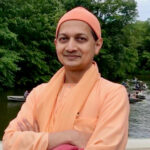
Evolution in Divine Love – Swami Padmanabha – Transcript
Summary:
- Guest Background: Swami Padmanabha, a Gaudiya Vaishnava monk for 26 years from Argentina, discusses his book “Evolution and Divine Love” and his journey through spiritual community life
- Core Philosophy: Emphasizes personal experience (pratyaksha) over blind belief, embracing paradox and uncertainty as essential to genuine faith rather than seeking absolute certainty
- God & Love: Presents the “sweet absolute”—God as both cosmic and intimate, with Radha representing the divine feminine. Defines love as intentional action without ulterior motives, aimed at the highest wellbeing of others
- Practical Challenges: Addresses spiritual teacher failures, religious trauma, and systemic issues in spiritual institutions while maintaining that individual failures don’t invalidate authentic traditions
- Evolution & Matter: Argues that revelation and scripture are ever-evolving, not static. Emphasizes the sacredness of matter and the ecological implications of seeing the material world as divine expression
- Key Practice: Cultivates humility and wonder over certainty, advocating for service-oriented spirituality rooted in feeling unconditionally loved by the divine
Key Takeaways:
- Faith Embraces Uncertainty, Not Certainty – Genuine spirituality requires patience with mystery and paradox rather than clinging to dogmatic beliefs for psychological security. The opposite of faith isn’t doubt—it’s certainty.
- Personal Experience Validates Spiritual Truth – Beliefs must be tested through direct experience (pratyaksha). Until validated personally, teachings remain in the realm of belief rather than faith, which is “undeniable trust from undeniable experience.”
- Love Is the Goal, Not God – Authentic love is intentional, devoid of selfish motives, and aims at the wellbeing of all. As Dorothy Day said: “I only love God as much as I love the person I love the least.” Loving God means loving everything in relationship with God—which is everything.
- Humility and Love Fuel Each Other – The more genuine love one experiences, the deeper humility grows, creating a reciprocal cycle. True humility is dignifying, not self-diminishing—like feeling small before the ocean yet expanded simultaneously.
- Matter Is Sacred, Not Profane – The ecological crisis stems from viewing matter as inert and separate from the divine. Every atom is “an embassy of the divine,” and authentic spirituality recognizes the sacredness of the material world as God’s living expression.
Sw. Padmanabha: Loving God entails loving everything that is in relationship with God, and everything for us happens to be in relationship with God. So loving God is no excuse to hate anyone, but on the contrary, it’s an invitation to love everyone. I always like to quote this line from Dorothy Day, Christian contemporary mystic, which is a strong one, but an interesting one. She will say, “I only love God as much as I love the person I love the least.”
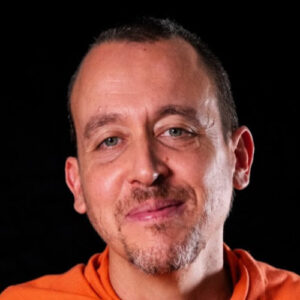
Rick: Welcome to Buddha at the Gas Pump. My name is Rick Archer. Buddha at the Gas Pump is an ongoing series of conversations with spiritually awakening people, 730-something of them now. And if this is new to you and you’d like to check out previous ones, please go to backgap.com. You’ll see the previous interviews organized in various ways. There’s some other interesting things there, such as an AI chatbot that is informed with hundreds of thousands of transcripts of spiritual talks and books, 1700 of the world’s sacred texts, things like that. All kinds of things. So visit the site if you like. easier to find things there than on the YouTube channel. But speaking of the YouTube channel, if you subscribe to the podcast and if you like it, it sort of alerts YouTube’s algorithm that, “Hey, this is a good thing. We should share it with more people.” So please do those things if you wish. This whole project is made possible through the support of appreciative listeners and viewers. So if you appreciate it and would like to support it, there are PayPal buttons on every page of the website and there’s a page that explains alternatives to PayPal. My guest today is Swami Padmanabha and we met a couple of months ago and have had some interesting conversations. He feels like a brother from another mother because even though we’ve had we followed very different spiritual paths, I feel that our thinking about many things is very much in synchrony. We just have come to very similar conclusions. And by conclusions, I don’t mean that we’ve arrived in any kind of final truth, which is one of the ways in which our thinking is similar. The evolution is ongoing for everything in the universe. But we’re on a kind of a similar trajectory or way of seeing things right now, as you’ll see as we get into this interview. So anyway, welcome Swamiji.
Sw. Padmanabha: Thanks so much Rick. Pleasure to be here and pleasure to be seen by you as a brother from another mother. Beautiful.
Rick: Your mother was in Argentina; that’s where you’re from. Did you grow up in a big city or a little small town out in the country someplace?
Sw. Padmanabha: Actually a very big city, which is Buenos Aires, capital city of Argentina. Well, half of the country lives there, like 20 million people or so. So I was pretty much a city boy.
Rick: Yeah.
Sw. Padmanabha: Till I joined the ashram basically.
Rick: Right. Your book is beautiful. I mean, I wanna read more of your books, but the one I just read, it was one of those books that makes me feel like I shouldn’t ever bother writing a book ’cause I can never write one as good as this. It was really good. So you seem to be very well educated. I mean, did you go to college? You have degrees?
From City Boy to Monk
Sw. Padmanabha: No college, no degrees. I joined the ashram when I was 19. So I just had finished my secondary school. I took one year off and then, yeah, I connected with my particular tradition, go to Vaishnavism and joined the ashram when I was 19, became a monk at that time, which is 26 years ago. So yeah, no official education, so to say, though I always was very much inclined toward studying, reading, writing, and have been always in touch with even academic people and papers and books, but yeah, nothing official, so to say.
Rick: Oh yeah, well, I listened to your interview with Swami Medananda, who I’ve also interviewed, and you really went toe-to-toe with him, you know? You kind of like, he’s a super sharp, very well-educated guy, and you held your own. What ashram was this that you joined?
Sw. Padmanabha: That was an ashram from my tradition, Gaudiya Vaishnavism in Buenos Aires, in Argentina. So yeah, that was in the city. So even for my first, I will say, 10 years in an ashram, still I remained pretty much a city boy till I moved to an ashram in the countryside.
Rick: Nice. So what is Gaudiya Vaishnavism?
Sw. Padmanabha: That’s a good question. Vaishnavism will be the monotheistic or personalist expression of the wider term Hinduism, which I generally try to quickly clarify for Western audiences when they say, “Oh, you belong to Hinduism.” But Hinduism is a very abstract term. This will be like calling Judaism, Christianity, and Islam as Abrahamism, right? So it’s not very specific at all. So Vaishnavism is the devotional, theistic, personalistic, if you will, branch of Hinduism, which basically has almost like 600 million followers worldwide. So Gaudiya Vaishnavism is one of the many branches inside the broader designation, denomination of Vaishnavism.
Rick: What does the word Gaudiya mean?
Sw. Padmanabha: Gaudiya is connected to one area of Bengal called Gaudadesh, related to the birthplace of Sri Chaitanya, who is the, so to say, the founder of this movement, who in our tradition is seen not only as a saint, but also as an avatar or a divine descendant expression of the divine.
Rick: Okay, and most people will be aware of this because of the Krishna movement, ISKCON, the Hare Krishnas, but that was not your group.
Sw. Padmanabha: Yeah, I mean, ISKCON, also sometimes known as the Hare Krishna movement, is one institution, so to say, representing this tradition, but there are many others and each one, each branch of the tree, so to say, has their own mood and flavor. So yeah, it doesn’t mean that all of them are exactly the same.
Rick: Okay. And you were a founder of something called the Tadatmya Alliance. What’s that?
Sw. Padmanabha: This is something that is relatively recent. It happened like two years ago after a long series of things that happened in my life in my last years in connection to some previous former teachers and so on we may be speaking about that later, but It was like a very organic gathering of like-minded souls, and we were sharing a particular way of practicing our tradition which felt relevant and relatable and healthy and human And honest enough so somehow we as they say birds from the same feathers flock together. So we ended up Getting together though. Many of them have different institutional affiliations or connection with different gurus But we became kind of one tribe and at one point it felt natural to to put to give a name to that particular type of group. Not not to to institutionalize it or anything. So we we brought the title tadatmya sangha tadatmya In Sanskrit means empathy or oneness of heart. so to say. And sangha means a kind of community.
Rick: Well, that’s a good word to use. You also have a podcast called the Free Radical Podcast.
Sw. Padmanabha: You have kindly accepted the invitation to be there, so we’ll be sharing our episode in a few months.
Rick: Good. And do you have a home base or do you just travel constantly, live out of a suitcase.
Sw. Padmanabha: Yeah, the latter option. Yeah, for the last six, seven years or so I’m just living with my suitcase and traveling almost all year. I stopped for a few moments now when we are doing this conversation. I’m in Switzerland on a solitary retreat for two weeks. In between I take some solitary retreats but yeah, mostly traveling all around the world for the whole, most of the the year.
Rick: Yeah, I did that for about 15 years when I was in the TM movement. Didn’t have an actual address of any kind.
Sw. Padmanabha: Yeah, and I must say that’s the question most people ask me the most. What’s your home base? And I like to say I live nowhere, but I prefer to say I live everywhere. My home is everywhere, right?
Rick: Your home is wherever you are.
Sw. Padmanabha: Yeah, basically.
Rick: Yeah, that’s true, you know. One of my former teachers often used to say that a certain state of consciousness development feels like mother is at home. You know, there’s this kind of security that a child feels when his mother is at home. And he said, you know, you can feel that way all the time wherever you are once you’re established in the Self.
Home Is a State of Consciousness
Sw. Padmanabha: Yeah, that’s how I see this, the challenge of my traveling all year in the good sense of the term is that it forces me to to find home everywhere basically because if not I feel kind of exiled of reality so it has been a very beautiful experience to realize that home is a state of consciousness ultimately.
Rick: And also since you’re a Swami it helps to prevent the buildup of attachments in some cases although you can get attached to traveling but you know you don’t kind of get into a habitual groove so easily when you’re constantly moving?
Sw. Padmanabha: Yeah, we could make that case as you say, but everything has its two sides, so to say, right? So, whether traveling, traveling can also become some escapism and spiritual bypassing of not confronting the daily dynamics of relationship with people that you live in community with, because I lived in community in the same place for 20 years, and I can tell you there were beautiful challenges that, in one sense, I do not find while traveling. I I find a different set of challenges and in both cases I need to cultivate some form of detachment for sure. Yeah.
Rick: Yeah, sometimes spiritual communities are compared to a tumbler where you put a bunch of rough rocks into the tumbler and then turn the handle and they tumble around and rub against each other and eventually they all become smooth but the process can be a little bit traumatic
Sw. Padmanabha: I agree
Rick: Yeah And marriage can be like that too and many other relationships.
Sw. Padmanabha: Yeah. Yeah. Yeah, I’m totally in favor of the challenges that any relationship brings for and they’ve got the mirroring that that creates and how we need to be seen through others eyes and and discover ourself through through the eyes of other people as well. Even while traveling I try to keep connection with people who are close to me and know me a lot so I’m grounded to to a realistic view myself, and I’m not just traveling around the world like a rock star with people that just know you for five minutes and they project and over-idealize who you are that can be pretty dangerous
Rick: Yeah, that’s one thing I like about you is you’re you’re kind of, I could say self-effacing, but you’re not putting yourself down, but you are open to critical feedback. You don’t put on airs, you haven’t, it hasn’t gone to your head, and unfortunately, that’s a pretty common syndrome among spiritual teachers, which I think we’ll talk about more as it is with rock stars, speaking of rock stars, but it has led to a lot of problems. Anyway, we’ll get into that more as we go along but I want to ask you some general questions now that I ask myself. One is how is it that we really know what we claim to know? Is it because– Like you and I have certain things that we believe in like maybe reincarnation or certain ideas of God and various other spiritual ideas. How do we really know those things? Is it because the scriptures have said it or because teachers have said it and how do those teachers know if they said it, or how the guys who wrote the scriptures really know? How much of it are things that we believe but can’t verify experientially? Just before you answer that question, near the very end of the Rig Veda, there’s a verse which says something like, “From whence did this creation come? Did the gods create it? And who created them?” And you know, maybe he who created them knows from where it came. Or maybe even he doesn’t know. Maybe nobody knows. So anyway, what do you think?
Sw. Padmanabha: Thank you for kick-starting with such an opening yeah beautiful First of all, I’m I’m in a stage of my journey where I feel more and more comfortable with uncertainty And I don’t feel like this urgency of having The ultimate answers for everything to the to every single level I really like like one of my friends and mentors Father Richard Rohr that came to your podcast. He will say Like the opposite of faith is certainty so faith is more like being patient with mystery and with things that are beyond our grasp, but I really insist and a few hours ago I had a lecture on this topic. We were talking about pratyaksha You may know this term, which is basically personal experience. I tend to gravitate towards that as the ultimate pramana or evidence epistemologically speaking and the Bhagavad-Gita says that in the ninth chapter verse two Krishna says pratyakṣāvagamaṁ dharmyaṁ Like this dharma this bhakti can only be understood by personal experience. So of course in our tradition, we have, and in many traditions guru, shastra, scripture, teachers, sadhus, and we are open to have an experience of them but until and unless is validated by our own personal experience that still remains in the realm of belief. So I try, I tend to make a difference between belief and faith, because for me faith is the undeniable trust that comes from an undeniable experience. And belief can be more like a mental conviction, a social convention, something that everyone says, and I go along with the flock to fit in, but for me, I’m after undeniable experiences which are so deep and profound that I cannot deny them. But also they are so unfathomable that I cannot control them and colonize them, but but there are real enough for me to say this is undeniable. There is something real. I cannot deny that even against, even if I try to use all my faculties in that direction, this is so concrete and undeniable that I give myself in this direction. So, and of course I’ve had those experiences on a personal level in connection to other people and to teachers, especially with other people with the scriptures that gave me those experiences. Of course after that experience I tend to open my heart to trust more in those directions because they gave me that experience, but at the same time I have my critical faculties with me to discern between absolute content and sometimes I don’t know, cultural, relative elements that may be there in the life of a saint, in certain sections of scripture. So these will be some of my initial thoughts.
I try, I tend to make a difference between belief and faith, because for me faith is the undeniable trust that comes from an undeniable experience.
Rick: Good.
Sw. Padmanabha: What do you say, Rick, when someone ask you that question?
Rick: The question I just asked you?
Sw. Padmanabha: Yeah.
Rick: Well, these days I tend to quote Aldous Huxley. I heard this great quote from him a while back, which was that he felt that the greatest innovation of the scientific revolution was the development of the working hypothesis. Because the scientific revolution was kind of a corrective to the Middle Ages where people believed all kinds of weird things and could be burned at the stake if they didn’t agree with what the church said you should believe. And the scientific revolution was like, “Okay, let’s see what’s what on the basis of actual empirical evidence.” And so I think that everything can be taken as a working hypothesis, including all the spiritual and religious beliefs. And scientists are not scientists if they say, well, those things are outside the realm of science, therefore they couldn’t be real. It just means that science is limited. It doesn’t mean that those things aren’t real. It means that science needs to expand its methodologies and technologies to be able to investigate those things.
Sw. Padmanabha: Yeah, and very much when I say Pratyaksha, I kind of refer to that, to a personal experience that need to be gone through and put to test. And of course, so many biases and assumptions may need to be dethroned, so to say, in the context of that. And an ideal scientific spirit has to remain in terms of openness to further disclosure and never settling for a final resolution and conclusion. Because again, we are dealing with ever-evolving reality, right?
Rick: Yeah. So to use the example I brought up earlier, It’s like I really think reincarnation makes a lot of sense. There’s evidence for it. Guys like Ian Stevenson and I forget the guy I interviewed who was his student and then but I can we be absolutely sure of it, you know Well, I don’t I have had I’ve had a couple of experiences that might have had something to do with past lives, but I don’t remember them. Clearly, so who knows maybe it’s wrong. It won’t be the end of the world if it’s wrong but it just makes a lot of sense. It’s one of those working hypotheses for which there’s some interesting evidence. And of course, there might be many things which will never have evidence for, but that doesn’t mean they’re not true. Like, for instance, are there parallel universes? Well, you know those universes would be outside the so-called light cone that we can actually perceive and so we’ll probably never have a way of verifying them unless and this is an important point unless there could be be spiritual or yogic techniques which could enable you to exceed the speed of light through something akin to what is that word, quantum entanglement, where you you’re not limited by that and and you could actually experientially explore those things. But then if it’s just some rare individual who experiences them how do you know if he’s telling the truth. Maybe he’s hallucinating so any such thing, and this is in keeping with science, would have to be corroborated,
Sw. Padmanabha: Replicated
Rick: Yeah, replicated by numerous people before it gains adequate credibility.
Sw. Padmanabha: Yeah, that’s what at the end of the day, even if some of those hypotheses are actually true, but they cannot be still replicated on a massive scale, we have our own personal experience and our own patience with mystery, with things that fly beyond our grasp at present also, which I think is a humbling and sobering stance for religious people, spiritual people in general, which sometimes we have so many concepts and absolute ideas that we can become quite addicted to them as givers of certainty, and we lose this openness to co-exist with mystery, basically, right.
Rick: Yeah, and think how many people, millions of people have been killed because of religious certainty. “Accept my God or I’ll send you to him,” kind of an attitude. And so I think that it’s really, it behooves a spiritual aspirant to have a more scientific, open-minded attitude and not to grasp at beliefs in order to attain some kind of security, which certainty is in some people’s opinion, but to rest in uncertainty. What was that quote from Richard Rohr about uncertainty?
Sw. Padmanabha: He will say that the opposite of faith, and of course most people say it’s doubt, and he’ll say the opposite of faith is certainty.
Rick: There you go.
Faith Embraces the Unknown
Sw. Padmanabha: Like, in playing faith is a journey into uncertainty, into the unknown, into the infinite, into mystery. So we are not here to just get the right beliefs so we are certain about everything and who is right who is wrong and all that you are explaining now, Rick, right like like security Insurance or something right, but it’s a risky quantum leap, An adventure basically, right?
Rick: I forget who it was, but somebody some British guy said consistency is the hobgoblin of little minds Yeah, I think there is kind of at the core of this desperate need for certainty is an insecurity. If somebody is hammering you with his beliefs and this is the only way and this is the truth and accept this or you’re going to go to hell, they are defending themselves against a deep doubt that plagues them.
Sw. Padmanabha: Oh yeah, yeah. I always like to say if we want to, sometimes some members of my tradition, not all, but some of them are very much about outreach and sharing the message and converting basically in some cases even envisioning the whole world converted to their own creed. So it may outside look like universal compassion, but many times it’s just your own weak faith That you need everyone else doing what you are doing So you feel safe enough and secure enough i’m doing the right thing because everyone else is doing it Right.
Rick: Yeah
Sw. Padmanabha: It seems universal compassion, but you’re trying to To how to say to convert everyone because of your weak faith because you are not still sure enough about what you are doing so
Rick: Yeah, I think a related point to that is that the the feeling of my thing is the best thing because if it weren’t the best thing I wouldn’t be doing it i’d be doing that some other thing that was the best So it’s the best, and I have my whole logic for why it’s the best. And, therefore, anybody who’s not doing it is kind of a lost soul. They’re doing some… they’re somewhere else down the mountain, and they need to get up to the top of the mountain with me, and then they’ll see things the way I see it. And the whole thing is just like this desperate quest for self-affirmation or something.
Sw. Padmanabha: YeahAnd of course, in our tradition, we’ll say, if you feel that this is the best, it’s fine, but you add to that sentence, “It is the best for me.”
Rick: Yeah.
Sw. Padmanabha: Right? Because, of course, you, me, and so many practice our spirituality in a certain way, so that’s the best for us. That’s why we are doing that, but that doesn’t mean it’s the best for everyone else, right? So one verse in our tradition says, “Every practitioner feels that their connection with the Absolute is the best, and everyone is correct.”
Every practitioner feels that their connection with the Absolute is the best, and everyone is correct.
Rick: Right, yeah. Different strokes for different folks, as Sly and the Family Stone sang years ago before you were born.
Sw. Padmanabha: I learned that one recently and I’m using that quite often.
Rick: And what’s the best thing for you now or for me now may not be the best thing for me 10 years from now. Who knows? I’ve gone through various phases as I think you have and there were things that I was damn sure of a couple of few decades ago that now, not so much.
Sw. Padmanabha: Yeah, totally agree. I like to take generally that conversation in connection to things like vows, that I’m a Swami, I’m a sannyasi, I took lifelong celibate vows and other vows. So it’s delicate because you take a vow at certain point of your journey, and after some years you are in a very different place. So what to do with those vows? and I personally feel myself basically renewing my vows on a yearly basis, or even I may say on a daily basis. But renewing my vows in terms of rediscovering the motivation why I’m choosing this lifestyle. It’s not that I’m rejecting it, it fits my nature. But from which place I’m now being a Swami, it’s very different from the place I had been that to keep that ongoing thing. So vows or something do not become also like suffocating, but dynamic and facilitators basically, right?
Rick: Do you think there could ever come a time at which you feel like, hey, you know, this lifestyle is no longer appropriate for me I feel like I need to do something else and maybe I meet somebody I want to get married or something. And would that be out of the question or if you confronted that, would it be a huge issue that would feel like you’re a fallen soul if you moved in that direction or what?
Sw. Padmanabha: I’m sure most people in my community may see it that way as you depicted the last, not in my community, but in general overall, unfortunately, it’s seen that way. If you were a monk or you were celibate and for some reason you left that ashram, that order, you broke your vows. But for me, the real vow, we have a beautiful verse in our tradition which says, “Always think of God, never forget Him.” And all the other rules and regulations are servants of these principles. So whatever helps you at any given stage of your journey to keep the first vow in place, which is fall in love with the divine, that’s important consideration. So in that sense, I will be flexible, open to do so. But also to be honest, Rick, in my personal case, I don’t feel that will be the case. Again, I don’t want to speak too loudly. I don’t have any absolute conviction, but it’s very natural in my nature to be like a monk. I never had any girlfriend or boyfriend even when I was a teenager, which was very strange because I was a musician. We had bands, we will play, and I would never hang out with anyone. Then I had a chart done for some health issues and it came there like I had the perfect chart for a Swami actually. So it’s very much ingrained in my DNA. I’m not saying with this I’m better than anyone. I’m not the one who thinks–
Rick: No, no, no, it’s just a matter of–
Sw. Padmanabha: A Swami is higher than a non-Swami. I’m not that type of person, but it’s just very much present in my nature in this lifetime. But of course, again, as I told you, I’m trying to, even if I continue as a monk and as a Swami, as I’ve done for the last 25 years, I’m recreating myself in so many ways through so many times. So even if I continue with the saffron cloth, So to say so many things are changing about me. So, yeah, transformation is ongoing.
Rick: Okay, good. Here’s another question similar to the one I asked you earlier, but maybe an extension of it. To what extent do you think our beliefs shape our experience? For example, the primary focus in Buddhism is on personal enlightenment and the alleviation of suffering through practices like meditation and ethical living, rather than devotion or a belief in God. Do you think that if that’s one’s training and upbringing, then one is less likely to arrive at some kind of experience of God or devotion to God or something than if one grows up in a tradition where that kind of thing is emphasized? And the flip side to this question, well, maybe answer the first part first, so I don’t ask you too many things.
Sw. Padmanabha: No, no, it’s fine. So I will agree, we have this word in Sanskrit, you may know it, samskaras, which means like impressions. So we can receive whether material samskaras or spiritual samskaras as well. So different mystical traditions will have their own imaginarium, so to say, their own way of conceiving the divine, conceiving reality. I’m not saying one is wrong, the other is right because we are dealing with the infinite here. So there are so many ways to approach infinite reality. But I will say that in general what we see is that if you are brought up in a certain tradition with a certain conception of the divine and certain, I wouldn’t say even beliefs though we can call them such until they become experiences, hopefully, so probably your experience eventually will match, I will call the conceptual orientation you receive in that particular tradition or the certain emphasis that is done like we may have traditions who emphasize more monistic focus like in my conversation with Swami Medhananda. We’re talking about Brahman and Bhagavan— So if your tradition the main emphasis is like non-differentiated fusion in Brahman, so to say probably if you have been receiving those samskaras and that education your experience will tend in that direction and if you receive a more devotional personalistic formation you may tend to conceive unexperienced reality in that way. I wouldn’t say that that’s a limiting thing. It’s just a matter of samskaras and choice because again in eternity I will say we we may be experiencing our chosen relationship with the divine we will say and in one sense we will be absorbed in one direction and we may not be so much absorbed in another direction of another expression of the divine. I wouldn’t call that a limitation. I will call that just the natural outcome of choosing to approach the infinite in a certain way. Right, so I don’t see that as a problem if that makes sense.
Rick: Well, that makes sense and I suppose in terms of samskaras we might surmise that people are born into the circumstances that align with their samskaras, so that they have the kinds of experiences that they are destined to have by inclination, by the quality of their soul and what they need to learn in this lifetime and so on.
Sw. Padmanabha: Yeah, and I will add to that that still there is some measure of free will, let’s say, because it’s not just that, okay, we are born in a certain family, a certain country, a certain and culture, which tells them samskaras, you have no choice in the matter whatsoever. You’re, everything is absolutely predestined. So maybe that’s another conversation free will here, but we do believe in that. So still, even if I have some samskaras, some acquired nature, some tendencies surrounded by some environment, I still have some, I think, real free choice and opening myself to other samskaras to enter into the picture and to affect my trajectory in different ways.
Rick: Yeah, I’m thinking of the story of Prahlada, who was born in a family of demons. (laughs) And ended up becoming this great devotee of the Lord. Okay, so we’ve been throwing around the word God a little bit. And sometimes I listen to atheists or even have conversations with them. I listen to Sam Harris, for instance, or have conversations with a friend who’s an atheist, and I end up concluding like, “Okay, well, I don’t believe in the same God you don’t believe in, but that doesn’t mean I don’t believe in God,” because they end up with a certain conception of God that to me seems ridiculous anyway, so I don’t believe in that. But what is your sense of what God is? Although, obviously, it’s really hard to do justice to it in words. Impossible.
Sw. Padmanabha: Well, first of all, I totally agree with what you just said, Rick. I tend to say the same thing when I’m sharing with atheistic people and I ask them, “So what’s… you said God does not exist, so you don’t believe in God. What do you mean by God?” And they gave the whole list of probably many times religious PTSD that they’ve gone through, and I’m like, “I don’t believe in that God either.” So we are on the same page basically, right? And in many ways, I feel that many times, atheism or agnosticism is like a necessary healing chapter for those who have been oppressed or traumatized by toxic notions of the divine. So I’m not entirely against that. I can really understand the necessity of that, especially if you come from a very oppressive, traumatizing religious background. But for me that doesn’t that that doesn’t mean throwing out the baby with the bath water, but God can be.. Again, the word god is tricking itself, right? Just it’s one word, but It has so much historical generational baggage And weight. I remember one of my mentors once proposed let’s stop using the word God for 50 years because there’s so many biases and assumptions attached to those three letters that.. But every time we say God so many things get triggered. So maybe we need to stop using it for it for some time so we can rediscover it for it what it actually meant ,so I personally like to, I love etymology and meaning of words So in connection to one word of God that sometimes is the divine or divinity it comes from the Sanskrit deva and deva Come from datu the verbal root div Which actually one of the meanings is to play. So interestingly the idea in this case then for God will be a playful God Not a wrathful, narcissistic, angry old Daddy above the clouds or whatever idea we may have but a playful charming divine. We in our tradition will say by a Bajaniya Guna Vasishta. God is Ideally the only reason, for me, the only reasonable coherent divine will be someone who is so charming, so sweet, so attractive, so compassionate that when you contact such qualities you feel irresistibly drawn to dedicate your life in that direction. That’s why one of the names we give to the Divine is Krishna, which means “the all-attractive”. That reality that embodies all that is attractive to us in its highest possible degree and even beyond our wildest imagination. That for me will be the only possible divinity that makes sense, basically.
Rick: Okay, so, playing Mr. Atheist here, what’s so playful about the Holocaust, or about Gaza, or about starvation in Sudan? God is a rather sadistic player, it seems.
Sw. Padmanabha: It seems, dear Mr. Atheist, that your question has an assumption, which is God’s hyperbolic omnipotence, that God could control and stop everything and anything. So that’s an assumption in your question to begin with, because at least from our tradition we wouldn’t dare to say so. God is loving, is merciful, is compassionate, and because He’s loving, He invites us to a loving relationship, but love is voluntary by nature. So for love to remain what it is, it has to be voluntary. And for it to be voluntary, we have to have free will and choose. And choosing love entails the necessity of having the possibility of choosing something else. Which has to be differently enough from love for it to be a meaningful, different choice. And when we dare to choose that, we have gas and holocaust and all this stuff. stuff. So God, in our tradition, in my understanding, cannot stop that because cancelling that will be to cancel the consequences of our free will and cancelling that will be to cancel our free will. And in our tradition, free will is an intrinsic inherent quality of the Atma. That will be my answer.
God is loving, is merciful, is compassionate, and because He’s loving, He invites us to a loving relationship, but love is voluntary by nature.
Rick: I can answer these myself in my own way, but I’m asking you. So did the Jews choose the holocaust?
Sw. Padmanabha: No. But you just said it’s like in reference to the holocaust and Gaza and Sudan, you said, well we have free will, we get to choose, you know, seems like the poor, the people who suffer those things had no choice. But, going for a minute outside of the holocaust, did you choose that today is rainy or sunny? No, you didn’t choose tha,t but it’s happening but you you have a set of choices in how to respond to that, because having free will also entails coexisting with other people who have free will. So sometimes other people’s free will choose to be expressed in certain ways that of course create horrific situations and tragedies. I’m not trying to downplay that at all, but still in that moment, a horrible tragic moment, we still have a choice to make. And I cannot avoid thinking of someone like Viktor Frankl, who was, you know, he went through that, specifically through that, and he found meaning and purpose in the meaningless and purposeless greatest place in history. He discovered some meaning and purpose for himself in the midst of all that to continue thriving, so to say. So I’m not, I know he may sound more like an exception to the rule, but those exceptions also show us our potential and our possibility of thriving even in the midst of the worst of the worst, which for me is kind of very similar to the scenario in which Arjuna finds himself in the Bhagavad Gita in some way or another, very catastrophic, tragic, uncomfortable situation, but still you have a choice there.
Rick: Yeah, here’s how I would answer that question, is that if you’re gonna have a universe, you have to have relativity, have to have pairs of opposites, you have to have duality, and it can’t all just be heavenly. There’s got to be, you have hot, you have cold, you have fast, you have slow, you have pain, you have pleasure, and so on. And so there has to be all these pairs of opposites. And yet, in the big picture, the whole universe is a giant evolution machine. a giant learning school and all souls, everything in the universe is evolving and it might seem heartless but there’s evolution, like you just said for Viktor Frankl, but I think it was probably true for everyone there, there was an evolutionary value to that. It’s a delicate thing to say because it was so horrible, but in the big picture and perhaps after people passed from this life, they realized, oh, there was some evolutionary influence or value in my having gone through that.
Love Enters the Darkest Places
Sw. Padmanabha: Yeah, and I will say that, argue that love is always entering even into the most broken and darkest places. And again, nothing of this to downplay the horror of the Holocaust or any suffering that each of us may go through. And I’m totally for being with people and being empathic and accompanying them in the pain and grieving. But as you say, Rick, also holding the bigger picture in mind, even if we may not be able to bring the bigger picture, if you just come and tell, I don’t know, my my my brother died, I won’t just tell you. Just hold a bigger picture. I may need to give you my shoulder and cry together. But but eventually we need to to see the bigger picture. Yeah, for me the bigger picture is that love triumphs over suffering always and there’s always a lesson to be learned and I’m just talking about by the my personal, I wouldn’t dare to call them holocaust, but situations of extreme confusion and pain and loss and betrayal and I look back at them and they were the most painful chapters of my life and they were the most enlightening chapters of my life simultaneously and many times I was able to witness those two things happen simultaneously. It was so paradoxical, but here my heart is breaking so much. But in that heartbroken, I’m tore open and in that openness so much grace and love is coming. And looking back now I’m so grateful for that. Not that I’m in masochist and that I want suffering, but whenever..you don’t need to want suffering. It would come nonetheless. So we need to just open the door and stay with it enough so we can learn the lessons we need to learn from it, yeah.
Rick: Yeah, Nisargadatta Maharaj said, “The ability to appreciate paradox and ambiguity is a sign of spiritual maturity.”
Sw. Padmanabha: Totally, I’m totally for paradox. Our philosophical system begins with the word achintya Sanskrit, which basically means paradoxical. So for me, paradox holds the most truth. If not, we are just half the equation. We are getting just half of reality. The black, the white, the good, the bad, but paradox entails a very beautiful invitation for harmony and for allowing things to coexist and developing a more accommodating capacity in life, right? To grow to accommodate those things that we could have never thought were possible to coexist together. And there’s paradox everywhere, basically, if we pay close attention.
For me, paradox holds the most truth. If not, we are just half the equation.
Rick: There is, the universe is structured in paradox. A photon is a particle, a photon is a wave. This solid matter is actually almost entirely empty space, and there’s nothing material to be found if you look deeply enough. All kinds of paradoxes.
Sw. Padmanabha: And what to speak, as I wrote in my recent book, God is described in scripture as changeless and ever evolving at the same time. These type of things, right? So impersonal and personal. And so, yeah, to move from the either or to the both and is a challenge.
Rick: I like that phrase, both and. And you know, people do have a tendency to want to land in one or the other.
Sw. Padmanabha: Yeah.
Rick: And to, it’s kind of like what you were saying earlier about insisting that you know the truth or that you’re aware–
Sw. Padmanabha: Security.
Rick: Yeah, security and it’s got to be this. And it’s just the way you.
Sw. Padmanabha: Yeah. There’s a place for that in the beginning of the journey, I will say. I mean, I’m not totally against that. We need some certainty, some security. We may, we may even need to be a little bit fanatical in the beginning. Fundamentalist, like, like a baby will say, my father is the best father in the universe, and he really believes that. But at some point he needs to add that, to add to that for me and understand there are other fathers and so on. So there’s a place for that in the beginning. The problem is when we are ready for a new stage and we insist on those kindergarten notions, yeah.
Rick: Yeah. You use the term sweet absolute a lot. What do you mean by that term? Why do you use that term?
Sw. Padmanabha: Well, that’s a term that originally was invoked by one of my teachers, Srila Bhakti Raksak Sridhar Dev-Goswami Maharaj. And he will refer to God or Krishna or however you may like to call him in this case, as the sweet absolute, which is kind of balancing two classical aspects of God that in Sanskrit are called Aishwarya and Madhurya. So Aishwarya means like the magnificence of God, God as the cosmic personality, the biggest of the big, something that invokes this awe and reverence. And Madhurya means sweetness. So it has to do more with intimacy, with sweetness, with love. So both exist simultaneously, at least for us in our tradition. And for us, we are especially interested in a relationship with God in intimacy and love. And to such degree of intimacy, we will say that we lose sight that God is God. That’s kind of our theology. Now, we start not to love God because he or she or they, God again words do not suffice but we love that person for who that person actually is. Now god is more like a term of the person in the office like if you will say you are the president of the states in the office You are certain, you have, there’s formality and bureaucracy And everything happens in certain parameters. When you reach home maybe your grandchild is waiting for you and he jumps on your back and tells you become a snake grandpa and the president of the states is like rolling on the ground He forgot he’s the president. He still is the president, but he’s forgotten. He’s in another reality, but he’s himself way more there than in the white house so to say. So for us we have those two ideas of god. Aishwarya, god in the presidential house cosmic administrator and god at home in the intimacy forgetting his own godhood by the power of love But both of them are coexisting again, paradoxically. So sweet absolute indicates proper integration of these two.
Rick: So forgetting his own godhood. Some people say, and you might say, that actually it’s all God. There’s nothing but God. If there’s anything other than God, then God can’t be omnipresent. And so we are God forgetting our own godhood. Right? Is it fair to say?
When Teachers Fall
Sw. Padmanabha: That wouldn’t be our philosophy in in absolute terms. Of course, we can say we it’s everything is god Sarvam Kalvidam Brahman. Of course, that’s in our tradition But we will qualify that statement because personally i’m not a follower of shankaracharya or advaita vedanta, although I We agree that there is the reality of impersonal experience But for us there are many other forms of the vedanta just to clarify advaita vedanta is just one of them and there is Vishistha, Dvaita, Dvaita, Dvaita, Sudha, Dvaita, Cinta, Vidavida and so on. So we will say, yeah, everything is God in the sense that everything is connected to God. But I wouldn’t say that I’m God in every single sense of the term, because again, that will come, if I’m God, but I forgot that I’m God, what is causing that forgiveness, this forgetfulness, sorry. That’s not the same example as I gave you before, because I’m giving the example of God forgetting he’s God or losing sight of his Godhood because of the impact of love. But if we are here on this world, many times not very much surrounded by divine love and I’m God forgetting that I’m God, that kind for me of compromises the reality of a divine who is beyond the goodness, beyond illusion, so to say. So we will say that everything is God in the sense that The only thing that exists is God and His Shaktis, His energies. That’s said also in the scriptures. “Parāshakti bibhidaiva shruyate.” So there is God, this world is one energy, the Atma is another energy, love is another energy. So in that sense, everything is God. It is and it is not. Again, for me, that comes the paradox. Like now I’m in this room. I could say the Sun is entering the room, but in another sense, I could say the Sun is not entering the room. because if it will enter, literally, the room is over and we have no more podcast here. So it’s entering and it’s not entering. So in that sense, we will say we are God and we are not God. We are an energy of God. That’s what at least, how we read verses from the Bhagavad Gita, like 2.12, where Krishna says, “na tvevāhaṃ jātu nāsaṃ,” there has never been a time that I did not exist, nor that you did not exist, nor that these other people exist. So it’s a clear establishing of the eternal individuality of the different beings. So that’s our, again, that’s our particular worldview, so to say. And that’s what for us allows a loving interaction, a loving relation between God and the soul. If I will become God in every sense of the term, if I am God in every sense of the term, there wouldn’t be a dynamic loving interaction in my opinion. So some thoughts.
Rick: Shankara said the intellect imagines duality for the sake of devotion. Sri Ramakrishna had his thing about you want to be sugar or you want to taste sugar? All right you have a choice. I think it’s the old paradox thing again. Both can be true. Everything can be God and if everything is not God if I mean.. I feel a little ridiculous here because I’m making such a broad statement, but I’d say this. If you boil it right down to its essence and you take anything, you know, this microphone or whatever, and you boil it down, down, down, down, down, down, you get to a point where it’s just sort of pure being, you know, Sat Chit Ananda, whatever, God appearing as a microphone. that doesn’t mean there isn’t a microphone, but if you get… it’s like, you know, all the different forms of milk, yogurt, and cheese, and…
Sw. Padmanabha: Ghee.
Rick: Ghee, and all the different things, they’re kind of all the same thing, essentially, having taken different forms. That’s just an analogy. And, you know, if there is something that is definitely not God, even in some kind of ultimate, absolute sense, then there’s a kind of a hole in God where it’s all God everywhere except this thing which isn’t God.
Sw. Padmanabha: That’s what I say, there are no things that are not God in an absolute sense,
Rick: Right
Sw. Padmanabha: But also I don’t go to the other extreme of saying everything is God in every single sense of the term with no ultimate individual entities like us or other realities.
Rick: Oh no, I’m not saying that.
Sw. Padmanabha: So we will try to make this middle point, that’s why our philosophy is called “Achintya Bheda Abheda” or paradoxical difference and unity, oneness and difference. So everything is one, everything is God, in the sense that everything is interconnected to God. Reality is non-dual. There are not two realities. But at the same time, there is Shaktis, there are potencies, there are individual beings, but they do not exist in isolation. They are not their own source. So in that sense, nothing exists outside of that center. But we will, and based on, of course, of what Bhagavad Gita and Upanishads and other texts mention we will insist that as much as you can have an impersonal non-differentiated experience of ultimate reality As you quote the Ramakrishna, there is the option of tasting sugar and eternally engaging in a loving interaction with the divine and with other beings so in that sense personality and individuality doesn’t need to be a problem Of course, if we are..very much many times we are very troubled by our own Sense of self and how we interact with others that we kind of wish Let this all go to hell and become just no personality. No interaction. I’m frustrated and many times I’ve seen that’s the impetus for many people who see reality as without form without variety without individuality more out of frustration Of their earthly interactions that out of the actual realization. Some cases–I’m not saying all of them, of course. But I will insist that there is a place for keeping individuality and relationship and love not as a problem, but as actually something that allows for a beautiful dynamic of back and forth in eternal love.
Rick: Yep, brother from another mother. I’m totally on board with that and I used to be more in the other thing, you know the sort of world negating perspective but kind of grew out of that I think. And it’s sort of a world negating perspective to me is rather an insult to God. It’s like the whole attitude of all the universe is sort of a mistake and I just want to get out of it as quickly as possible. and it’s total illusion. I mean, to me it’s just divinity in every molecule, in every iota. The whole thing is just… I can’t walk down the street without looking at a worm or a blade of grass or something and just contemplating the pure intelligence that pervades and orchestrates that life form.
Sw. Padmanabha: Yeah, one of the main teachings in our tradition given by Sri Chaitanya is one verse that begins with this line related to what you say, Rick. “Trinad api sunicena.” Try to learn humility from a grass Because the grass is bending without breaking. So bend like the grass without breaking may your humility be dignified may a blade of grass. And one of our teachers actually literally set up and goes Swami, he said, If you relate to a blade of grass for what it is for what it actually is you can attain all perfection. So all perfection is waiting for you in every single blade of grass. It’s just that we happen not to be there yet present fully attentive, but I agree that for me spirituality is not about leaving this world as soon as possible. It’s not an evacuation plan into the afterlife that for.. For us the goal is not mukti or moksha like just emancipation from earthly creation, but prem or divine love and and that can be experienced internally anywhere and everywhere And for me, that’s the actual challenge. No, it’s not so much. Okay, I will practice and somehow will be taken out of here and somewhere else. But whatever you want to go it begins here and now or nowhere at all. So and if you are properly situated Perfection is everywhere so you can really contact that Wherever you are. You don’t need to wait to leave this body be transferred in some mothership into some other galaxy or whatever It’s a movement in consciousness, not so much a geographical moving but where you are internally so yeah for us in our tradition we’ll say even we don’t care for samsara. Actually if I have the chance Sri Chaitanya will say in the next verse to the one I quoted, “mama janmani janmanīśvare bhavatād bhaktir ahaitukī tvayi” If I can offer to you self and loving service. I don’t care being born over and over again in samsara That’s no longer a consideration for me. If I have the chance of contacting everything from a place of love I’m already in heaven so to say
Rick: Yeah, I have a feeling that some of the guys who thought my goal in life is to get out of here once and for all When they finally got out of here, they realized ooh, it’s not once and for all I’m still existing and I may or maybe I’m gonna take another life or I have some function to perform where from where I am now, that kind of thing.
Sw. Padmanabha: Yeah, and it still is negatively motivated right? It’s more like I want to get out of here. So there’s not like a positive reason for what you are doing and I will argue it’s still on some level selfishly motivated because it’s about what I want.
Rick: Yeah
Sw. Padmanabha: So for me the higher reason is dedicating myself in love to others and I choose to do that but it’s not something that is about what I want and it’s about me, but it’s related to me. It’s including me, but it’s including everyone else as well. So I personally feel more inclined to that broader perspective so to say.
Rick: Yeah me too actually, and I used to have that I want to get out of here attitude very strongly but these days it’s like hey, it’s not my choice. It’s in God’s hands and however I can be of service, that’s what I’ll be happy to do. Many more lifetimes, no more lifetimes, whatever. It’s just I’m at your service.
Sw. Padmanabha: Brother of a different mother.
Rick: Too bad our mothers couldn’t have met. So, okay, here’s another thought. So you speak of Krishna and Radha and your tradition does a lot and which is ultimately my tradition too because I was kind of raised in something related, but I think of, I often just, I can’t help but zoom it out to the to the whole universe and think about what a tiny little speck of dust we happen to live on and how we might be kind of narrow in our thinking, I mean, They’re estimated anywhere between two and twenty trillion galaxies in the universe and each galaxy has perhaps a hundred billion stars and we now know that almost all stars have planets orbiting them and so my assumption is that there are trillions of intelligent civilizations throughout the universe.
Sw. Padmanabha: And that if you don’t accept the theory of a multiverse, right?
Rick: Right, so there could be trillions of universes and so on. And so somebody says Jesus is the only way, I I say, “Oh, okay, is he on tour? Because he’s gotta be a busy guy. There’s trillions of intelligent civilizations. And I would say the same thing about Krishna and Radha. I wonder if ours is the only planet where those words are used, or if on some other planet, there was some being that looked like an octopus and was a great spiritual leader, and that people think of that as the avatar of God.
Sw. Padmanabha: Well, in our tradition, We may, I’ve never heard of an octopus avatar, but if you may have heard about this dashavatar. God appears as a fish
Rick: as a As a turtle
Sw. Padmanabha: as a turtle. So, in one sense also it gives, there are only 10 there, but it gives the idea of I mean like there’s no limits
Rick: Could be all kinds of forms.
Sw. Padmanabha: We can put so many limits and again each form we will argue that each form of the divine also is How to say, it’s facilitating a certain type of interaction and relationship. So according, our philosophy will be according to the type of love God will take a particular shape. I speak about that in my book as well that, I like to put it like god is a byproduct of love So according to the love we have, As Krishna says in the Gita 4 11, “ye yathā māṁ prapadyante” “As you approach me, I reciprocate accordingly.” So the infinite is infinite again how much we can put the infinite in a box And we will approach the infinite in one way or another and there will be a particular reciprocation, but that doesn’t mean that that’s the only possibility, the only version. And even when we speak about Radha and Krishna What’s Radha and Krishna? Again, we can have an idea about that but God is not our ideas about god as I like to say, right? And sometimes we don’t draw that line very easily. So that’s why we I insist personally again in personal experience. So, we can have a concept—a name a form details, information, but that has to take us to transformation to put them into a laboratory and experiment and get an undeniable realization of them. But yes, in our tradition we’ll say the forms and the avatars of god are asankya, which means uncountable. So we don’t have a problem acknowledging the Infinite appearing in any way the Infinite desires to the soul.
Rick: And when Krishna said that, there could be some civilization in New Guinea or something that never heard of Krishna, is never going to hear of Krishna, but what he was saying is, I’m this universal intelligence, and if some guy in New Guinea or on Alpha Centauri or in the Pleiades or something, you know, expresses devotion, I receive it and reciprocate.
Sw. Padmanabha: Yeah, yeah. It’s humbling. We should be always very humble and not take for granted that whatever I’m experiencing is the only one real best ideal thing. It may be the ideal thing for me at the present moment, again, but always having that humility of remaining open for further disclosure of the absolute. And that’s what will keep us in my opinion in a state of ongoing wonder which for me is the ideal place from which to engage in any form of spirituality.
Rick: Yeah
Sw. Padmanabha: Surrendering out of wonder not out of fear out of pressure out of social fitting in out of anything but wonder and beauty and surprise, mystery
Rick: Yeah, that’s the thing. I mean there’s this phrase that’s popular kind of among the Neo-Advaita people which is give up the search. Papaji said it and you know some of these people say things like well you only just have to realize you’re already enlightened and then you’re done and don’t worry about practices or anything like that because that just reinforces the notion of a practicer, and my attitude is yeah okay the search feeling kind of dropped off or faded off over time that sort of desperate, “Oh, I gotta get there and this isn’t good enough.” But then that was replaced by the wonder feeling and the adventure feeling, you know, like, “Oh, wow, there’s so much to explore and so much to learn and so much to deepen and, you know, grow.”
Sw. Padmanabha: Which is its own search unto itself, but from a very different place, right?
Rick: It’s kind of from a fulfilled place, like the goal is already here, but also it can be… Like you, I heard you referring to infinity and I I think it was in your book where you can say you can always add one to infinity, you know, or square infinity or take it to the cube root or whatever. (laughs) It’s still infinity.
Sw. Padmanabha: Yeah, in general, in India in general, one name for infinity will be 108, right? So 100 represents like the totality, but then they added eight to say totality plus. And the eight on the side is the symbol of infinity, right? So.
Rick: Yeah. Let’s talk about love. A lot of your book discusses love and most of the pop songs are written about love and so on. So, like the word God or perhaps even more so, there are a lot of flavors of love, a lot of definitions. Sometimes it’s a synonym for just sex, you know, “let’s make love” and other times it can be really sublime and reach tremendous heights. So go ahead let’s talk about love a little bit.
Sw. Padmanabha: Okay, so of course what you are mentioning I assume is related to this book of mine that I recently published just in case because maybe the listener yeah and maybe the listeners didn’t know which book we are talking about since I published a few yeah, so yeah Evolution and Divine Love. Okay.
Rick: Yeah.
Sw. Padmanabha: Just to confirm because we have been talking privately about some other books and I send you some excerpts of my second one. So yeah love is a big word and we can never do justice to it by trying to say something about it as I quote in my book. I think I quote Rumi that he says “I try to write in my pen and say something about love and when I try the pen broke” Right, like, collapse. So we can try it.. At the same time I think it’s good to try to have some coherent definition of love because if not as you said love can mean anything and everything. So at that point it becomes nothing in one sense right if love is just anything and everything I love.. if I love chocolate and I love my wife and I love my car and I love god and I use the same word in the in every direction and maybe It’s a very loose expression. Of course if you are totally enlightened you can say that. You love god and chocolate and wife from a very universal unconditional place, but most of us are not there so we may use the term very loosely as we use the term god or as we use the term I. The the words we use the most are the ones we understand the least probably. So in my book, I try to invite for a coherent definition of love according to what sounds coherent to me and I kind of define love as a profoundly intentional act which is devoid of ulterior motives and which is aiming at the highest possible well-being of the person I love. Again it’s a very broad general definition. Our tradition will have a similar one in connection with God trying to serve the center without self-centeredness, without self-serving the center for our own sake, but for the sake of love, with an intentional, favorable attitude. And understanding that loving God, and this is an important point for us, doesn’t exclude loving everyone else. But actually, loving God entails loving everything that is in relationship with God, and everything for us happens to be in relationship with with God. So loving God is no excuse to hate anyone, but on the contrary, it’s an invitation to love everyone. I always like to quote this line from Dorothy Day, Christian contemporary mystic, which is a strong one, but an interesting one. She will say, “I only love God as much as I love the person I love the least.”
Rick: That’s interesting.
Sw. Padmanabha: Yeah. So like trying to say your love of God has to be expressed all the way down, so to say, every possible direction. It has to remain loving in every direction including to yourself right because sometimes we end up trying to love everyone – we hate ourselves many times so then this self-love comes into the picture as well so the real love has to be loving in every direction. If i love you I cannot love you in a way that is degrading to me that’s not actual love it has to be dignifying and nourishing for both of us so that will be for me a coherent definition of love.
Rick: I used to have a teacher who used to say that self-realization is a prerequisite to God-realization, because if you don’t know the self, then who is it that is gonna know God or that’s going to appreciate God’s creation? And he used to say that without self-realization, trying to rise up in great waves of devotion is like a small pond trying to rise up in big tidal waves, it just stirs up the mud at the bottom. So you have to be an ocean and then you can rise up in great waves without, you know, without any mud being stirred up.
Sw. Padmanabha: I appreciate that point. Actually, it’s quite related and I make kind of that point in my book. Though in my book I start speaking about love, then about God, then about the soul, and then about matter. Another way of taking it, and we have that in our tradition, is even before talking about God we talk about the soul but even before talking about this the Atman, the self, we even talk about the realm of matter because for most of us matter is the most concrete and immediate reality and in many sacred texts in our tradition first and foremost we find descriptions of the universe in connection to the divine. Like learn to see the world as sacred and then they proceed to the self and then they proceed to the super self. So I find also that sequence very interesting in connection to what you say. If you just pay try to jump into God directly it may be a limbo at the end. You may not be able to get God not to get everything else that is in connection to the divine, so we have to proceed in a safe, sustainable way, so to say.
Rick: But how can you perceive the world as sacred if the perceiver has not been realized? It’s like it says in the Bible, “Seeing through a glass darkly,” like you have dirty glasses on or something, and you kind of have to clean the glasses or cleanse the windows of perception, as William Blake said, and then you can see infinity in a wildflower, eternity in an hour. The ability to perceive based upon the realization of the intrinsic ultimate perceiver needs to be cultured and then the appreciation of creation will grow profoundly and then you’ll really want to… There’s a story. So a man was an artist and nobody appreciated his work, but he would just keep painting and he heard that some guy in some town really appreciates my work. He just kind of flows on waves of love and devotion when he sees it. The artist himself would want to come and meet that guy who can appreciate his work. So the story relates to the idea that if people can’t appreciate God’s work, if they can’t and appreciate the creation, then knowing God is kind of a moot point. But if their appreciation becomes really profound, God will come to them.
Sw. Padmanabha: Yeah, that’s nice. and I appreciate the insight you brought. Thank you for that, Rick, in terms of how much can we see the world as sacred if our own self-perception is distorted? And of course, I didn’t want to mean that, first concentrate on the world and there’s nothing about yourself. I mean, it’s always, all of them are kind of interacting with one another in conversation: God, self, the world. But I meant to say that in the beginning, there may be a little bit more of an emphasis in learning to see this world, which is for many the most concrete things, as sacred while at the same time, of course, working on yourself and cleaning your own lenses or glasses of perception, but giving some special emphasis into perceiving matter as sacred and then proceeding to the self even deeper and deeper and then to the divine. But anyhow, thank you for that.
Rick: Sure. And this thing of working on yourself, I mean, you and I have exchanged some emails about teachers gone wrong, you know, and in the Gaudiya tradition, but this is across the board throughout all traditions. And it kind of makes it – it’s a head scratcher. It makes you wonder. Like the 11 chief successors of Sri… What is Sri…
Sw. Padmanabha: Srila Prabhupada.
Rick: Prabhupada ended up being very corrupt and kind of crashing and burning after having been in their positions of authority for a number of years.
Sw. Padmanabha: And I wouldn’t say all of them, but in most cases, yeah.
Rick: Yeah, so it kind of makes you wonder, well, what is the efficacy of that path? Is if this is how people end up? Is there something wrong with the path? Or is it that people jump to conclusions about their level of attainment and lose humility and lose self-scrutiny and egos become inflated and so on? They overestimate how much they’ve attained and how infallible they actually are, which they aren’t.
Sw. Padmanabha: Yeah, how much? Yeah, so much of all that can be happened simultaneously. But I wouldn’t, I wouldn’t, how to say, rush into concluding about the path, but how a particular individual or set of individuals are representing or misrepresenting it. It will be like, I don’t know, concluding about the mystical Christianity of the Desert Fathers by the sexual scandals of the church. So to say, right?
Rick: Good point, good point.
Sw. Padmanabha: I mean, I’m not denying those scandals and something needs to be done about it, But I’m not denying the life of St. Francis of Assisi, so to say, or the undeniable life testimony of so many other mystical people from any tradition. So I think we always need to engage in that discernment, though sometimes it can be hard, because sometimes the scandals may seem to supersede the mystical depth of the tradition. But that’s where we are also invited to see from which place I want to participate. If I’m a Gaudiya Vaishnava like I am, my tradition, and I see a lot of scandal going on in my tradition, I have a choice to see, okay, should I separate between the scandals and the essence of the tradition? From which place do I want to participate? That’s why in my second book I send you the file today, I start in the introduction mentioning (Rick laughs)
Rick: That’s great.
Sw. Padmanabha: I titled the introduction, Should I Stay or Should I Go?
Rick: I’m gonna read that book. (both laughing)
Sw. Padmanabha: Yeah, and then I gave 10 reasons to stay because I am here, but there are reasons for me not to stay, not because of the actual essence of the tradition, but how that can be misrepresented in so many ways. So going to the specific case that you mentioned, this 11, I wouldn’t call them successors, but let’s say 11 appointed gurus, that Srila Prabhupada appointed but he never said this will be the only 11. Eventually will be more but those were the first 11. Of course in many cases lots of scandal happened there with sex, with drugs, with crimes. Very sad.
Rick: Even murder.
Sw. Padmanabha: Murder, lots of stuff. Actually I was going to say you could make a whole Netflix series about it but then I stopped myself because there are already some serious stuff. But again, it’s very tempting to say, “Oh, again, another call there, all this crazy stuff going on there,” and we delete that from the list of bona fide paths. But we need to… we are being tested there, how sincere I am in researching the actual essence of a very ancient tradition with thousands of years of practice, or just judging that by some cases, which again, we are not to downplay. We need to deal with them properly but we are not to make them the whole essence of the tradition, and in this particular case, Of course not to downplay all the stuff that happened, but it was a very interesting cultural social dynamics playing out at that time when Srila Prabhupada left. He was, it was in and most of his disciples were in their 20s. So suddenly they are in this situation of being a guru with power, influence, position, and I will say that most of them, and I don’t want to talk for each one intimately because I don’t know Them but from what you can see from their life, most of them were really sincerely wanting to serve their guru, but they enter into a position with lots of naivety where very quickly they got like basically swallowed by by position and power and influence and followers and people worshiping you as they were worshiping Srila Prabhupada and if you don’t have deep profound realizations and you have thousands of people bowing to your feet daily that can be mind-altering not for the best so And I’m not saying any of this to justify any of the wrongdoings that happen but also just to bring into the picture some some other elements, not to just rush into stigmatizing individuals because many times even after those 11 people some similar situation continue to happen whether in ISKCON or in other groups and sometimes I personally feel more inclined to address the systemic evil so to say than just crucifying one specific individual. Of course, if some individual made something wrong, that needs to be addressed. But also sometimes that individual just walked into the group narrative of—to give you an example like Okay, you are now a guru in this institution. Guru means you have to be perfect and you have to show yourself as perfect for the whole community so to nourish their faith, which is totally dysfunctional, but sometimes that’s the the assumption. So that person enters into that role with good intention trying to serve but naive and immature and they play perfect and they have still their own struggles and things to integrate but they cannot show that because they are supposed to be perfect and there is a whole reinforcing system of deception, which is ingrained in the collective narrative. So the individual enters into that, chooses to enter into that their responsibility. But still there is the collective systemic problem that needs to be addressed merely than just pointing at one individual and say he broke his vows, he was an abuser. He did that. Yes, but there is a bigger picture that is even more complex than that
I personally feel more inclined to address the systemic evil so to say than just crucifying one specific individual.
Rick: Yeah, there was a British historian named Lord Acton and he’s the one who said “power tends to corrupt and absolute power corrupts absolutely” And like you said these guys were in their 20s. I mean, I remember when I was in my 20s I was appointed one of the directors of a big TM facility in the Catskills and with two other guys that were directors and all of a sudden we felt like we deserved to have our meals brought to our room and there always had to be ice cream and you know even though all the other people weren’t getting ice cream every day you know things like that it just went to our heads.
Sw. Padmanabha: Yeah yeah it’s human human nature so to say. Again not to justify anything but just to also have some understanding and compassion of our fragility in those cases.
Rick: Yeah, I think one of the problems is true mystics don’t really feel like being administrators and they’re not in a big hurry to become a guru and so on. They just want to enjoy being a mystic. But, administrative types, they’re attracted to the authority and the position and all the perks that go with it. And so they move into positions. So you have someone like Jesus and then next thing you know, within a couple of centuries, you have the Roman Empire appropriating Christianity and setting up all these administrative figureheads.
Sw. Padmanabha: And I’m not, against, of course, administration and managerial stuff. It’s not my cup of tea, to be honest, but someone needs to do that. Someone needs to keep the order, but someone needs to disrupt the order as well. Sometimes the words for that used at least in Christian lingo is you have the priest and you have the prophet, right. So the priest is keeps the status quo and keeps the structure everything in order and the prophet is challenging that in a healthy way in service to the community. So it’s not that one is against each other but in one sense, it’s a complementary work. But yeah sometimes this is not as validated in religious institutions like the role of a prophet the role of the sacred disruptor. There should be a, one of my teachers will say, there should be a seminar to create disruptors, to create prophets that can really challenge the tradition for self-examination, self-criticism, and growth and preserve the mystical essence of every school, right?
Rick: Yeah, unfortunately, the administrative types who end up taking control very often persecute the prophets. The prophets are the guys who are really the lifeblood of the tradition and they’re being threatened and burned at the stake and all that stuff. There’s a story about God and the devil are walking down the road and God sees something shiny on the road and puts it in his pocket and the devil says, “Hey, what’s that? “What’d you find?” And God says, “Oh, it’s just the truth.” And the devil says, “Give it to me, I’ll organize it for you.”
Sw. Padmanabha: Thanks for reminding me that story. I had heard it but I had forgotten, so good to keep it in mind. So a good daily reminder. Yeah, yeah.
Rick: So, I put your book through AI and it gave me a bunch of nice main points. I’m gonna run ’em by you. We can talk about anything we haven’t talked about yet. And also, as we talk or even right now, if there are thoughts in your head that you would like us to talk about, just bring ’em up.
Sw. Padmanabha: Okay.
Rick: Okay. One is, revelation and scripture is ever evolving.
Sw. Padmanabha: Congratulations to AI for that selection. Important topic. So, do you have any particular question, any particular thoughts about that yourself, Rick?
Rick: Yeah, and also here’s what chatGPT thought. It said, “The book emphasizes that revelation is not static, but an ongoing affair. Scriptures are ever fresh. And Swami Padmanabha even speaks of “updateable” scripture, where each generation adds new insights without negating past wisdom. This is a bold paradigm shift that could generate rich discussion.
Updatable Scripture
Sw. Padmanabha: Yes, I agree with ChatGPT. That’s in the book. I agree that revelation or… Sometimes we use the word “revelation” and it sounds like an ancient stuff, right? Like something said in the past, something set in stone, something that was said once and for all and can never change. And of course, I agree that there is a changeless side to revelation, there is a changeless side to, I don’t know, we will say the Atman is eternal, so that doesn’t change. But, so there are eternal truths that do not change, but in that context, things are evolving and growing. So, like I refer to in my book for a moment with the word “Brahman”, which interestingly is a word for the absolute, and many times it’s a word that people relate to a changeless absolute, but Brahman comes from the Sanskrit verbal root “bhrim”, which means to grow and makes others grow, interestingly. So it speaks about expansion and movement. So, at the same time, it’s changeless. So in the same way, scripture or tradition, yeah, there is an ancient side to it and timeless changeless side to it, but it’s ever evolving because we are dealing..revelation and scripture is our attempts to to engage in conversation with the infinite. So you can never say enough about the infinite. So there’s always something new to be said in our tradition we have this system of parampara or guru-disciple relationship that comes generation after generation and you are not expected just to parrot what your previous teachers said and copy paste and just be like a robot, but just to add something new to it to add your own..not only to render the same message in an updated language to make it more relevant to the time you’re living. Yes, but also to add your own insights and realizations because again, there’s infinite scope for that because we are dealing with the infinite. So yeah, updatable scripture, updatable revelation. Doesn’t mean we are rejecting ancient revelation, but just there’s always something new to be added on that foundation.
Rick: Yeah, that’s why so many commentators have commented on various, you know, Shankara’s writings and others. They just, “okay, here’s what he meant. Here’s what I think he meant. And let’s embellish that. Let’s elaborate on that and so on.”
Sw. Padmanabha: Yeah, yeah. In our tradition, we have a very rich commentatorial tradition. of our main books is the Srimad Bhagavatam, sometimes known as Bhagavad Purana. And it has like–
Rick: I’ve read it.
Sw. Padmanabha: Yeah, and it has like, to this day, like at least to my knowledge, almost 100 commentaries.
Rick: Yeah.
Revelation Is Ever-Evolving
Sw. Padmanabha: So, and they are not repeating what the other is saying, generally, so there’s so much. For me, that’s a beautiful example of how you can draw so much from a text and end up writing your own book. Many books in our tradition are reiterations of the Bhagavad Purana, but it’s a different book. So, and a different book, based on the same book. So, that hints to me about the nature of reality. Changeless and ever evolving.
Rick: Only a new seed will yield a new crop. And about Brahman, one of the things that is said about Brahman is Brahman is the eater of everything, meaning it subsumes or includes or contains everything. And if that is the case, then, and whether we interpret Brahman in the sort of more impersonal sense of Advaita Vedanta or in a more devotional sense as God, it means that it’s dynamic. It contains the whole infinite dynamism of the universe within it.
The Sweet Absolute
Sw. Padmanabha: Yeah, yeah. Yeah, we use the word Brahman not only for the impersonal absolute, but for a personal one. There are many verses in the Bhagavad Purana or others referring to Krishna as Parabrahman or Purna Brahman. And yeah, I love just the very meaning of the word Brahman means to expand that which expands and makes other expand. So that’s very clearly indicating movement, dynamism. So it’s a beautiful concept.
Rick: Yeah, which you can’t deny. I mean, science tells us that at the level of the vacuum state, there’s more potential energy in just a cubic centimeter than there is in vast expanses of the manifest level.
Sw. Padmanabha: Yeah, yeah. And we will say again, going to science, that everything has some frequency, everything has some vibration, so everything is, if I have to become a little poetic at this point, everything is having its own tune, its own dancing rhythm. Everything has this, there’s a melody, a musicality to creation. And in our traditional world, they pick God as a musician and as a dancer, ultimately. So we all say, “Yeah, that’s because God is in every atom, that every atom has vibration and frequency.” And for us, Krishna plays the flute and he’s called Natavara, the greatest of all dancers. So there is a whole movement to the backdrop of reality. Yeah. Yeah. So on this revelation and scriptures point, it seems like to me there’s a value in preserving tradition, but also in breaking new ground. You don’t want to throw the baby out with the bathwater, there’s a lot of truth in those time-honored scriptures, but they were written a couple thousand years ago in a very different world. And they can be…It’s like the Constitution of the United States, which is a real problem these days, because the founding fathers wrote it 250 years ago, and they didn’t anticipate a lot of things that could happen. Certain people could become president, for instance, and could assume a whole lot more power than they imagined anyone ever would do. And we have a problem because it’s very hard to change the Constitution. It takes like, I don’t know, two-thirds of Congress to agree to it, and we’re always about 50/50. So, I remember, I think it was the Dalai Lama saying, “What if science discovered something that totally conflicted with some ancient Buddhist teaching?”
Everything has some frequency, everything has some vibration, so everything is, if I have to become a little poetic at this point, everything is having its own tune, its own dancing rhythm.
Sw. Padmanabha: Yeah, he said, “I will discard.” I will discard the Buddhist teaching.
Rick: Yeah, throw out the ancient Buddhist teaching.
Sw. Padmanabha: Yeah, I include that in one article that I attach as a footnote in my recent book. I agree with that. There is some undeniable truth that somehow conflicts with what I’ve learned so far, I have no problem. Again, I’m all for the truth, basically.
Rick: And you talk about paradigm a lot. You use the word a lot in your book. And have you ever read The Structure of Scientific Revolutions by Thomas Kuhn?
Sw. Padmanabha: Yeah, yeah, yeah. I speak about him also in my second book. This one, the third one that you have read is a continuation of that. So yeah, I love to speak about paradigm shift. In my previous book, I made a play of words and I named the whole chapter “Holy Shift,” right? (both laughing) In terms of paradigm shift, right? And I referred to Kuhn’s book and so on. Yeah, I think it’s so necessary to keep us in a very flexible state. And yeah, again, going back to the idea of wonder, right? And rediscovering the ever unfolding and limited infinite. And that’s why at the end of each chapter of the book, you may have noticed, actually I finished with a list of key paradigm shifts explored in this chapter.
Rick: Yes.
Sw. Padmanabha: Just to summarize my intention, I’m writing the book to invite the reader to change their angle of vision and to at least entertain different possibilities. Even if you agree with them or not, that’s a separate story, but at least to be willing to do that sacred exercise, to look at reality from a different angle of vision.
Rick: Yeah, that’s good. And you know one of the things Kuhn says is that paradigms have to have a certain stability. You can’t just flip them out every every time some new idea comes up. But as more and more anomalies, as he calls them, which are information that conflicts with the established paradigm, come along and challenge that paradigm. Eventually a a certain critical mass is reached and the paradigm gives way to a new one that is an improved updated version more in alignment with actual observation.
Sw. Padmanabha: And I would say that’s how in one sense.. Again going back to my friend and mentor Father Richard Rohr, he will use this have this book called the Wisdom Pattern and he speaks about how reality operates in this triple wisdom pattern: order, disorder, and reorder. So that That sounds similar to what you just said, right? Like some elements come, create disorder, it forces the whole situation to a new level of order that can accommodate the conflicting elements and now we have a new order that eventually becomes the status quo and needs to be disrupted again. And that’s how we grow and progress all along, basically.
Rick: Well, I hope that’s what’s happening to the world right now because the world is in a very disorderly state. And a lot of people feel like we’re just going to hell in a handbasket. And, but to put an optimistic light on it, some people feel that this is a necessary phase, all this disorder, in order for something much better to be restructured.
Sw. Padmanabha: Yeah, many times this happens. We see those cycles in nature, in life. We can say order, disorder, reorder. We can say birth and death and resurrection, whatever words we want to use. But of course we have to be willing to go through the disorder stage, because again, going back to this toxic certainty, many times we just want the order part of the equation and disorder knocks on your door and we don’t want even to see it. Or even when we accept it, we then need to trust the new order because sometimes we may be too nostalgically attached to the old order of things. So also it demands something of us to allow the new order to happen.
Rick: Tell us more about the central role of Radha. I know in Kashmir Shaivism there’s the idea of Shiva and Shakti, and Shakti is a sort of creative feminine expression and Shiva is a silent absolute and all. Is there a corollary between that and the Krishna-Radha relationship or is it different?
Sw. Padmanabha: Different I will make a full parallel, I will make a full difference either. Again, I love grays But Radha for, in our tradition, is the goddess, the goddess part of the equation because sometimes we use God and again God is a masculine term and there has been so much chauvinistic patriarchal assumptions attached to the notion of God and so much toxic masculinity based on our conception of God as masculine and as a toxic masculine figure in many cases that we end up being toxically masculine as men here on earth and unable to properly integrate our feminine side or unable to properly deal with the feminine in itself. So for us Radha Krishna is like the two polarities, the two sides, the yin and the yang, if you want to use that term. So there is God and there is the Goddess. It’s one non-dual reality, we will say it’s not two different people, is the same non-dual absolute, but appearing in two forms for the sake of what we will call rasa, or the enjoyment of loving interaction. So Radha is the feminine side of the Divine, representing mercy, representing sacred vulnerability, representing dedication, so many important feminine qualities. Krishna is the male side of the Divine, which also represents a lot of healthy, of feminine qualities in its own way, vulnerability and compassion and so on. It’s not like they are opposites with one another. So our particular tradition makes lots of emphasis on Radha, lots of emphasis on the feminine. And that’s very interesting to me because though that’s the emphasis in principle, in practice, in general, I don’t see that much being embodied by many practitioners we still have a very much toxically male-oriented way to address reality or life. So that’s interesting. I was reading once that sometimes we find in different cultures worship of goddesses, like an unconscious way to make up for our lack of properly dealing with the feminine in our life. So I still feel we need a lot of work to do, but yeah, I dedicate a whole section in my book to Radha as the embodiment of love. Basically, that’s another way of speaking. If love will have a shape, an embodiment, a personified expression, in our tradition we’ll say that’s Radha. And interestingly, in our tradition, though Krishna is most famously known as God, he is subservient to Radha as being the personification of love. We will find statements in scripture where Krishna says, I’m a student in the school of love, and Radha is my teacher, and i’m a dancing puppet in her hand. So this very interesting poetic beautiful statement so for us for us in our tradition love is the goal of life, not god but love. And love is the goal of life for us and love is the goal of life for god we will say. And when I say a goal of life doesn’t mean like something that once I attain it’s over but it’s an ongoing state of further attainment, so even God is love. Love by its very nature is insatiable and always invites for a new degree of expression. So it always invites for a new level of embracing that same reality. That’s basically one of the main theses of my book. The nature of love is, it’s an insatiable, a feast that invites for an insatiable appetite of always fulfilling newer and newer expressions of it.
Rick: What is your subjective experience of love?
Sw. Padmanabha: Well, thank you for that question. I always like to begin by emphasizing the principle of feeling myself unconditionally loved by the divine. That will be for me an ideal, healthy starting point. Before speaking about us loving God or us loving everyone, emphasize this idea that we are already being loved and fully accepted unconditionally. And I’ve had very deep moments of that in prayer, in practice, in relationships. And that’s for me very foundational. And many times that’s missing in spiritual traditions when we overly emphasize loving God as if only when you love God, you will be loved after that. But actually you are already being fully loved. And I learned that lesson mostly I must say from Christian mysticism though it’s present in my tradition, but I was only able to fully discover that after going through Christian mystics and how much they nicely emphasize that. Then I was able to go to the Gita and to the Bhagavad-Gita and say oh, this is also in my scriptures and tradition. Thank you mystical Christianity. So for me, that’s a very healthy beautiful subjective experiential starting point for for love. I’m being fully accepted, fully embraced, fully loved. I already belong. I don’t need to belong. I don’t need to do something to belong. You already belong.
Rick: So when you say we are loved, does that mean that God you know, feels an emotion towards all the billions of beings that God, you know, in God’s creation? Or does it sort of relate more to God’s nurturing influence, where all beings are evolving because of God’s presence and so on, and the way God has structured the universe?
God Cannot Not Love
Sw. Padmanabha: Yeah, I wouldn’t personally necessarily separate one from the other that God feels something in particular lovingly for each one of us or that their love, God’s love, is his nourishing in our ever-evolving journey. I will say because of one the other happens so to say; or the two happens simultaneously as I mentioned in my book and as my tradition or Christian tradition and I will say every mystical tradition say God is love. So, if you are love, you cannot not love, basically. It’s not that God is loving as an optional quality that He exhibits only at times. But He is love. So, if you are love, you cannot go against your essential nature. You cannot not love. So, you don’t have a choice in that one. God is limited, if you want to put it that way, in that sense. God cannot not love. And that’s our, of course, great fortune. So, in that sense, I will say the fact that God is love. And of course, these are words and we can think about it as much as we can. But at the end of the day, as one of my teachers will say, you need to enter into Samadhi, into deep meditation and realize all these things for yourself. But yeah, in our tradition, we’ll feel God as being love itself and expressing and experiencing a particular loving attitude for each one of us, individually, uniquely, and in that context, accompanying each soul, nourishing their path, even when we may not be aware of the Divine Presence, even when we may officially deny the Divine Presence. I like to give the example of the GPS. Even when we turn on the right direction, The GPS say go left and we went right, GPS will never retaliate right and say, “You stupid. What did you do? I’m tired of you.” It’s always Recalculating recalculate.. I’m presenting the best possible a scenario considering your latest mistake, So that’s how I like to express God’s accompanying and nourishing us in our even ups and downs on shortcomings Recalculating to be nourishing and present as much as he, as God can without fully canceling our free will at the same time, right?
Rick: That’s good, but you didn’t quite answer my question. What is your personal experience of love?
Sw. Padmanabha: Sorry, I’m such a wordy person. I get too much into words and
Rick: oh, I’m that way too
Sw. Padmanabha: Again brothers of a different mother
Rick: Right
Sw. Padmanabha: So what’s my.. help me with this one a little bit Rick? Give me your answer on that and that will help me.
Rick: I’ve had periods in my life where I felt very devotional like around my former spiritual teacher and so on and really feel a great deal of devotion. And I know you did too with your spiritual teacher who turned out to be kind of a turkey, but, one of them, You see the Hare Krishna people dancing in the street and raising their arms and the Christians are doing a similar thing And you’re wondering it’s not just kind of a state of excitation? I mean, how much actual genuine love are they feeling and how abiding is it?
Sw. Padmanabha: That’s a good question. You are sending me into another question now just in case. But it’s totally fine. I agree. It doesn’t necessarily means that you are exploding into a genuine ecstasy. It could be performative in some cases. I’m, not so much. I wouldn’t define myself much more as an emotionalist so to say, but but of course we have emotions and we need to to do something with them though sometimes yeah, it can become a performance. It can become a social religious function for the sake of impressing others, which I do not agree with. For us chanting and dancing and jumping or doing whatever should come as a natural consequence of what’s going on inside of you. If it’s not just an extension of your inner experience, then please don’t don’t make a show. So for me, yeah when I’ve experienced that love I feel very much inspired to to serve, as you mentioned the word, service. I really love the word service. I really love— Though I may have gone myself through very through a few complex situations with my former gurus, I must say that I love being a disciple. I love being a student. I love serving teachers and not only a teacher, of course, not only like senior-junior relationship, but I really feel that one natural way of experiencing and expressing love is in the form of service in the form of dedicating your time, your energy without personal interest for the sheer benefit and inspiration of other people and that’s so so beautiful, so rewarding. Though I’m not doing that with a planned reward in mind, but that’s how it happens right.
Rick: That’s a good explanation because sometimes you think of love as just sort of a self-gratification kind of thing where it’s really enjoyable, but what is the practical application of it? It should be kind of a spontaneous concern and nurturing and giving to someone or something else.
Sw. Padmanabha: Yeah, that’s why before I define the definition I put in my book that love is a very intentional act devoid of private agenda, ulterior motives, trying to provide, facilitate the best, the wellbeing for the person we love. So it’s not self-centered, but other-centered, so to say. And of course it’s not, how to say, We are included in that equation. By me loving someone from that place, I’m actually receiving all that I need, though I’m not calculating about that separately.
Rick: Right. I also remember from your book, you mentioned that a lot of renowned bhaktas would say that they were just real toadstools as far as love. They didn’t experience much love at all, you know, because they just felt that they were kind of pathetic compared to what might be possible, I guess.
Sw. Padmanabha: Yeah, that’s the paradox of love, right? The more you have it, the less you feel you have it. It’s very paradoxical. I gave the example of Sri Chaitanya, which even if you make the objective research of his life at the symptoms of love he exhibited a few hundred years ago, you may find it hard to find someone who exhibited that degree of ecstatic devotion. And I don’t want to sound biased here by saying that because he’s the deity of my tradition, but it’s very interesting. And he will say “na prema-gandho ’sti darāpi harau me” In me there is not even the scent the aroma of love, but you see his life and he’s like a volcano. One of our teachers will depict him as a volcano erupting in ecstasy but that’s a paradox of love—the more you have it, the more you realize how much more, how much more love could be had and could be given so by contrast and comparison you always feel there’s nothing. I always like to give examples of great genius artists that you may see them, I don’t know, playing an instrument or painting or whatever and you feel wow you have reached the the Everest of genius attainment, right? The highest peak of… but they will say, no actually I feel myself just a neophyte. I’m just beginning to explore this whole thing. That’s the real honest… if they’re a real genius they should have that humility, I will argue. Because they are having a glimpse of infinity. So there is no limit to how much progress you can make. So that’s by nature will be humbling.
Rick: Yeah, well that was one of chat GPT’s points here the role of humility. In bhakti thought the more love expands the deeper humility grows. The cycle of humility fueling love and vice versa is a profound spiritual psychology woven into your book.
Sw. Padmanabha: Thank you ChatGPT
Rick: ChatGPT likes your book.
Sw. Padmanabha: At least someone who likes my book. Yeah.
Rick: Oh, I liked it.
Sw. Padmanabha: Okay, we have two already. Yeah, that’s the nature of love. Genuine love like warranties humility. One of our teachers will say that humility and love are like cause and effect of one another. The more genuine humility you have, the more love you receive. The more love you have, the more humility that creates and so on and so forth because again it’s such a humbling moving deeper infinite broad reality love that you become humbled by that but in a very dignifying way. Again, I give the example if you’re standing in front of the ocean or in front of ..Or if you’re standing, I did it a few times, below a redwood tree in a redwood forest I you find you feel yourself very small but you don’t feel bad about yourself, you don’t feel miserable, it’s beautiful. So it’s humbling but expanding at the same time.
Rick: I think humility is like almost the most important vaccine against ego aggrandizement, you know, that often trips people up on the spiritual path, especially when they reach some kind of fame or prominence or something. It’s sort of like, there’s a Padmasambhava quote that I’ve quoted a million times, which is that he said, “Although my awareness is as vast as the sky, my attention to karma is as fine as a grain of barley flour.” And, you know, what he’s basically saying is, “Hey, you know, I’m pretty cosmic here, but I could screw up.” You know? And I think that humility, if one can continue to culture it and keep it in direct proportion to whatever else you have developed can be a real safeguard.
Sw. Padmanabha: Totally, totally. And again, a healthy version of humility because sometimes spiritual circles, we have weaponized sacred terms like humility or surrender and made them tools for oppression and blind submission. Be humble, don’t think, don’t argue, surrender to me or who knows what, right, In the name of humility.
Rick: Yeah, well, the teacher needs to sort of take his own medicine. I mean, he’s the one who needs the humility more than the students, really.
Sw. Padmanabha: Yeah, because how you will survive being a teacher with people following you.
Rick: Making a fuss about you.
Sw. Padmanabha: Yeah, so you have to be really well situated and in deep, grounded humility. Actual humility comes from the word “humus,” which means “earth,” “ground.” So it means something that grounds us, that brings us back to earth, instead of the ethereal self-aggrandizement that we may be thinking about. So, yeah, it’s such an important quality when it’s expressed, again, in a dignifying way. And for me, the best way of contacting humility in a safe way is, again, remain in touch with wonder, remain in touch with those things that keep you at the edge of your seat. And that keeps you humble. A real mystic, a real scientist, those who are exploring reality from their respective ways with openness, they have to be humble because they will be confronted with a bigger reality than themselves at every step if they pay enough attention. So humility should be a natural byproduct of contacting the nature of reality basically.
Humility should be a natural byproduct of contacting the nature of reality basically.
Rick: And I think the kind of humility we’re talking about is not a self-diminishing or devaluing or, it’s not like you think, “Oh, I’m just a worthless worm,” you know. It’s more of a recognition of your place in an amazing universe and your relationship with an amazing vast intelligence. Yeah, Krishna in the Gita, chapter 2, verse 29, he will describe the soul as āścharya or as “amazing”. Three times he uses that word. You are amazing, amazing, amazing. Like, even if you as an Atma got a glimpse of who you are, you will be humbled by that. And of course, you are not your own creation, so you don’t have any reasons to become proud of that. That’s another point. The Atma, at least for us, exists eternally. So I happen to be amazing, as I like to say. It’s not that I designed and crafted my amazingness. The soul happens to be amazing, so I’m humbled by that.
Rick: Yeah, and the soul is not this little body thing here. It’s vast and eternal and all that stuff. So it’s not that this is amazing, you know. Joe Schmo, it’s Joe Schmo’s essence that is amazing.
Sw. Padmanabha: Yeah, and of course, if I dare to say, okay, my soul is amazing for what the soul actually is, I have, of course, immediately to recognize every other soul is equally amazing and I have to treat each other accordingly. So then the whole thing becomes a little bit more challenging, but it’s a beautiful challenge, I would say.
Rick: Yeah. Another thing I liked a lot in your book was the sacredness of matter. And I think we’ve touched on this a little bit, but your book emphasizes that matter is not inert. It’s alive, it’s sacred, and it’s an expression of divine intelligence or divine affection. And this kind of ties into eco-spirituality and the idea that the material world evolves in tandem with God
Sw. Padmanabha: Yeah, that’s the last chapter of my book it’s interesting because The last chapter of my previous book my second book radical personalism. That’s the name, I also end up concluding on the sacredness of matter for some reason I feel that needed to make that point over and over again from different places And yeah, I agree that matter in our tradition. We will go to the like the vedanta sutra brahma sutra There’s one aphorism that I love that says Lokavattu lilakaivalyam which basically means The whole cosmos is a byproduct of divine love Like God’s love is filling Himself so to say to the brim and over filling over start to spill and that becomes the cosmos. Something like that will be like the the way of expressing somehow poetically the sacredness of matter and how if we pay close attention, matter is way more alive than what we think it is. If you tell me no, sorry, but this table is actually inert, it’s dead, it’s not moving, just bring a microscope for a minute and you will realize there’s so much more going on if you just scratch the surface just a little so that’s why I personally love how scientific investigation can shed so much light about what’s going on in the depths of matter as I called the chapter in my book.
Rick: Me too. I think scientists should be the most devout religious people are you spiritual people. They get to look at it, you know at a level that most of us can’t see. And how any of them could think that this is a lifeless mechanistic universe. I don’t know. It’s like Jesus said something like if you if you crack open a stone ,there I am. And so in other words, he’s not talking about Jesus of Nazareth is it is inside the stone. He’s talking about his his essential nature as God.
Sw. Padmanabha: Yeah
Rick: which is all of our essential nature is Inherent in every apparently inert thing.
Sw. Padmanabha: So yes, God is omnipresent by definition. Every atom is an embassy of the divine we will say
Rick: yeah
The Sacredness of Matter
Sw. Padmanabha: every atom is oozing with the divine presence So how can we consider that profane? No, and for me that’s interesting because the word profane means outside of the temple. So in other words the idea is the whole world is a temple because the whole world is pervaded by the divine. And profane means that you are living outside of the temple, which means we are disconnected from that reality and you’re living in a consciousness which doesn’t see sacredness everywhere. And interestingly, contemplative means inside of the temple. Contemplation. So, contemplation is inside of the temple, profane is outside of the temple. It’s not a physical temple, it’s just how you are tuned in inside, right? So, if we are always properly connected, you are always inside the temple. That’s why I remember recently watching a documentary with the Native Americans in the US and they were saying when the Christian colonizers came and enslaved them and they ordered them, you turn down the whole forest and they were like “Why?” because we need that wood to make a church And they was like, “You need us to.. We go to the forest to speak to, to talk to God, and you need us to destroy this to construct something to talk to God? These white people are a little bit strange, right? So, for them, nature was the temple, basically. The church is everywhere, basically.
Rick: Yeah. That’s nice. Another thing Jesus said was, “Whatsoever you do unto the least of these, you do unto me.” And I think that would include the forest and the mountain and the oceans and all that stuff. And if we despoil those, we’re despoiling God.
Sw. Padmanabha: That’s a good point. I’m again remembering this quote that I shared with you of Dorothy Day. “You only love God as much as you love the person you love the least.” And sometimes we may not say, “I hate the ocean. I hate the forest.” But we lead our lives in ways that are harmful to them. So somehow we are hating them unconsciously. So that reflects how we are relating to God again. God again. So I think, as you are saying, we…
Rick: Yeah, we see them as inert, as lifeless, as insentient. Otherwise we couldn’t do this stuff to them.
Sw. Padmanabha: Yeah, and that’s the point I bring in one part of my book quoting this research done in the 60s where the author says that the main reason for the ecological crisis, and he’s speaking about ecological crisis 60 years ago, is religion, right? Because religion generally posits a God who is overtly transcendent, outside, removed from this world. So God is over there and what we have here is mundane, profane, so therefore we start to treat this world as such and then we have the ecological crisis we find ourselves in now. So I will say now, as religious people or spiritual people, we have that duty to redeem and reclaim the sacredness of matter, to counteract all the nonsense that was said in the name of God and spirituality in connection to this world and that puts us in the trouble we are in now in ecological terms.
Rick: Yeah, another thing Aldous Huxley said was that all these problems in the world that we have are not problems, they’re symptoms. Basically, they’re symptoms of this kind of, I don’t think these were his words, but of our fundamental inability or failure to realize that our divine nature and the divine in all of nature.
Sw. Padmanabha: That’s so interesting, Rick, because I always say that exact same thing and I never knew that Aldous Huxley has said that, though at the same time I read Aldous Huxley a lot in my pre-Gaudiya Vaishnava time, so probably I read it from him. It stayed in my subconscious and now it’s coming as if it’s my own stuff, which it’s not. All copyrights to Aldous Huxley.
Rick: I’m sure others have said it too.
Sw. Padmanabha: Yeah, yeah, yeah.
Rick: It’s kind of a universal idea.
Sw. Padmanabha: It’s perennial. Speaking about Aldous Huxley, it’s perennial wisdom. But yeah, we’ll say that in our tradition. Everything, what we think is a problem is a symptom of the problem. And the actual problem in Sanskrit we’ll say is avidyā, which is lack of knowledge, ignorance. So an awareness of who we are of what nature is of the sacredness of everything so that unawareness is the problem; everything else is a symptom. So sometimes we misdiagnosed the problem and we confuse the symptom with the problem. So we try to alleviate the symptom, but we are not doing away with the problem, with the root cause. So that’s why the whole thing pops up again in different ways so important to go to the avidyā roots and gain proper awareness and the symptoms disappear.
Rick: Avidyā, another Jesus quote, “Forgive them, Father, for they know not what they do.”
Sw. Padmanabha: Exactly. (Rick laughs) Brother, there you are. (both laugh) I always, when I speak about avidyā, I refer to that exact quote. He’s realizing he’s not taking it personal, right? He knows it’s not about, they’re not against me, it’s their own ignorance. So how much we can judge them? They are covered. So it gives so much space for compassion and understanding. Yeah
Rick: I’m gonna interview a guy in a couple of weeks who talks about life on Venus and Mars, which might seem pretty woo-woo for Batgap, but he’s not talking about biological life. It’s hot enough on Venus to melt lead. He’s talking about the subtle levels. And he seems to say that on these planets and perhaps many, many other places that we would consider lifeless. If you could see the subtle level, you would see that there are beings dwelling in those places. I don’t know why they need a planet. Maybe it sort of helps to have a planet (both laughing) to live on, even if you’re in the subtle level. But I sometimes think of that because not only if you could examine a molecule and see with what intelligence it functions, on the sun or on Pluto or something. I think that on more macroscopic levels, there are impulses of intelligence functioning.
Sw. Padmanabha: Yeah. Yeah
Rick: everywhere.
Sw. Padmanabha: I would say we can even, we can even see that on this planet Earth, to give you an example, like, the same way that we may not be able to conceive more subtle forms of existence, not necessarily physical or biological, and our tradition also speaks about that. Even on this planet you can take, I don’t know, an insect, a cockroach, or an ant, and they are probably not aware of the existence of us human beings, right? So my point is the same, basically. We are aware of their existence, cockroach, ants, but we may not be aware of existence of other realities, not because they’re not there, because it’s just is beyond the scope of our capacity to perceive that particular type of existence, as other species will not be able to see others and so on.
Rick: Yeah, I do that very same contemplation. Sometimes I’ll be sitting and watching an ant going along and I’ll think, well, that ant has no idea that I’m sitting here or what I am or what all this is, the sky and the trees and all this stuff. He’s just living his little ant life. And I’m just like him. You know, I have my little perspective, but that’s minuscule compared to larger perspectives that could be had.
Sw. Padmanabha: Yeah, and even we may be, as the ant is unaware of our existence, or we may be also most of the part unaware of the existence of an ant as well, right? (laughing) Though we know there is something called an ant and so on, but in practical terms, we generally are not present enough to acknowledge that existence.
Rick: Yeah, we have no idea what his experience is, you mean.
Sw. Padmanabha: Yeah, or even to value their life. And sometimes, again, how we treat nature, it basically says, “I don’t value your existence.” So that for me speaks even of a more primitive way of perceiving things than that of an ant toward us, so to say.
Rick: Yeah, yeah, interesting. All righty, well, we’ve been going on for a couple hours. Is there anything that we haven’t talked about that you’re gonna think that after we hang up, we should have talked about that.
Sw. Padmanabha: Hmm. Nothing is coming to my mind at this precise moment, to be honest.
Rick: All right. Well, maybe we’ll have more conversations.
Sw. Padmanabha: I don’t know about you, Rick.
Rick: No, not at the moment. I mean, I could always dig something up, but…
Sw. Padmanabha: There’s no need to go there spontaneously. No need to force it.
Sw. Padmanabha: My cup is pretty full so far, so yeah, I’m very thankful for the conversation.
Rick: My cup runneth over. So as I always say, I’ll have a page on BatGap that will link to your books, to your websites, and people can look there to see what you’re doing and if you’re giving some retreat or something, they can check that out. Maybe, right now you’re in Switzerland. Where are you going after this?
Sw. Padmanabha: I’ll be here. I’m in a solitary retreat in Switzerland for two weeks. Then I have a retreat in Davos in Switzerland as well. Then another small retreat in Germany. Then I go to Ireland. Not that many retreats there and then in retreat in the UK. And then i’m going for my own retreat in India for a few months before
Rick: okay
Sw. Padmanabha: Going to New Zealand and a few other places. But yeah, I generally, I share whatever lectures I give I share material in my youtube channel and online social media.
Rick: Okay, great. So like the Beach Boys, you get around, remember that song? And people can.. Do you have like an email list that people can get on so they get notified of what you’re doing?
Sw. Padmanabha: Yeah, particularly in this Tadatmya Sangha that you referred to before, we have this website, tadatmya.org, if you maybe can add that, and there is the option to subscribe to a newsletter and you can send your email there and receive any news of any activities, retreats, courses, workshops, etc.
Rick: All right, so I’ll link to that stuff. So thanks a lot. I’ve really appreciated getting to know you better, and we’ll be continuing to get to know each other better.
Sw. Padmanabha: Thank you. Thank you, Rick. My pleasure to be here and to discover another brother from a different mother. But we’re all one family at the end, so thanks so much for the invitation.
Rick: And thanks a lot to those who’ve been listening or watching, and we’ll see you for the next one.
 Apple Podcasts
 Spotify
 YouTube