Rough draft
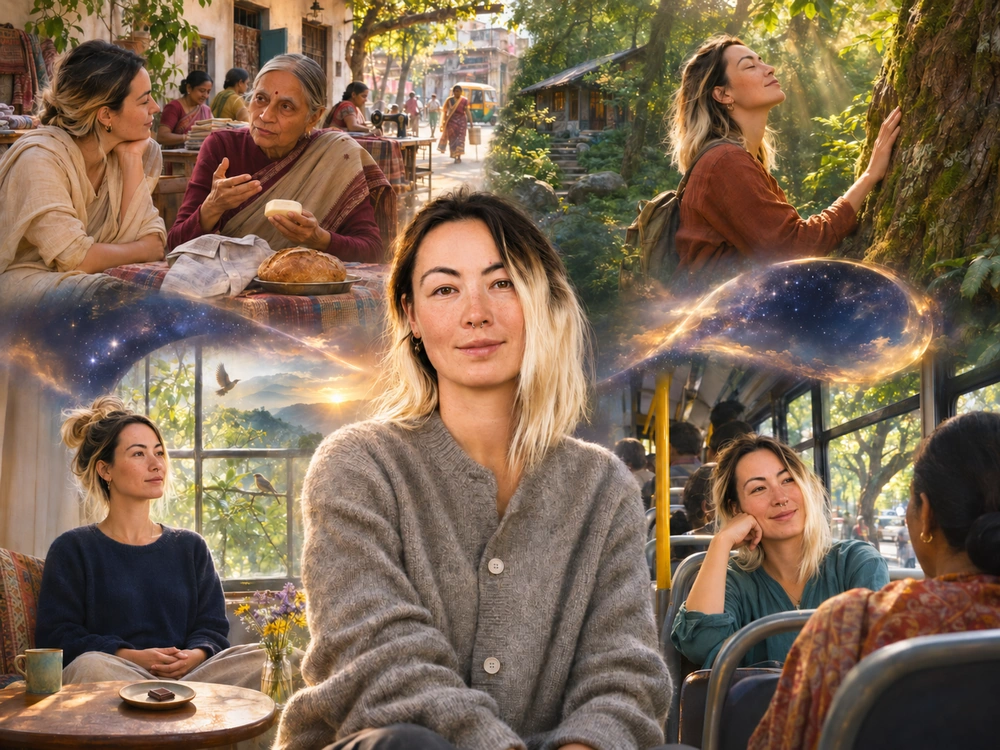
Sarah Walker Ting: I saw love everywhere. I saw love in the tree, I saw love in the leaves, I saw love on the bus, when I looked across at a stranger. Everyone has told me love is rare. It’s only when you find a certain special someone. But in fact, love was the most common thing in the universe.
Rick Archer: Welcome to Buddha at the Gas Pump. My name is Rick Archer. Buddha at the Gas Pump is an ongoing series of conversations with spiritually awakening people. We’ve done many hundreds of them, and if this is new to you and you’d like to check out previous ones, go to batgap.com and look under the interviews menu where you’ll see them organized in various ways. This program is made possible through the support of appreciative listeners and viewers. So if you like it and would like to help support it. There are PayPal buttons on every page of the website. It’s funny because I listen to a lot of podcasts and I was listening to Sam Harris’s and all he does is “Hi, today I’m with so-and-so” and they just get started. But then they also have this thing at the beginning of “Well, you’re listening to the free version. If you want to listen to the whole thing you need to subscribe and otherwise it’s going to be cut off after half an hour.” So we don’t do tricks like that. Okay, my guest today is Sarah Walker Ting and by way of introducing her I think I’ll have her introduce herself and the fact that her name is Sarah Walker Ting gives her a springboard to explain who she is, what her family background is, and we’ll start with that. So go ahead, Sarah.
Sarah Walker Ting: Thank you, Rick, and thank you for the introduction. So yes, my name is Sarah Walker Ting, and I guess I can start by just sharing that my name illustrates the way in which I was born into the world with a very dual identity in a sense. I was navigating the fact from, you know, being born into a half— what I was told is a European or Mayflower American family, a family that had been here in the US for a very long time, and then my father’s family who’s Chinese American, and so I was the first generation in my family to be mixed. So from a very young age I had this identity crisis or a sense of needing to reconcile two identities as being mixed race and I was often asked the question “what are you?” strangers would come up to me like everywhere from when I was at sports games, at school or in public at a grocery store and come up and ask, “What are you?” And as a kid, that’s a very existential question, you know, like, “What am I? I don’t know. What am I?” And I never quite could answer the question in a way that felt satisfying. I didn’t quite feel like I fit into either identity perfectly. And my parents divorced when I was at a young age. So I was also split between a primarily like suburban, white, more affluent neighborhood, and then a very urban, diverse, higher poverty rate, and more cultural diversity city in California, in the San Francisco Bay Area. So there were so many levels of diversity and duality that I was navigating between community, in my own identity, and that kind of shaped my whole way of seeing from a very young age.
Rick Archer: Yeah, there was a point in your book, The Dark Bearing the Light, where you were in some family gathering and all the people on your mother’s side were going on and on about how pure blooded they were having come over from the Mayflower and all that stuff and kind of grumbling about these immigrants that are infesting the country or some such thing as if you weren’t sitting right there as one of their relatives.
Sarah Walker Ting: Yeah, yeah.
Rick Archer: That was kind of weird.
Sarah Walker Ting: Absolutely. And that’s one of these things that we see in the US today. There’s a huge divide between folks that feel like this country was made for the original pilgrims or the original immigrants. And I have parts of my family on my mother’s side who are very much in that camp of political identity of saying, “We came here first.” And they literally said to my face at a family reunion, “We don’t think new immigrants should be here.” And so I looked them in the eye and I asked, “Well, how about me then?” Because on my father’s side, we’ve recently immigrated in the last couple generations, and does that exclude me? And I think that…
Rick Archer: What did they say?
Sarah Walker Ting: In that moment, I remember my cousin, there were a bunch of cousins all around a bonfire, and everyone kind of looked down at their feet and couldn’t really look me in the eye.
Rick Archer: Yeah, like they didn’t even realize what they were saying.
Sarah Walker Ting: Exactly. And I think that’s so much about what our polarization is about is there’s a lot of folks who you don’t really have the conversation face to face with the folks that we’re talking about kind of in third person. And when you’re actually faced with the person that you’re saying you don’t want here, can you actually say it and maintain your connection to your heart? And I think that’s what I noticed in that moment was like, I don’t think my cousins didn’t love me or didn’t want me here, but so they couldn’t reconcile their politics with what they were saying. And that was, yeah, really interesting for me as a kid to try to reconcile within myself.
Rick Archer: And then, of course, there’s the irony that there were people here for thousands of years before, you know, all these whiteys came over from Europe. What about them?
Sarah Walker Ting: And I mean, I think so it’s this idea of how we construct our identities and what it means for our sense of belonging was something that I was constantly wrestling with and I think is a huge part of what I’ve written about in my book because I’ve had to try to deconstruct for myself, well, if my family doesn’t accept me as I am, but also I’m not, for some Asian folks, not Asian enough to be Asian, and I’m not white enough to be white, then what am I or who am I and where do I fit? And even from a young age, I was writing about that, and that was my college application essay was about this negotiation of my identities. So yeah,
Rick Archer: there’s a nice saying from India, which is the world is my family. We have like at least 75% of our DNA in common with a zucchini.
Sarah Walker Ting: Yeah, and we don’t really have to look that far to see that, right? Like you said, it’s like even– we can say in our DNA, but even just in our daily lives, we go through the same things. We feel the same feelings. We have so many similar experiences, and yet somehow we end up thinking that we’re so different. So, yeah.
Rick Archer: Yeah, and of course these days it’s a hot issue because the current administration has been trying to get all these people out of the country, many of whom have been there since they were babies, and don’t speak any other languages, and certain people are behind this effort and think, yeah, let’s get them all out of here. And then all of a sudden the lovely couple down the street that runs the Mexican restaurant is being walked off in handcuffs. And wait a minute, we didn’t mean them. But I think if we could meet everybody that is being expelled like this, we would probably say, well, we didn’t mean 98% of them. These are all wonderful people. What are we doing?
Sarah Walker Ting: Right. Yeah. And especially when we make this argument of certain people need to leave our country, we intellectualize it? Yeah, we’re not face to face with the person, with the family, and we don’t really reconcile within ourselves why do we need to dispel certain people from our communities? What is it really that it’s doing for us? Or is it a way to blame or shame other people for something that we need to find out for ourselves?
Rick Archer: Yeah. And of course, some people are thinking as they listen to us right now, “Oh, we can’t just let everybody in. And why are they even talking about this? Because this isn’t what they usually talk about on BatGap. But there is a kind of a spiritual implication to it all. You know how the astronauts, when they go out into space and they look at the planet Earth as this one thing and they say, “Holy crap, it makes no sense that we fight over these little parcels of this beautiful globe.” And then there’s the Carl Sagan thing, pale blue dot, where we’re looking at the Earth from the perspective of the rings of Saturn And it’s just a pale blue dot. And Carl Sagan gives this beautiful monologue about how all the blood that’s been shed and all the crazy stuff that’s happened over the centuries, fighting over little tiny pixels of this pale blue dot. And why can’t we just see it from this perspective?
Sarah Walker Ting: Yeah. And there’s something about that zooming out of being able to find an identity that does include, that does embrace more than what we might see in a day-to-day basis that is also, I think, I write about as a kid, I kind of, when I was navigating these two identities, I would literally go through a tunnel between the hillsides to go from one identity to the next identity. And when I would emerge from the other side of the tunnel, and the land would expand out into this vast horizon, I would have that visceral feeling of like, okay, I’m emerging into something greater on the other side. And I think that we can all relate to that there are certain times when we’re navigating between two places or two communities or between two senses of ourselves, and it feels like an enclosed and small place. But we can go through that also and come out into an expanded sense of something on the other side.
Rick Archer: Yeah, I have a collection of NASA photos, maybe a thousand of them, that rotate as my desktop pictures. So it’s like many times a day I’m looking at galaxies. And I always contemplate every day, not intentionally as a practice that I put on the clock that I have to do it at three o’clock, but just spontaneously. I’ll look at a galaxy for a while and imagine all the life in those hundred billion stars and all the little dramas that everybody goes through. And it’s one way of zooming out. And then of course I get back into my life. But I think one way of defining spiritual awakening is to culture the capability or the condition of being totally zoomed out and totally zoomed in at the same time?
Sarah Walker Ting: Yeah, we may get into this a little later, but I have a way of sort of illustrating that. And I think we can do both at the same time and actually move in and out of that sense of our own individual self and a sense of it being into that expanded sense of connecting and community and that these two things don’t actually negate each other at all.
Rick Archer: Yeah, they supplement and complement each other.
Sarah Walker Ting: And that way, in the end, we don’t have to choose between two identities. We don’t have to be one or the other and kind of coming into a greater sense of self or an expanded sense of self of self or even, you know, some may say our being, our eternal sense of spirit doesn’t require letting go of who we are in our smaller sense of self. Yeah. Yeah.
Rick Archer: It enhances it. I was with a spiritual teacher for many years who emphasized this point a lot. He said that we need to cultivate the ability to maintain very broad perspective while focusing on narrow boundaries that you need to focus on if you’re functioning in the world. But he kind of presented it as an advantage for business people who need to keep the big picture and yet do all the nitty-gritty stuff. And many people can’t do that. Either they can’t focus in on the nitty-gritty stuff or they’re so focused on the nitty-gritty stuff that they lose sight of the whole and then they get kind of compartmentalized or isolated into details without being able to coordinate in a very practical sense all the variables that need to be considered if you’re going to function effectively.
Sarah Walker Ting: Right, yeah, and sometimes it’s getting in focusing in on something more particularly that helps you come into a greater sense of something. I know like in writing this book that I’ve been working on over the last handful of years. It’s interesting the process of going into a paragraph when I felt like, “Okay, there’s something here in this paragraph that I need to go deeper into.” And I’d always find that same sensation of going through the tunnel and coming through it onto the other side that, in a sense, this to me feels like this spiritual journey is going into maybe a pocket of discomfort or pain or struggle within your body, within yourself, within your life, and then coming through it transformed. And that there’s something that either loosens or moves or shapes your life in a different way and it doesn’t mean it’s that you have to do it or it’s something that is like part of a to-do list, but it’s something about like life is just moving anyway and we are transforming anyway, but there’s something about how we can really go into something and come out of it in a different way that allows for that movement to be more fluid and to flow more. Yeah, and actually, I mean, we might as well— this is so on point with this symbol that I was speaking to, the infinity symbol, that I feel may— we could use this actually to help like frame the discussion in my story too. But I—
Rick Archer: Okay.
Sarah Walker Ting: use this throughout the book because it for me, my journey and what the way I see this sort of movement I was just describing is a movement between opposites that, in a sense, are being woven together and reunited into a whole, and at the same time are already whole as we hear from the great ancient traditions. And there was one time when I was in meditation, and this has often happened to me where I’ll just sort of receive an image that helps me illustrate something that I’m trying to wrestle with within myself. And one day I got this image of what was like how we perceive on a day to day as a normal regular human being, our life is the imagine like this is kind of like an eyeball that we’re looking out into the world, this sort of one way vision outward. And we’re looking out onto this globe here, outside of ourselves, as if we’re kind of moving forward doing things acting upon the world, and trying to understand and put together, like I was trying to do as a kid, like who am I, what is this, what is this world in front of me? And the journey often we talk about in spirituality, inward, is the inverse, right? To go from towards outside to the world, inward, and do this sort of inverse towards the other direction. But at the same time, we can call this outward and inward. At a certain point, as you go inward, this outward or inward journey reconnects to the outward. And there’s this way in which what seems to be outward becomes inward and what seems to be inward is also outward. And so what you’re speaking about in terms of the particularities becoming more, showing us the more expansive or the expansive showing us the particulars is really something we can live out through that constant movement of seeming inwardness coming back out into life and then that outwardness of life coming back inward and working something within ourselves. And for me, that’s this constant thing that’s always happening, no matter what stage we are in the journey. Yeah.
Rick Archer: Yeah. Yeah, so there’s different ways I think of using that analogy, but in light of meditation practice for instance, the Bhagavad Gita actually uses a verse where it likens meditation to a tortoise withdrawing its limbs inward into its shell. And in other words, the senses, it’s referring to the senses as the limbs, that instead of being outer directed toward their objects, they turn around and withdraw within. And then you’re not necessarily experiencing anything in particular, but you settle down into that which is the ultimate experiencer of everything, self or pure consciousness. And then you come out again, and then you go in again, and then you come out again. And over time, the in and out get integrated so that it becomes what is sometimes referred to as a lamp at the door between the relative and absolute where you’re able to sort of like, it illuminates both the inner reality and the outer reality. Whereas most people are exclusively engaged in the outer experience without any real recourse to the tremendous potential that lies within.
Sarah Walker Ting: Right, yeah, and I often like to think of this, I mean, you could put any sort of opposition in this diagram and it could work, but the way it makes, I think, clear sense to me is it’s this is being and this is human. So this is what it means to be human. So we could move from our being into our sense of our humanity, although these are not separate things. But at the same time, that’s what the wholeness of being human being is, is that is this movement that’s always happening, and it seems to be inner and outer, but it’s, in a sense, just the flow of life and creation moving through our bodies into the world. And a sense of the unknown coming into a sense of knowing. But that’s only, you know, the way that we can try to explain it for how little we know.
Rick Archer: You mentioned that as a child, you felt others suffering deeply and experienced God as an unconditional love in your belly. And you said that those inner experiences shaped your sense of belonging and connection, even as that felt connection later on became harder to access. So you want to talk about that experience you had a little bit as a child and then how began to be lost?
Sarah Walker Ting: Yeah, yeah. So as a kid, I was, I was very sensitive and very empathetic. So I would pick up on everyone’s feelings around me. And often felt and I didn’t realize this quite at the time, but I was overwhelmed with feeling everyone’s feelings. And often, I wouldn’t look into strangers eyes, because I could feel like I could sense everything that they were feeling, especially if they were carrying something particularly hard on their heart. And I also felt like when I looked at, especially middle aged folks, I didn’t understand them because I was like, they don’t seem to be who they portray themselves to be that they’re presenting one thing, but they’re not that on the inside. And I could see that as a kid that there was this discrepancy between what people were saying and who they seem to be. And as a kid, I was really interested in people and trying to understand that, trying to understand what was happening in my community, especially being in very different communities. And I was also really concerned about being good. I really wanted to be a good kid. I really wanted to serve my community. And I had parents who were both in public service. And so I think it was just part of the culture I was raised in, but I have this memory I write about where, yeah, I had this connection to God that I didn’t learn. I didn’t really go to church much. We sometimes would go on Christmas or Easter, but not in a religious way, more as in a, like, celebrating an American holiday kind of way. And we weren’t religious at home, but as far as I could remember, I had this connection to God, and it wasn’t a God that I had heard from other people. It wasn’t a God in the sky. It wasn’t a God outside of myself, but this God was in my belly. It was deep within me. And I never thought anything of it at the time. I didn’t tell anyone because it was as natural as anything, and I would ask this God questions. And I write about how one of my clearest memories of asking a question was being on the elementary school playground, and I remember that my parents told me not to use swear words and I was really concerned about not swearing because I didn’t want to be a bad kid. And I stopped on the blacktop and I asked God in my belly. What if I swore? Would you still love me? And what I receive back and I describe this as it’s like a transmission of both feeling and knowing it’s not so much words but the full rush of this full bodied like unconditional love came over me and this sense that emerged from me that there was nothing that I could do to change this unconditional love. And I was really blown away by that answer, because it wasn’t something anyone else in my life had said. It wasn’t a kind of love I yet had known from trying to be doing the right things in the world and that really stuck with me as this sense of…
Rick Archer: So then did you start swearing?
Sarah Walker Ting: Well, I think I did, maybe for a little bit, because there was something in that where because I was so concerned about being good as a kid, there was a part of me that always kind of wanted to be a little bad. But I wanted to try to do something that I could be more whole, not have to always be contained in this sense of doing everything that I thought everyone needed me to be. And I think we can all relate to that, right? There’s like a, you start to enclose into these smaller senses of what others tell you you should do or what you think is the right thing to do. Not that we should be doing things that are harmful, but I think I was, there was part of me that like wanted to swear and just be able to say whatever I needed to say and know that I would be okay.
Rick Archer: Yeah. Yeah, so you had this childhood aspiration to help people and stuff and then you actually began to manifest that as you got older. We might be jumping too far ahead, but there’s this Ela Bhatt lady, I guess that was in India. You went there and you started doing seva in an organization called SEWA. And so talk about that a little bit. How did it change your understanding of listening and compassion, nonviolence, and stuff like that?
Sarah Walker Ting: Yeah. So I was really committed to social justice and serving community from a young age. And by the time I got out of college, I had done some work doing policy research, and I found it was at a think tank, so it was very like heady and felt too intellectual for me. So I ended up feeling this intuition to go to India, and I cold emailed an organization there that I had admired who was, they were organizing women in this really powerful union of informal workers in the economy who were following Gandhian principles. So SEWA, as they’re called, was founded by Ela Bhatt, who is part of, if you’re familiar, the organization called the Elders with Desmond Tutu and Nelson Mandela. So she was one of the greatest elders of our time. and I felt so honored to even be able to work for them. I was just honored to be there and when they said that I could come over and help out. But once I got there, I unexpectedly one day got sent to Ela Bhatt’s house on the back of a motorcycle. Someone I didn’t even know, they’re just like, “Get on the bike, you’re gonna go meet her now.” And when I got there, I was met with this really powerful presence. She was very short in stature, but I could feel how powerful she was in the way she carried herself. And there was this real sense of integrity and strength that she led with, that I felt just being in her presence was its own wisdom. And she asked me to go on a quest where I had to investigate the source of three items that she was curious about in the Indian economy, where like where these items like originally came from and how they landed into the hands of the consumer. So she invited me first to find a young woman in a village in India and ask her where she got her soap, ask a man where he got his shirt, and then ask a family where they got their bread. And she sent me to different parts, rural and urban and large cities. And it took me on this quest of really connecting these Gandhian principles of sovereignty, right, of reclaiming economy, which is so much of what Gandhian, the Gandhian movement was about from the British, to this real sense of what the spirit of that movement was, which was moving from an interconnected sense of power, right? So, instead of what I saw at SEWA and what Ela was showing me in the way she moved and the way that this organization moved was unlike in the US when I was doing organizing and different policy work in the US, I noticed that often we were organizing against something, trying to fight injustice or always trying to put out fires and figure out how to be in this sort of fighting spirit. Whereas in SEWA, what they were doing was they were moving with each other for something. There was this generative way of moving in the spirit of Gandhian principles in ahimsa, nonviolence, in the interconnectedness that felt different in the day-to-day movements and the way that they were operating. I could feel that the way that they moved was more connected. It wasn’t as hierarchical, it was more flowing with the daily movements that needed to happen. There was real ways that they were connecting with each other on equal ground. We all had to sit together for lunch on the ground in a circle. We all called each other brother and sister every day after our names and emails and in person and we wore khadi clothing which is like locally hand spun cloth. There were so many ways in which the principles were woven into our work and that was the principles of interconnectedness of moving from nonviolence that is very much a spiritual principle in a sense. And it very much was for Gandhi, but it wasn’t preached, it was lived, it was embodied, it was a living wisdom that the organization was doing every day. And I don’t think I quite understood at the time how much that was something that I was going to really value. But it was something I, I perhaps was always seeking as well.
Rick Archer: As you were saying this, I was thinking about Gandhi and others who work for social and economic justice and things like that. And sometimes that kind of stuff is, it has a spiritual overtone to it very often. Gandhi was considered a Mahatma, which means great soul. And Martin Luther King was a very spiritual man, and Nelson Mandela and all the rest. But sometimes people who are really into spirituality don’t relate too closely to that sort of thing. They’re into their spiritual practice and their retreats and their meditation and their you know all that stuff. And you know I think it’s nice and it’s beautiful when people can marry the two and you know be deeply spiritual but also deeply engaged in some kind of service which in many spiritual traditions is considered to be a spiritual practice in itself, seva or selfless service, but it’s also sorely missing many times in certain spiritual groups and traditions. And I think the value of it is that even if you’re mainly interested in your own spiritual development, serving in the kind of way you’re describing or in the way that Gandhi and others have served gets you out of yourself and makes you more selfless. And that is actually an extremely potent spiritual practice, because sometimes you can find people who have been doing spiritual practices for decades who are still very self-absorbed and kind of selfish in the ordinary sense of the word. And you wonder, how is that so intractable? How is that so deeply seated that it hasn’t gone away after all these years of practice? because they didn’t do something like what you’re describing, getting out there, not thinking about themselves so much, and actually helping people in a humble way where they’re not considering themselves superior to them, but literally getting on their level and doing something.
Sarah Walker Ting: Yeah, there’s so many dimensions to this that I could speak to, but one, yeah, to start off, I guess I could say it with this diagram again. There’s sometimes when we go into the being side, the being dimension, and yeah, we just get stuck here. Right? And you feel well, this is so expansive, right? I’m expanding out into this sense of this beautiful being or bliss or that makes me feel good. But there is always I feel an intuition that you can tune into that says there’s something else beyond this even to at least for me and my experience, I could feel when I was here and I just wasn’t quite closing the loop. And I was feeling okay, so this is so expansive. This is so fulfilling in some senses, internally. But then if I don’t come back out into the world, I am dwelling in my being, but I’m not being human. I’m not fully engaging my humanity. So this is where, yeah, you can, a lot of teachers do emphasize the being part, right? And kind of letting go of the human part. And that’s one journey. That’s, you know, that’s one path. But to have the integration of being wholly human, for me has been connecting that and going all the way back out to that sense of going deeply into all of my human imperfections and all of the ways that I’m still suffering and still trying to figure out life. And then coming, it’s in the same flow that keeps going in and out and in and out. Again, like we’re talking about going through like a narrow tunnel of the frustration of the day and then coming out again, and then coming through it again, with the next thing. And sometimes there are periods, for me, I’ve had periods where I am very internal, and you could say selfish and not doing anything for others. And maybe there’s periods where I’m doing a lot for others and then not doing enough for myself. And I write about that in the book, that I also had very much a compulsion to serve. And that in itself is its own identity. So there’s something that can be very tricky about that too, because I was raised in a family of service. I had thought about service since I was basically born, like since I could remember I was thinking about serving my community. So it became such a strong identity that I actually had to really suffer through a lot of overextending myself, over-serving, over-working, and that led to actually my having to reconcile the suffering that came with that. Yeah.
Rick Archer: Yeah, and we often hear about burnout in service type professions like teachers, policemen, people like that who are doing a lot of service. But I’m a fan of this TV show, The Pit. Have you ever watched The Pit? It’s really cool. It’s about a hospital emergency room. And the people there, some of them are just so compassionate and just so caring for everybody, but it’s so intense and it just consumes them, you know, and they just get burned out. The lead character played by Noah Wiley just in the last season was going off on a motorcycle trip because he just needed to get out of there and reset his nervous system. We’ll see what happens in season three. But there was a really sweet scene in the last episode where he’s picking up this little baby who had been abandoned and had come and ended up in the emergency room. And it had been there all day because they hadn’t found some social services thing yet to pick up the baby. And he was just reflecting on his life and how he had been so consumed by this profession that there are so many lovely things he might like to have experienced which he just didn’t and probably wasn’t going to and he was just holding the baby and kind of starting to cry and just saying you know you’re going to have a beautiful life you know anyway it’s really sweet it’s a it’s a critical point because you—we need people to serve and the world is in such great need in so many different respects but if the people whose dharma it is to do that don’t have a means of continually replenishing themselves with some kind of inner resource, then they’re not going to be able to serve effectively and it’s going to be at the cost of their own happiness. Like if you want to be a lifeguard, you have to be a really good swimmer. If you want to really help people, you have to be acting from fullness, from abundance, and then you don’t get depleted. As the Bible says, “My cup runneth over.” You’re an overflowing cup that can continually quench people’s thirst, so to speak, without being emptied itself.
Sarah Walker Ting: Right. And there’s so many ways in which our cup doesn’t get filled. I found through my journey, you know,
Rick Archer: Life tends to drain it.
Sarah Walker Ting: Yeah, and when you’re constantly extending yourself outward towards others as I was, and not finding that inner connection within, I always had it, right? I had from a young age a sense of that, but there’s so much of my own pain and suffering that started to cloud and really contract my whole system, right to the point where I wasn’t really aware of my body anymore. Because I was so focused on everyone else, I didn’t know how much I was holding and containing within myself, and how much I actually needed to attend to my own suffering. Which is, you know, what led to one of my big openings, because I was so overloaded with overextension and pushing down everything that I felt internally, because it wasn’t as important as what other people needed, that it started to feel like, what I thought was I was holding everything together, and I think a lot of people can relate to that, but I was actually just holding everything in. And it was just like packing some, you know, more and more within this very crowded space. And so, of course, I couldn’t really see clearly much anymore, either. I couldn’t really act as clearly. And I couldn’t serve yet consistently well. I would burn out very often. And, but there wasn’t a sense of like, well, what’s the alternative? I didn’t really know, because a lot of people are in that mode, especially in service, that it’s just part of the normal way, especially in the US, we’re very oriented towards like, hustle and grind, and you got to, you know, do tons of work all the time. And we aren’t really in the practice of resting, or understanding how what is it to rest? How do you actually come into a sense of being in yourself, not just, you know, like a depth of spiritual being, but just literally sitting down and like, being okay when you’re sitting down for five minutes, which I couldn’t do at a certain point. And I write about this, but wow. So when I, at the end of my time in India, after I learned so much from these, these beautiful women, I had to return home early because, and trigger warning for folks, I had a friend who took his life and I came home to attend to my partner at the time who was roommates with our friend who was living in this home that had an extra empty room that was unbearable to live in. And I was there in that moment, again, trying to stuff down my own pain and my own suffering, because I was also very much suffering at that time, but attending to my partner and to everyone else in that scenario. But we, there was so much suffering in our life at that time that I finally went to a meditation class with my partner. It was like a desperate cry for like anything to help. And when I did, and I sat down for the first time after I was actually rushing to the meditation class, like really stressed out because I was late and I didn’t, I was like totally unprepared, didn’t know what I was doing. I rushed into the class late, stressed out, completely anxious, and really a mess. But I didn’t realize it until I sat down on that carpet in the meditation class, and just started crying. And for the first time in I don’t know how long, I was silent. And the silence was just piercing. And it just, it broke open something in me that the all that had been packed in all that I was holding into me to try to get along, try to help everyone else to try to make sure in a sense that I wouldn’t have to feel what I needed to feel inside. Because when you attend to everyone else, it’s a pretty good strategy not to attend to your own feelings. Not to say that that’s intentional, but it’s a strategy when you’re in a lot of pain, actually, to not feel your own pain. And I learned that I actually needed meditation, I needed that space. But I had such little capacity to hold what I had within me, you know, I still was very anxious. And, and so I did sit, you know, later on, for five minutes every morning, but I really struggled through that five minutes, like, because I had so much anxiety and so much stress, and this kind of churning sense of not being safe in my body. What I would do is I’d put a piece of chocolate in front of me on the table and I’d be like, “You get to eat that chocolate after you sit for five minutes.”
Rick Archer: After five minutes.
Sarah Walker Ting: Yeah. Because it was so uncomfortable just to sit with myself for five minutes. And I couldn’t even sit with my eyes closed. I had to do meditations where I could keep my eyes open because it didn’t feel safe.
Rick Archer: Staring at the chocolate.
Sarah Walker Ting: It’s often that, but also like, yeah, I mean, it was quite the motivator. But yeah, staring out the window at the birds, trying to–
Rick Archer: But just to sit there for five minutes without–
Sarah Walker Ting: Without helping someone, doing something, cooking, cleaning, doing something. And I think so many of us can relate to that. It’s just you’re constantly doing something, even if it’s really nothing, right? It’s like you’re kind of puttering around in the kitchen, opening the refrigerator door, closing it, moving around, not really necessarily intending to do anything, but because there’s so much restlessness inside, there’s a sense of not being able to rest. Yeah.
Rick Archer: I’ll give you a couple of little platitudes. One is rest is the basis of activity. That’s a good one. Another is from the Gita, actually, it says, established in yoga, perform action. And then it says yoga is skill in action. And yoga means, doesn’t mean just yoga asanas, it means union or transcendence, establishing your awareness in the self or your true nature, then perform action. It provides a foundation for action to be more successful, kind of like pulling the arrow back on a bow before releasing it to try to hit a target rather than just holding the arrow there and letting go without even pulling it back, which is like activity without such type of preparation. So personally, you know, and, you know, starting from about the age of 18, I began to adopt a lifestyle, which has gotten very habitual, of regular meditation, but also taking care of other things, and more and more so over the years as I get older, but enough sleep, enough exercise, enough meditation, and then be as dynamic as you like in all the other time in the day. Go like a bat out of hell. But if you have that kind of preparation of adequate rest and taking care of your body, enough exercise, then the activity tends not to be a burnout. You can handle it, you can deal with it, even if it’s high pressure and everything else. And then you have an opportunity to recuperate again after so many hours of it. But if you try to go day after day with that intensity, without any kind of remedial recuperation, as they say, life is a marathon, not a sprint. You can’t run a marathon at sprint pace, you’re gonna collapse at a certain point.
Sarah Walker Ting: Right, yeah, and that’s, I mean, if we’re, you know, constantly going outward, out into the world, there’s no sense of that wholeness as well, right? Like the rest, that’s beautiful, you know, the image of pulling back the arrow, and that yoga asana, it’s, it is literally the movement of going inward into rest. That is what propels movement. And so it’s like, you can feel that in the pulling back the arrow, and then the arrows coming from a place that is actually not your own, right? It’s like, that we can reach into this deeper well of something beyond what I know, beyond my own thinking of what I need to do or what I think I need to where I need to go. within that deep rest of being, then there’s some other actions that arise too. So, it’s even the direction of the arrow changes, I’ve found.
Rick Archer: Yeah, that’s a good point.
Sarah Walker Ting: Because for me, while the issue with being someone who’s addicted to service, was that I was celebrated for it, right? So, everyone’s like, “Oh, this is so great. And, you know, you’re doing such great work and get promoted in my workplace and all this stuff. So there’s all this reinforcement for what is just like any other addiction. And it’s in a sense a compulsion. And what I write about is it’s not just that, you know, to de-shame it, it’s really also part of the conditioning of for me what it was to be raised as a woman in our society. For most women, you can relate to serving others all day, every day. Like, that’s just part of how we’re raised is to be attuned to everyone’s needs, to move through a space, trying to take care of everyone you can. And so in a sense, it’s just a part of this way of being conditioned as that role of a certain gender in this, in our society, not to say that men don’t play that role, because my father certainly was a very nurturing and caring person and moved that way as well. But in our society, there’s structural ways in which it’s reinforced that, oh, yes, like, this is how I’m meant to move. And so that it wasn’t coming from a deeper place of my own truth of like my being moving out into the world as much as it was an overlay of a lot of compulsive movements that and yet the compulsion you can tell is there because there isn’t a choice in the matter. It’s not like, oh, I’d really like to rest right now and I can. It was like, I would like to rest right now and I don’t know how. And I can’t find it in my body that sense of rest, which to me actually is what meditation is, which is why it’s so hard when you’re coming from a more anxious place. When people everyone says like meditation’s hard when you’re when you’re first meditating. For me, it’s like, well, yeah, because meditation in itself is rest. So when you’re anxious, when you’re thinking a lot, when you’re compulsively going to all sorts of places in your mind or with your body, that’s the point is that we’re not able to access rest yet. And whether it’s mentally or physically, there’s all these compulsions to go to different places and not be still. And there’s nothing wrong in that, right? It’s something that we all go through and we all have periods of. So I think in approaching it with more compassion with my chocolate and like, and little bits of time and not overdoing it, slowly but surely, rest became more of a safe thing to do and became an okay thing that I could, my nervous system could start to handle, but not going from total restlessness to total rest, right? That took a long time.
Rick Archer: Yeah, it takes a while to transition. But judging from your book where you were going off on retreats and living in cabins in the woods and all kinds of things, you definitely changed your pace and learned how to get into a deep, restful state for long periods.
Sarah Walker Ting: Yes, and so you could say that for me, I was dwelling at a certain point. Yeah, after I had this breakthrough, so maybe I could—
Rick Archer: Talk about the breakthrough. You’ve alluded to it a couple of times. You haven’t really described it.
Sarah Walker Ting: Right. So after I started meditating and realized that I had suffering in myself and was sort of reconciling that, but not really. I kind of returned back to work this time in the US again, and was climbing unexpectedly in politics because I was organizing for social justice, and then I ended up working for a politician to reform the system from the inside. And then
Rick Archer: On the state level?
Sarah Walker Ting: Local level. So for the city council here and then the county supervisors here.
Rick Archer: Okay.
Sarah Walker Ting: And I was, so I kept being promoted to higher positions and I was just overworking, overextended and taking a lot a lot of responsibility again taking care of everyone, managing a team, managing budgets, writing legislation, and I was trying to do so much. And then I got into a relationship that was really unhealthy, and I didn’t realize how bad it was because, again, it was the same thing. It’s like when you’ve been swimming in certain waters, you don’t know that you’re in them, right? And I knew something didn’t feel right, but I didn’t know what it was. And I developed this autoimmune condition where I had this huge skin condition that went all the way down my face and down the side of my body, completely down my back where it was basically like an open sore. And I had to go to meetings with all these politicians and directors and I had this thing on my face, literally like right in everyone’s face and I was like, probably, yeah, it’s not easy to be on the other side of the table, but I put on what they gave me was like a topical steroid to literally put a solution to the surface of my problem every single day. And I applied it, even though it’s a very strong, you know, thing that wouldn’t solve my problem. The problem was how I was moving through the world and in my life and relationships. But I couldn’t stop and I didn’t know where it was coming from. So I literally just hit my breaking point. And I, in this overwhelm of my entire system, left my relationship, which I was also living with a partner at the time, so I left my home. And I was completely, my whole nervous system overwhelmed. And I, and I really just broke open into this rock bottom of my life where I was out of control for the first time. You know, I was always containing and helping and trying to hold everything together. But for the first time, I truly like, I remember I was just like, my knees to the ground, like wailing, raging, crying, weeping, and just waves upon waves of emotion just pouring all that was stuck behind this massive wall of all of this identity of the one that was helping everybody else and keeping it together. And yet that wall, of course, was now like covered in this condition and like starting to have, starting to break its, its, you know, sheen. It wasn’t looking as good. I was, literally my pain was breaking through the surface of my body. And I broke.
Rick Archer: When you were literally on your knees like that, wailing and crying, and was there this feeling like God help me? Was it a feeling like, I beg you, you know, whoever is hearing this, I need help? Was it that kind of a feeling?
Sarah Walker Ting: At that time, I think I was just suffering. I wasn’t even in a place.
Rick Archer: There wasn’t any sense that you could entreat the Lord or some higher power or something like that to come to your aid?
Sarah Walker Ting: No, at that time I was just in pure suffering for weeks and I was on the ground.
Rick Archer: Were you still going back to work or you had to stop at this point?
Sarah Walker Ting: Yeah, there was a period that I kind of took some time off and then I think we also, it was like a recess for us too, so I didn’t, just happened to be good timing I guess. I also, yeah, I tried for a period not to go to work, but it’s interesting because, yeah, my team really didn’t know that I went through this, you know, because I was able to not show it, you know. I was so good at being able to take care of others and not show them that I had any pain, that I had any issues.
Rick Archer: So how did all this finally resolve? I mean, your skin looks nice now and you’re not freaking out. I mean, how did it kind of come about to where you are now, which is in a very good place, obviously.
Sarah Walker Ting: So what happened is, it was what I imagine, it felt like, you know, like a whole ocean of emotions that were behind this dam had, and then when the dam cracked, and broke open, all of this flooded out. And like we were talking about before, it’s like if you don’t know how to fill your cup, like how are you supposed to pour from it, for me it was like, oh, my cup was filled with all of this, right? So I was trying to pour from the very little that I had because I wasn’t letting anything in. I also wasn’t like either from my internal wellspring, but also from other people. I wasn’t getting support from others, and I wasn’t getting any internal well-being.
Rick Archer: Right, so your cup was full of stress and there wasn’t any room in the cup for the bliss.
Sarah Walker Ting: Right, exactly. Or any sense of a flow, you know, like we talked about the flow that I witnessed in SEWA with the women flowing throughout their work days is that same kind of flow that I feel like, you know, in a rickshaw, you’re riding through the streets and there’s this sense that everything knows where it goes because it’s following a certain intelligence. My intelligence was completely blocked off and so there’s nothing flowing and so as soon as that started flowing, I felt this massive shift in my perception where it felt like kind of erupted out of me and then literally I actually described this in the book when I went to that first meditation class years before I tried to scan my body and I literally couldn’t find my toes. I couldn’t, I could imagine them in my mind’s eye, but there’s a –
Rick Archer: You couldn’t wiggle them and feel them?
Sarah Walker Ting: Wiggle them, but I couldn’t sense them without wiggling them, right? I couldn’t just sense my body without actively moving it. And I realized I wasn’t really in my body because I was so, I was attending everyone else that I wasn’t really abiding in myself. So after this massive shift where I was in a sense emptied of all of this content inside of myself, I felt this shift from not really feeling real, not really feeling like I was here. I wasn’t really here in this body. I wasn’t, and I had that sense a lot growing up and as a young adult and into my 20s, this sense that I wasn’t really real. And I know a lot of folks can probably relate to this. When you’re disassociated from your own body and from yourself, when you’re in a lot of pain, it literally feels like I’m not real. Like I don’t, I’m not really a tangible thing. Like am I, like I would have this sense that I was kind of hovering above myself or not really in myself. I wasn’t really fully vital, you know, and alive in myself. And I think it was so normal for me that I didn’t really have a comparison. So it wasn’t that I was trying to fix it or thought, you know, something’s wrong here. It was more of a, well, here’s another way of putting it. And this is another way that I see the journey generally for me, is the journey is from the sense of absence in oneself, like, I was absent from my own body absent from my own spiritual life in a sense, inner life, but also from my own expression in the world, right. And so that absence came from the absence that I experienced growing up, which we all do, right? everyone’s able to be present for us in the ways that we maybe have needed or wanted. And so there are certain aspects of me and of any of us that when no one’s present for them, and we don’t know how to be present for them ourselves, end up being neglected, pushed down, you know, made unreal. And so, for me, it was moving from that sense of not being real into presencing myself. Like being able to be with all those emotions as they were flowing through was the first time I had really let myself have at least myself present for rage, for sadness, for grief of that magnitude. No one was present for those before in my life. So I didn’t…
Rick Archer: How did you achieve that? Was it because of the meditation class and instruction or just something you kind of learned on your own?
Sarah Walker Ting: I mean, I think honestly, it was just like life forced me to feeling it.
Rick Archer: Forced you to do that.
Sarah Walker Ting: And so in a sense, there was then this all this space and for this sense of presence to be here. And so my perception then cleared both with all that moved out of me, but also this sense of being present to be with this really difficult time in my life where the world around me felt real for like the first time. Where I was like, wow, like their colors are brighter. I feel like there’s, it’s like everything’s HD. Everything feels like, you know, the way people talk about NDEs, when they say that when they go, I feel personally my spiritual journey feels, I always feel more resonance with NDEs because it’s this, most of what a lot of people talk about is exactly what I experienced. It’s like, oh, it feels more real, you know, when they say they go on the other side and There’s all these bright colors and this almost high dimension. That’s what I felt here in this body. That the experience of being like heaven on earth is that I can see more clearly. I can see colors. It’s almost as if, yeah, you’re in this Garden of Eden and everything’s coming alive. And I’m coming alive. You know?
Rick Archer: And then so did your skin start to clear up?
Sarah Walker Ting: Immediately. Like as soon as I left that relationship, within a month or two, I had completely cleared. And this is after I had gone to several experts, done many tests, had tried all the different medications and nothing worked. And the way I describe it is it was really because my body was fighting and saying, you know, an autoimmune disease is literally you’re fighting yourself. And for me, and this may not be true for everyone, but for me that was that I was fighting myself internally. And I know that the rates of autoimmune disease are much higher for women. And often there’s this correlation that I’ve heard people make that, especially when you’re conditioned to neglect yourself as a woman in society and serve everyone else, that there can be this real sense that your body is literally moving against itself, that it’s moving it, you’re not moving in a sense of nourishment toward what it is maybe that your body is trying to express into the world. And for me, that went to an extreme where I really, really was battling my own natural way of being until it broke. Yeah.
Rick Archer: It could have been much worse. It could have been some kind of cancer that this resulted in rather than just the skin condition.
Sarah Walker Ting: Yeah, yeah.
Rick Archer: I’m sure a lot of times that’s what causes these things is some kind of intense stress that’s accumulated and is not getting any kind of means of release and it manifests as some even fatal disease.
Sarah Walker Ting: Yet we all have different ways in which our body speaks to us. And that was something that I realized for the first time that all the confusion I felt being in that scenario where I did feel this constant battle inside myself, that sense of I’m so confused, what’s going on? What should I do? was really the wisdom of my own body, knowing, you know, in this sense of being, knowing, and then all this conditioning and self-doubt that was coming up against it. And so all along I knew what to do, but it was in the battling of that, what I was taught to do, that created all that tension, that inflammation within my own system, for me. And I know that for everyone, it’s not that, that’s not the fix, but for me, that was really a powerful lesson of how wise the body really is. Yeah. –
Rick Archer: Yeah. It’s interesting because just this morning, I listened to “The Velveteen Rabbit” because you had recommended it, and it was a lovely story. Of course, I’d heard of it, but I’d never read it or listened to it. So I just listened to the whole story. It took about a half an hour while I was walking in the woods. And the thing that reminded me of it just now was that you were saying about, all of a sudden you began to feel real and the world began to feel real. And that was a theme of the Velveteen Rabbit was like, am I real or am I just a stuffed toy?
Sarah Walker Ting: Yes.
Rick Archer: And at a certain point he realizes that he’s real, even though he was still a stuffed toy. And then eventually he becomes a real rabbit.
Sarah Walker Ting: Yes.
Rick Archer: So, it’s a very sweet story. I really appreciate you turning me on to it. But do you feel like that story relates in a way to what you were just saying?
Sarah Walker Ting: Yes. Yeah. And I didn’t realize that either until very recently. I hadn’t re-read the book until recently. And I was like, “Oh, how interesting.” Right? Sometimes these childhood stories are really profound. And when I re-read it myself, I was thinking, It’s incredible because yes, so the rabbit, I think, he’s talking to the horse, the skin horse, I have the quote here, that he tells the rabbit, “Once you are real, you can’t become unreal again. It lasts for always.” And that is the shift. That wasn’t the, you know, the first time that sense of feeling real in the world wasn’t necessarily the shift that I would say would be that full arm can never become unreal again. But there’s that real sense that of incarnating into this body of this sense that the you know, the Velveteen Rabbit is this stuffed animal, and then is animated into life into a real bunny. That we can all relate to that sense that I’m here, but there’s something not quite right. There’s something that isn’t quite what it’s supposed to be. And it’s not that there’s something wrong with us, but it’s more kind of the way life is just set up, right? That there’s this unease within. And that’s the journey, right, of the disconnect. There’s something inside that gets disconnected through, for me, I explain it as that sense of absence. And absence usually like in our families of origin or our communities where someone didn’t meet us with presence, and then a part of us becomes absent to ourself. And then that happens again and again and again until it feels like there are many parts of ourself that become invisible and become unreal, become like a stuffed animal instead of a fully alive rabbit, you know. And so that metaphor really works for this sense of it’s not that one’s better than the other, it’s just a real felt embodied sense of what that experience is like to feel invisible or to feel absent from oneself, to not feel fully engaged in life or to feel seen and loved and known as we are, which is part of the Velveteen Rabbit’s journey too is that the rabbit becomes real from being loved by the boys. Yeah, but it’s interesting that his transformation doesn’t happen just from the boy’s love. The boy tells him that he’s but he doesn’t actually become real until the rabbit sheds a tear. It actually has
Rick Archer: Right.
Sarah Walker Ting: Catharsis, that movement of being able to feel, feel the pain of loss, of being neglected, of the absence in life and presencing that, really bringing that back into the fold of our whole humanity, that like whole human being that sense of that integration. And then it’s really actually not the rabbit’s doing but the grace of the fairy in the end that grants him his realness that so it wasn’t the boy that loved him. It wasn’t fully his, his emotional presencing, but in the end it was this act of pure grace that set him free into his real rabbit body. Yeah.
Rick Archer: Yeah. And that, you know, there’s a lot we could say about that too in terms of the grace of God, the grace of the Divine, which ultimately makes things right. And, you know, they say God helps those who help themselves, so as long as we feel like there’s something we can do, we should try to do it. But you kind of, I think, eventually realize that it’s not my doing, it’s the grace of God that has saved the day, as it were.
Sarah Walker Ting: Yeah, and I experienced that a lot in my path, this sense of being in great suffering and eventually, you know, making those pleas to God, to spirit, to whoever would help. And at times not being met at all with anything that would help. But then at times when I completely didn’t deserve it or didn’t, you know, earn it or was met with that sense of release and grace. And there’s something, I had never really used the word grace, I think, in myself until I experienced it and then realized, wow, there’s something way beyond what we know that grants this, I think, this grace really shows like this sense of unconditional love, right? This sense that without having to earn it, without having to have been worthy of it, we can be granted an enormous gift from life. And that doesn’t need to be because of, you know, what we’ve done or who we think we are, but just because, because we’re here.
Rick Archer: Yeah, yeah. The reason I asked you earlier whether when you had that kind of cathartic breakdown or whatever you want to call it, there had been a sense of help me, you know, is that I often find in talking to people that once they have the intention, the yearning, the desire for something more and it’s sincere, and they’re beginning to look in the right direction, not in terms of, “Oh, I think I’ll get it with this new car or this new person or this drug or something.” But when they’re beginning to look in the right direction, then the grace comes, you know, and you say, “Okay, you’re ready. Now, here you go. Here’s something that can really help you. Here’s a profound experience. Here’s a teacher. Here’s a technique, something, whatever will suit the person at their stage. But I think it’s good for people to know that that’s possible because some people feel helpless and some people commit suicide because they feel like life is meaningless and there’s no help for me, but it’s there. We just have to kind of make ourselves accessible to its helpful nature.
Sarah Walker Ting: Well, in a sense, you could say everything is grace and that every moment–
Rick Archer: even the rough stuff.
Sarah Walker Ting: Yes, and that’s not to romanticize suffering or make pain, because I can very much relate to that feeling of meaninglessness and to not being loved and not being known. And that is not, you don’t meet that with, “Oh, everything’s grace.” But at the same time, when you pay really close attention, like when I try to look at my story, I’m like, wait, but wasn’t that grace too? And wait, wasn’t it? Because, you know, after, yeah, after I had this shift of everything was real, I looked around and everything looked like love. And because I had left this really harmful relationship, but I was so attached to making it work. I thought that was love. But I realized that an opening from the most painful experience in my life, hitting a rock bottom where it literally felt like I shattered into a million pieces, and went through the most horrifically painful purging of all of my pain. Then I saw love everywhere. I saw love in the tree, I saw love in the leaves on the ground, I saw love on the bus when I looked across at a stranger, and it made me just laugh at like, this is ridiculous. Like, everyone has told me love is rare, you have to hold on to it. It’s only when you find a certain special someone, it’s something that not everyone finds. But it seemed that it was this big cosmic joke that, in fact, love was the most common thing in the universe, and that we had somehow created this idea that it was rare, and it was not commonplace. And when you when you started seeing things that way, well then, yes, in a real sense, everything is grace because everything is this love. It doesn’t mean that harm doesn’t happen that needs to be addressed or all those things, but it’s this sense of the essence and looking into everything is that grace. And that, though, of course, was not a fully stable realization. So I had very like high highs and low lows, you know, as one does through these kinds of journeys where I really was swinging, like I describe in the book through this like pendulum of I would wake up to do my meditation all excited for the day and have my chocolate. And I still did my chocolate like every day for many years. And then I started reading the mystics, like Meister Eckhart and Teresa of Ávila and Lao Tzu, and I would receive the transmission that I really felt was the same transmission of what I was feeling when I could really tune into it. But then by the end of the day, I would feel lonely, anxious, hungry for more, and desperate for connection. still felt that aching existential void that we feel when we’re disconnected. And so it didn’t make sense. Like I couldn’t quite reconcile how do I stay with this love. And I really had such a strong devotion to it. I knew this was like where I needed to focus my energy. But I found myself suffering a lot still in the swinging on a daily basis in that time.
Rick Archer: The connection is tenuous at first, but over time it gets established and stabilized and very kind of invincible. Again, I’m reminded of a verse in the Gita where Arjuna says to Krishna, “The mind is like the wind, it’s just so, it keeps flitting about and moving. How can it be steady? And Krishna just says basically through, you know, regular practice and devotion to the, you know, what you’re trying to do here, eventually it is held. It just becomes your natural state.
Sarah Walker Ting: Yeah, I would, every day I developed my own practice that seemed to fit my particularity of, because I didn’t really have a teacher at the time, I was doing meditation, but I was intuiting what I needed, and what I would do is read the mystics and really attune to that sense of what that love was. And then it was almost like, yeah, like a radio dial, I would just tune into that station and really build my capacity for it. As I did, of course, it brought up more things to feel and to move through. And I actually one day ended up feeling, and this is where the title of the book came from, a transmission that came through my own body. There was an impression one day when I was sitting in meditation of, similar to when I was a child, when I would get that transmission from that God that I felt within myself. But this time it was, I describe it as like a block print stamp, you know, it’s like of feeling and knowing and, and also imagery. It’s almost like receiving a metaphor. And I translated it into a poem over time, but the poem was, “I am everything. I am no thing. I am the space between. I am the dark bearing the light to your eyes.” And what I saw when I received that and I can still see it is this, it’s like the dark, the pitch black dark of, of night, bearing the light of a star. And as we know, starlight is the light that’s been traveling for a long time, right? When it comes to our eyes, it’s actually because light travels, you know, it’s, it’s being born in a sense across space and time by the darkness. And so there’s this real sense of like this, this poem encapsulating what this love felt like. And I actually have now that I’ve seen like NDEs and things like that, this is how a lot of NDE people talk about the other side is that there’s this kind of luminous darkness where there’s this, it’s like a void, or, but to me that word’s not so much, it’s more like this alive darkness that then creates, it kind of bears the light into the world. It’s like the source of light. And to me that felt so visceral, like I know this place, I know what this is, and this is that unconditional love. And it didn’t make any rational sense, and I had never heard anyone talk about this, and it wasn’t even in the books that I was reading, but I could feel it in my body, and I could feel that sense of that transmission. And so that became my practice every day to repeat that poem and to really meditate upon it because it seemed to be kind of designed for my own system to really tune into that energy, that sense of that unconditional love.
Rick Archer: That’s nice. I think in some traditions and scriptures and spiritual accounts, you know, the deep inner nature, the transcendent or whatever. It’s often referred to as light, but I think it’s sometimes also referred to as dark because it’s hidden, it’s unconscious in most people. And so it’s kind of like this unknown, which eventually gets illuminated or always has been illuminated, but then we realize that we are that and it’s the source of all light, all luminosity.
Sarah Walker Ting: Yeah.
Rick Archer: And there’s an interesting thing that you just said about your star analogy, about the light coming to us from stars because from our perspective as a stationary observer it takes many years for light to get to us and billions of years from some stars that we can now see but from the perspective of light itself according to Einstein’s theories of relativity it’s it arrives instantaneously there is there is no time that it takes to get from the star to its destination But it’s interesting because from the perspective of light, it’s everywhere already. It doesn’t take a while to get to its destination.
Sarah Walker Ting: Well, that’s what makes it a perfect metaphor too because that is the experience of the eternal, right? It’s like that eternity is in time, but time isn’t in eternity. there’s this sense that later in my path that when I, instead of looking into the leaves on the street or a person and seeing love, I also saw eternity. And that actually within time is eternity. And that both can be true, right? Like that both the starlight is traveling across space and time and both it’s not at all. That in a sense, yeah, there was something about the way that poem kind of compacted a lot of information into a very short, you know, few lines that I am everything. Yes, everything like this unconditional love is everything. But at the same time, it’s no thing. It’s not an object. It’s not any separate thing. It’s, there is no thing that you can particularly, yeah, cut apart from another, although we can express as individuals. And yet, yeah, this darkness that I agree for this, it’s there’s this darkness. That is light also that there is a light that is just the light beyond what we can know, too, right? Like, there’s the apophatic way of relating to God or to the divine or to spirit, which is really the unknown, because we can’t know. We actually can’t confine this to something like light or dark even, but there’s this unknown that but we can know it more in a sense of knowing in our body and our heart and our real sense of depths of knowing, not a knowing that’s mental but a knowing that’s beyond any sense of knowing yeah
Rick Archer: you’re reminding me of the cloud of unknowing. I just interviewed a woman who translated that book.
Sarah Walker Ting: Yes, I love that book. All those books that are related to that school of thought, I found them later on and was like, they’re talking about what I’m talking about. This is that thing. It’s so exciting when you find something that relates to that. And some of us, yeah, be more drawn to other schools, you know, some more than others, but some people, there are a lot of folks that talk about the light as something bright, yeah, and casting and knowing so that you know you’re lucid of everything and you really have a sense of awareness of everything, but for me that’s not as profound as this deeper sense of knowing which is beyond that sense of awareness, beyond a sense of consciousness, beyond a sense of being, yeah, shining a light onto something, but a generative original primordial sense of that. Yeah.
Rick Archer: Yeah. Pure knowledge, you might call it.
Sarah Walker Ting: Yeah, sure. Yeah, or in Indian…
Rick Archer: The home of all knowledge, one way of saying it.
Sarah Walker Ting: Right. Yeah, that’s a beautiful way of saying it. Or in the Hindu mythology, Kali, the black woman who, in her depths of blackness, is the primordial mother, or in Buddhism there’s some, you know, empty…
Rick Archer: You got Kali up on the wall up there, I see.
Sarah Walker Ting: Yes, exactly. Or the Prajnaparamita, right? Or in the Tao, the first page of the Tao is the darkness. So for me, that darkness really is that for all traditions.
Rick Archer: What is it? The Tao that can be known is not the Tao.
Sarah Walker Ting: Right. Yeah, and in different translations too, the first page literally translates as darkness.
Rick Archer: Right. And Krishna actually, I believe, the word Krishna means black, even though he’s always depicted as blue. But there you go, there’s another one.
Sarah Walker Ting: Yes, yeah, which is beautiful. Yeah. So that practice helped in a sense that becoming-real process that we were talking about, like really I guess enlivening my own heart and opening it. And I do describe in the book that it really felt like fashioning a door stop to keep my heart open every day because it would still slam shut. It would still, I would still struggle to keep my heart open. But reading the mystics and finding the mystic connection I had inside helped me keep prying it open, keep devoting myself to that. And then eventually, I did have my own, so I did kind of switch from my daily routine of going to work every day and taking the bus and then, you know, swinging back and forth in these ups and downs. When I had another kind of breaking point with my own sense of being out of my own truth, when I was at my, my job, and I had a day at work where I knew something was up that I didn’t agree with. I didn’t want to, I knew something wasn’t quite right. And when I talked to my team and I found out what was going on, I felt this like righteousness of like, this is not okay, I’m not okay, you know, all this. I was like running, like pacing around my room trying to figure out how I was going to fight everybody and all this stuff. And my boss told me something that really struck me. And he said, “Sarah, we know you’re in your integrity, but we’re going to need you to let this go today. This is…” And something pierced me in that moment when he said that because I knew what he said was true to him, but it wasn’t true to me, that I did not feel an integrity with myself, even though I was seen as integrity. And I knew in that moment I had to find what integrity meant to myself. Because I did, I realized that because I was this public servant that did all these good things for the community, it seemed that I could play that role of someone who was in their integrity or doing good things, being a good person. But I didn’t feel that to my core. I didn’t feel that all the way in and out. I didn’t feel like I was standing on a ground that I could really know from the depths of myself that that was true. So I left that work and took some time to meditate. And that’s when I met a…
Rick Archer: With or without chocolate?
Sarah Walker Ting: Still with chocolate. Okay, still with chocolate. I don’t think, yeah, I don’t think I stopped the chocolate thing, and I still love chocolate. But it was a daily practice. I knew I needed to investigate what it meant to be an integrity. I didn’t know where to go or like who would help me with that, but I ended up doing a Zen retreat. That was supposed to be a weekend, but I ended up extending it for a month. And I had a meeting with my teacher who only had enough time for one question. And I asked her, what is true compassion? Because here I am as a public servant, I’m trying my best to serve. And yet somehow when I left that work, I felt like I was small, I was contorting myself to kind of fit into something. I wasn’t quite true. I wasn’t, I didn’t feel like I was also able to be clear about what it really was to be compassionate, what it really was to serve. I didn’t really have a confident sense of what that meant. Because I was still in this compulsive sense of serving at that time. And so she answered very simply and she said, “Compassion is to be with suffering.” And when I told her what I had been experiencing at work, she said, “Well, it sounds like you were a fish swimming upstream.” And both of those sentences just really struck me as exactly what I was experiencing. Even though I thought I imagined myself as like a Robin Hood that was like, “I’m here for social justice. I’m going to take the money bags and I’m going to throw them down to the people and we’re going to redistribute justice and it’s going to be great.” And there’s a real sense of like heroism in that and a savior kind of complex in that. And yet, I was actually feeling like a fish swimming upstream. That was the real experience was this. I was going against the grain of my life. That even though maybe some of the effects of what I did may have helped people, it wasn’t, it wasn’t in the flow of life. It was more in the sense of this fulfilling this identity. And so that being was suffering, I realized I didn’t know how to do that. I didn’t quite know how to be with my own suffering, even though I had experienced my suffering for the first time for a handful of years before, I didn’t know how to fully hold and be with it in such a way that that real sense of presencing my own suffering and also being with another person’s suffering without fixing it, without jumping in and trying to serve and trying to help and trying to do because I felt I needed to. So that took me on a whole nother, yeah, what you were talking about earlier, like spending a lot of time in cabins in the woods, being in a much more being-oriented time to unpack and really deconstruct the sense of the self that needed to do all the time, particularly for others. So I didn’t have to look within at my own suffering and spent a lot of time in the woods with trees. And actually, that year that I left my job, this was in 2020. I spent a lot of time in nature. And I started connecting with trees in a way where I would feel called to go to a tree, this particular tree. And when I touched it, I felt this energy turn on within my body from the root of my body and rise up my spine. And I didn’t, I was like, what is that? I’d never heard of that. I’d never at the time, I didn’t know what Kundalini was or anything like that. So I just thought it was the strangest thing. And I kept going back to the tree and it kept happening. And eventually I found someone who called themselves an energy worker and asked, “What is this thing that keeps happening? “When I touch a tree, this energy rises in my system.” And he said, “Oh, that’s good news, actually,” and invited me.
Rick Archer: Getting Darshan from a tree.
Sarah Walker Ting: Actually, yeah, like a Shaktipat from the tree.
Rick Archer: Right.
Sarah Walker Ting: Basically, I didn’t realize that, it wasn’t until actually very recently I started thinking about it that way, But I was being awakened by the tree. And the tree was my first teacher, you could say, actually, maybe. But I began joining this group that did energy work and because they, apparently I had been doing energy work. I didn’t realize it. I thought it was very strange though because I hadn’t really done anything. It was just sort of happening to me. But somehow these, yeah, these energies would move through me and even at night I would have energies moving and I would be lucid of like huge movements of clearing energy and movement out through different centers and even I could feel myself at times moving energy without intending to, but my own, like putting my own hand on my heart and feeling that energy move through my hand, it was a very strange period where it’s almost as if this kind of, yeah, this movement of energy was happening at a different level of myself that I wasn’t fully conscious of or trying to do. So there was a lot of this for me where I wasn’t really doing anything, but things were being done even through my own body and self.
Rick Archer: Yeah, like automatically.
Sarah Walker Ting: Yeah.
Rick Archer: A question came in from Kenny Haugen in Scotland. Many people are so busy and preoccupied that it can take a breakdown in their lives to allow space and time for spiritual contemplation, which is what you described. Is this a natural mechanism in our conscious experience to ensure that we engage with our spiritual selves? In other words, I think he’s saying, is it sort of nature’s doing that we have a breakdown so that we can get off the hamster wheel and begin to awaken to our spiritual nature?
Sarah Walker Ting: That’s a great question. I mean, I can’t say I know the answer to that, but I can say that in my own experience, I almost intuit sometimes when I’m doing something that I know isn’t good for me or that there’s something that I’ve done that I almost feel a knowing or have felt a knowing at the time that there’s a deeper knowing that I could do something else that would be better for me. But that somehow there’s a choice being made, right? like, I’m going to continue doing this other thing. And then there’s a there is something that comes of that, that there’s a fruit, in a sense of wisdom. And I can’t say where that decision is made, or who makes that decision if it’s a part of my unconscious or, or the collective unconscious or if it’s spirit. But I do have that sense, at times that there’s some intuitive choice almost in order to gain wisdom in myself. And I’ve certainly, because I have taken more of a path of learning what compassion is, that means being with a lot of suffering, that I wouldn’t have as much connection to that, you know, to be able to relate to as many layers of suffering if I hadn’t chosen so much suffering in my life, in a sense?
Rick Archer: Yeah, I can relate to that too. It’s like, I went through a rough childhood, alcoholic father, suicidal mother, all that kind of stuff. And, you know, drugs, high school dropout, getting arrested, all those adventures. And I sort of feel like if I hadn’t been through all that, then I wouldn’t be able to relate to all that so well. And it’s not like I’ve become a person who professionally deals with people who are going through such things, but it sort of enabled my life to span a very wide spectrum of experience from where it was then to what it is now. And I feel like it’s enabled me to kind of relate to people at all stages and conditions and hopefully provide something of value to them.
Sarah Walker Ting: Yeah, absolutely. Yeah.
Rick Archer: Yeah. So there are about three questions I’d like to pack into our remaining minutes. One is that awakening doesn’t eliminate our conditioning, point one. Another is the implications of spiritual awakening for the collective human condition. And the third is the paradox of being already whole. It’s like, you know, if we are already whole and unconditional love is our fundamental nature, why is expressing it consistently a lifelong process? So I think all these things relate rather closely to one another.
Sarah Walker Ting: When I left my job and I was spending a lot of time in nature, I would lie down, I had this like sense I really wanted to lie down on the ground in the sun and just rest, finally just rest. And there was one day I was lying down and I got this again this image that came to me of a human pyramid. And it was like, and that this was during the time when George Floyd had happened here in the US where a black man had been murdered by a white police officer very brutally. And he was saying 20 to over 20 times begging for his life saying I can’t breathe. And so how can this world that is already whole, and there’s this unconditional love? How could we have that? Right? And for me, as someone who worked in social justice, I needed to reconcile that. And I needed that within myself, just like I needed to reconcile my whiteness with my Asian-ness since I was a kid. It’s like these dualities within me, were always trying to find their place. And when I got this image of our country, it was like this human pyramid, almost just like the white police officer kneeling his knee on George Floyd’s neck, this violence within our world of our bodies literally stacked upon other bodies creating violence within the structures and systems of our society. Within that, there’s no real sense of being able to connect to each other in that love, right? There’s no sense of our hearts are literally like, if you’re on that human pyramid, you’re like bent over, holding up someone that’s above you, or, you know, pressing down on someone that’s below you. And I got this image of, well, what if we all could unfold from the pyramid? We could ground, put our feet on the ground, then it’s only then that we could connect to each other heart to heart and actually feel that real sense of communion, of that unconditional love of really seeing one another again, like that, making each other real, really having that sense of being present to one another. And instead, what we feel like day to day, and, you know, in an average city here in the US, when I’m walking through where I live, there’s a lot of oppression everywhere and violence and suffering. Because of this literal embodied sense of disconnection, where we’re not able to come into that the dignity of standing upon the ground together, heart to heart and connecting in a real sense. And I could see that there’s something about that disconnect in our material world that we can only really undo by really tuning into our own sense of coming into that, like stepping down, like in our own body to that ground of our, you could say a ground of our being, but also a ground of our humanity, of really like feeling all of our suffering, our common suffering, and really getting that sense that we can, like you said, relate through compassion through all the suffering that you’ve been through in your childhood and all the ways in which so many other people have been in through that suffering, that until we feel our own feelings, we’re not going to be able to even relate to other people on that ground. And so when I had my more of these like sense of a spiritual shift, eventually later down the line, I did have this shift where that love within shifted to an abiding sense of this love that is always here. But at the same time, I could feel that, yes, this conditioning is still here, and very much shapes my life. I mean, the thing is, I think a lot of teachers who don’t talk about this, they may not have to deal with the conditioning in our world that causes oppression, you know, because for me, it was immediate that right after I had this shift where I had an abiding sense of love, I also was immediately met with sexism and harassment because of my gender. And so there was no ignoring the, the also the oppression and disconnect in our world from this body, because I didn’t have a choice, you know, because of how I, how I move through this world. I experienced racism still, I experienced sexism still. And I still have that real sense of being in the world, needing to unpack my own ways in which I’m not being in that loving relationship to the people in my life. And I think being very just real about the fact that who we are in our essence and our being for me is a very, it’s a practical tool to shine light onto all the ways in which we’re not loving in our world, in with each other, the ways that we’re not standing on the same ground, that we’re not relating to each other in a just way. And I actually, Recently I looked up the etymology for justice and realized that the root meaning for justice is a state of sincerity. And so for me, that’s what it feels like. There is no separation in a sense of having this sense of this unconditional love move through the body and into the world like we had in our little diagram of like instead of staying over here, continuously moving through all of the ways in which I am not fully living this love in the world. Every day having little things with people in my relationships or my community that need to be reconciled or resolved or attended to because there’s a massive history that we carry and the culture that we’re a part of and a collective that’s going through really difficult times and so the work of being able to bring this state of sincerity into relationship and into the world is justice. Like if you show up with a sincere sense of like a genuine sense of being there and present, it’s really hard to be unjust, right? Like to oppress someone to our systems are built on a lack of sincerity, right? It’s, it’s built on an inability to access that sincerity within ourselves and connect to another from that sense of sincerity. And that to me is where there’s a very clear connection between the two.
Rick Archer: Great. I guess the only comment I’ll make is that you can’t legislate sincerity. You can’t legislate honesty or goodness or compassion or all those other positive qualities. They really do have to blossom within the individual. And if they were to blossom sufficiently within enough individuals, then everything else would fall into line. All the legislations, all the politics, all the laws, all the social conditions, the environmental conditions, the economic situations, all of that is less fundamental than what we’re talking about here, because all of it is symptomatic of the condition of the billions of people who inhabit our world. And so if enough of those billions were to fully actualize their inner qualities, such as sincerity and consciousness itself, then I think the reflection of the ambient collective consciousness in our social systems, economic systems, and climate conditions and all the other stuff would undergo a profound transformation. So it’s not like we need to stop working on those things or that we shouldn’t vote, and we should just meditate or anything like that. We should do all that stuff. But unless we’re also doing the inner development on a mass scale, which is what my life’s work has been all about in trying to inspire people to do that, we’re not gonna see significant changes on the surface level of life. Kind of like, you know, if you want a forest to be green, actually all the individual trees have to get sufficient nourishment from the ground. You can’t just fly over them with a crop duster and spray green paint on them. That won’t really make it a genuinely green forest. You have to do something to help enough of the trees become healthy. So, you know, from an altitude, it’ll, “Oh yeah, that forest is basically nice and green. It doesn’t look dead.” Thank you very much for having this conversation with me, and thank you to the 54 people who are listening at the moment and the thousands who will listen in the coming days and weeks, months and years. And really appreciate getting to know you.
Sarah Walker Ting: Likewise, thank you so much. And I really appreciate, like you said, what you’ve been contributing and bringing forward this sense of how we can move from within this sincere place of ourself and bring that into the world as opposed to, Yeah, trying to impose things upon others. That is partly the shift that we can make, right? Is instead of controlling our outside world, we can generate what we want to create. And that bow, like we were talking about earlier, pulling back the bow so that it can shoot far and in the direction that we hope to go. So, yeah.
Rick Archer: So thanks, Sarah. And thanks to those who have been listening or watching, and we’ll see you for the next one.
Non-speech: [Music] [Silence]
 Apple Podcasts
 Spotify
 YouTube