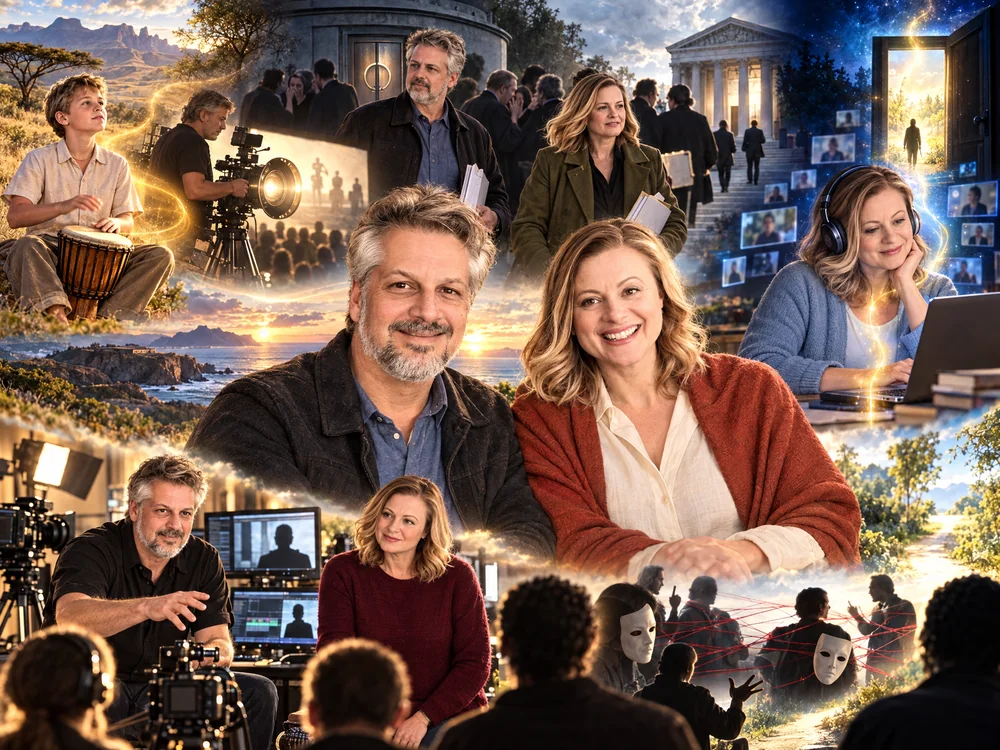
Mark Vicente and Bonnie Piesse Transcript: Narcissism, Cult Recovery, Spiritual Awakening, and Discernment
Mark Vicente and Bonnie Piesse interview
Rough draft
Bonnie Piesse: Because one of the things that they talk about in narcissistic abusive relationships when it comes to romantic relationships, you’ll hear a therapist say to somebody, “If you feel this terrified excitement when you’re around somebody, that’s not necessarily healthy. You think that’s love. That’s not love. That’s passion and lust and terror and a whole bunch of things altogether.”
Rick Archer: Welcome to Buddha at the Gas Pump. My name is Rick Archer. This is our 17th season of interviewing spiritually awakening people. There are over 700 of these on the website batgap.com and on the YouTube channel. So if this is new to you, check out the previous ones. The whole thing is supported by appreciative listeners and viewers. There are no ads anywhere except at the beginning of the YouTube video there’s an ad which you can skip but we don’t run them during the podcast. This morning I was listening to a podcast in the shower and a whole bunch of ads came on and I couldn’t switch it because I was all wet and I thought I’m so glad I didn’t put ads in my podcast. Anyway we’re supported by appreciative listeners and viewers so if you appreciate it and like to support it There are PayPal buttons on every page of the site and a page with alternatives to PayPal. My guests today are Mark Vicente and Bonnie Piesse. They’re going to tell us their bio sketches in a minute, but let me tell you how this arrangement came about. So 15 and 13 years ago, I interviewed a fellow named Bentinho Massaro twice, and then two years after the second interview, I took his interviews down because I realized he was kind of going off the rails. I engaged in some email correspondence with him, along with several spiritual teachers. He would write very long responses to emails, which my eyes would glaze over. But at one point, he said, “I’m perfect, and I don’t make any mistakes.” So I thought, “All right, that’s the end of this attempt,” and I moved on. But in any case, a couple of months ago, someone brought to my attention that there was a series about him on YouTube called Insta@Guru by a fellow named Mark Vicente. So I started listening to it and found it fascinating, especially since I knew Bentinho. And I’ve listened to all the episodes. And then as I got to know Mark, I reached out to him, and we ended up having a couple of nice phone conversations and decided I would like to interview him. And then I realized that he was the filmmaker of “What the Bleep?” Do We Know?, which I had watched many years ago, and that he was also involved in the NXIVM cult and in a documentary called The Vow, as was his wife Bonnie, who’s with us today. And so I watched that in its entirety. And that got me more and more fascinated with the subject of narcissism, also because Mark has recently made a movie, which I just watched yesterday, about narcissism, called The Narcissist’s Playbook. And then I started listening to a Dr. Ramani, who features in that film, who’s an expert in narcissism. And the reason this interests me so is that for years I’ve been concerned about the issue of spiritual teachers taking advantage of their students sexually, financially, working them to death without pay, things like that. And that really cuts to the quick because I regard spirituality and the aspiration towards it to be extremely precious in a person’s life. And if a predatory person takes advantage of that really sublime aspiration to achieve higher degrees of spirituality, it’s a severe assault on something so tender and deep in a person’s life. I know people, literally, who have—I knew people who have committed suicide because they were so disillusioned by being the recipients of that kind of treatment. So about eight years ago with a couple of friends, I helped to found an organization called the Association for Spiritual Integrity. We have over 800 members now and about 60 member organizations, and we’ve given presentations at Harvard Divinity School and the Parliament of World Religions and other venues. And it’s puzzled me because sometimes these spiritual teachers are really impressive in certain ways. They’re charismatic. They’re eloquent. They seem to radiate an aura of Shakti, of spiritual energy, and you easily get wowed by them and enamored of them. And yet then you find that behind the scenes, things are happening which are really quite unsavory and which probably would land them in jail if they were fully exposed. Or at least would cause them to lose a lot of their followers. So I keep pondering the discrepancy between the public appearance of many spiritual teachers and their private lives and why they could behave that way if they apparently had achieved such a high level of spiritual realization. Anyway, that’s what attracted me to this whole conversation. And enough from me, I would like Bonnie and Mark to introduce themselves, and in the context of doing that in our subsequent discussion, you’ll see why what they’re doing is extremely relevant to what I just said. Who wants to go first? I think Bonnie wants to go first.
Bonnie Piesse: You want me to go first?
Rick Archer: Okay. Yeah. Who’s first?
Bonnie Piesse: Hi, I’m Bonnie. I guess my labels would be I’m a singer-songwriter, sometimes actress, spiritual mentor, life coach, and cult escapee, and whistleblower. I haven’t pursued talking about cults and narcissism as much as Mark has. It’s been a real mission for Mark, and you can say that. I kind of had a spiritual awakening that got me out of a cult, and so for me, that’s what’s been powerful to talk about and help people with. But yeah, the whole cult story is a huge part of my journey and an important topic. And I don’t talk about it publicly that much anymore, Rick. But it feels important to talk to you about it and also my spiritual awakening came from watching a bunch of your videos in 2016.
Rick Archer: Oh, really? Wow.
Bonnie Piesse: Yeah. I was obsessed. I listened to so many of them and it led to a huge Kundalini awakening.
Rick Archer: Cool.
Bonnie Piesse: That just like disrupted everything.
Rick Archer: So you’re in my downline in the great cosmic multi-level marketing scheme.
Bonnie Piesse: Yeah, thanks for that. It made a big difference. So really, you’re actually partially responsible for the downfall of the cult.
Rick Archer: Wow! Fantastic! You know, as I was watching The Vow, the movie about NXIVM cult, the scene came where you started to have this gut feeling that something was wrong. And I thought, “Okay, right on, Bonnie. She’s the hero of this film.” Because Mark was still in it, Hook, Line, and Sinker, but you went against all odds, against the stream, to stand by the conviction, the intuitive conviction that was dawning in you that there was something seriously wrong there. I commend you for that.
Bonnie Piesse: Thank you. Yeah, I started listening to my intuition again.
Rick Archer: To what? Your intuition? Yeah, yeah. And you didn’t mention, but you have, well, you mentioned you’ve been an actress, but you’ve been in some Star Wars movies, Attack of the Clones, Revenge of the Sith, and Obi-Wan Kenobi, and something called My Favorite Girlfriend, alongside Tyler Johnson and Michael Nouri. I’m afraid I never got, I watched the early Star Wars movies, and I think it was after Jar Jar Binks made his debut that I kind of lost interest. So I haven’t seen some of the newer ones. Okay, so Mark, about you.
Mark Vicente: All right, so Mark Vicente, filmmaker. I was born in South Africa. I grew up in a country that was a little bit messed up. Some of you may know that. I had a lot of issues with the things I was seeing as a child. And my mom was the black sheep of the family. So she was into all kinds of sort of of spiritual woo-woo stuff, and so I had a lot of influence from her. I began to reject some of the more Calvinistic aspects of the religion that I was growing up with. But I became obsessed with, and I think because of the things I saw in my country even as a child, obsessed with how to change the country, you know, as a little kid, which is kind of weird. And I had this, I guess some kind of an awakening, I think I was eight or nine, I was listening to some Zulu music and you know, which involved a bunch of drumming and stuff and I was drumming along with it and I had this profound something that happened in my body, this rush of energy up my spine and I just began weeping for the joy of it and I thought to myself, if everybody could feel this feeling, the entire country would change. And so my obsession was how do I get everyone to feel this? And so I thought, well, I’ll just build very big speakers, but I think I was eight or nine So that didn’t work. And the speakers had to be very big because the country was quite big. And so cut too many years later, and you’ll see how this ties into who I married. I saw Star Wars when I was like,
Bonnie Piesse: Let’s say 13 and it blew me away.
Mark Vicente: And I saw it in Lisbon with my parents. And in that moment, I was like, Oh, this is this is how you this is how you reach people. You use movies. So my obsession was to become a filmmaker. maker. And I worked very hard in South Africa, worked my way up to camera department, eventually got to Hollywood, got a bunch of big breaks, got very, very disillusioned with Hollywood because I was just making a bunch of crap basically. And so began dreaming up making a film that could sort of address some of the issues I cared about and partnered up with some other people and that film became What the Bleep Do We Know, which had a real profound impact. I think the first version we came out, part one, was 2004. That had a really profound impact and I had been going from group to group to group and based on that film, a lot of people reached out to me and said, “Hey, your film’s amazing, all the stuff in your film’s incredible. We actually teach people how to do that.” And mostly I was like, “Nah, don’t. You guys are full of it. But I got this amazing email from this woman who said, “We’re putting together a symposium of scientists,” and that was my weakness, smart people. Fritjof Capra and this and that and whoever, all these different people. I was like, “This sounds fascinating. Would you like to come and meet us?” And so I met them, and they seemed very, very smart. And they basically said to me, “Hey, we’d like to help you with your mission, which is to change the world through movies. And, you know, they picked me up in a Learjet and flew me all over the country to go meet a bunch of scientists and said, “We’ll help you fund your movies.” And I was like, “This is super exciting.” And bit by bit, they enrolled me in their particular organization and their particular methodology and their particular tech, you know, which that was around 2005, 2006. And then 12 years later, through the help of my amazing wife, I realized, “Oh, this is a really, really bad organization. and the leader’s doing really, really terrible things to, especially the woman in the organization. And in 2017, we began our work to dismantle it and take it down, and eventually got law enforcement involved. It took a while. Massive federal trial, and the leader is now in prison for 120 years. He served five years of 120 years, so he will die in prison. That’s the very fast version of like, that brings us to the point.
Rick Archer: Yeah, I was riveted by The Vow. I just, I didn’t realize the extent to which you and Bonnie were featured in it until I started watching it. And then I just really got into it. And also, you know, Sarah Edmondson and Nippy Ames, who I’ve started listening to their podcast A Little Bit Culty, and would like to have them on BatGap sometime. But it was very educational for me. So, um,
Mark Vicente: Dark as well. Very dark. Yeah. It’s a rough ride. Yeah.
Rick Archer: But it took a lot of courage actually, because, you know, there was a lot of peer pressure for you not to blow the whistle like this. And a lot of people who were, you know, thought you were crazy and so on. And, um, there was a lot of legal, um, attacks. Uh, I think at one point you were kind of underground so that you couldn’t be served subpoenas or something because they were going after you.
Mark Vicente: For quite a while, yeah.
Rick Archer: Yeah. So anyway, I commend you on your courage and persistence. And I think the whole thing, I told you this in one of our phone calls, but I had the feeling like you had to go through that in order to make this movie and to educate yourself on the new movie you’ve made, because it’s really going to help a lot of people. And you couldn’t have done it if you would just examined it objectively from the outside. You wouldn’t have had the intimate Appreciation of how these things work that you that you now do
Mark Vicente: 100% 100% It was actually Bonnie was the one who gave me the idea to make Narcissist’s Playbook
Rick Archer: Great
Mark Vicente: I think it was after the trial end of 2019 Because she was the one that was explaining to me, you know Having me read articles and look at different movies and things And she said you should make a film about narcissism. I was like, that’s a great idea, you know, so I partnered up with some of my producer friends, but it’s been a long ride. We’ve taken five years to make this film and part of the reason that it was so important and Bonnie said like she’s not as interested in these topics as I became obsessed with part of the reason I wanted to make the film was because In some ways I was trying to answer the question for myself like how did I get fooled? Yeah, how did I not see this and I realized part of the reason is because I was never trained to see these things So I began, you know reading and listening to people that were narcissists psychopaths to see how they operated and To some degree that making the film has been therapy because you know I interviewed four self-confessed narcissists who basically tell me what they feel how they operate what they don’t feel What they do to people why they do it to people why they like doing it to people people. And in some ways, that was, those were proxy interviews because my cult leader never admitted anything. In fact, he maintains to this day a sort of messianic delusion about him being a very special human being that’s just misunderstood. In fact, he reached out to me from prison a few years ago via somebody else saying, “You know, I’d like you to tell the judge you made a mistake.” That’s the level of delusion we’re dealing with.
Rick Archer: Oh, sure, Keith, anything you say. After that whole fight. Right. Get right on it. So, let’s not presume that everybody understands what narcissism is. And as much as I’ve studied it, which is 1% of how much you’ve studied it, I still don’t feel that I appreciate all of its nuances as much as I would like to. So let’s lay it out for people. What is narcissism?
Mark Vicente: Yeah, so the DSM-5 Diagnostic Statistical, I don’t know. DSM-5, whatever it is.
Rick Archer: The thing doctors use to keep track of all this stuff.
Mark Vicente: They have these nine criteria and they say if you have five of these nine things I knew you’re gonna ask me this question and I can’t memorize them. So I have them up here There’s an acronym called special me So number one sense of self-importance number two preoccupation with power beauty or success number three, they’re entitled Number four can only be around people who are important or special five interpersonally exploitative for their own gain six arrogant seven lack empathy eight must be admired and Nine envious of others or believe that others are envious of them So they say if a person displays five out of these nine on a consistent basis Likely they have narcissistic personality disorder. So that’s Basically what it is
Rick Archer: Okay, and as Dr. Ramani said and she’s someone will probably be referring to throughout this interview and she’s in your Your film she’s an expert on narcissism. There’s a spectrum, you know, you’re not either Narcissist or not narcissist there are degrees of it and you know degrees of severity Right.
Mark Vicente: Yeah, it’s interesting. I’ve had a slight change of heart about some of that Because I’ve spoken to a lot of clinicians now. There’s there’s one particular person who’s done a meta study and they say look You’re either predatory or not. I was like, okay, that’s that’s kind of binary, but that’s kind of true I think the issue with the spectrum discussion is that sometimes people say well everybody has narcissism And I don’t think that’s true. Like I think that you can have a healthy ego You can have ego boundaries. That doesn’t mean you’re you’re narcissistic, you know narcissism implies a kind of fragile ego that wants to do to others whatever it wants to do in order to maintain that false sense of self. And I don’t think that’s the case with everybody, you know. So that’s my only thought on that one, you know. But yes, generally…
Rick Archer: – Once you get into narcissism territory, then there’s a spectrum of mild, medium, and severe.
Mark Vicente: – Absolutely. Absolutely. All the way up to like dark tetrad territory, yeah.
Rick Archer: Okay. Do you think that narcissists tend to be more abundant in certain communities or organizations than in the general population?
Mark Vicente: Yes. Yes.
Rick Archer: And Hollywood? Yeah, Hollywood, politics comes to mind.
Mark Vicente: Yes. Yes. And unfortunately in spirituality. Yeah. when I look at leadership in spirituality. Look, I think there’s some people that have latent tendencies and they suddenly have some kind of awakening in something and something gets fired up. And this is something Bonnie and I talk about a lot. We can talk about this in great detail ’cause we’re fascinated at this. And then there are some that they see the amount of fuel that they can get in the spiritual world. And so they mimic or model some kind of a spiritual leader in order to get that power.
Bonnie Piesse: I think there’s lots of ways it shows up, but there’s a lot of it in spirituality. A lot.
Rick Archer: Yeah. Do you think that narcissists tend to rise to positions of leadership or authority, or are they content to be followers or mere members?
Mark Vicente: Oh, they crave it. They crave it. Crave the authority. Yeah.
Rick Archer: Yeah. So they would be restless if they had to just be one of the foot soldiers. They kind of need to climb the ranks of the hierarchy.
Mark Vicente: Yeah, because they’re, you know,
Bonnie Piesse: They’re being underappreciated if they’re just following, you know, nobody, nobody understands my greatness, you know, so I got to work my way to the top. And I also think they desperately need control. And I think in the most severe cases, you know, when they have messianic delusion that they need to be God and they need to have subjects. Power.
Rick Archer: Yeah. The best place to get power is leadership. – Yeah. – Yeah, and in spiritual communities, I mean, you literally have people waving puja lamps in front of you and washing your feet in some cases and giving you flowers and prostrating and all that stuff. And unless you’re a really humble person, that can go to your head. – Right.
Mark Vicente: – That’s interesting. I do, I wonder about that a lot. You know, you know that the old adage that, you know, money is the root of all evil. I don’t believe that. I believe that it may expose who you really are. And I do wonder about that adoration. Like, I feel like it exposes, like, who you are, I think. Yeah.
Rick Archer: It happens in politics too.
Mark Vicente: Because like some people are terrified of… Yeah.
Rick Archer: But it’s kind of written into the formula in some cases in spirituality. You know, you’re supposed to honor the guru as God. Literally, you know, the scriptures say that. And Keith Raniere, as far as I understand, actually sent someone into an ashram. You might know more about that, Mu. Sent someone into an ashram to like look at the guru. Yeah, he was getting ideas.
Bonnie Piesse: I think he then went to the ashram. Did he? And then he began to diddle a bunch of, or try to, with a bunch of the female students and he was kicked out. Of course he did. Of course he did.
Rick Archer: Keith did or his emissary?
Bonnie Piesse: I think he did. As far as I know, he went and then he… apparently he was so enamored by the amount of power the guru had, but then he started to try to diddle some of the female students
Mark Vicente: And at that point they kicked him out.
Rick Archer: Yeah. In one of our phone conversations, I was telling you about this idea that Joan Shivarpita Harrigan, whom I interviewed years ago, explained to me, which is you can have a genuine spiritual awakening, but the kundalini, if you want to explain it in those terms, can get sidetracked into what is called a deflected rising, where it has risen up through the series of chakras without having fully purified each one, such that you are gifted with eloquence and charisma and intellectual brilliance and other such qualities. cities, if you know what cities are, kind of supernatural powers, but you are not enlightened even though you are convinced you are and you give the impression to others that you are. And so inevitably there’s a downfall when this has happened. I don’t think this is necessarily universally an explanation for some of these charismatic teachers, but I think it very often may be in some of the cases.
Bonnie Piesse: I wonder though, kind of like what Mark was saying, I think a lot of psychopaths will get into these realms and have awakenings and of course they get all that power or whatever with the Kundalini. But I feel like then a psychopath will go and do a certain thing with it where someone who didn’t have that mentality wouldn’t ever do that. I wonder if it does just reveal what was there and it kind of plays out differently.
Rick Archer: Yeah, I think you’ve got something there because not everybody experiences a huge explosion of grandiosity. They don’t all develop this sort of mega spiritual ego. It doesn’t go to their heads. They manage to remain humble and they manage to realize that they still are a work in progress and they continue to work on purifying and refining their whole mind-body behavioral system.
Bonnie Piesse: Yeah, I mean, in my awakening for sure I had a moment where I was like, “That’s it, that’s everything. We’re done here, all good.” So I for sure had that moment, but there was nothing in me that wanted to go and start exploiting people. So that’s interesting for me, that with some people it would really ignite that in them.
Rick Archer: Yeah. So we’re actually answering some of the questions I had written down by talking about this stuff. So one point we may have covered now is that spiritual communities might be particularly vulnerable to having narcissistic leaders, because Because narcissists are attracted to a community in which they’re going to be admired and praised and even worshipped and so on, in which they are considered to be infallible. I mean, I mentioned that thing about Bentinho saying he never made mistakes. There’s another guy who I had interviewed years ago, and he was at my second most popular but I took it down because a couple people had visited his ashram in Mexico and were lucky to get out of there with their lives. They had had medical emergencies which were ignored, and they kind of saw the backroom dynamics of what was happening. It was like, if you’re working in the kitchen, you wanted to try a different kind of salad dressing. Oh, no, no, we have to check with the leader. Only he can make decisions. He knows best. We can’t think for ourselves. people were literally saying that. That was baked into the culture.
Bonnie Piesse: Yeah. Total control.
Mark Vicente: We had the same thing. We had the same thing. Yeah, well, a lot of people, I mean, Bonnie and I found this, we’d say, “Well, what if we do such and such?” And they’d say, “We have to ask Keith.” I’m like, “Why?” Like, “We’re going to go fly somewhere or travel somewhere. I have to ask Keith if I can go.” Like, why? Like, why do you have to ask him? Just go. We were very puzzled by why there was so much checking with him.
Bonnie Piesse: And I guess for the women who were close to him, they actually did have to check, like they would get severely punished if they hadn’t checked with him. They actually, according to their vow or whatever to him, they needed to get his permission.
Rick Archer: Huh. So, there will be a number of points in this conversation in which I might want to pause and say, “Okay, what’s the lesson here for somebody who might be in a spiritual organization or thinking of getting into one, what can we do to give them the spidey sense to spot this kind of thing if it exists and not get involved? So based upon what we’ve said so far, what are the clearest warning signs that someone is using spirituality as a cover for narcissistic control that people can add to their toolbox so as not to be taken advantage of?
Bonnie Piesse: I can think of one thing that’s kind of intuitive, because I’ve experienced this with multiple cults or situations where there’s someone controlling things, is it’s just a feeling of tenseness. Everyone’s kind of-
Rick Archer: You feel uncomfortable, unpleasant?
Bonnie Piesse: Yeah, like everyone’s kind of uptight. It’s like you can feel the control, it’s palpable. And it very much feels like everyone’s referring back to the leader. I would say that’s one thing just that and not that people can’t be stressed and tense, you know, for other reasons, but it’s like this, the organism has like a control feeling.
Rick Archer: Yeah. Okay. Mark, do you want to add to that?
Mark Vicente: I mean, that’s actually a great one because I’ve been thinking about, you don’t realize it when you’re inside, but like you’re walking on eggshells constantly because there are all these, it’s funny, Raniere even talked about this invisible barriers. Like he once wrote this paper about like, you know, when you have a dog with those electric fences, fence things, and eventually, you know, the dog doesn’t run because it gets zapped and eventually you don’t need the fence anymore. And I was thinking, yeah, but that’s kind of what he did with us. So there are these edicts. Some of them are not explicit, but you know, you can’t do certain things. And everybody’s very careful with their language. I see it even today in culture. Everybody’s terrified to step out of line. That is a huge red flag. Like, step out of line? What line? Like, why? Why can’t you just be free to say whatever? Why can’t we discuss ideas? So I do think that’s a huge thing. And also, if you go against the narrative, do you get punished? Do you get ostracized? Do you get shunned? And most people don’t realize because they’re so entrained to the narrative that they don’t realize there is a narrative. They just think this is just the way that they are. But if you break, you push against the prevailing narrative and there are consequences, that’s a huge problem. Huge problem. Even with a question. Even with a question. Yeah.
Rick Archer: Yeah, one thing that I’ve really come to appreciate having been in two rather cult-like organizations and having interviewed all these people and become aware of all these groups and all this stuff is the importance of cultivating critical thinking capacities or skills on the spiritual path, which doesn’t mean you have to be skeptical of everything, but it means you have to, like like you were just describing, feel free to analyze and dissect and discern and discriminate and play with ideas and not take anything just because someone says it. In fact, there’s a quote from the Buddha. He said something like, “Don’t believe something “just ’cause it’s in some old book “or because someone says it, “or even if I said it, don’t believe it.” You know, just kind of use your mind, use your own discernment to see if it measures up or not against your own experience.
Mark Vicente: That’s a good point. Yeah, that’s a very good point. We should be, I mean, you should, here’s the other thing that’s funny in our particular, in NXIVM, we were taught critical thinking, we were taught logic skills, we were taught all those things. But it was in a, there’s a, there’s a call to expert called Janja Lalic and she wrote a book called Bounded Choice, which I think is a very accurate term. So you’re doing critical thinking in a bounded area, but don’t go outside that area to do critical thinking. So you think you’re very logical, and there are different organizations that think that they’re very good thinkers. But they’re very good thinkers inside the box, but not outside the box, and they’re not philosophically adaptable to where they can step outside the box and question the box.
Rick Archer: Yeah, you couldn’t have said to the whoever was leading the critical thinking class. Okay, like in today’s class Let’s analyze everything Keith Ranieri says and decide whether or not it’s valid
Bonnie Piesse: Absolutely, not you’d get thrown out Rick
Mark Vicente: You’d get thrown out and you’d be called a suppressive Yeah, you’re having suppressive thoughts like anytime you had any negative thought about the leader. That was that was suppressive. Yeah What do you mean? That was what do you what are you talking about? I can’t have doubts. No, no know why because well he’s the greatest example of ethics that’s ever lived. So you’re now questioning ethics.
Bonnie Piesse: Yeah, that’s where the gaslighting is too because then it’s turned back on you of like you might want to look at what your issue is that you have to question there.
Rick Archer: Yeah, like there’s something wrong with you because you’re doubting Thomas. Yeah, not just giving tribute. Okay, now as we go along here, don’t limit yourself to responding to questions I think to ask. If something comes to mind and you want to go off on some tangent or something, it’s fine with me.
Mark Vicente: I do actually want to bring one thing up that Bonnie and I have discussed at great length. And Rick, I brought it up to you I think in a phone conversation. We both assumed for many years that spiritual enlightenment or some kind of a peak experience or some kind of awakening implied morality and goodness.
Rick Archer: Oh man, this is a big one. Keep going.
Mark Vicente: Right? And Bonnie and I really, really felt this. And then we began to question, like, well, what if that’s not true? Which was a huge thing for us. Because I had a conversation with Raniere once where I said, you know, he said to me something like, well, what if you just abandoned morality?” And I was like, “Okay, well, okay, let me try that.” So, and I went into a very deep place of meditation inside myself, and when I reached in there, I felt love. And so the next day I took a walk with him and I said, “Well, I could abandon morality and I can go deep inside and I experience love, and therefore morality emerges out of that place.” And he was like, “Oh yeah, of course, of course.” And I later realized he was full of shit. He didn’t know what the hell I was talking about. But the experience that Bonnie and I have had of deep connection, there is connection with all things. There is a feeling of goodness that’s so sublime that sometimes there’s tears. And so we never thought that those experiences don’t imply morality and are not about being good. What if a psychopath can have them. And that was a pretty big deal for us to understand that.
Rick Archer: Yeah. Bonnie, did you want to add?
Bonnie Piesse: Just that it’s still hard for me to understand. I’ve seen now many cases where I think people have had awakenings and then gone to do horrific things. And so, yeah, in my experience of going within, like what Mark was saying, it just kind of cracks open gratitude and appreciation and love and all of that. And so for me, it’s still hard to imagine that, like, if someone’s feeling that, then how does that cause them to go and do horrific things? But I do think that’s a reality.
Rick Archer: Yeah. My answer to that, and I’ve given it a lot of thought too, is that awakening is not an absolute term. There are degrees of awakening and there’s no end to it. And, you you know, having had some profound awakening doesn’t mean that you’ve completely purified your whole personality and your whole mind-body system. There’s one of my favorite quotes is from the Buddhist sage Padmasambhava, who said, “Although my awareness is as vast as the sky, “my attention to karma is as fine “as a grain of barley flour.” – Totally. – Yeah, so he’s saying basically, “Hey, I’m a pretty cosmic dude, but I could screw up, “you know, so I have to be careful.” Yeah, and it heightens everything. It kind of puts a magnifying glass on everything, for sure. So perhaps the takeaway point from this one is, well, Carlos Castaneda’s teacher, if he was a real person, said something similar. He said, “A warrior,” by which he meant a spiritual aspirant, “has time only for his impeccability.” And he was constantly emphasizing self-scrutiny and precision and being careful in your behavior, not being sloppy or taking liberties.
Mark Vicente: Yeah, you know, Rick, you mentioned anything that comes to mind. I want to quickly go back to something that you talked about. Well, what are the warning signs that you can see? And I do think there’s something else, and this is not a popular one for some people, but I look at sort of codependency. I’m not a fan of that word, but I look at in different times of my life, I was looking for somebody to give me the answer to all the internal confusion. Maybe a big daddy or a big mommy or a big something or a big angel or a big whatever. And so I think there’s also that, like when you find yourself in a situation, whether the thing in front of you is good or bad, but you’re looking to that symbol as though that is your salvation, as though you are nothing and that is everything, that’s a huge warning sign. You know, whether or not the thing is good or bad, that opens you up to so much potential abuse because you’ve literally, the locus of control is so far outside of yourself and somebody else is the salvation. And I think that’s super dangerous.
Rick Archer: Yeah, it’s a good one. This kind of relates to what you just said. In spiritual communities, people are inclined to be or are trained to be compassionate, non-judgmental, and forgiving, and this might tend to increase their vulnerability. So let’s discuss how those qualities could actually be manipulated by a narcissistic teacher.
Mark Vicente: Yeah, go for it.
Bonnie Piesse: Yeah, that’s where the self gaslighting kicks in. So within the system, it’s like the gaslighting happens where, for example, as we were saying, if you question the leader, then it’s turned on you of how is this your issue? And the fingers are all pointing at you. And within that kind of a system, you are super encouraged to be responsible and to look at yourself and really take responsibility for things and doubt yourself, actually. And there’s this self-gaslighting that kicks in, which doesn’t allow you to actually see what’s in front of you. Because if you see something, you’ll immediately be like, “Well, but how am I doing this? How am I responsible?” And so that doesn’t allow you to actually point the finger where it needs to be pointed.
Rick Archer: Yeah. Another way I would put it is that there’s very often an explicit teaching that the teacher in a group knows best and sort of has the enlightened vision and thereby implicitly you’re encouraged to doubt your own vision. If this teacher is doing something that you consider to be off kilter, you’re likely to think, “Well, you know, but he’s supposed to be enlightened and I’m not, so So who am I to say, I guess I’ll just keep sitting here and it must be crazy wisdom or something.
Mark Vicente: Yeah. Yeah. And also like this thing about, I was just thinking about this, thou shalt not judge. Why not?
Bonnie Piesse: Who said thou, who said you shouldn’t judge?
Mark Vicente: Well if you’re judgmental, you’re not a good person. Who said? Who said that those things, two things equal each other? They don’t equal each other. So that’s interesting to me. I’ve seen people leave, let’s say, Calvinistic religions, and then they go and embrace some New Age whatever. It’s basically the same pattern. I shouldn’t judge. I shouldn’t judge. Everybody deserves a fair this, that, or the other. Instead of saying, as with Bonnie and I, now that we’re out of these situations, we’re like, “No, call a shitty thing a shitty thing.” If you are unable to use your moral compass and decide what’s good and bad, that’s a huge problem. You know?
Bonnie Piesse: Actually, Ranieri told me that I was the most judgmental person he’d ever met.
Rick Archer: Oh, congratulations. Now I take it as a compliment. But he was very serious that that was a really bad thing. I suppose there could be healthy and unhealthy forms of judgmentalism. know, a person could have really good discrimination and think, “Oh no, something’s off here, you know, this is wrong.” Or on the other hand, they might just be bad-mouthing everybody and everything,
Mark Vicente: You know, making a scene. Yeah, but the act of just having discretion, I don’t think that’s bad. I mean, also, there’s words for bad judgment. Like, you know, if you’re racist and you assume all people of this, you know, persuasion are this whatever, that’s a stupid kind of judgment.
Bonnie Piesse: Yeah,
Mark Vicente: I think discretion though. Yeah, prejudice. Thank you very much. Couldn’t think of the word. Discretion is very, very important. And I feel like, especially when, you know, we first enter the world of spirituality, you know, we’re swimming in all this ocean of wonderfulness and stuff. And like discretion sometimes goes out the window, you know, because people use the right words or they, you know, sing the right song or whatever. And it’s all just very floaty. And I think there’s something about growing up, individuating, and like having a real sense of yourself and what you like and what you don’t like. It’s one of the things that anybody who’s ever left a cult or left an abusive relationship, especially narcissistic abusive, the therapist will often say to them, “What do you like? What do you not like?” like and they can’t say at first because they don’t know. Because the compass has gone offline. So they have to try to re-find the compass and re-find what they like and what they don’t like because often, let’s say in a cult, the thing that was bad they were told was good. Like them not having boundaries and being abused they were told was good. But objectively it’s bad and they have to re-find that distinction, you know? Yeah.
Rick Archer: You want to comment on that Bonnie or are you good for now?
Bonnie Piesse: I was just thinking about the boundaries thing because towards the end, when I was starting to try to fade out and plan my exit, I started having more boundaries. And they were working us around the clock, like 23 hours a day at one point for me. And so we’d be in these trainings and then after the trainings, there would be this obligation to have a meeting or do something else. And I remember one training. I was in a team and they were like, “We’re all gonna meet at lunchtime,” and I said, “No, I’m not gonna come.” And then there was like this silence, like, “Oh,” talk about tension, like, “Oh, she’s not gonna come.” And then I got some feedback from a higher rank later via a message saying, “You know, you might want to look at this,” because it came across as very rigid. I know that you’re trying to reach the next level on the Stripe Path, which was kind of the career path. And that was really used against me of like, if you want to get to the next level, you can’t have a boundary.
Rick Archer: One thing you said just there is this sleep deprivation thing. A lot of cults use that where everybody gets exhausted, and then you’re more malleable, you’re weaker, you’re foggier, you don’t have clear judgment, you’re more easily manipulated. Totally. Yeah, you’re not right in your head at that point. You can’t think things through, and you’re very wishy-washy. People can definitely control you more at that point. And another thought that comes to mind, I’ve heard you guys discuss it and I’ve also thought it over the years, is that people who get involved in cults, first of all, they don’t know they’re in a cult but, generally, but secondly, they’re not necessarily bug-eyed zombies. They could be be very highly educated, accomplished, intelligent, creative people who’ve already done significant things in their lives, but they’ve gotten sucked into this thing without even realizing that it is malignant in some way. And I guess you two would just define yourselves that way in the next thing. So let’s address that thing, ’cause a lot of people might be thinking, this would never happen to me, you know, because I have a PhD in chemistry or something and, you know, I’ve had a successful business. I couldn’t get drawn into a cult.
Bonnie Piesse: Yeah. Was it Janja Lalich who said, “You just haven’t met your cult yet?”
Mark Vicente: Yeah. Yeah. Yeah. You know, it’s funny. People in intelligence, CIA, NSA, whatever. understand everybody has their weakness. Everybody has the thing where they’ll break or the thing that they want. And so they’ll use whatever leverage based on they’ll do an analysis of a person they’ll use whatever leverage they can on this person. Maybe family’s everything to them or this is everything or they’re very, very ambitious. You know, ambitious people can be can be played. So they figure out like what you want. They’re very, very smart people. scientists, let’s say for instance, and somebody wants to, some intelligence agency wants to get them. They just figure out what they want. You know, are they in debt? What’s the situation? What do they want? Fame? So in the case of, you know cults, they do study people. They studied me. They had meetings about me. They read all the, anything I’d ever written, any interview I’d done, any radio stuff.
Rick Archer: You mean before you came in, they were learning about you in order to lure you in?
Mark Vicente: They spent a weekend profiling me to figure out what I want. And in that case, what I wanted, more than anything, is I wanted to find a way to make the films that I thought would impact the world. And I was at the top of my game. I just made what the bleep, it was out in the world. People were like, there was accolades all over, but like I wanted more. I wanted to have more reach. And this was my mission in life. And so they figured out what my mission was. It didn’t matter whether I was smart or not. I had a yearning. It was almost a limbic yearning for something. They figured out what it was and they offered me my dream. So I think that no matter how intelligent you are, if intelligence agencies can profile you and find your weakness, so can a cult. It’s, you know, it’s not that different. So everybody has something that they need. Something that they can, some place they can be gotten. And so the way I talk about it, you know, some people say they get you by the balls. They got me by my values in my case, my dreams, the things I wanted to do, the way I wanted to be an artist, the way I wanted to use my art to improve the world. That’s where they got me. Um, you know, for, for Bonnie, it was different. I mean, for everybody it’s different, but I don’t think anybody’s immune.
Rick Archer: You want to say anything, Bonnie, before I ask another question?
Bonnie Piesse: Yeah, just that we all have different areas of lives, like some where we’re strong and clear and confident and others where we’re feeling lost. And so like one person could have an amazing career and be at the top of their game, and yet they struggle with something in relationships or maybe they’re just feeling empty and they’re, you know, spiritually seeking. And I feel like those are the points where we’re vulnerable.
Rick Archer: We’re open, we’re looking. Another thing about cults is that they have concentric circles. So the outermost circle might be the public facade that they want people to see and it can seem so attractive and interesting and all that, but if you could go right to the innermost circle you could see all kinds of crazy things going on, like in the case of NXIVM women literally being branded with some kind of a hot iron or in Bentinho’s case all these drunken parties and whatnot that go on. There was a funny story in one of the InstaGuru things about Bentinho where he had been up all night smoking cigars and drinking and the next morning he had to he had some expensive retreat he had to what $15,000 for the weekend or something. He was supposed to be there and give the talk and somebody was, I forget the guy’s name, was trying to wake him up. Come on man, you got to get downstairs, it’s time for the meeting. And finally he got him to get up and he went downstairs and he just, you know, he was hungover. He sat in his chair with his eyes closed for about half an hour and everybody in the audience was like, “Whoa man, look at the, that’s really feel the vibes, it was profound, you know. He was just trying to get… – Because he took a nap. – Yeah, he was just trying to wake up so he could talk.
Mark Vicente: It’s actually interesting that moment as well because, you know, he just stared, he kind of closed his eyes and then sometimes he stared at people and I thought it was interesting because this is us, you know, like the good people are busy projecting all kinds of stuff onto the person, like, “Oh my God, he’s so deep, he’s so still, it’s like this endless pond of still water or lake or whatever.” And I keep thinking about, Bonnie and I talk about this a lot, like we’re literally exporting who we are and our experiences into some other person who may or may not be feeling those things. And this is the other thing about the certainty that some of these leaders have, you know, we look at the certainty. Now, the certainty might be psychopathy. It might be a complete lack of anxiety. Psychopathy at the extremes, there’s no anxiety whatsoever. So we look at that, and I believe that I mistook that for depth and profound spiritual awareness. And then later I realized, wait, I was exporting my own depth and my own spiritual awareness on a block of concrete, basically. thinking that the concrete was deep and profound because it had no anxiety, for instance. That is good news as well. Because that means like, oh, if I’m the projector and I’m projecting myself, then I am that thing already, perhaps not expressed as I’d like to yet, but I have it. They don’t. That’s the good news.
Rick Archer: Yeah, I actually formulated a question about that. Could narcissism imbue people with spiritual intensity or confidence, which might be mistaken for genuine realization? How can a community distinguish between healthy confidence in a teacher and narcissistic grandiosity?
Bonnie Piesse: That’s a good question. I don’t know, I just want to say like healthy confidence feels grounded to me somehow. Whereas with a narcissistic person, you can feel like there’s a real attachment, like a need to get the admiration or something that feels different to me.
Mark Vicente: I like that. I think there’s a show with that kind of narcissistic impulse, there’s a show. Like I’ve been in a bunch of different spiritual groups where sometimes the leader will come in, it’s a massive show and there’s like sound and music and lights and whatever and chanting and verses like somebody who’s just very, who might be very still. And I do think there’s a frequency thing as well. Like the frequency of like, how does it feel? You know, not the frequency of you projecting a bunch of stuff on somebody that’s not there, but like, how does it feel being in that person’s presence. Because one of the things that they talk about in narcissistically abusive relationships when it comes to romantic relationships, you’ll hear therapists say to somebody, “If you feel this terrified excitement when you’re around somebody, that’s not necessarily healthy. Like you think that’s love. That’s not love. That’s passion and lust and terror and a whole bunch of things altogether. If you’re feeling that kind of giddiness around somebody. I don’t know if that’s good.
Rick Archer: Yeah, another thought that comes to mind is, I think if a person could have a lot of confidence and presence and so on, but it would speak for itself. They wouldn’t have to brag about it. They wouldn’t have to say, “I am the greatest ever. Nobody could do this as well as I can,” and you know, that kind of stuff. Which, you know, we can think of examples in politics where politicians sometimes talk that way, one in particular.
Mark Vicente: But here’s the thing, like let’s take that one in particular for a second. That’s obvious though. That’s easy.
Rick Archer: Yeah.
Mark Vicente: And grandiose narcissism, that’s easy. It’s the covert stuff. It’s the communal narcissism. It’s the people that run, you know, NGOs and charities and like do all these good things. That’s the tough stuff to spot. And we know that because they get unmasked at some point. You know, somebody who ran some benevolent thing turns out to be a complete schmuck. That’s the stuff that’s more difficult to uncover. And in the case of Ranieri, he never boasted personally, he had other people boast for him.
Bonnie Piesse: Yeah, he trained them.
Rick Archer: About his IQ and his concert pianist and all that business.
Mark Vicente: All that business, all that stuff. Oh my God.
Bonnie Piesse: Right, he wasn’t saying it. For the most part, it was all the people who had been trained To just say how amazing he was, how amazing.
Rick Archer: Do you think narcissism, or at least a certain dose of it, could ever be an asset that would enable you to be successful in a field where otherwise you wouldn’t be?
Bonnie Piesse: Yeah. I think we need some of it to be successful, for sure. Like as a performer, I’m thinking, I guess in some ways, I do really enjoy the craft or being on set or something. But I actually find it challenging getting tons and tons of attention, like, whereas some other actors might walk in and they just love it, like they lap it up. And so for them it’s fuel. And so their career is going to go further than mine in some ways. Not to say that I don’t have like some narcissistic traits either, but like on that scale, I think, yeah, you’ll get a great acting career if you’re just soaking it up.
Mark Vicente: There’s also something to be said for a certain amount of delusion, you know. Because you can sometimes achieve the impossible because you have this impossible dream and everyone’s telling you it’s not possible, it’s possible. You guys are idiots, I’m gonna do it. There’s something to be said for that self-belief, you know, like radical self-belief. I don’t know that it’s bad. I mean, I would have to look at the quality of what is their dream, you know. does their dream involve like harming other people but like they’re there I sometimes I think there’s a certain amount of delusion that might be very very good because if you take into account all the different obstacles that stand in your way you’ll just get frozen so there’s that.
Rick Archer: I’m just watching a documentary about Live Aid which was this big concert that took place in 1985 to raise money for the starving people in Ethiopia and it was it was spearheaded by a guy named Bob Geldof, who was a, you know, kind of a medium-level rock star whose career was fading. And he just bullied and lied and pushed, and he was just driven by this thing, because he was so moved by the plight of these people in Africa. And he, against all odds, he got this huge thing accomplished. But if he had been more mild-mannered and honest and whatnot, it wouldn’t have happened. Yeah, or if you’re willing to walk over people to get there as well, you know, a narcissist would be fine with knocking on people’s door. Yeah, he had all these rock bands lined up, or he didn’t have any lined up, and he kept telling all the other ones that all the other ones had been lined up, and so then they got on board because he said that they were kind of, you know, that kind of thing.
Mark Vicente: Yeah, yeah. I do think that in the case of presidents, pretty much, I think it’s universal. You have to be, you have to have a high level of narcissism to be a president or a prime minister or whatever, you know.
Rick Archer: So you think Barack Obama, Jimmy Carter.
Mark Vicente: Absolutely.
Rick Archer: Really?
Mark Vicente: Absolutely. 100%. Yeah. It doesn’t mean just because you’re a narcissist that you’re like, you know, you’re evil. But you have to have a high level of confidence. And sometimes confidence is that’s impenetrable, you know. Confidence is a good quality. I don’t know if there’s necessarily a Venn diagram overlap between confidence and narcissism. Can’t you be an extremely confident person and not be a narcissist? I think healthy confidence. I don’t think there has to be an overlap. But I think that, how should I put this politely, I think I mentioned my dad was in intelligence. Oh, yes, like a South African CIA kind of thing. Yeah, that kind of thing. So I think that presidents are also, they have their squad that presents them a certain way. I don’t think any presidents are squeaky clean. They have to maybe appear squeaky clean, and there’s a lot of people that do a lot of cleanup, and they have to make some pretty radical decisions. It’s funny, we talked about this the other day, I’m terrified of that level of power, terrified.
Rick Archer: Of that level of power.
Mark Vicente: Terrified. Oh my God. Just think about it. Like you make a decision and a hundred, you know, a hundred thousand people die. Like that’s just, I can’t live with that stuff.
Bonnie Piesse: I was also thinking like in the case of our “war,” quote unquote, I guess it was a war.
Rick Archer: Oh, we’ve won it so many times, but it seems to keep happening. Yeah. But like in bringing down NXIVM or getting justice. Oh, your war. I was thinking the one in Iran.
Bonnie Piesse: Yeah, well there’s lots of wars, but our personal one, I won’t name names, but there were a bunch of narcissistic people who were a part of bringing it down. I think they’re narcissistic, you know, but it was needed. It’s like sometimes it takes a certain kind of person to be dog headed and just like take down another narcissist. It’s interesting.
Rick Archer: Takes a thorn to remove a thorn, as they say. Kind of. Yeah, like a sensitive empath would not be as brutal. Yeah, I mean imagine someone like General George Patton being a sort of a sensitive empath, probably wouldn’t have worked.
Mark Vicente: No, no, no, exactly. I think though, you know, I think that just to go back to spirituality, I think that the damage though with these people, there’s a kind of opening yourself up on a very deep level, perhaps a soul level. And so when you get harmed in this area, it cuts to the sort of the very existential self and the hurt is so profound. I mean, I certainly understand that people in romantic relationships get hurt and it can affect their ideas of love and everything, but I feel there’s something about spiritual abuse that is so profound, the pain and the hurt that it causes, that some people don’t recover. And Bonnie and I have friends who’ve been through stuff like they just throw everything out and they never go back. They never wanna know anything about source, universe, awakening, anything. It’s just dead to them, and that’s very sad.
Rick Archer: – Yeah, that’s what I was saying in the beginning when I was introducing our talk today. It’s like I still believe that spirituality is the most fundamental and pivotal level on which we could influence the world. And if people are abusing their spiritual authority in a teachership role, they kind of sabotage that effort, which has serious implications for the future of humanity, not to sound grandiose. Yeah, it’s like the deepest wound that there is. Yeah, and I just took it to a world level, but on an individual level, we might believe that our spiritual evolution or enlightenment is the most precious thing that we could attain. And if that is being thwarted or destroyed by somebody, and if you believe in karma, there’s some pretty bad karma in there.
Mark Vicente: Yeah, and also, let’s take, I don’t know, a leader or a priest or something, you know, becomes, let’s say, the representative of the divine or the representative of God. When that person does bad things,
Bonnie Piesse: For somebody who believes in a God, then God is a cruel, merciless son of a bitch who should not be dealt with anymore. And that door is now closed. That’s just sad.
Rick Archer: It really is. That’s one of my big motivations in doing this show and in establishing the ASI. I just feel like anything that can be done to prevent that kind of harm should be done.
Bonnie Piesse: Yeah. But I was just remembering, before we actually really woke up and saw what was happening in NXIVM, both Mark and I did have a sense that some things were really wrong. And Nancy Salzman had been very abusive to me and triggered a whole bunch of PTSD and we were troubled about this.
Rick Archer: – She was Keith Raniere’s right hand person. –
Bonnie Piesse: Right. And so Mark and I were troubled about it and we saw a movie, do you remember which movie it was?
Mark Vicente: – Spotlight. –
Bonnie Piesse: Spotlight. And so we hadn’t pieced together that we were in like a religious cult or anything at that point, but we saw that movie and it really registered for both of us and we were like, “Whoa, it’s like we’re in an abusive church. And that was kind of one of the pieces that started to fall apart for us. Yeah.
Rick Archer: Good one. A question came in from a fellow named Christopher Slaymaker, and he actually sent me an email this morning. I think I’ll read it. He said, “Hi, Rick and Irene. I was just going to get on here and recommend Mark Vicente. What a fun synchronicity,” because he just saw on the website that I was going to interview you today. He said, “I think his work and his documentaries are so nourishing and relevant right now. I remember seeing your first interview with Bentinho Massaro and being so excited by the prospect of an enlightened guy younger than me for a fresh perspective on it, but I never kept up with his work. But it was still so shocking and disturbing to see how this kind of extreme narcissism can totally co-opt an awakening. I knew stuff like this was happening, but I feel a little naive now. Not only does it illuminate how I’ve been vulnerable to narcissists, which can be so confusing, but it also sheds light on my own much milder forms of spiritual arrogance. Such a clarifying moment. Thank you. And then his question, which you just sent in, is, “Do you think someone like Bentinho or Keith could ever snap out of it and just be honest?”
Bonnie Piesse: Don’t we wish?
Mark Vicente: I think it’s a beautiful question, and it’s a beautiful question because it assumes a kind of redemption. Yeah, that Christopher, that’s part of who he is, that he allows for that in his world. I don’t see it happening. There’s no reason for it to happen because their egos are, the fabrication they’ve created their egos is so delusional, I believe, that to let it go is to die. Because I don’t know if they know anything other than that false self. So it would be annihilation and there’s no reason they would want annihilation. That’s just my theory.
Bonnie Piesse: I think so too in the case of those two. But I was thinking, wasn’t there a guy, Rick, you probably know about him. Was it Andrew Cohen?
Rick Archer: Yes, I interviewed him. Yeah, yeah. So he had some wrongdoings and people came out against him, but I think he apologized. He did a pretty darn good job. job. He really humbled himself, got into therapy, did an ayahuasca journey, was driving an Uber for a while. He just sort of did what he had to do to kind of take himself down quite a few notches and make amends. I don’t know if everyone has forgiven him, but I think some people have. He’s probably one of the best examples of somebody doing an about-face.
Bonnie Piesse: Yeah, that’s amazing. I don’t think that’s possible for Raniere.
Mark Vicente: Yeah.
Bonnie Piesse: But that’s great. Yeah.
Mark Vicente: No, I think that’s because it sounds like I’m not sure who the Andrew is you’re talking about, but like, I think a lot of people that do that do bad things and then they experience true remorse. And I think there’s a pathway back when you experience true remorse, but I don’t see Raniere doesn’t have remorse about anything because he did nothing wrong.
Bonnie Piesse: Right.
Rick Archer: Right.
Mark Vicente: It’s us. We’re the ones that can’t see his genius. And the FBI. And the IRS. And the judge. And the jury. And the judge. And the DA. And like none of us could see because we just don’t have the capacity to see his brilliance.
Rick Archer: Your IQs are probably less than 200.
Mark Vicente: Way too low.
Rick Archer: I mean what are you going to
Mark Vicente: Do? Way too low.
Bonnie Piesse: Right, we’re so unenlightened.
Mark Vicente: We’re so unenlightened.
Rick Archer: Andrew Cohen made a documentary actually called “How I Started a Cult.” You might find it interesting.
Bonnie Piesse: Oh.
Rick Archer: Yeah.
Bonnie Piesse: We discussed Vikram, right? The Vikram documentary?
Rick Archer: Yeah, Bikram Yoga, the hot yoga guy. Are you talking about?
Bonnie Piesse: No, no, no. Oh, Kumaré. Kumaré, sorry.
Rick Archer: Oh, that movie, yeah, Kumaré, right.
Bonnie Piesse: Yeah, that’s so worth watching. If anybody hasn’t seen it, Vikram Gandhi, who directed Kumaré, just co-directed with a friend of ours the Burning Man HBO series. But it’s a fascinating film to watch, Kumaré.
Rick Archer: Yeah, Kumaré is great. Yeah, it’s about this – well, you explain what it is, so you do more talking than I do.
Bonnie Piesse: Do you want to explain it better? No, you go. So Vikram Gandhi, who looks very Indian, he grows his hair very long and he decides he’s he’s going to try as an experiment just to see if he can convince everybody he’s some kind of like Indian guru. So he starts a cult and he documents the whole process and towards the end he begins to realize like he’s going to have to disband this thing but he starts to feel so attached to the power and he’s struggling with should he disband the thing or not and it’s a fascinating look at behind the scenes and so he has all these followers And so towards the very end of the film, he goes and tells them, like, it’s all just a ruse, you know, none of this is real. And some people are very, very angry at him, and some people just think it’s a test that it is real. They’ve had awakenings. They’re like unraveling things and touching God.
Rick Archer: Yeah. You’ve probably all read Lord of the Rings, right, or seen the movies.
Mark Vicente: Yeah, yeah.
Rick Archer: I’m often reminded of what Frodo had to do. He had to throw the ring into the fire, But the closer he got to the fire the harder it was to do that, you know Because because its power got magnified the closer he got to the fire
Bonnie Piesse: Yes
Mark Vicente: Yeah I keep wondering if that could ever become the Bible like if we get wiped out and all that’s left is like a few copies of Lord of the Rings and the new civilization thinks that all of that is like the new Bible
Rick Archer: I’d join that religion. Okay.
Mark Vicente: It’s kind of a cool religion.
Rick Archer: You know all this talk of Narcissism. I was reminded of the concept of the hungry ghost in Buddhism, and so I looked it up. And here’s a little bit about the hungry ghost. The hungry ghost, or preta, is one of the six realms of existence. The image is striking. A being with an enormous swollen belly and a mouth or throat so tiny, sometimes described as the eye of a needle, that it can never take in enough to satisfy itself. It’s perpetually starving, perpetually thirsting, and nothing it finds can nourish it. The insatiable need for attention, the hunger that can never quite be filled no matter how much comes in. One teacher described it in this way, “The hungry ghost’s small mouth means that whatever favorable attention arrives is never enough. The hunger is structural, not situational. You could pour love into it all day and it wouldn’t satisfy, because the capacity to receive is constricted somewhere deeper. With narcissism, something similar seems to be happening. often a wound underneath, a deprivation of some basic sense of worth or safety early on, and the constant seeking of admiration or validation is an attempt to fill that, but it doesn’t fill it, not lastingly, so the hunger returns.”
Bonnie Piesse: Wow.
Mark Vicente: Spot on. That’s spot on.
Rick Archer: That’s from the BatGap bot, by the way.
Mark Vicente: Oh, really?
Bonnie Piesse: Wow.
Rick Archer: Yeah. It’s a chatbot.
Mark Vicente: You have a chatbot? That’s great. I love it.
Rick Archer: Nearly 500,000 documents uploaded to it, including 1,700 of the world’s traditional spiritual texts.
Mark Vicente: It’s
Rick Archer: Really great for checking out spiritual questions.
Mark Vicente: I love that. But that was very accurate. There is that insatiable hunger. It’s so funny. They’ve, a part of them,
Bonnie Piesse: For some, I think, have killed a part of themselves, and now they can’t feel that, and so they’re constantly hungry. I just had a conversation with somebody who’s in Narcissist’s Playbook, a neuroscientist and clinical psychologist, Heather Berlin, which I’m posting on Sunday, and we had this conversation about the dissociation. Like, and are they born that way? Do they make a decision? Like, what goes on? It’s a fascinating conversation as well. I spoke to a couple of people that I think are narcissists. I won’t name any names, but they both talked about how if they don’t get attention, they won’t exist. Like, that’s the belief underneath. Yeah.
Rick Archer: – You know, one thing that comes to mind as we discuss this point is that the old saying in every tradition that the kingdom of heaven is within, you know, and the Hindu tradition has similar statements, and they all say that, well, that’s where the real fulfillment is. But if you don’t have access to it, then you naturally seek fulfillment from without. but it’s never fulfilling. It’s just kind of a faint reflection of the inner fulfillment, but it can never satiate you. And so it would seem to me that a narcissist is somebody who somehow has not learned to access the reservoir of inner fulfillment, and therefore they’re kind of like, you know, they’re perpetually addicted to getting little scraps of fulfillment from outer attention and stuff. Yeah. Yeah. And everyone, I mean, we’re all, you know, externally focused. It’s quite, that’s normal. But yeah, that’s a good way of putting it that with narcissists on that scale, there’s no access. Yeah. Yeah, and I think spirituality is a matter of developing the balance between inner and outer focus so that you’re simultaneously both inwardly and outwardly focused. And you know, you have the foundation of fulfillment and on that platform you engage in your outer life. Yeah. Yeah. Okay, any thoughts before I ask my next question? Mark looks like he has a thought. I was having one thought about what
Mark Vicente: You’re saying, you know, because I was thinking about Cheap Thrills, you know.
Rick Archer: You mean the album by Janis Joplin and Big Brother and the holding company?
Mark Vicente: But that did cross my mind. That when we don’t have a deep connection, we go for the cheap thrills. You know, it’s food, sex, drugs, rock and roll, whatever, right? And so I wonder sometimes if part of what goes on for some of these people that have these pathologies is that they only have cheap thrills. So they don’t have the ability to actually connect in a very deep way, which is what’s so interesting about people with these pathologies that have had spiritual breakthroughs, where they feel this bliss or this elation. I don’t know if they feel connection necessarily. They may not. I don’t know that we’ve dug into it deeply enough, but I’m so interested in, well, what are they feeling? Are they just feeling the thrill of charisma and of power, like this electricity in their body? Are they feeling the cheap thrill version of what is available? These are questions we ask ourselves a lot.
Rick Archer: Yeah, good. Okay, a nice little question/comment came in from a fellow named Craig Smart in the UK. He said, “It’s not really a question, but more of a want to express gratitude. Thank you for having the courage to come forward and share your experiences and for bringing the darkness into the light. I think he means bringing the light into the darkness. It makes it easier for others to follow the path that you’ve created for us to walk behind you. Thank you.
Mark Vicente: That’s awesome. Thank you. Maybe it is bringing the darkness into the light. You know, it’s funny because, Rick, I mentioned to you that Bonnie and I want to make a film about some of the experiences we’ve been through, especially the spiritual experiences. And we both feel that the spiritual journey for us is maybe not complete without also acknowledging the darkness. So not just being like, “La la la, everything’s wonderful, how beautiful,” et cetera, et cetera, but you have to also look at the coercion, the control, the cruelty that exists not only in the world, but in the spiritual realms as well, I think in order to fully come back home so to speak. So I do think it’s important to look at those things as well.
Rick Archer: Yeah. I’m sure you’ve heard the term “spiritual bypassing” where people try to just sweep it all under the rug and keep your eyes on the light, but then you kind of neglect all kinds of stuff that actually needs to be looked at.
Mark Vicente: Yeah, and predators love spiritual bypassing. Predators think it’s great. Bypass all you want. We get to do what we want and you can’t see.
Rick Archer: So you’re giving me easy segues because you just mentioned predators. And my next question was that in the film, Narcissist’s Playbook, it’s suggested that narcissists are often skilled at mirroring and reading vulnerability. Explain what those are and how they might play out in let’s say a retreat center or a sangha or a church or a meditation community. Some of the interviewees in the film describe narcissists as predators who scan for vulnerability. What makes spiritual seekers especially vulnerable targets?
Mark Vicente: I’ll just jump in first. I mean, I think one of the things that people like that are very good at doing is they are very good at mirroring.
Rick Archer: What is that? What’s mirroring?
Mark Vicente: Let’s take an extreme example. Well, let’s say if you and I, I can’t see you right at second, but if you and I are together, we were taught this in the cult too, whatever you do I do physically as well, like if you lean this way I lean that way, if you do this I do that. The person starts to feel on an unconscious level that you get them. You know when they’re excited about something, you show excitement about the same thing and they feel like, “Oh, we’re simpatico, he gets me.” That’s a technique that somebody can use and psychopaths have talked about this, that they’re very good at this, they’re not feeling any of the things you’re feeling, but they’re mirroring you and they’re matching your tone, they’re matching what you’re doing so that you feel, “Oh, he really understands me.” That’s really problematic because they may not understand you at all, you know, but they understand that on a very, maybe it’s almost a limbic level, if you’re mirroring the thing that they’re doing, then the target feels like they’re understood. Everybody wants to be understood. Everybody wants to be heard. Everybody wants to feel like that they’re being seen. And so that’s very dangerous because now you think, “Oh, I’m finally seen.” And some of these people are very, very skilled at that. And also they may love bomb you to where you feel like, “Oh my God, I’m finally understood. I’m finally loved in the way I always wanted to be loved. And if you’re looking at some teacher on stage who’s like, just feels like they’re just beaming love at you, it feels intoxicating. It could just be a game. It just could be a ruse.
Rick Archer: Yeah. Another thing I felt with a couple of spiritual teachers, and to a certain extent I think it might have been true, was that they know me better than I know myself. It’s like they can really see into me and pick up on things that I’m unaware of.
Bonnie Piesse: I remember feeling that, yeah, especially in the beginning of ESP. We still call it ESP, but yeah, NXIVM. Because they did have such a way of pinpointing everything that you’re experiencing, and it did feel like deep understanding, which then caused you to doubt yourself as well. Like, “Yeah, maybe I don’t know myself. Maybe I am whatever they’re saying I am.”
Rick Archer: Yeah. Mark, any comments before I go on?
Mark Vicente: No, no, no, that’s 100% true. 100% true.
Rick Archer: Do you think that some spiritual traditions or organizational structures unintentionally reward narcissistic traits?
Mark Vicente: I’m just thinking about this feeling of like wanting to touch heaven. And you know, the idea that there’s something other than where we are and something better than who we are. And I think especially organizations that somehow demean just being human. that everybody starts to feel like they should be reaching for something greater than who they are. I’ve been in organizations where they sort of trash humanity, trash being human. Now, that may not come from a malignant place, that may come from somebody who’s, the leader may be spiritually bypassing, you know, and they say, “You need to be more than human, you need to be the lion, not the lamb!” or whatever bullshit comes out of their mouth. And that could intentionally become very, very narcissistic because now you have to build a false self. You have to pretend you’re this great noble something that you are maybe as well as just being a human being with certain foibles. But I think the rejection of human foibles can build a very narcissistic structure in an organization.
Bonnie Piesse: Yeah, I think also just society and maybe this is natural, but society rewards narcissism. I’m even just thinking in terms of a tribe, like you want the strong leader. You want the leader who doesn’t have any uncertainty, who’s fully confident and certain. And again, that doesn’t necessarily mean narcissism, but I feel like there’s a link. And if there’s a, you know, a really charismatic narcissist that feels like super certain and strong, then for the tribe members, that feels like a strong leader.
Rick Archer: – Yeah, I mean, I can think of a societal leader who never admits that he’s made a mistake, even though it’s blatantly obvious that he did make a mistake or was wrong about something, but won’t admit it. I mean, at least half the population buys that line of BS, and the other half sees it for what it is, but the percentage that buys it can be sufficient to get the person elected.
Mark Vicente: – Yeah. – Yeah, and I think a lot of, this is why I think individuation is important. If we’re looking for a big mommy or a big daddy, I don’t know, that’s not a grownup. So I think that a lot of that could be solved, perhaps, by people taking just personal responsibility. This, I think, to me, is one of the dangers of some organized religions is the idea that there’s something divine outside of you that you need to supplicate yourself for. You know, a sky wizard. I really have problems with the different sky wizards, you know? A sky wizard with a rule book. Yes. Yes.
Rick Archer: Yeah. On the other hand, a couple minutes ago you were saying that the hope that there’s – or the belief that, you know, there’s something much more glorious than this sordid, tawdry place in which we live. You know, and in a way, there is. There is. I mean, there could be such a more ideal society or your own inner experience could be so much more profound than it is. So some teachers say to people, “Well, this is it. Just accept reality as it is. Don’t be aspiring to anything other than this.” And what if a person is deeply depressed or psychotic or something? It’s almost cruel to say that to them, because there could be something so much better for them. That’s one thing.
Bonnie Piesse: Yeah. I’m all for aspiring to things being amazing, which I absolutely believe they can be. And I do think we live in a world that has its problems and has its trappings and, you know, all the boxes we think we need to fit into and the programming and the conditioning and everything that I think it’s a natural thing to want to break out of that and come back to source, like find yourself, come back home to yourself.
Rick Archer: And to Mark’s Sky Wizard point, I mean, there are people who in any field know more than you do. You go to college to get a PhD in quantum physics. Presumably the professor knows more about it than you do. And that could be true in spiritual realms as well. So it’s one of these nuanced points that you have to approach thoughtfully. – Discernment. – I agree.
Mark Vicente: I agree. At the same time, I’m somebody that was very susceptible to people that were very smart. I love smart people. There’s something about just like the basic human being, just being, I’m going to say this very badly. Everybody has intrinsic potential dignity. And I think that just because somebody has a skill in a certain area doesn’t mean that we are lesser than them. them. I think about people on their deathbed when they’re about to pass, they’re stripped of everything. So who’s better? Is there a better person or a worse person? So I worry sometimes about the perhaps unearned respect we give certain people. I’m all for respecting a particular skill that somebody has. I was at the Boy Scouts as a kid and I grew up in sort of a very sort of Calvinistic religion and the film crews are like that as well. Like you have respect for somebody that knows more than you in terms of that job. Yeah. But when that job is over, you’re just a human being, you know? Sure. I think sometimes we forget, like we’re just human beings as well. Sometimes we look at the people on stages that wear the robes and think that they somehow float on water and they don’t. And to me the best teachers are the ones that are just very, very human. Yeah, I agree. You know, that can talk about the human vulnerabilities and the struggles that they’re having, because then it makes you go like, “Holy shit, even you? Wow, this is different than I thought.” You know, I think that’s very freeing.
Rick Archer: Jeff Foster talks a lot that way, if you know who Jeff is.
Bonnie Piesse: Yes, he’s great.
Mark Vicente: Love Jeff. Jeff’s amazing. He’s amazing. Yeah.
Bonnie Piesse: And there’s something to be said for always checking things, like even if there’s an expert, just always checking things with yourself. So not outsourcing. yes, trusting someone who knows their stuff and taking that in. But also, I always remind people to put your hand on your heart and just take a moment to drop in and connect and ask yourself what’s right for you. And that’s going to come from you, not from someone saying, “You need to do this.”
Rick Archer: That’s the way. And you know, I mean, the three of us are all lesser basketball players than LeBron James, but it doesn’t mean we’re lesser in every respect. Einstein was asked to to be the first president of Israel and he says, “I’m a physicist. What do I know about politics?” Find somebody who understands that. Yeah.
Mark Vicente: Yeah, I would be terrible at politics because I would just speak my mind and then I would probably be dead.
Bonnie Piesse: I’d just walk away.
Rick Archer: Another big theme in many cults is secrecy. Again, it has to do with the concentric circles, But often it’s a very tightly controlled need-to-know basis. And you know, in the TM movement, there was always like a lot of paranoia, like, “Oh, the CIA is looking at us and we can’t let this be known publicly,” or whatever. And there might have been some legitimacy of that. I think they might have. I was teaching in the DC TM Center shortly after Jonestown, and I can swear the phones were tapped. pick up the phone all of a sudden click and it’d be a hollow tone I’d say hi to the person that was there. But secrecy actually plays an insidious role in many of these organizations. Yeah.
Mark Vicente: Yeah the thing is it’s so funny secrecy was sold to us in a different way. Like it was interesting I remember them saying what we should we shouldn’t either we shouldn’t share it because it’s patented or whatever you know and you know that you’re breaking you’re breaking the contract or sometimes it’s like, I wouldn’t share these things. They wouldn’t understand. And so you’d be, that was the kind of secrecy that was, you know, um, that was going on, but then also I remember, this is really interesting. There was this belief that people had and Ranieri told me about certainly that he was being watched very carefully by intelligence agencies. So we had to be very careful about never letting anybody know where his whereabouts were, which I bought. And later I realized it’s just so he could avoid accountability. He just wanted everyone to protect him. But like there was this big thing about being secretive about where he was, who he was with, you know, where he was going, what time he was going there. Sort of like, you know, a president where the secret services don’t publish any details, you know. Also, it was so he could just like do his own schedule and not commit to anything and just when he felt like it, show up. Yeah. His famous thing was that he had a 23-hour clock.
Rick Archer: What is that?
Mark Vicente: I said, “What do you mean?” He says, “You know, I don’t have a 24-hour. It’s 23 hours, or maybe it was 25. I can’t remember. There was so much drivel, my brain can’t retain it anymore.” But it’s not true. He was napping all the time. He was napping all the time. He was like screwing in the day and napping, screwing at night and napping in the day.
Rick Archer: And claiming to be a celibate.
Mark Vicente: Indeed he was. He was a renunciant. They said he was a renunciant. And I was like, I’ve never seen a renunciant need so much sex and attention. No, he’s right.
Rick Archer: But the secrecy thing, I mean, in your Bentinho series, there’s all these NDAs that everybody has to sign.
Mark Vicente: Yeah, that was really interesting. And part of the reason that people have been scared to speak is because they signed NDAs, like some of them for $300,000. Which, by the way, if anybody’s listening, that shit is not enforceable. That’s not enforceable. We’ve spoken to lawyers, that’s just not enforceable. Not when there’s crimes. No, not when there’s things going on like that. But a lot of people are quiet because of that. And there’s also the thing, you know, when I… So Bonnie woke up first out of the cult, and then, you know, she helped me wake up. And one of my first conversations was with a cult deprogrammer called Rick Ross, not the rapper, the cult deprogrammer.
Rick Archer: Oh, I know him. Not personally, but I know of him. Yeah.
Mark Vicente: Yeah. So Rick was very interesting. So I called Rick and I said, Hey Rick, my name is Mark Vicente. Did you know who I am? He says, I know exactly who you are. Cause like, you know, I was, he was the devil to me and I was probably the devil to him. And I said, listen, this is what’s going on. And like, I’m out and like, I need to talk. And he was great. He was wonderful. And one of the things he said is you have to get rid of the unreasonable fears you have. You have to get rid of the idea that he can see what you’re doing and knows your thoughts. I thought that was interesting. Because that is one of the things that happens when people leave cults because they’ve been led to believe that the leader is all-seeing and all-knowing
Bonnie Piesse: And knows your secrets.
Mark Vicente: Because what’s also happened as well, and this is not the same thing, but what’s also happened is there’s a culture of confession that goes on in cults. So there’s secrecy but also confession. So you’re confessing all the time. And some organizations take copious notes about all your confessions. So you feel like they know your secrets, but you don’t know their secrets. That’s so true. You have to be an open book. Yeah. But they’re not. They’re not an open book, yeah. And so people leave and they’re afraid, for instance, at first, to say anything negative about the leader, because what if the leader feels them saying it? And so when you’re in that mindset, you need to talk to somebody that’s going to say to you, “You know that’s bullshit, right? It’s just bullshit. The leader doesn’t know what the hell you’re doing. The leader’s self-involved in their own thing and their own paranoia. They don’t know what you’re thinking. They don’t know that you just met with the FBI. They don’t know that. They’re going to find out.” They’re not omniscient. No, they’re not omniscient. But there is this feeling, and as Bonnie said, because you’re an open book to them, but they’re a closed book to you, and they use that. So there’s a lot of mystery around the leaders because there’s stuff you don’t know. And also, Bonnie and I laughed about this. There was all this whispering going on all the time. Oh, the whispering. The whispering. But there was all this, yeah, there was all this whispering. And I would sometimes say it, I would sometimes say in executive board meetings with the company, like, “What’s all the whispering?” And it was weird, there was all the women that were whispering. Now I realized later they were all sleeping with him and there was all this weird stuff going on. And so we didn’t understand what the whispering was. And the whispering was all this, all their little secrets, you know, about Keith said this and Keith said that. It was infuriating. And then later we realized, oh, because they’re all in this damn blackmail, multi-level sex ring thing that’s going on.
Bonnie Piesse: But even before we woke up and knew that that was happening, we were making fun of that, just Mark and I, like between ourselves, because they’d be like this huddle of them just be like, and they look at you like, I mean, it was so bitchy.
Mark Vicente: It’s so true. It’s very bitchy. It’s very weird.
Rick Archer: That’s
Mark Vicente: Funny. But then like once you know, when you read the court documents, you realize what was actually going on. That’s where all the secrets that were going on, you know, it was like, Raniere was, you know, wanting to have a recommitment ceremony with a group blowjob with six women. There’s all this weird stuff going on, you know, and like paddling and sex toys and dungeons and just like oddness, you know. Or Claire was trying to sue someone into oblivion. Yes, yes. And like you said, Rick, there’s these circles, you know, like so clearly we weren’t in deep enough to know what was going on because when we found out the true nature of it, I mean, I remember the FBI told Bonnie and I, like said to us, like, there’s stuff you still don’t know about you’re going to find out about like in the next week. And then the indictment documents would come out and we were like, oh shit, we didn’t know about that. you know.
Rick Archer: And meanwhile, people might, the public might have been signing up for $2,000 courses, you know, for this exciting self-improvement thing with no idea whatsoever that there’s this really weird inner core behind this thing they’re signing up for.
Mark Vicente: Absolutely. Aren’t they still doing stuff in Mexico?
Bonnie Piesse: They’re still doing stuff. In Mexico. They’re still running courses or something. They’re still going. Interesting. You know, Rick, I don’t know if you saw the
Mark Vicente: Discussion I had with Dr. Ramani on my podcast. That’s the one you saw? We were chatting?
Rick Archer: I think I did, yes. It was just one of your recent WTF episodes.
Mark Vicente: Yeah.
Rick Archer: Yeah,
Mark Vicente: I
Rick Archer: Listened to that.
Mark Vicente: I had to cut a piece out of it, but the piece that was cut out of it is we were talking about, you know, when people leave abusive relationships, there’s a lot of good stuff they remember and the same with cults. And, you know, there’s the issue of throwing the baby out with the bathwater. So like when we talk about those $2,000 courses, the thing that’s complex is they were good things in there. There were some profound things in there. And I threw everything away, Bonnie didn’t, and I’m starting to retrieve the stuff that, Bonnie just went deeper. I just was like, screw everything. – Well, I threw that stuff away, just not the spirituality. – Yes, 100%. But there was some good stuff. And Bonnie and I talk sometimes about the way we think about things now, the way we, Bonnie is an excellent, pattern recognition is Bonnie’s thing in life. She is really good at it. And some of the tech actually helped her get good at it as well. You know, so there are good things, it just takes time to separate out well what was the good thing and what was the not good thing. I think that takes time.
Bonnie Piesse: Yeah, like tools that can have good effect but they’re used by someone with a bad intention.
Rick Archer: Kind of you have to separate it out. Yeah, I mean, you know, I practice basically TM meditation to this day since 1968, and my predominant sentiment towards Maharishi is gratitude because it saved my life and continues to enrich my life. But on the other hand, there was some weird stuff in that organization, which, you know, the general public still doesn’t know about. But I still encourage people who learn the technique just maybe just don’t get too heavily involved. Yeah, right. Yeah,
Mark Vicente: Yeah, because there was good stuff, you know, it was really good stuff. And people get confused as well because they say, but there was good stuff and in some ways, therefore, they can’t be any evil.
Bonnie Piesse: Yeah, that’s where you have to be nuanced,
Rick Archer: You know, it’s, you know, right. Don’t throw the baby out with the bath water, but don’t drink the
Bonnie Piesse: Bath water. Right. Don’t justify the bath. Yeah.
Rick Archer: Yeah.
Mark Vicente: But I think, I think at first some people, like in my case, I had to throw everything out. Yeah. That was just my way. Because you need distance from stuff that is so tainted.
Rick Archer: Yeah. And then maybe start picking, picking through it afterwards. There’s a song by the band in which there was a line, “You take what you need and you leave the rest.” Just in terms of coaching and mentoring, Mark and I threw that away very much. I think it took me seven years to start mentoring again. A question came in from Yvette Amore in Ontario. “What the Bleep” was heavily funded by the Ramtha organization, comment on that cult and how it evolved to today or how you left it or whatever you want to say about that.
Mark Vicente: I think it’s an important point. It wasn’t funded by the Ramtha organization.
Rick Archer: Okay, good to get that straight.
Mark Vicente: That came about because Jay-Z Knight was aware of what I wanted in my dreams and one day I got a call from one of the guards to say, “Hey, could you go up to the house?” I’m like, All right, fine. I went up to the house. She had guards. Oh, yes. And so sitting there was Salma Hayek, who was like a friend of mine, and they were having tea with some other person. And Jay-Z said, “This is this guy’s Will, you know, and tell him your dreams.” And I go, “All right, fine. Tell him my dreams. You know, I want to make a movie, and I want to do this, and I want to do that, quantum mechanics, and yada, yada, yada.” And basically Will said, “Yeah, okay, great. I’m in.” And I was like, “That’s weird.” Because I thought he was joking. And he basically said, “Well, I’m very rich, so yeah, I’ll fund it.” That’s how that started. Now, it was, you know, at that point, Joe Dispenza was a teacher there. Miceal Ledwith was a teacher there.
Rick Archer: Interesting. So Dispenza was into Ramtha?
Mark Vicente: Oh, yeah. We were in the inner circle for years. Yeah, for years.
Rick Archer: Wow, didn’t know that.
Mark Vicente: Oh, there’s so much in this brain of mine. Careful, this is going to get egged out into the press. I know this is going to get out there and someone’s going to be, “You shouldn’t say these…” Anyway, but that’s how it started. And many of the teachers that were teachers at the school were in the film. And basically, a lot of the philosophical ideas that we had been exploring there ended up in the film. And of course, JZ Knight, a.k.a. Ramtha, was in the film as well. As far as how I feel about it, you know, I have some reservations. I think I threw too much of it away, because in the end, we started something. You know, we created a film that became, I guess, the beginning of many films like that. You know, then came The Secret and then there’s many, many films. And also, honestly, to be frank, it’s miraculous getting anything made. So I now I look back with extreme pride at having created something that I think was a cultural conversation starter It wasn’t like some kind of
Rick Archer: You know funded by this nefarious organization to like, you know conquer the world kind of thing. Yeah,
Mark Vicente: It wasn’t that it was a Few people that really felt impassioned about these ideas and my whole thing was I want to get them these ideas out of the weird bookstores onto screens into the world. That was my passion at that point.
Rick Archer: Well, you did it. That’s good. It made a splash.
Mark Vicente: Actually, I do want to say one thing since we’re going a little longer. So Bonnie and I, and I mentioned this to you, Rick, Bonnie and I have been wanting to make this film for a long time about some of her experiences waking up and also how that affected the Nixxiom coming to pieces and also looking at this very issue, well, can psychopaths experience enlightenment as well? But mostly the focus of the film is about how this is available to everybody. And Bonnie came up with something wonderful the other day that I love that I’ve been talking about. She said to me, “We get stuck at the doorway towards divinity. We think the doorway is it, and we get stuck at the door.
Bonnie Piesse: Maybe the door is a person or it’s a church or it’s a leader or whatever. It’s a proxy for the real thing, but we get stuck there. And so we want people to really understand that this is available to everybody at any time, at any moment, in any walk of life. It’s not like the sea of consciousness is this big, it is closed for certain people and open for other people. So that’s an important thing we want to share.
Rick Archer: Yeah, I think that’s what might be meant by that phrase, “If you see the Buddha on the road, kill him.” Kill him. And it’s also part of the reason I called this “Buddha at the gas pump.” I want to convey the idea that this is for ordinary people. You don’t have to float on a cloud.
Mark Vicente: Yeah. Like Bonnie said, this has been your podcast, was a big part of our awakening from the cult.
Bonnie Piesse: Yeah, huge. I binged like every episode back in 2016 and it just ripped open my programming, and then I was off. Thanks, Rick.
Rick Archer: Cool. I’m really pleased. I mean, I’m sure this is true of you guys too. You do something, it sends out ripples of influence, and you have no idea how it might be affecting people. But occasionally you hear some little feedback that is just so gratifying.
Bonnie Piesse: Yeah.
Mark Vicente: You did good, Rick. You did good.
Rick Archer: Well, I’m going to keep on trucking as long as I can. And you’re a podcast pioneer too. Wow, you’ve been doing it for so many years. Yeah, I started podcasting it in 2010. Wow, awesome. So, okay, I have a few related questions that’ll be good to wrap up with. So, firstly, what responsibility do senior students, board members, or institutions have when they see red flags? And what comes to mind here is the Kripalu thing with Yogi Amrit Desai, who turned out was having sexual affairs and so on. And so they kicked him out basically, but then they kept the organization going and they did all kinds of therapy and self-assessment and this and that. And to this day Kripalu is a healthy organization that’s doing good stuff. So very often the opposite happens where all these senior people and board members and so on are part of the cult and they can’t be objective or honest or question the leader. But perhaps in a healthier society or a healthier organization, they’d be able to. And so how would you advise them to step up and take that responsibility?
Bonnie Piesse: Yeah, it is a responsibility. And I would say, come back to your why. What’s your mission with this whole thing? If you’re trying to free humanity and create great things in the world, then what does that mean if you stick around and support something terrible, how does that go against your own life’s mission? And I do think some people get really hung up on like, “But it’s my job, I can’t lose my paycheck or something.” And not that we were making very much money, but we were entangled. But it’s like, when you realize the darkness, how can you stay? I don’t know, I guess it depends on how much of a conscience you have or how much you’re listening to it.
Rick Archer: It kind of reminds me of the Nuremberg trials where all of Hitler’s underlings kept saying, “Well, we were only following orders.”
Mark Vicente: Yeah, yeah.
Bonnie Piesse: I like what you said. I think that a person has to decide what’s important to them. Are their values important
Mark Vicente: Or is the brick and mortar of the organization important? What’s important?
Rick Archer: Why’d you get into it in the first place?
Mark Vicente: Yeah, because your values like you take to the grave, you got to like sleep with yourself. The other stuff is whatever, whatever. So I think people just have to decide like what’s really important. Like Bonnie said, like, you know, what’s the reason you got into this? Because if the reason you got into this is to free people, then basically suppressing your values to protect something that goes against your values is like, I mean, that just damages your soul.
Rick Archer: Yeah. Okay. So any feedback on that, Bonnie, before I go on?
Bonnie Piesse: I do have one more thought in terms of responsibility, like for me especially, because I had promoted NXIVM publicly, like even if it was just like a couple of Facebook posts or I’d mentioned it publicly because I thought it was so great. I was like, “People need to come and do it. So I felt a very strong responsibility to speak publicly about it and say, “Look, I talked about this. I was wrong. This is going on.” And it was interesting for me to watch people who were also very public, like top salespeople who were out and about, really promoting it publicly, who then didn’t do anything to try to stop it or say that it was bad, ‘Cause I think there is a responsibility there.
Rick Archer: Well, Sarah Edmondson’s example is admirable. I mean, she was running the Vancouver Center and she had gotten all these people into it. She gave them all their money back. And she had these meetings with them explaining what was actually going on and so on. So that was cool. I love that. Yeah.
Mark Vicente: And then the Vancouver police came after her. So she was the one that was-
Rick Archer: Because Raniere kind of sicced them on her.
Mark Vicente: Cause Clare Bronfman got a meeting with the high up police in Vancouver. They gave her a two hour meeting, perhaps money speaks, and listened to her. And I called the police and I called the investigator relentlessly to tell him what was really going on.
Rick Archer: Yeah, and Clare Bronfman was an heiress of the Seagram’s fortune, right? And she ended up going to prison for a while.
Bonnie Piesse: Yep.
Mark Vicente: She did, but she’s out now. She’s out and she’s still loyal. – Yeah, she’s still loyal, yeah.
Bonnie Piesse: – As far as I understand, yeah.
Rick Archer: – Okay, so here’s a good closing question, I think. If a spiritual community truly understood narcissism, let’s say they had narcissism courses in a spiritual community to make sure everybody really understood what it was, what would they do differently to ensure that it didn’t infect their community or its leader, or if its leader were already infected to disinfect him or get rid of him or whatever. What advice would you give to any spiritual organization, which could be more broadly any organization, to set up a force field against narcissism?
Mark Vicente: I’m going to jump in quickly with a pitch. Please see my film, Narcissist’s Playbook.
Rick Archer: Alrighty, which I’ll provide a link to on your BatGap page.
Mark Vicente: Narcissistsplaybook.uscreen.io. Go see it because the entire idea about the film is to show the playbook. You know, sometimes we say #SeeThePattern because it’s my belief that if you see the pattern, you can see what you’re looking at. Instead of thinking like, “Oh my God, they’re so charismatic and yes, they have off days and okay, they were a bit hard on that student, but maybe the student needed it and you can see.” No, no, no, that was cruelty. you know, or whatever it was, you sort of like you take the blinders off and you can actually see the pattern in front of you. It’s well established. What makes cults so similar is the leader has the same pathology. It’s always some kind of narcissism, perhaps malignant. That’s why they operate in such a similar fashion. fashion. Whatever clothes they’re wearing, whether it’s an MLM or an orgasm cult or whatever, it pretty much operates the same way because the same pathology is running
Bonnie Piesse: The organization. So if you can understand the pathology, you can start to see what you’re looking at. So that’s my pitch for why it’s important.
Rick Archer: Are you aware of spiritual organizations that aren’t run by narcissists, that are really healthy?
Mark Vicente: They might exist, but maybe I have a bias because I’ve just been looking at the ones that are run
Rick Archer: By
Mark Vicente: Assholes, so it is entirely possible they exist, but I haven’t been looking broadly enough. Yeah. I can just think of like some smaller ones, I bet
Bonnie Piesse: You there’s like yoga studios and stuff like that, that are run by good,
Rick Archer: Like truly well-meaning people? As far as I can tell the Vedanta Society is really good. I’ve interviewed Swami Sarvapriyananda a couple of times and also Swami Medhananda who’s been the Swami in their Hollywood chapter but they seem pretty squeaky clean. I don’t hear much. And the Yogananda’s group has I think had a pretty good track record over the years. I think there have been some rogue teachers who’ve gotten off track but on the whole I think think it’s maintained very healthy. Yeah.
Mark Vicente: Yeah. Also like, you know, Bonnie and I have always enjoyed like Adyashanti, you know, Jeff Foster, Eckhart Tolle. I mean, we’ve always enjoyed the stuff.
Bonnie Piesse: Yeah, those are great teachers.
Rick Archer: I know when Adya first got into teaching, he told his mother and his wife, “Keep an eye on me. You know, if I start getting off track, you know, let me have it. Sock it to me.” That’s great. Yeah, that shows the intention, right? He’s like checking on himself. Yeah, which is another interesting point actually. I’ve interviewed some spiritual teachers who routinely either go to therapy or go to some retreat or get together with peers. In fact, the ASI, the Association for Spiritual Integrity, has this peer group thing where groups of four or something have these conversations with each other once a month or once a week, whatever it is, to get feedback from peers. Because that’s one problem, is very often spiritual teachers don’t have any friends other than their students. And so they have no peers. And that creates a problem, because there’s no one who kind of can call them on their shit who’s at the same level of authority.
Mark Vicente: That’s interesting. I like that.
Bonnie Piesse: Yeah.
Rick Archer: Yeah.
Bonnie Piesse: Yeah. I was also just thinking on the topic of like, like educating within organizations on narcissism. It’s interesting because like, just because there may be education about narcissism in a group, don’t assume that that’s not a destructive group. Because Raniere actually did.
Rick Archer: Yeah. And he had the critical thinking education. Yeah. Yeah.
Bonnie Piesse: Exactly.
Mark Vicente: Yeah, he taught us about psychopathy and he taught us about narcissism.
Rick Archer: Interesting.
Bonnie Piesse: Yeah,
Mark Vicente: Not the full picture. And in some ways, what I think he was trying to do was inoculate himself, inoculate us so that we would look at him and go like, “There’s no way somebody teaching this could be that person at all.”
Rick Archer: Yeah, that’s what came to mind when you said that. It was like a sneaky way of… I couldn’t be.
Mark Vicente: Yeah, right.
Rick Archer: I mean, if I were that, obviously, I wouldn’t offer a course on it, so I couldn’t be that. Yeah.
Mark Vicente: 100%. 100%. And it’s in plain sight. There seems to be some enjoyment. Yes, it’s a pretty sophisticated trap, you know. People, and this is one of the issues, you know, when people will look at something like the vow and they go like, well, clearly he’s a monster, but they don’t see the beginning.
Bonnie Piesse: You know, that’s why at the last minute we were able to get a new episode, one for the vow to show the dream. Because we felt like if we couldn’t show people the dream, they couldn’t understand why the hell would you be involved in something destructive. And I say to people sometimes it’s like, you know, it’s like saying, well, the Titanic was going to crash. Yeah, but they didn’t know that. They thought it was the greatest ship that would ever sail. It was, there was a lot of excitement. You know, the Titanic crashed,
Mark Vicente: You know, it went down. So you think it was doomed and fated from the beginning. That’s not what they thought. They were told it was the greatest ship that was ever built to ever sail. So it’s the same thing. You see a cult, you go, oh, that terrible cult. Yeah. But you know that now. Like, because they look at these TV shows and they go like, “How could you not have seen? I’m seeing it.” Yes, because you have all the information now. You know he went to prison. And some media leads with like the most sensational, horrible stuff, like the sex trafficking, everything. And so the audience sees that and they’re like, “Yeah, how could you be so dumb?” Yeah. It’s like, well… I believe I was called a sex cult official one day. In the New York Times. In the New York Times. Thanks, New York Times.
Rick Archer: You got the label, you didn’t even get the sex.
Mark Vicente: I did that. I keep saying that I keep saying that it was so much stuff going on. We didn’t know about,
Bonnie Piesse: I got the sex cult label too. I’m like, I wasn’t in it.
Rick Archer: Which is again, that concentric circles thing, you know, here you were one of the higher ups in the whole thing. And, uh, and yet you didn’t, you still didn’t have the whole picture of what was going on.
Mark Vicente: I did not. I did not. Yeah, I did not. The FBI said there’s more coming. you’ll see stuff you don’t know. And I was like, oh shit, there it is.
Rick Archer: Yeah, I mean, I know people who were Maharishi Mahesh Yogi’s personal secretary, who knew that he was having affairs and stuff like that, and others who were his personal secretaries for years and never even got onto it. Right. They weren’t trusted with that information. Yeah. Well, he never divulged it to anybody, I don’t think, but some people got wind of and left and others just, he managed to conceal it well enough that nobody, that, you know, people in his tightest inner circle didn’t know what was going on. Mm. Crazy. Yeah. Mm. And I say that again, I gotta sort of add that I’m very grateful to the man. He was, he had a wonderful influence on my life. He was a mixed bag. Yeah. I mean Einstein was a bit of a sexual predator. He was bonking his secretary and you know cheating on his wives and all that stuff so and he was Einstein so. Yeah do you write everything off? Yeah you can’t. There’s a nice quote from Nisargadatta he said the ability to appreciate paradox and ambiguity is a sign of spiritual maturity.
Mark Vicente: I think that’s – That’s true. – Yeah.
Rick Archer: – Okay, guys, well, this has been wonderful. I’ve really enjoyed getting to know you a bit more concretely than I have so far. (Rick laughs) –
Bonnie Piesse: Thanks, Rick. –
Rick Archer: Yeah. And hopefully we’ll meet in person someday. Most of my best friends I’ve never actually met in person.
Mark Vicente: – That’s crazy, that’s crazy.
Bonnie Piesse: –
Rick Archer: Yeah, we’ll have to come visit. – Yeah, keep up the great work.
Mark Vicente: – Thank you very much, Rick. –
Bonnie Piesse: Thank you, you too. And thanks again for everything you’ve done, really like I can say that you know lightly how much you’ve affected my life but that was such a key moment for me and that was actually ten years ago but if I think about the course of my life and our life you had a profound effect.
Rick Archer: Wow. With what you’ve shared. I’m very flattered and grateful and appreciative and all that stuff and you know it makes it makes me feel really good that I’m just doing my thing here, you know, and wanting to, like you, wanting to contribute something uplifting to the world.
Mark Vicente: Yeah, yeah, well thank you. Thank you for doing your thing.
Rick Archer: Sure. All right, we’ll be in touch. And thanks to everybody who has been listening or watching, and we will see you for the next one.
Bonnie Piesse: Thank you.
 Apple Podcasts
 Spotify
 YouTube