Clare Dubois Transcript: Trees, Sacredness of Nature, and the Age of Restoration
Summary
Clare Dubois reflects on how childhood trauma shaped her path toward service and the founding of TreeSisters. The discussion connects spiritual growth with ecological responsibility, shared leadership, and a more reciprocal relationship with nature.
Questions This Interview Explores
- How can someone move beyond victim consciousness after experiencing trauma?
- What does spiritual growth have to do with caring for the planet?
- How can people take collective responsibility instead of waiting for a leader to solve problems?
- How can humans develop a more reciprocal relationship with nature?
Key takeaways
- Painful experiences can be worked through without letting them define who you are.
- Taking harmful actions personally can reinforce victimhood; recognizing where they come from can help loosen its hold.
- Lasting change depends on people sharing responsibility and seeing themselves as leaders.
- Treating nature as something we belong to, rather than something to use, changes how we relate to the living world.
- Clare sees service to the planet as a path that helped her move beyond fear and reconnect with herself.
Transcript
If you can commit to just being in the process and being blind, to me now, I don’t need to know what’s up ahead. I just need to know that I’m putting myself 100% into what I’m doing now. What’s around the corner will show up when I’m ready for it. I don’t have to try and manufacture a safe future. I want to manufacture a fully alive present.
Rick: Welcome to Buddha at the Gas Pump. Buddha at the Gas Pump is an ongoing series of interviews with spiritually awakening people. I’ve done about 535 of them now. And if this is new to you, and you’d like to check out previous ones, please go to the past interviews menu on batgap.com—B-A-T-G-A-P. Oh, what’s my name? My name’s Rick Archer. Hi. And that’s Irene over there, filling in the essential gaps in the information. Another essential thing that I always say is that this program is made possible by the support of appreciative listeners and viewers. So, if you’d like to support it, there’s a PayPal button on every page of the site, and there’s also a page of other ways to contribute if you don’t like dealing with PayPal. My guest today is Clare Dubois.
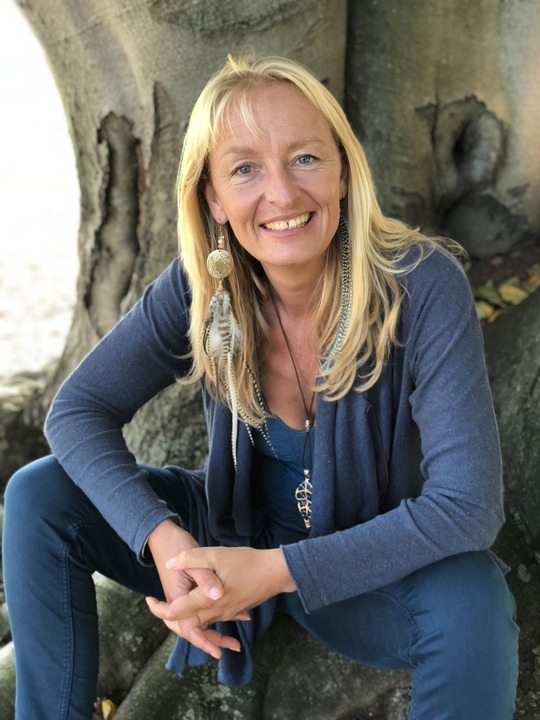
Clare is the founder and CEO of TreeSisters.org, a global women’s movement spanning over 200 countries, which has collectively funded the planting of over 8 million trees. TreeSisters is a social change movement and a tropical reforestation organization working towards normalizing cultural reciprocity with nature. The aim of both Clare and TreeSisters is to make it as normal to give back to nature as it currently is to take nature for granted, while supporting humanity in its transition from a consumer species to a restorer species. Before founding TreeSisters, Clare worked internationally for over two decades, coaching business leaders and facilitating group behavior change processes in multiple sectors.
Known for her direct, catalytic energy, her inspirational speaking, and her holistic approach to collective transformation, Clare is a walking invitation to anyone ready to step up and step in on behalf of the planet. Now, having read that little bio, I just want to say that I’ve had the privilege of listening to, I don’t know, seven or eight hours of Clare’s other interviews and talks over the past week, much of it while walking in the woods amongst trees, and it’s really been a delight. Clare has a really interesting story. At first, when I considered doing this interview, I thought, “Well, how’s this going to fit into the BatGap theme? You know, spiritual awakening and all that.” I’m convinced it’ll fit very well now, having gotten to know Clare.
Also, people who’ve watched this show before know that I don’t consider spirituality to be divorced in any way from everything that’s happening in the world, the problems the world is having and the solutions it could have, and so on and so forth. I think it’s inextricably intertwined. Whatever level of consciousness is ambient or prevalent in human society is going to show up in the world at large, and there seems to be a shift in consciousness happening in a good direction, but a lot of shaking up seems to be in the works in order for the effects of that to percolate up and change everything that needs to be changed. And Clare is very articulate on this topic, so let’s get rolling. Aren’t you, Clare?
Irene Archer: And what’s your name?
Rick: Oh, what’s my name? My name’s Rick Archer. Hi. And that’s Irene over there, filling in the essential gaps in the information. Another essential thing that I always say is that this program is made possible by the support of appreciative listeners and viewers. So if you’d like to support it, there’s a PayPal button on every page of the site, and there’s also a page of other ways to contribute if you don’t like dealing with PayPal. My guest today is Clare Dubois. Clare is the founder and CEO of TreeSisters.org, a global women’s movement spanning over 200 countries, which has collectively funded the planting of over 8 million trees. TreeSisters is a social change movement and a tropical reforestation organization working towards normalizing cultural reciprocity with nature.
The aim of both Clare and TreeSisters is to make it as normal to give back to nature as it currently is to take nature for granted, while supporting humanity in its transition from a consumer species to a restorer species. Before founding TreeSisters, Clare worked internationally for over two decades, coaching business leaders and facilitating group behavior change processes in multiple sectors. Known for her direct, catalytic energy, her inspirational speaking, and her holistic approach to collective transformation, Clare is a walking invitation to anyone ready to step up and step in on behalf of the planet. Now, having read that little bio, I just want to say that I’ve had the privilege of listening to, I don’t know, seven or eight hours of Clare’s other interviews and talks over the past week, much of it while walking in the woods amongst trees, and it’s really been a delight.
Clare has a really interesting story. At first, when I considered doing this interview, I thought, “Well, how’s this going to fit into the BatGap theme?” You know, spiritual awakening and all that. I’m convinced it’ll fit very well now, having gotten to know Clare. Also, people who’ve watched this show before know that I don’t consider spirituality to be divorced in any way from everything that’s happening in the world, the problems the world is having and the solutions it could have, and so on and so forth. I think it’s inextricably intertwined. Whatever level of consciousness is ambient or prevalent in human society is going to show up in the world at large, and there seems to be a shift in consciousness happening in a good direction, but a lot of shaking up seems to be in the works in order for the effects of that to percolate up and change everything that needs to be changed.
And Clare is very articulate on this topic, so let’s get rolling. Aren’t you, Clare?
Clare: No pressure.
Rick: None whatsoever. I was thinking maybe the way we could do this is there’s a lot of stories you’ve told a thousand times, but you still tell them in a fresh way, and most of my listeners will not have heard them, so you’re going to have to tell some of those. But I’ll interject and ask questions and make comments and so on. I was thinking you can do this any way you like, but I was thinking that we should start with some of the highlights or milestones that led up to your car crash, and then you’ll talk about the car crash, and we’ll take it from there, if that’s the way you want to do it. You can do it any way you like.
Clare: OK, I’ll play the game however you want to play it. In terms of milestones, are you meaning, like, probably what would be the steps along the path that took me to where I am now, like the specific things that happened?
Rick: Well, as specific as you want to be. Like, for instance, I was listening to you this morning while walking across a golf course, actually, and you were talking about your father and how kind of repressive and controlling and so on he was. But you were—I don’t know if you did this to the extent I even would—but I kind of got the feeling, like, I thought of my own life, you know, with an alcoholic, abusive father. But I sort of feel like they’re all as well and wisely put in a lot of times. These difficult things happen to us, and it turns out decades later we have a feeling like, “Oh, yeah, you know, if that hadn’t happened, I might not be where I am today,” and things are going pretty well now. So, you know, there’s sort of a wisdom to the stuff we all go through.
Clare: Well, I mean, yeah, let’s start with the really difficult stuff.
Rick: Okay.
Clare: So, yeah, no, if I hadn’t had the upbringing I had, TreeSisters wouldn’t exist. I’m pretty sure about that.
Rick: Yeah. So, I mean—
Clare: Yeah. And I do feel like, you know, depending on what your belief systems are, depending on how you perceive karma, depending on whether you believe that the sort of contrast that you’ve experienced in the first few years of your life is very instructive in forming that sort of basic nervous-system imprinting that paves the way for the theme of your life. A certain theme of my first nine years was: how many ways can you trash a female? And he started very violently, very young, like he started when I was a baby.
Rick: Hitting you. But that was—
Clare: Very violent, yeah, just violent. I won’t go into details, but let’s just say my father probably tried to find as many ways as he could of sort of experimenting on how close to death a child could be before they survived. I have severe internal injuries from my father—not just the physical kind, the emotional kind, the sexual kind. But, you know, I think of him as my teacher. It took a while, a long while. I would say I was almost completely hooked in victim consciousness for the first probably 38 years of my life, trying to transition for 10 of those years, really aware that that’s where I was and doing everything in my power to get out. But what it did was, you know, I say to people, if you haven’t been lost, then you’ve never experienced the pure joy of being found, or finding your way.
And when you’ve systematically had every part of yourself that you value hacked up, when there’s no part of you that doesn’t feel really badly damaged, then your life—I could say my life has been a life of recovery. You have to painstakingly reclaim every element of yourself. And when you do that, you have to carve your way through what is not true that you have interpreted to be true; you have to cast out the lies and then find an aspect of yourself. When you find it, it’s so priceless. It brings your consciousness deeply into it, so it cannot be taken for granted. So I’ve crawled my way back to being what I would call a sane, functional human being, although some people would probably question it, and to somebody that I actually like being, into somebody that has had to work through so many levels of fear. I was crippled with fear as a child. Absolutely.
I grew up in a state of high, high terror. So, you know, when I did have the car crash, and I was given TreeSisters, which we’ll talk about in more depth later on, the reality was it was asking me to, at the time, turn myself inside out. I was a complete introvert, and I really believed that that’s what I was. But actually I was an introvert through nurture, not through nature. I’d been taught that hiding was the way to survive. So when you’re asked to become the front person of a movement, or to become a leader when you’ve never even run a team before, I do all the things that I was asked to do.
It was like, “You are not just asking the wrong person, you’re actually trying to talk to me all over again.” But essentially, really what it was was: do you want to stay wrapped up in the shape that you are made through the circumstances of your life, or do you want to discover that you are something completely, radically different? No matter what the circumstances of your life, your soul or your essence is entirely something else, is free, is life, is love, is not ashamed, is not all contorted in its insecurities, is something completely other. And I remember being at that juncture where it was like, “Okay, what am I going to buy into?
My neuroticism and my insecurity, or the possibility that there is some version of myself that I have no clue what it is, but that is led by love rather than fear, and that can move into service on behalf of life rather than figuring out what’s the least I can do so that I can stay invisible and safe?” What am I going to do? Bow to my fear or my love? And love won. And love won not because it was for myself, but it was for the planet, which is my primary passion in life. And that was really ingenious for spirit, because it could pull me through all my nightmares because of my love of planet. And then in doing that, of course, there’s no separation between self, other self, and nature. So it sort of brought me through the back door back to myself.
And so, yeah, I would not have been so sensitized to what I call repressed potential in others, especially repressed potential in women, unless I could not stomach the suppressed potential in myself. And that was my father’s gift to me: finding any level of what I call inauthentic feminine behavior that has to do with being conditioned or frightened of being too much or too little, or self-betraying to compromise to make it all right for the masculine. My relationship to patriarchy was imprinted heavily by my father to be something that I just saw as unacceptable in our world. I’m just not willing for this to be the full expression of humanity, because it’s not a full expression. It doesn’t call out the best of us. It doesn’t move us into the expression of our souls, it doesn’t liberate us, and it sure as hell doesn’t take care of people or planet. So, yeah, my father’s gift—
Rick: Yeah, two thoughts come to mind. One is, you know, those that will say, as the parent beats you, “I’m doing this for your own good,” I wouldn’t want your story to excuse that kind of behavior in case anyone feels like they’re behaving that way and they’re doing it for somebody’s good. I mean, that has its own karma. And the second thing that comes to mind is just that, you know, it’s almost a cliché, but many people say we have a calling, a purpose for which we came into this world. And some even say that we predetermined the circumstances into which we’re born so as to facilitate the finding of that calling and the fulfillment of it. And—
Clare: I think so.
Rick: Yeah. And you strike me as being a person who very much has a calling, and who got hints and indications of that calling a number of times over the years, but it eventually just sort of clicked in a way that you could no longer ignore.
Clare: You know, I just want to go back to one of the things that you said: no abuse of children is acceptable. No abuse of anyone, frankly, is acceptable; no abuse of the forest is acceptable, no abuse of our waters is acceptable. I mean, we kind of go, “Children—but how is a child different to an ocean?” In my perception, when you’re no longer living in a place of, “Well, there’s humans, and then there’s nature,” humans are part of nature, we’re part of a woven tapestry. So any abuse over any level of unconscious separation that allows us to perceive ourselves as somehow superior or separate from, and therefore able to do what we want with this thing without having any relationship to it, is not the highest expression of what we could be.
Moving beyond perpetrator and victim consciousness
But when it comes to shifting victim consciousness, which all of us, I believe, will be having to do, because our world in the guise of patriarchy is in the shape of perpetrator and victim, therefore you’ve got addiction on both sides when it comes to the masculine and the feminine. And I say that because this is not just about men and women; this is about the aspects of ourselves inside ourselves, which also play these games. Shifting out of perpetrator and victim mentality, at its most fundamental level, to me, we’re talking about being able to perceive things as they are as opposed to how we interpret them. For instance, when it comes to my father, yes, I interpreted myself as evil, loathsome, useless, at fault, all the rest of it. That was my interpretation. And I was wounded because I took it personally.
It’s the act of taking it personally, the act of taking anything personally, that I think is one of the greatest areas that spirituality at large, for me, seems to miss. It’s one of the most crucial things that we can learn: to witness another doing whatever the hell they want to do to us and understand that it’s not about us. It’s about the other, and therefore no longer being in the mindset where we take it personally. Now, at a global level, we need to be able to distinguish the difference between a culture that has been imposed on us, which is killing our planet, and that we are woven into in a convenience-oriented consciousness that we can’t imagine any other way, and the birthing of something completely other that needs to come through us, that is not at the expense of life and not at the expense of ourselves. And that means it’s not actually about us, again; this isn’t personal.
And yet it’s intensely personal because something else has to come through us. To me, that’s the greatest spiritual awakening that needs to happen right now: stepping out of this patriarchal world that also says the white man on the big chair over there is going to sort it out for us, especially if he’s got really bad hair. But actually, the growth and the awakening and the shifting into personal responsibility and growing up and no longer looking for Daddy over there to sort it out for us means that there is something that needs to come through each of us that contributes to this awakening. It’s all of ours; it belongs in all of our hands.
Rick: Trump actually played into that meme during his campaign: “I’m the only one who can fix this. I’m the only one who knows how to fix this.” And people bought into it because they saw him firing people on TV for 10 years, you know, being authoritative.
Clare: Yeah. And why do we want—what is it about Daddy or shadow daddy that somehow feels safe? What is it in us that doesn’t want to grow up, doesn’t want to actually say, “You know what? I need to step into some sort of leadership”? There’s something inside of me that fundamentally disagrees with this person because we’re woven into “someone else is going to save me, someone else is going to make it better, technology’s going to save us, something other than me is going to save us.” And actually, that is the malaise that is anchoring the system in place. We have no concept of what a collective shift of consciousness that moves us into collaborative leadership could actually do on this planet. But we’re going to have to let go of Daddy, or Mummy, and look at what collective leadership actually looks like. What does grassroots responsibility actually look like?
Rick: Yeah, I don’t want to get too political here, but one of Bernie’s campaign themes is “Not me, us.” And he kind of prides himself on getting these $2.70 donations, you know, lots of them, as opposed to big super PAC money.
Clare: Well, that’s how we’ve almost planted 9 million trees. Yeah, there you go. It’s been $5 here and $10 there. And I’m regularly saying to—remember talking to Starhawk and saying to her, “Would you come on as an advisor to TreeSisters?” And her saying, “Thank God you’re doing this, so that I don’t have to.” And I was like, “That’s the wrong answer.” I’m not doing this. This is not me. I might be the mad one at the front banging the drum, but when my network of women all around the world say, “We’ll be the wind under your wings,” I’m like, “I don’t want you to be the wind under my wings; you need to be the feathers on the bird.” This belongs to all of us. What is this automatic handing over of responsibility that we seem to do that says, “I do it”? David Attenborough, Nelson Mandela, these incredible leaders—I’m so afraid when David Attenborough goes.
To me, he’s a being on this planet that holds the planet. When he does go, we’re all going to have to pick up their mantle. Polly Higgins, when she went, when Stop Ecocide was sitting in her hands, it’s like, okay, now we all pick up the mantle. Yes, I’m standing for the trees, but more, my reason for being is to try and turn a key in as many people as possible that helps them realize that they’re a leader.
Rick: Yeah, that’s great. You know, when you say you’re not doing it, all of your people are doing it—even in a different sense. Do you often have the feeling that even as you’re doing things, you have the feeling like, “I’m not doing this; there’s something bigger than me that’s kind of the puppeteer here. I’m just sort of cooperating”?
Clare: Yeah, I often think of it as I’m a chess piece on a chessboard, and somebody much bigger than me is moving the pieces around, and I’m just kind of wandering around going, “Oh, oh, okay. Oh, it’s you.” But I also feel like, increasingly, I think of the trees as the global brain on this planet. And increasingly, as I drop into a more conscious relationship with them, and as increasingly as we as a species understand how the forest floor operates and the profound interconnectedness of everything, trees can teach us how to live. When you start to understand that each species of tree is in communication with a different planet, that they’re actually bringing in cosmic energy and spreading it around, it literally is like the synapses of a brain.
When you look at a brain, it’s a massive tree; when you look at the brainstem, it’s trees; when you look at the lungs or circulatory system, everything—we’re full of trees. So they are a fundamental relationship of ours. I increasingly feel that I am literally being moved around by them. Our understanding of the consciousness of nature is so lacking, profoundly lacking, because we have elevated ourselves into a dominant position and acted as if nature is just something to use, rather than something that we are in dynamic relationship with and belong to. I don’t think we understand what we are. I don’t think we understand what it is. I don’t think we understand the relationship between the two. I don’t think we have a clue what can come through us, or the way that some of the indigenous tribes in this world understand how to be in profound relationship with the natural world.
We’re inside a mystery. I think of spirituality, or my path of spirituality, as: is life trying to become aware of itself through me? Well, I think the natural world is trying to help us become aware of what we actually are as a part of nature. Because when you are in the awareness of being part of, there is no abuse of; there’s no power over, this is just power through. And I think that’s one of the biggest gateways that we’re standing at right now: a complete redefinition of what a human being actually is, and then a falling into sufficient humility to move into intimate relationship with nature so that we can discover what actual intimacy and creativity are all about.
“When you are in the awareness of being part of, there is no abuse of.”
Rick: Wow, beautiful. I’ve got goosebumps several times as you were speaking. I don’t cry that easily, but that’s your job. I get goosebumps.
Clare: If you’ve watched eight hours of me and have seen me cry a lot—
Rick: I’ve heard you, at least, and I usually convert it to audio. There are several threads I want to pick up on from what you just said. One is the trees communicating with each other. I’ve seen Paul Stamets speak about the mycelium that interweaves the forest floor, and there’s, God, like miles of it in a cubic centimeter of Earth. It’s just this network in the trees. Can you take it from here and explain how the trees help each other and communicate with each other? It’d be worth touching on that.
Clare: Well, I mean, the reality is, as we know it thus far—and I think we’re just going to keep going down the rabbit hole and realizing that there is so much going on—but the fungi is like the circulatory system and communication system of the forest. So every tree is dynamically connected to every other tree, both by their roots—they will root onto each other—but the fungi, the mycorrhizae, also link them. The mycorrhizae, or the fungi itself, spits out acid onto rock and then turns it into minerals. The fungi basically gathers the minerals and helps to create the soil. The trees are creating the starch. So what you’ve got are starch-loving fungi that are creating minerals, and starch-creating trees that need minerals. And so they basically start swapping.
There’s a fundamental dynamic relationship between the fungi and the trees that enables the trees to feed the fungi and the fungi to feed the trees. But what you’ve also got—and this is why I call it the global brain—is the reality that the trees in a forest take care of each other, nurture each other, feed each other. They send signals to each other, and they use the mycorrhizae to do that. If you’ve got conifers and deciduous trees in a forest, in the wintertime the conifers are generating carbon; they will feed the deciduous neighbors who aren’t because they’ve dropped their leaves. When the deciduous trees start to grow their leaves, if they start to block out the conifers, then they will basically start to feed back the other way.
Similarly, if you’ve got bugs, pathogens, beetles attacking at one end of the forest, they will send out chemical signals that will warn everybody else, “Change your chemistry; see if you can block the bugs.” Why are they doing that? They’re doing that because a forest is as healthy as its entire community. If one of the trees starts to go down, then they’re all threatened—not just in terms of pathogens, but also when a tree dies and it creates a gap in the canopy, or it’s cut down, the wind can get in and start uprooting. So they understand at the most physiological level that for all of them to survive, they all need to take care of everyone. They don’t have this superiority mentality that we do, where it’s okay to drive through LA and see God knows how many outrageously wealthy mansions and then more homeless people than I’ve ever seen.
The forest can’t do that, because one is no better than the other; they take care of each other to ensure that everybody is healthy. To me, that’s one of the fundamental reasons why we need to turn to nature as a teacher rather than just be their dominators and torturers. The more we can learn from the natural world, the more I think nature will teach us how to be the highest expression of humanity that we could actually be. There’s a version of humanity that would only take care of future generations, and we know that because most of the indigenous people on our planet live like that. They live in order to perpetuate at least seven generations. But certainly our generation has normalized stealing from the future, stealing from our kids.
Even though the kids are now taking to the streets saying, “What the hell?” we’re still going, “No, let’s perpetuate the same economy that requires the death of nature in order to thrive.” What it must be like to be a child now—an awake child. We wonder why there’s so much drug addiction and addiction to devices and all the rest of it. Who wants to actually be wide awake to the level of enormous disregard that’s going on now? The future that’s coming is a reflection of the consciousness that we’ve been prepared to contribute to. And this is why, right at the beginning of this interview, you were saying, “How might Clare Dubois be part of BatGap when it’s about spirituality?”
Rick: Well, that was before I got to know you.
Clare: Yeah, I know, I know. But unless the spiritual beings, the so-called spiritual beings of our planet, or those that are meditating for hours a day, or those that are on profound spiritual journeys—all of us—can open that wing of the bird that we are, that embraces all of life, our one individual journey, yes, it might be fabulous for our soul, and yes, we may incarnate onto a healthier planet next time around, or whatever the hell it is that we believe in. But we’ve incarnated onto this planet now. This is where we are at this point in time, which has to be one of the most nail-biting moments in human history. This isn’t just war happening to us, or Nazism happening to us, or whatever happening to us.
This is us destroying life as we know it and preventing our planet from being able to maintain her circulatory system in order to provide the weather that we need to survive, let alone thrive. We’re doing this to ourselves. There has to be a shift in consciousness, a massive one. Therefore, the meditators of our world, the dancers of our world, those that know how to move their consciousness in their physiology in a way to alter their state—we need every single one of you waking up to the fact that there is no separation between you and the natural world.
While she is being hacked apart, unless we’re willing to put our consciousness into her body, allow her to communicate through us, and allow her to lead us in some way that actually has our action start to make sense on behalf of life, not to me, it’s wholly a spiritual journey; it’s a disconnected one, because it’s not actually contributing to the continuation of life in our world.
Rick: Brilliant. We were using the word “abuse” a little while ago. As we were using that, I was picking it apart and thinking, okay, “AB-use”—using something improperly. If we’re abusing someone or the world in some way, then we’re using it improperly. Why are we doing that? We’re doing that because we don’t see it in its essential value. We don’t see it as actually part of us; we’re part of it. We don’t see the oneness, which is the actual reality of the situation. You wouldn’t cut your own finger because you see it as part of you, but we’re doing that to nature because we see it as dead, inanimate, separate, unconscious stuff. And there are these misinterpretations of the Bible, like, “I grant you stewardship,” or whatever, over nature and so on.
It sort of has this patriarchal tone to it, like this is just a resource to be used for our pleasure, our convenience, rather than something holy, something as imbued with God as any saint has ever been, which needs to be treated accordingly.
Clare: Yeah. Can you imagine? One of the really interesting things about moving to America for me has been being able to hang out with First Nations people from here, from Alaska, from Colombia, from the jungle, the Amazon jungle, from Hawaii. For a while, I couldn’t put words to what it was that I could feel that was so profoundly different. But I cried every time. Okay, I’m a crier. When I cry, it’s because my body is recognizing something and signaling to me. It’s signaling a loss or a lack or a pain or a yearning or a longing, and it moves through me in tears. It’s the way that I can’t miss it. Something is there; my body is telling me. What I experienced with them all was they’re not separate from the land and not separate from their lineages. They honor their bloodlines like I was never taught.
Bloodline, land, and the meaning of belonging
There’s so much dysfunction in my family line; all I wanted to do was sever myself from them, without any consciousness that I was severing the river of consciousness that ran through my own bloodline. I just wanted to cut off everything and make myself safe. In doing so, I cut off one of the primary blood routes of my own existence. But they also belong to the land. They belong to the land. We don’t know what that actually means. We only know land as belonging to us. But when you start to experience nature as all your relations, when you realize that the buffalo are your relations, and the cows are your relations, and the hummingbirds are your relations, well, you don’t put chickens in cages. You don’t overfish the oceans. You don’t cut down the trees, because they’re all your relations. They are your family. Now, I was noticing—
Rick: Remember what Jesus said: “Whatsoever you do unto the least of these, you do unto me.”
Clare: Yeah. And I was—I have suffered from a lot of ill health in my life, and I’ve started noticing, like, I’m hurting because there are no bees. There are flowers everywhere around me, and there are no bees. That hurts. I’m supposed to be living in the sound of the bees, and the absence of the sound of the bees is hurting me. When sandhill cranes fly over, and I listen to their call, I can track the part of my body that directly relates to them and knows them. I think this body of this human being that I am is designed to live in a world with all the other species, of which they are a part of me and I’m a part of them. They have found inside what they call the so-called junk DNA of a human being the DNA of every other living thing on this planet. So we are encoded with life. Now, I just want to go back to one of the things you were saying around abuse.
I found it fascinating that, as a thoroughly abused being, I somehow moved myself into Nevada City, which is the center of the gold rush, onto some of the most abused land and the site of total genocide. Where I live, if you killed a Native Indian, you were given $1.20 per scalp for the privilege of killing one of the natives—these people who lived in complete reciprocity with the land. It was a good thing to wipe them out, not just wipe them out, but with the mentality of, “I want that thing. I want that gold. That gold will give me something.” In order to get that gold, or that pleasure you want from doing what you want to that child, or whatever level of abuse you’re doing, you have to not be able to see the child. You have to not be able to see the sacredness. You have to forget that it’s your daughter, forget any social norms.
You have to not be able to see the forest, the Indians, the beauty of the place, or recognize the sacredness of a river, to destroy the whole lot just to get the gold and believe that that’s a good thing. That level of abuse—it’s not just that we don’t see everything as sacred. It has to be a pain in us, a deep level of pain in us, that can inflict that level of pain on another, whether it’s human, animal, or mineral, and not find it wrong. And I think that deepest of wounds that enables us to blindly stay numb, numb enough to keep perpetuating the destruction, is our mother wound. When I say our mother wound, it’s our fundamental severance from the planet of which we are a part. We are born part of this planet. We’re made of her; we’re breathing her. There is no indivisibility. We don’t exist outside of her. We are completely made of her.
When we poison her water, we poison our own bodies. When we poison the air, we poison ourselves. We think we can poison everything and get away with it. Well, we’re all dying. Cancer levels are off the charts. Autism levels are skyrocketing. Why? Because we’re pouring metal from the sky. It’s in our water. We’re all getting metal poisoning. There’s nothing to be surprised about in the level of mental, emotional, and physical sickness that’s going on. But what is it a reflection of? To me, it’s a reflection of a profound level of disconnection due to a severance from our own nature as nature, so painful that we do not know how to go back home to ourselves. So what are we doing? We’re killing indigenous people as fast as we possibly can around the planet. Why?
Because they’re in the way of our perpetuating business as normal, greed as normal, dominance as normal, because they hold the sacred seeds of pure sanity. They hold the memory of what it means to live in relationship with nature as nature. So they are our absolute lifeline back to sanity; they’re our path home.
Rick: When you were saying that, one thing that occurred to me—and see if you agree with this—is that I suspect when you’re inflicting pain on someone, or on the environment, or on an ocean, or whatever kind of damage you’re doing, on some deep level you must be inflicting an equal amount of pain on yourself, because we’re all connected on a deep level. But you have to pile on an adequate amount of numbness to not feel that. Like that old “forgive them, Father, they know not what they do.” You couldn’t allow yourself to feel that, or else you wouldn’t be able to continue doing it. So there must be a— I can’t, I don’t know why I’m quoting the Bible so much today. When the Israelites were being persecuted, the Bible kept saying, “Well, Pharaoh then hardened his heart,” and then he was able to do this.
So we kind of have to harden our hearts and pile on a lot of numbness in order to continue to behave this way.
Clare: Yeah, yeah.
Rick: Yeah.
Clare: Absolutely. And that’s one of the reasons why I think it was TreeSisters as opposed to TreePeople.
Rick: Yeah, yeah.
Clare: Because I fought against it being TreeSisters; I didn’t understand. Then, as the path started to show itself to me, I looked at the treatment of women and our emotionality and how much that has been shamed and belittled and made out to be weak. And I thought, you know, what’s stronger: somebody that basically refuses to feel anything because it’s too traumatic and is violent over the top of that, or somebody that could collapse in a heap on the floor, bawl her eyes out until such time as she can fully feel her connection to the thing that she’s crying for and then steps up and takes action? Emotionality has been trashed on this planet. That’s why I say the feminine has been repressed—not just women. The feminine is considered less than because it is instinctual and intuitive and harder to measure, and it is emotional, therefore harder to control.
Feminine and masculine forms of strength
Both those things, to me, are a different kind of strength. They are an extremely different kind of strength than “How strong are my muscles? What can I pick up? Who can I protect?” The masculine forms of strength and the feminine forms of strength are designed to complement each other completely; one is no better or stronger than the other. Our attributes are fundamentally different, and all of them are vital. But what’s happened in our world is that patriarchy is not the masculine. Patriarchy is the shadow masculine. Only the shadow masculine would stand on the throat of the feminine and consider that healthy. That makes sense to the shadow masculine that needs to put somebody else down in order to think of himself as superior. The healthy masculine is as much in service to life, the feminine, husbanding life into its fullness.
The healthy masculine is the most exquisite thing, but it also knows that the healthy feminine is this exquisite thing, and the two come together and just go, “Oh my God, look at this beauty. How do we serve each other into our fullness?” What does that look like? It looks like the masculine creating structures and systems and processes and architecture and all the rest of the stuff that husbands life into its fullness, so that the feminine gets to express itself as love and relationship in this world. We say the feminine is less than. But show me somebody that doesn’t desperately want to love, doesn’t want to be in relationship, doesn’t want to feel loved, doesn’t want to open their heart and express love, doesn’t want to experience themselves through generosity because they’re full enough and connected enough to know what it feels like just to love and to give.
We’re all longing for it. We all can’t bear ourselves in our small-mindedness and our selfishness and our contraction and our judgment. But that’s just a symptom of an empty system. It’s a symptom of emptiness. If there was fullness there, then the world would look different. Why isn’t there fullness? Because fullness comes in through connection, and connection comes in through the feminine principle. You have to be in intimacy with something in order to feel it, connect to it, and receive from it. If we were in sufficient humility as a race to be in humility before the natural world, we have a boundless source of energy, natural energy, the energy of Gaia, cosmic energy. There is no limit to the energy available to humanity if we understand that we are part of something massive, rather than this small ball of self-importance trying to dominate the crap out of everything.
That severs us from the life force of our cosmos.
Rick: You know, sometimes I get criticized for talking too much during interviews. I think you’re the cure for it; I could just listen to you for hours. I don’t feel like saying anything.
Clare: I didn’t talk too much during interviews.
Rick: Great. I love it. You’re so articulate. How do you feel? I mean, I’ve heard you allude in a number of interviews or other talks to the massive shift that’s taking place in the world. There’s some kind of transformation in collective consciousness that seems to be afoot. How do you feel that’s going? Do you feel that we’re just sort of at the very dawn of it, and that there will be a huge amount of transformation yet to undergo, many, many, many years of it, perhaps, until—
Clare: We don’t have—yes.
Rick: Pardon? What were you going to say?
Clare: Yes. We don’t have many years.
Rick: No, we don’t. So do you think that dooms us, or do you think that it’s going to proceed—it has to proceed at a pace that would accomplish what needs to be accomplished in time for us to survive, and therefore things are going to get really intense? As you know, in terms of the environment, we’ve been dragging our feet for decades now. It was way back in the ’70s, or perhaps even earlier in some cases, that we were told global climate change was going to be a thing. We just kept kicking the can down the road, and now it’s gotten to a point where all sorts of deadlines have passed and tipping points are actually already kicking in or about to. It’s going to be a lot harder to make the necessary changes now than it would have been had we been working on them steadily for a few decades.
Clare: Well, the honest answer to what you’ve just said is I haven’t got a clue.
Rick: Right.
Clare: Now, if we push “I haven’t got a clue” to one side, I can try and sound like I know what I’m talking about. Several things. This is going to be a very bitty answer, but I’m going to try and come at it from different angles.
Rick: Okay.
Clare: I don’t know whether you’ve heard the story on one of my interviews about bumping into Barbara Marx Hubbard on an airplane.
Rick: No, I didn’t hear that one.
Clare: Well—
Rick: She’s been on BatGap, by the way, for people who want to look it up. Go ahead.
Death, rebirth, and karma
Clare: Barbara Marx Hubbard—yes, if you haven’t heard this woman, go and hear this woman. She passed, but she was one of the most extraordinary transmissions of a different quality of consciousness. I’d just driven through Colorado for 10 hours, and I hadn’t seen a tree that wasn’t either dead or dying. I was in pieces, completely in pieces, and getting on a plane to go home. I couldn’t hold myself together. I was bawling my eyes out, sitting on the airplane on the aisle, head in my hands, trying to hide because you don’t cry in public transport. My world as I knew it was coming to an end. As far as I was concerned, I’d just witnessed—it was no different to driving through a war zone and seeing everybody dead or dying on the floor. It was no different.
While I’d been driving through Colorado, I’d been on Facebook sharing photographs of mountainside after mountainside of dead Aspen and dead this and dead that. Every species was dying. What was coming back on Facebook was, “It’s the same in Montana; it’s the same here; it’s the same there.” What I realized on that journey was the entire Rocky Mountain forest is dying right now. So if you have not experienced the Rocky Mountain forest, go now, because it’s going to be gone pretty soon. I was in this place of, “Wow. Okay. The entire rainfall system of North America is changing right now. And not only is nobody paying any attention, but they’re just going to carry on trying to take more and more water out of the ground because that makes more and more profit, and to hell with the groundwater. In fact, why don’t we just frack it?
Why don’t we just frack it and put carcinogens into it that will poison it forever?” I’d gone down this rabbit hole and was in despair. So I’m sitting there, and I look up. On the other side of the aisle is Barbara Marx Hubbard, literally sitting next to me, and she’s asleep. I sat there just going, “Oh God, can’t—you can’t wake up an 86-year-old.” And I was like, “Barbara, wake up, wake up, wake up, please wake up.” As I’m crying, this arm shoots across the aisle, and she grabs me. She was like, “Clare, do you know what this is? This is divine timing.” And I said, “Barbara, I can’t handle it. I cry now. I can’t handle it. I can’t do my work. I can’t bear the loss. I can’t bear it. It’s too much. I can’t keep going. I don’t know how to deal with this. I’ve just driven through death, and nobody’s even bothering to stop and look.
Everyone’s just driving through it as if it’s normal.” It was so symptomatic of, “We’re just carrying on as if this is normal.” She looked at me and said, “Clare, you have to find your intimacy with the evolutionary impulse.” And I got it. I got this pure Barbara transmission: stop taking it personally, expand your consciousness to a level that can take in the whole thing and understand that something much bigger than us is running the show. You have to find your intimacy with the evolutionary impulse. It was just like, “Oh God, thank God, okay.” It doesn’t make it any easier for me to see polar bears eating their babies; it doesn’t make it any easier to understand that these species are going extinct hundreds a day around the world.
But I can sort of reverse myself back up into a bigger consciousness of which I am a tiny facet and just go: at this point in time on my planet, which is one planet out of God knows how many, life is changing forever. That’s what’s happening here right now. The so-called superior species, which is acting like it’s the most inferior species on the planet, is doing the damage. We now get the choice to wake up or not. If we could have done it differently 30 years ago, presumably we would have. If we had the capacity to elect non-assholes, presumably we would—
Rick: Say we should start a political party: the Not-an-Asshole Party.
Clare: No, we’re not done with assholes. We’re not done with assholes. That’s just a reality. We’ve just done it in my country as well. Some part of us has not come topside yet. It needs more gestures of egoic trumping. It needs more exposing of the ridiculousness of welfare at any cost, more exposing of the insanity of trashing our forests and our indigenous peoples. We’re needing more. We’re not done. If we were done, it would be over. Therefore there is a much deeper process happening, that’s real, where we are choosing this path for our awakening. If we could be doing it differently, we would be. If it could be less severe, it would be. It pisses me off, frankly, that I hear David Attenborough saying, “When the tipping points tip.” If you’re an environmentalist, the tipping points have all tipped. We’re past 12 o’clock; we’re not even two minutes to 12 anymore. We’re over the hump there.
When you look at the science, it’s over. When you listen to indigenous tribes from all over the world who met in 2017 in Hawaii, they all discovered that they had the same timeline: they can all see to 2026 and not beyond. We’ve got five years, maybe, to turn this around before this irrevocable climate change, and nobody can see what’s on the other side of that. It took me about two years to come to terms with that. When I came out the other side, it was just like, “Okay, so what if I went through a thousand incarnations preparing for this one, just so that I could be of use in the next five years?” Who knows what that’s going to look like? I had another friend whose 17-year-old son was wanting to commit suicide because he didn’t see any point. “I’ve got no future. There is no future on this planet for me. There’s going to be no work. I can’t actually have my life as I would want it.
I don’t want to be here.” He went to his mom and said, “I’m going to commit suicide, but I’m going to give you one shot. Tell me why I shouldn’t do this. Give me one reason not to kill myself.” She thought for a while, and then she said—she rang me after and said, “You won’t believe what came out of my mouth.” She said, “Women are going to learn how to do magic.” The most surprising thing was he stopped, looked at her, and then went, “Oh, okay. All right.” And he stayed. When I first met the Dalai Lama’s thangka painter, I heard him tell the Tibetan myth: when a thousand goddesses gather, the Divine Feminine will rebirth through their combined energies, and the frequency of the planet will shift from one of fear to one of love.
When I first heard that myth, it landed in my head as: when sufficient women can move beyond their egos, bring their multiple energies together, and bow in sufficient humility for the Divine Feminine to move through their combined energies, a different frequency will come onto this planet. That was when TreeSisters made sense to me. I thought, “Oh, okay, there is something particularly unique that women carry that is needed now—not because we’re better than men, but because something has been lost through the suppression of the feminine in women. There is an energy that is not on this planet.” If that energy were on this planet, patriarchy couldn’t exist. If that energy were on this planet, we would be in relationship with nature, not beating the crap out of it. Therefore, there is worthiness in trying to help women remember who and what we are.
I know people, tribes, people in Colombia, the Kogi, who have gone to Fukushima and done ceremony and reduced radiation. I know there are weather workers on this planet who can call the rain, who can put crystals in the ground and call up water. There are beings on this planet who know how to be in relationship with this planet. We only know the science as it is panning out ahead of us in relationship to ourselves as a disconnected species that doesn’t know how to be in relationship with nature. When I’ve had those moments in my life when I’ve properly merged with the natural world and my consciousness has expanded—usually through trauma of some kind, when I’ve just opened up and suddenly all of it is coming through me—I have no insecurity, no neuroticism, no desire to do anything to anybody.
I just am in a place of pure service, and I can access levels of energy that I didn’t know were even available to me. Maybe it’s going to take levels of disaster, helplessness, humility, shame—because we know we should have been doing this a hell of a lot sooner—levels of threat. The financial system goes down. I’ve been in California for the last year; we lost our power God knows how many times. We had no power, no water, no internet, nothing. That was humbling. I was going, “I can’t function like this.” I’m living like a human being that says all of this power and convenience is my birthright. It’s not, because all of it is at the expense of our planet. We are in a crucible of circumstances designed to shake the convenience-oriented consciousness that means we take everything for granted. It’s going to be shaken to its roots.
Is that the exact scenario we need in order to free ourselves from a particular shape of consciousness and allow an evolutionary bounce? Is that what it’s going to take? All I know is that that’s what we’ve created. This is where we are. I don’t believe it’s coincidental that we incarnate. I do think every single one of us has got something absolutely fundamentally unique to ourselves that we are here to bring. I think our togetherness is fundamental in elevating consciousness, allowing our uniqueness to find its voice. Bottom line: we have no idea what we’re capable of. I think we’re having all of our convenience yanked away from us—our safety, our numbness, our “yes, life is going to carry on as normal.” It’s not. We’re going to have to grow, and it’s going to make something else available to us. Is it happening fast enough? To me, no, it isn’t. But this is where we are.
So what are you going to do about it? If you’re me, you stand on every street corner and bang a drum as loud as you can. I have to know that I’m doing something that’s not going to be everybody’s path. But I do want to get everybody by the shoulders and shake them hard and say, “If you’re still doing denial, if you’re still thinking somebody else is going to save you, if you’re doing a spiritual practice but doing nothing for the environment, wake up, wake up, because you’re going to miss the biggest party ever. You’re going to miss the transformation of yourself into a relationship of belonging with this planet that will rock your world. Wouldn’t you rather experience that for four years before you’re wiped out by a tsunami or a drought or a fire, or whatever, than never experience that at all?
What’s it all been for if we’re not going to give it everything that we’ve got to turn the corner?”
Rick: I’ll base my next question on what Barbara Marx Hubbard said to you about getting in touch with your evolutionary impulse, and relate that to what you were saying about how the forest communicates through the roots and the mycelia. In every interview, and in between, I mention the fact that to me it seems that the universe, both near and far, is so utterly pervaded by intelligence orchestrating everything. I think we could argue that the mess the world is in is a reflection of the degree to which we, like teenagers with free will, have deviated from that intelligence and gotten out of tune with it. What Barbara said—“Get in touch with your evolutionary impulse”—was not only the remedy for what you were going through at that moment, but I think it’s really the remedy for every human being and for the planet.
If we were really in tune with the intelligence of nature, then we would be instruments of what we could call the agenda of nature: unfettered evolution, growth, creativity, flourishing, and so on. That’s enough; you can springboard off of that.
Clare: I don’t know why it took me to the place where I was remembering the exact path in England that I was walking down when I realized that the fish in the river beside me had absolutely no choice about the environment they were living in, because we could just do whatever the hell we wanted to do to it. I remember being so shocked, so shocked, bawling my eyes out, of course, because that’s just what I feel when I have these moments. Suddenly realizing, “Oh my God, that horse has got no choice where it’s stuck. That cow has got no choice. Those birds, when all their insects disappear, which they are, they’ve got no choice. They’re just going to die. They’re totally helpless.” What I was crying about at the time wasn’t just that I thought it was desperately unfair. It was that it had taken me until my early 30s to wake up to that fact, that I had been so completely divorced.
I remember walking up a hill in the Lake District with my mother when I was 11 years old and saying to her, “Do you realize there are still people living in the forests? Can you imagine how backward they are?” Then saying, “They haven’t understood about industrial agriculture yet, and they don’t know about…” I was in a British boarding school that was teaching me geography, and that geography had nothing to do with sacredness. You weren’t taught sacredness. The indigenous people say, “Why have you made everything sacred belong to one building, and everything else is there to be plundered?” I was like, those moments: “Oh my God, that church is the planet. Our church, the sacredness, is in there, and not one person over there can tell you whether you’re good or bad depending on what religion you’ve got.” But we are not taught about the sacred. I was a very good student as a child.
I loved geography. I took it hook, line, and sinker. It never occurred to me there was anything sacred about nature. I loved it. If I was taught that industrial agriculture was the really sensible, evolved way of farming, then I believed it. If I was taught that the best thing to do would be to get the indigenous people out of the forest and educate them, just like Bolsonaro was wanting to do, I believed it. It took me until I was walking down that path, looking at the river, and realizing those fish were helpless to our whims, to our soap and our hormones and our poison and whatever else, the plastic that is everywhere now. It was like, “Oh my God, what do I do with this knowledge?” When you have an awakening, when you see the insanity of the system, and yet the system is so much bigger than you and it’s plowing over you, what are you going to do?
Then it’s like, “Well, why did my choices even matter? There’s one of me in this space of millions who are still chewing down plastic every day, still heating their houses and having the windows open.” That’s when it becomes personal. I live with a man who tried to give his life for a river to stop it being dammed, chained himself to the bottom of the canyon—Mark Dubois.
He had got to the stage where he loved nature enough to risk giving his life. He lost that river, and the loss of it carved him out so profoundly that he now cannot waste a single thing. The loss of what he loved made every single thing sacred—not a conceptual sacredness, an actual felt, lived sacredness. If I buy some food and it’s going to go to waste, he physically hurts. I get to rub up against him every single day of my life. It’s one of the reasons why I chose to marry him. I get to be with somebody who lives with all life as sacred. I look at him and think, “Yeah, he’s a complete one-off. How do we get the rest of humanity to where he is?” Well, he exists, and what he lives is a truth. That truth exists inside every single one of us. Even if you’re a drug addict, nightmare, child-molesting bully in that corner, the soul that you are is as sacred as Mark Dubois.
It’s just that one has gone through one set of experiences that has arisen as that, and one has gone through another set of experiences that has a resonance. Both have the capacity to fall into the truth of their sacredness, and both have the capacity to fall into the truth of all things as sacred and move back into dynamic relationship. There’s something about the level of suffering happening on this planet, having it in our faces that we’re losing so much, like everything we’ve taken for granted—there’s something about that which is starting to go deeper and deeper and ring a different note. It’s touching a deeper place where the actual truth of who we are as part of nature is starting to be stimulated en masse.
I have no idea whether six months of a huge crisis, whether coronavirus is part of it, or what the furniture is going to be that’s arranged in a particular way to facilitate a quantum leap of consciousness. What I know is that it’s latent. We’re not living the truth; we’re living a constructed life that is patriarchy. Therefore there is a completely other truth that is possible, a different quality of relationship, a different spirituality, a different experience of union with our own souls, each other, and nature. Could that happen in six months? My brain doesn’t think so. My body knows I have no damn clue and that something bigger than me does.
My job is to log on to that evolutionary impulse, stop taking everything personally, make myself available to a frequency that can activate whatever is latent inside me that’s needed for now, and then get out of the way and let whatever wants to come through come through. That is my prayer for everybody. To me, that’s all we can do. Our job now is to get out of the way, recognize our insecurities and our stories as clutter we don’t need anymore. We’re past the point of needing to continue to perpetuate this power-over, victim-perpetrator-rescue crap we’ve been doing forever. Elevate to a level where our consciousness is in union with all that is, and we can start to bring through the solutions that can actually make our way.
Yes, and of course “get out of the way” doesn’t mean stand on the sidelines and watch the parade. It means get our egos out of the way so that we can be a better instrument of this divine intelligence, or whatever we want to call it. We’re going to be very much engaged, but without mucking it up through our interference.
Rick: Yes, and of course “get out of the way” doesn’t mean stand on the sidelines and watch the parade. It means get our egos out of the way so that we can be a better instrument of this divine intelligence, or whatever we want to call it. We’re going to be very much engaged, but without mucking it up through our interference.
Clare: Yeah, and knowing that we don’t have the overview. We’re not supposed to have the overview. The evolutionary impulse, the overarching intelligence, or God, or whatever you want to call it—spirit knows. We don’t have to. Our job is to show up for the next thing, and then the next thing, and then the next thing, and not need the whole game plan laid out in front of us, squeaky clean, to take the next step. We’re supposed to be blind; that’s part of the journey.
Rick: I think it was one of the Raiders of the Lost Ark movies where Harrison Ford had to walk across this chasm and there was no bridge. But as he stepped, steps would appear at each point where he needed to go, so it took a sort of leap of faith with each step. There was actually another line from the first one of those movies, where Karen Allen, I think, was the actress. They were in the middle of this incredible thing, pits of snakes and all kinds of wild stuff going on. She said, “Well, what’s the plan?” He said, “I don’t know. I’m making this up as I go along.”
Clare: Well, that’s TreeSisters. I started TreeSisters from a pit of depression with no experience, no resources, nothing. Literally, with just this feeling of everything else I tried to do failed. I was trying so hard not to do it. I was frightened on every level. There was not one place that I felt I was qualified. It wouldn’t leave me alone. In the end, it was just like, “Okay, what are you going to do? Are you going to spend the rest of your life saying, ‘I didn’t even bother to try because I was too afraid,’ or are you going to say, ‘I’ll give it a shot. I’ll learn something’?” Now, the car crash?
Rick: Oh, yeah, the car crash.
A car crash and the beginnings of TreeSisters
Clare: The genius of the car crash was I was just on my way to a communications meeting in London to hand over my concept of a reforestation revolution. I’d spent three years in Southern India, on and off, deeply studying this agroforestry initiative and figuring out how they were mobilizing, doing mass mobilization of a caste culture. I was going to give this idea to this communications team. Instead, I swerved on ice. I was heading for an edge, and a tree stopped me from going over an edge, which is one of life’s genius moments: reforestation could stop humanity going over an edge. What happened was I hit the tree, and there was a blinding flash of white light inside the car. There were two words, “the experiment,” inside the car, literally hanging over my dashboard.
I sat looking at these words, just going, “You know, what the hell?” A male voice starts talking to me, literally as if he’s in the car. This wasn’t clairaudient or anything; there was just a voice in the car. It said, “Humanity is running out of time, but it’s not over yet. It’s going to take all of us rising to the challenge to get through what’s coming. The single greatest threat facing humanity is fear of failure. But you can get over fear of failure by calling everything you do an experiment, because you can’t fail an experiment; you can only learn.” After that came, “Watch the experiment. You have to reforest the tropics within 10 years.” After that came, “You have to mobilize the women. You have to make it as normal to give back to nature as it is to take nature for granted.
You’ve got to reinstate the feminine principle,” and the whole operating instructions of TreeSisters were given to me in the next half hour. That one thing—call everything you do an experiment because you can’t fail an experiment, you can only learn—the fact that they gave me that before they gave me the job was the reason TreeSisters even exists. I’ve been on my hands and knees so many times, just going, “Oh, I can’t do it.” A disaster, like I am careening from one learning experience to another. That’s a polite way of saying complete catastrophe. With my team going, “You’re just learning. It’s an experiment. Let it go.” Getting up and going, “Yeah, you know what? I think my greatest gift these days is that I have turned falling down and getting back up again into an art form.” Do I have the skills to run a global organization? No, but I’ve done it anyway.
When you grow something, I had to learn accounting, compliance, how to run a team, fundraising, social media, how to get onto my devices, which I hated, how to have a board, how to run meetings. None of them are my skills. I couldn’t do any of them, but I’ve had to go through them to learn. What that’s done is shown me painstakingly that every limitation I thought I had is a lie. Every single one is a lie; you can learn pretty much anything. Even if what you learn is “I am fundamentally crap at this,” then you learn how to find somebody else who isn’t. But you don’t give up on your dream.
If life has given you a dream, and life knows you way better than you know yourself, then inside that dream is a path to self-realization that is so much more than your spiritual teacher, because it is intimately and intricately created specifically to pull you through all the limitations that are in the way of you and yourself. And there’s no excuse. That’s the age we’re living in. There is no excuse. The gauntlet is thrown down; our lives and the future of all our children are at stake. The entire fabric of our planet is on the line right now. There is no more excuse to not look at yourself, feel into what your gifts are, and figure out how to bring them. No, it’s not supposed to be comfortable. None of this is supposed to be comfortable. Growing isn’t. We like everything to stay the same. Nothing stays the same.
Rick: How many trees have you guys planted so far?
Clare: We’re approaching 9 million.
Rick: Okay. And this is not a cynical question. I’m going somewhere with this. How many trees die each day, each week, each month, each year?
Clare: We’re losing between 14 and 40 million a day.
Rick: A day. Okay. So what do you say to the person who says, “All right, it’s taken you, I don’t know how many years now, to get almost 9 million planted, and we’re losing like four times that every day”?
Clare: I would say, yeah. Isn’t that shit?
Rick: Yeah.
Clare: Yeah. And I would say if the spirit had chosen somebody who knew, who had any of the skill sets that I didn’t have, could we be at 100 million? Probably. But they chose me, and that means they chose me with all my frailties. Does that mean 9 million trees doesn’t matter on the scale of things? No. 9 million trees matter, because it’s not just me. There are hundreds of other organizations also doing their absolute damnedest. They’re also working against the consciousness of our planet, which is consumer consciousness that says, “I want to use all my money to take from the planet. I don’t want to use any to give back.” TreeSisters is not just a tree-planting organization. We’re a consciousness-shift organization.
Rick: Yeah, yeah.
Clare: That’s the bit where I actually am useful, because I’m sitting there saying the tree-planting effort is a reflection of successful consciousness shift or culture change. There’s no point me sitting there saying, “Everybody plant trees,” and I do anyway. But essentially, the not planting of trees is a symptom of a disconnected culture. Therefore, if I want tree planting, or any form of ecological restoration or protection, to happen, you’ve got to deal with the consciousness of the people running the show. You’ve got to deal with the consciousness of the consumers that are feeding the market in order to perpetuate all of this. The computer that I’m sitting on right now—God knows where the minerals were mined from—but I’m on an Apple. Apple does not have good policies around their mining. We want the smart future, the majority—
Rick: The manufacture, by the way.
Clare: Yeah, yeah, yeah. So I—
No, but I think it’s being used in appalling ways. I think money can be used in an extraordinary way. Money can be used in extraordinary ways. We use money in a beautiful way.
Rick: You know, they have nets around the buildings over there in China so that the Apple employees don’t jump to their death. The nets catch them because they get so frustrated with their jobs.
Clare: Yeah. Well, so I’m colluding with that. I’ve unknowingly colluded with that because I was given this computer. I didn’t know anything about Apple at that point. I’ve subsequently known, and I’ve also subsequently educated myself on the reality that the majority of the richest mineral deposits needed for our green-technology future—which, of course, doesn’t require any healthy weather on the planet—are sitting underneath the last remaining intact forests on our planet. People just want the new phone. They don’t want the death of our planet, but they don’t relate the death of our planet to their phone, and they do relate to their phone. We’ve got a massive issue going on. I’m not just trying to plant trees. I’m glad that we are.
I see the significant changes that are happening locally in the areas that we are, and the social changes that are happening in the areas that we are, and I love it. It helps me sleep at night because I know I’m making a difference; I know I’m restoring something. I look at the age that we’re going into as the age of restoration, and that’s what my life is given to. My life is given to helping humanity choose and then create the age of restoration, whereby every single one of us is inside the act of restoration. But my reason for being is so much broader than that.
I want, in whatever way I can, with this life that I’ve got—and I think it’s a useful life because of where I come from—if somebody can be as badly abused as me and as mentally ill as me, and turn that on its head to become a being of service, specifically looking to say there is no amount of pain that can’t be got over, there is no amount of abuse that can’t be redeemed, there is no amount of trashing that can’t be not taken personally. I am a different kind of transmission because of where I come from, because of what I have resolved in my life, because of what I know is possible. I’m looking to have experiences like this.
Thank you so much for having me on BatGap, because whoever listens to this, just maybe something I transmit can turn a key in them, can touch the part of them that knows what I’m saying is true, that knows that how we’re living is out of whack, and just maybe after the call they’ll start to make different choices. How many people have I touched in this world? I have no idea. A lot. I’ve been doing this for almost a decade. We’re in 200-odd countries. Do I know all the stories of what the women are doing in those countries? No. Do I know all the different places that people are planting trees? No. I haven’t got a clue. What I know is it’s what my mum always used to say: “Claire, outcome irrelevant, outcome irrelevant.
Just inspire yourself along the way.” If I can be doing the best that I can, living the most honestly, authentically, rawly—when I interview people, I ring them up beforehand. I say, “What’s your absolute growth edge right now? And what’s my absolute growth edge? Let’s do the dance around the edgiest place we possibly can, so that it’s got the strongest possible chance of touching the edge in someone else.” How can you make sure every experience in your life is as pregnant with possibility as it possibly can be? How edgy can you make it? How alive can you make it so that you just grow, grow, grow? Grab every second as pricelessly sacred.
Rick: I hope we’re at your edge. I heard you tell a story in one of your interviews about a hummingbird that was taking beaks full of water to help put out a forest fire while all the other animals were running in the opposite direction. It was a sort of metaphor for doing what you can. In fact, that’s what the hummingbird said when the elephant asked him why he was doing that: “Because I can.” It reminds me of another story I wanted to tell you. Irene told me I have told the story on BatGap before, but I think it’s been a while. I think this is from the Garuda Purana, but I’m not sure. There was a seagull, and she laid her eggs on the shore. At one point a big wave came and washed the eggs into the sea. The seagull said, “Give me back my eggs,” and obviously the ocean didn’t respond.
Then she said, “Okay, then I’m going to make you dry.” She started taking beaks full of water out of the ocean, day and night, and didn’t seem to be having much effect. But the king of the birds—she came to the attention of the king of the birds, I guess it was Garuda or something, who was Vishnu’s mount and had the power to suck up the whole ocean. So he said to the ocean, “Okay, give back those eggs or you’re toast,” and boom, the eggs were returned. I see you as something like that seagull, and others like you are doing things against impossible odds. I just outlined the math: how many trees are killed every day, how many you’ve managed to plant in almost 10 years. But that’s not, as you said—
Clare: The point.
Rick: That’s not the point. And the point is something more fundamental than that: a shift in consciousness.
Clare: The point is just having a go.
Having a go. But then the point of the story is that if you really have a go and give it your all, something much larger begins to take it seriously and come to join in the endeavor, and then huge sweeping changes can occur.
Rick: Having a go. But then the point of the story is that if you really have a go and give it your all, something much larger begins to take it seriously and come to join in the endeavor, and then huge sweeping changes can occur.
Clare: I mean, what do you want to do? I am written to by mothers frequently saying, “What do I tell my children about climate change? My kids are terrified about climate change. What do I tell them?” I have no answer for them, because I’m like, “Well, what are you doing? What are you doing? Are you sitting there waiting for me to rescue you? You’re sitting there waiting for David Attenborough to rescue you. You’re sitting there waiting for Apple to rescue you.” I didn’t say that, but you know what I mean. What do you want to tell your children? Do you want to tell your children that you’re really sorry but you’re not going to do anything? Or are you going to say, “Okay, I’m going to give it all I’ve got. I’m going to figure out some way of making a difference that shows you that you matter more than my belief that I have nothing to contribute”?
To me, we are standing at this most fundamental moment. Here’s the thing. At Christmas, not last year but the year before, I had a dream. In it, there was a stage, and the roots of trees were coming across the stage. Then the stage filled up with trees. Then these trees poured off the stage, and the whole auditorium filled up with trees. I woke up to the words, “And so it begins.” I remember sitting up in bed and just going, “What do you mean, ‘And so it begins’? I’ve been at this for like eight flipping years. What do you mean, ‘And so it begins’?” I was in a very dissociated, seismic state.
Part of me was absolutely in a new timeline, or something had happened in the dream and I’d shifted, and the other part of me was sitting in the life as it was, just going, “Don’t understand what’s just happened.” Then I read on Facebook that one of our TreeSisters said, “Well, why can’t 2019 be the Year of the Tree?” I thought, “Well, that’s exactly what the trees just said. It’s time for trees to be center stage.” At the time we did try to make 2020 the Year of the Tree, but then I got sick, and various other things happened, and it’s now 2021, Year of the Tree. What was fascinating to me was those words, “And so it begins.” That was a year short of a decade since the car crash. What happened to me during that decade? Apart from almost 9 million trees, what happened was the mother of initiations.
That initiation process through the birthing of TreeSisters and bringing it to the world basically said to me, “There’s no fear in you that can’t be conquered. There’s nothing that you think you can’t do that you can’t either discover you can do, or somebody else can do it. It seriously doesn’t matter whether people think you’re a prize asshole or whether you’ve got something good to bring to the world. Who cares? Essentially, you’re free now. What are you going to do with your life?” I stopped and looked at myself and went, “Wow, I’m ready. Now I am officially ready.” I’ve been mashed a million ways; there’s no part of me now that’s invested in anything other than the future for which I actually am living. I’m a stand for it. I’m probably genuinely useful now.
Then all these coincidences started happening around me, which also suggested, “And so it begins.” What if the car crash was saying, “You’ve got 10 years to reforest the tropics”? What if those 10 years started at the end of 2019? I’d been looking at myself as a consummate failure because I’d only been able to plant however many millions of trees. I thought it would be so much easier than that when everybody realized that trees were carbon made visible. But no, we like shopping. What if? It doesn’t even matter if it’s true. I now get to live into the reality of: okay, we make 2021 the Year of the Tree, which coincides with the UN Decade of Ecosystem Restoration. Then we lay a game plan out for 10 years and give it our all. That’s a fun game. I wonder how many people will play it with me. How many other organizations will jump onto this bandwagon?
How many other people want to pour their creativity into this? Suddenly it becomes this whole open book waiting for you to write on it. The book of human history is waiting for you to write on it with the gifts, tears, love, longing, prayers, practice, service, humility, and outrageous creativity that exists inside all of us. That book fully opened and laid itself on its back a year ago. I don’t care, frankly, if we’ve only got until 2026. I’m not in the story of how long we’ve got to go; I’m in the story of what is actually possible if we put ourselves fully into the game. Live every moment as if it’s a miracle given to you to discover what is possible right now. Every relationship pulls you over your comfort zones and magnetically attracts the people and circumstances also living on that edge.
Then it becomes this exponential experience of growing, discovering, exploring, and more possibility. It’s a way to live that’s available to us now in a way that it’s never been available to us, because the odds are so great and the awakening is so steep and so rich, because there’s so much loss going on. The love that’s becoming available because the grief is finally strong enough to blast through our apathy—this particular cocktail is so rich. It’s everything to me now. The trees are dying, the whales are dying, the hummingbirds are dying, the bees have gone. This is where I am. How am I going to let that grief alchemize me into something that can listen to life in a different way and see what more of a difference I can make?
Rick: Speaking of trees and whales, I heard you say in one of your talks that the sequoias and the whales are actually sort of in cahoots with one another. I thought that was pretty cool. This is a bit of an abrupt segue, but do you want to elaborate on that? Earlier in this interview you said something about different trees being conduits for energies from different planets. I thought that sounded interesting. Maybe you could talk a little bit about those two points.
Clare: I can’t talk too much about the planets, because that was just one of those things that a wonderful tree oracle said to me: “Do you realize that every species of tree is in relationship with a different planet?” I got as far as, “Wow.” That’s as much as I can give you on that one. But what was interesting about the whales was my husband and I had this habit of managing to go to the redwoods after dark. I didn’t mean to, but I always managed to time it really badly and get there late, at twilight or whatever. What I discovered was I could tell where the trees were because I could hear whale song. I could hear the bulk of the trees as if I were swimming with whales. He would test me and say, “Okay, close your eyes and point to a tree.” I would go, “There’s one over there, and there’s two over there,” and I could pretty much go to them. I would say, “It’s the weirdest thing.
I am literally with whales. These trees are whales.” Then I took it to when I was interviewing some of the Kogi, who are the big brother, as they consider themselves, from the mountains in Colombia. Their shamans spend the first nine to 26 years of their lives in the dark in a cave, just learning how to commune with the mother, with Gaia. They shared that the biggest alive masses on the planet are conduits for the largest amount of cosmic energy. The biggest receivers of what you would call cosmic energy coming into the planet are the biggest trees and the biggest beings. You’re talking elephants, whales, trees, probably fungi. The biggest living masses receive these great downloads.
In that respect, they said that the whales of the Earth—the giant sequoias and the great redwoods and the other trees we’ve already gotten rid of—and the whales of the ocean, who are still with us by the skin of their teeth, are—how would I say it? This is where I don’t have language, because we don’t have the understanding of the level of intimacy that the beings around us have with the cosmos. We can’t even arrange our minds to understand interdependence. The level of intimacy of interdependence between the species on our own planet: there are beings on our planet that are in that level of intimacy with off-planet, with other stars, with other cosmos, with nebulas. That’s their norm, and that includes many of the tribes. The Kogi are one of them. The Kogi—this is just one aspect of their life.
They’re custodians of this planet, but they’re in communication with multiple other dimensions. What I love about it is I’m an intimacy junkie. I just am an intimacy junkie, because that was severed for me as a child. My body was forced badly, and therefore I did not know how to open it or close it or have any relationship with feeling. I just left my body in order to manage living in violence. What that’s done is meant there’s been this steady reclaiming of intimacy. What is intimacy? What does it mean to be in relationship with and to feel the filaments of communion with a tree—actual communion? When you realize that tree is paying as much attention to you as you are to it, when your whole body flushes and your energy runs up your spine because you can feel the fluid in that tree running up its spine, and your body starts answering because you’re intimate enough with it.
When you can start to feel the branches of your own energy communing with sunlight because you’re learning how to merge with that being. When you realize you can do that with a blade of grass, a dewdrop, the surface of the ocean, or the depth of the ocean. I remember when the sky fell into my chest for the first time. I wandered around bawling my eyes out up and down on this beach because I couldn’t look at the sky without this love pouring into me. I couldn’t manage it; my heart was still too contracted to manage the scale of it. So I would open a little bit, bawl my eyes out while the pain was so intense, and then shut again, and then look at the sky and it would happen again. I was consciously opening and opening and opening because I don’t want to stay limited. I don’t know that I would ever be able to live in a level of intimacy where I can feel it all the time.
But there are moments in my life where I’ve learned: “Oh my God, communion, actual communion.” You don’t even have to have the concept of what it is. There isn’t even a concept that it’s sacred, because you’re inside it; it’s you. It’s the most exquisite level of longing. To me, that’s what children should be taught: how to belong, how to merge with nature. Taking meditation into schools was great. Okay, now let’s take meditation out of schools and do it with the trees. Let’s teach kids how to lie on the ground and merge with nature, how to feel it as part of themselves and themselves as part of it.
There are so many forms of meditation, but the meditation that takes you into, merges you with consciousness—the embodied meditations, the body-based ones, where you’re not just moving out of body awareness and into expansion this way, but the actual limitless expansion through the physical—is a whole other dimension of intimacy, which is belonging.
Rick: Both, so as to integrate the two, you know, and to be in the world but not of it, kind of thing. Yeah.
Clare: Yeah. But also, how about being in the world and made of it?
Rick: Yeah.
Clare: Bringing its consciousness through you, and being in such a state of love that you can do no harm.
Rick: Yeah, it’s beautiful. I can listen to you for hours. I want to make sure I have enough time to talk a little bit more about TreeSisters, and I would invite anyone listening to send in any questions they may have. There are so many interesting cosmic implications to all the stuff you’re saying. It’s very deep and very profound, and just so timely. Given how rough the world has been throughout history, I kind of think we’re entering into evolutionary rapids now. We’ve been cruising down the Grand Canyon; it’s been pretty smooth. Now we hear the roar of the rapids and we’re starting to hit them. I think there are going to be, as you said, huge changes in the coming years. There needs to be.
If we’re not the charioteer holding the reins of this thing, then whoever is the charioteer has it under control and is going to increase the pace in order to—my metaphor is getting a little stretched there. Go ahead. You’re going to say something.
Clare: I want to talk about my husband.
Rick: Okay, great.
Clare: So Mark has this really helpful metaphor. Excuse me. When you’re whitewater rafting—
Rick: Well, good. Yeah.
Clare: Class One, totally flat. Class Two might have some rough bits. Class Three, you’ve definitely got some rapids; they could be quite interesting. Class Four, I’ve never been on a Class Four; I’m not very brave. Class Five, you could die. You’re nuts. Class Six, you’re dead. Unless you’re on the Grand Canyon, in which case they have a whole other scale. Anyway, that’s classically how they rate rivers. As Mark says, humanity is in a Class Five. We’re in a Class Five. That’s all of us. We’re all in a Class Five. When you’re all in a Class Five, everybody that’s in your boat needs to be awake. You can’t have anybody that’s not awake. We’re all in this boat together. When you’re in a Class Five, you have to be able to see way ahead and look for the through line.
If you look for each individual obstacle—there’s a hole, there’s a rock, there’s a shredder rock—you’ll go to them, and then you’ll get shredded or drowned or go down a whirlpool. If you can look through all the obstacles to your through line, the path through, then you’ll all be able to put your attention on the through line and get through the rapid. That’s how you get through a Class Five rapid: you get through with the through line. He’s always talking now about, “What is the through line? Where’s the through line?” My through line is the age of restoration. My through line is there is a world up ahead where every single member of humanity is giving back to the trees, where every single one of us is not consuming in the way that we have been. There is no such thing as waste; there is nothing going into the ground that used to be nature that’s been poisoned. We just don’t do it.
The age of restoration is a humanity consciously moving into reciprocity with the natural world as ourselves in order to perpetuate life for future generations. That’s where I’m going. That’s my through line. Trump—who gives a crap? He’s a shredder rock over here. There are so many obstacles I could get distracted by through my own fear. How do I live in a boat? That’s another rock over here. You have to deal with these things, but we need to have a through line to get through a Class Five rapid, and you need to figure out what that through line is for you. Denial is not a through line. Denial is not a way. You don’t let everybody else get on with it and sit in the back of the boat with your headphones in, thinking you’re going to stay in the boat; you’ll probably fall out. If you want to make it in any meaningful way, you need to create your true north. Figure out: where am I going?
Who do I want to be? How do I want to get there? How do I want to be living? How do I want humanity to be living? What do I want my children to be facing? What do I want my grandchildren to be inheriting? There’s your through line. Now, how are you going to show up in that boat to get down that through line to the destination of your choice? How do you not let anything else take you off course? How do you say, “I don’t care what you think of me; I’m still going that way. I don’t care if it’s an inconvenience for you because you don’t want to look at your shit; I’m still going that way”? This is where we need to go. I love river analogies. I could do them all day, every day. They are brilliant.
Rick: I’m really glad I brought it up. You did a great job with that. Again, I use this fumbling little example and you knocked it out of the park. I’ll give you another one because it’s brilliant. Please, awesome. Yeah, do—
⛰️ Struggle, suffering, and transformation
Clare: So if you go to a river and get thrown out of your boat and sucked down into an underwater eddy, what can happen is that they call them washing machines underwater, where the water is going round and round and round and you can get stuck in one. The classic thing we think to do is, “I need to get up to the surface. Let me get away from the pain as fast as possible. Let me get back to the light.” When you’re stuck in a washing machine, when you’re in hell underwater and you can’t get out of it, what you do is throw your arms up and force yourself to go deeper. You exit the nightmare by going through the bottom of it. The bottom of it will take you downstream, push you up in a boil, and then you’ll come out. If you try and get up, you won’t get up; if you try and go down, you will come up. I love that analogy, because it basically says, embrace the suffering when you’re in it.
Go bottom it out; don’t try and get away from it. Trust that life is bringing you this particular circumstance because there’s a gift for you. Go down and see how deeply you can be in trust. When you’re ready, life will bring you back up again. It’ll do it for you. Your job is just to fully meet the situation where it is and not try and get away from it.
Rick: That’s fantastic.
Clare: I love that analogy.
Rick: Yeah. It kind of reminds me of not swimming against the riptide, but going parallel to the shore and then being able to come in. But your analogy is better. Any more river analogies?
Clare: I’m sure I’ve got a whole bunch, but I think that’ll do for now.
Rick: Yeah. Have you ever heard of the notion of phase transitions?
Clare: I’ve heard about it. I don’t know what it is.
Rick: It’s a simple thing. We actually see it every day. It’s like when water boils. That’s a phase transition from one state of water to another state of water. The interesting thing about it in this context is that water can get within one degree of boiling, and it appears like nothing much is happening. Then, as soon as it reaches that extra little bit of heat, it turns into steam; it boils. With regard to society, we can be much closer to the brink of a radical transition than we realize. Everything just kind of seems like same old, same old, but we’re building up the temperature, so to speak, and getting closer and closer to a phase-transition point where there could be an abrupt shift. Yeah. Argina—I’m sitting here in Argina’s office. Argina was—
Clare: Argina, our dog, who’s been—
Rick: Yes, who’s just brought out a book, Radical Brilliance , which I recommend to everybody. It’s so good. He was coming out with this analogy the other day where he was saying, “Do you want overflowing life force?” And I was like, “Oh my God, I would so love overflowing life force.” He was just like, “Well, what would it look like?” And you’re saying, “Do you realize that right before overflowing is full, and full can look like absolute stillness?” That’s another of those phase transitions that you were talking about. That was such a subtle one for me: stillness can be that absolute pregnancy, that potential before all hell lets loose, before everything starts to move. We want it on our own timing, to look like something that makes sense to us, to happen so that we’re comfortable. These transitions aren’t comfortable.
Actually, they need to not be comfortable so that we’re shaken out of our normalcy, because our normalcy has been an addiction to a convenient culture that is profoundly inconvenient to nature and everything else, including ourselves. There is a level of discomfort. In the washing machine, we need to let what is become uncomfortable. I say to women, if you’re not crying, you’re not paying attention; if you are crying, you’ll be evolving. If you are crying, your creativity will be linking your love into action. The feelings elicited by the circumstances that are asking us to pay attention will evolve us in a way we can only dream of. Our job is to let this have us, to let our circumstances have their way with us.
That’s why I say denial isn’t an option; you’re missing the greatest party, you’re missing your own evolution, if you don’t let the reason why you chose your incarnation right now have its way with you. Get into the washing machine. Let yourself be changed by our circumstances and discover who you are through the giving of yourself.
What if people don’t know their purpose? What if they feel like life is tedious and drab and struggle, and they don’t feel like they’re here for anything in particular? “I’ve got to earn money. I’ve got to raise the kids, and there’s no cosmic purpose to my life.” How do you kind of wake that up in yourself or discover it?
Clare: Well, I don’t think I’m here to try to give anybody a purpose. Nor am I here to say, “Oh, come on, you’re just being too slow.” What I will say is, if you’re unhappy, if you’re dissatisfied, if you can be honest with the fact that your life isn’t working for you, then something’s missing. If you were brought up to believe that your lot is your lot, maybe you will stay in your lot and won’t move. If you were brought up to believe that’s all you’re worthy of, and you want to believe that, then you can keep believing it and stay in that place. I always say to people, follow your longings.
If you can let yourself even register what your longings are, if you can let yourself feel that you’re dissatisfied, that there’s an emptiness you’re trying to fill with God knows how much coffee or whatever else you’re filling into the void, if you can stop acting in a way that manages the discomfort and actually feel it in its fullness, inside that discomfort will be a whole lot of truths you don’t particularly want to own up to: this relationship, my work, how I’m working with my children, what I’m eating, how I’m self-medicating, addiction to technology, or whatever we’re doing to manage the “Oh my God, I just can’t handle any of it.” If you’re satisfied, fine. If there’s any part of you saying there’s more and I’m dissatisfied, follow it.
What I’ve witnessed in my own life is if I can let myself grieve, if I can fully own up to the absence of what is possible, or the absence of what I know to be true. For instance, when I had the car crash, I had the whole download of TreeSisters. I was shown a version of myself in the future, on stage, wandering around, huge audiences, blah, blah. I remember thinking—I just sat there and broke my heart. I fell into an 11-month hideous depression. It was so confronting. I saw that version of Clare they were showing me, and I knew she was in here somewhere. I was terrified of her, terrified of not being her, terrified of the process of becoming her, terrified of what would happen to me if I became her. There was nothing about it that didn’t scare the crap out of me. I was so ashamed, because what I chose was not to be her.
For 11 months I squirreled around in my own shit and tried to do anything but that. Everything failed until I basically said yes, and then it all started to happen. I had to admit to myself all the different areas where I was compromising myself, shutting down on myself, not living my truth. There’s a video out there that I did called Waking Up , which you may or may not have seen—the ritual theater of my own awakening. It was probably the single most important wake-up experience of my life. My name back then was Clare Daikon. If you look for Clare Daikon and “Waking Up,” you’ll find this story, which was my biggest awakening. It was where I absolutely met the depth of my insecurity and my depth of love for this planet. Putting the two of those things together, eventually my love of the planet won, but it meant there was no more room for the insecurity that had basically run my life.
Everybody can only be as honest with themselves as they want to be. I can’t force anybody to be more honest with themselves than they want to be. I’m not going to say it’s a fun process, but it is a process of self-liberation, a completely other process of self-liberation, that will show you what you’re made of. Do you want to know what you’re made of? Do you want to discover that there’s more in there? Do you want to live a life that will be so meaningful? Do you want to know that you gave it your all? If you do, there may be some course corrections up ahead. It doesn’t mean there is your final destination; here is the path. The path is a path. Start with one step and see what happens. As my brother famously once said to me, “Life can’t steer a stationary object.” You actually have to get going.
You have to just move, and if you’re going in the wrong direction, your soul will find the creative components necessary to move you. Just start. Don’t sit and wait for it to be perfect. Don’t wait to be your perfect self before you have a go. There’s no such thing. We don’t have time.
Rick: And it also doesn’t mean that you have to necessarily make a dramatic change in your life, like quit your job, leave your marriage, go off and completely upend everything. When I started this, I was working full time, self-employed, but full time. Over the years, we managed to shift the ratio gradually between that and this to the point where this is what we do now. We needed to do that; otherwise, we wouldn’t have been able to pay the mortgage or buy the food and stuff. So—
Clare: I did it the other way. I did the—
Rick: You did the abrupt thing.
Clare: Huge gestures. And I would say never do that.
Rick: Yeah, no. Yeah.
Clare: You don’t need to hurt yourself in the process. But you do need to be honest with yourself to start a process.
Rick: Yeah, yeah. And as we’ve been saying several times during this interview, if you start, then the next step appears. There was a great book called Collision with the Infinite by Suzanne Segal, and her mantra was, “Do the next obvious thing.”
Clare: That’s a great title.
Rick: Yeah.
Clare: Yeah. And it is, you know, my old teacher used to say, like my mother, “It’s not the destination. It’s the journey.”
Rick: Yeah.
Clare: If you can commit to just being in the process and being blind, to me now, I don’t need to know what’s up ahead. I just need to know that I’m putting myself 100% into what I’m doing now. What’s around the corner will show up when I’m ready for it. I don’t have to try and manufacture a safe future. I want to manufacture a fully alive present.
Rick: Perfect. So we probably should wrap up in a few minutes. Let’s talk more specifically about TreeSisters. Here’s a question that will segue you right into that. This is from Paulo in Santa Cruz, California, who asks: “Do you believe that money is inherently bad?”
Clare: No.
Rick: It’s a setup for you.
Clare: No, but I think it’s being used in appalling ways. I think money can be used in an extraordinary way. Money can be used in extraordinary ways. We use money in a beautiful way.
Rick: Yeah.
Clare: I think our economy is fundamentally flawed. That’s different from “Is money bad?” Money is just an energy. It’s just a thing. I think greed is terrifying in terms of what it actually perpetuates in our world. But greed is just one face of disconnection and lack. There’s a roaring great hole that people are having to fill with money and power, as the pseudo-power, because we’ve decided to make money God on our planet. Money is not God. Life is God, as in, in my world, the perpetuation of life. You can’t have healthy ecology on a planet where the economy exists at the expense of nature. We are living in an insane system, therefore at—
Rick: The expense of the vast majority of the people.
Clare: Well, exactly. But it’s the same thing in nature. If we have an economy that’s at the expense of life, if we’re just going to measure the GDP and not look at the effect on ecosystem services, which is the genius that nature creates for us, we’re stupid, frankly. We’re just going to head off down a hellhole, which is where we’re going. Transformation of the economy—what they do with money, I don’t know. But how we’re using it right now isn’t it.
Rick: Yeah. I often say in my life, and in these interviews, there are so many structures in this world—economic, political, environmental, all these policies and structures and governments and everything else—that really couldn’t exist; they would be so inappropriate or out of place in a really enlightened world, or what’s that term you use, a restorative society or something?
Clare: Yeah, restorer species.
Rick: Yeah, that. But then I think, “Well, how are we going to get from here to there?” These things seem so powerful and entrenched. But look what happened: the Berlin Wall fell overnight, unexpectedly. The Soviet Union collapsed unexpectedly. I think radical changes can take place quite abruptly, and you don’t see them coming.
Clare: Look at Greta.
Rick: Yeah, absolutely. She’s—
Clare: A girl with a sign on her own outside of—
Rick: Sitting there all by herself, and then she’s Time’s Person of the Year the next year.
Clare: Yeah. And she’s like a global conscience, you know, a conscience. Absolutely. How many adults would sit outside a bloody thing with one sign on their own? It’s taking the bravery of children. We just don’t know what’s possible. That’s where I stand. Women—we all need to figure out how to learn to make magic. We all need to move into our magical selves. We all need to learn how to activate more of ourselves. That world, who knows where it is? But if that’s the only world you’re prepared to live in, then you’re calling it into this reality. That’s what I’m trying to do.
Rick: Okay, here’s a question that’ll segue you into telling us a little bit more about TreeSisters. This is from Maria in Philadelphia, who asks: “I was curious to know where all the trees are going. Is this figured out ahead of time, or can group cities, parks, and such get on a list to accept trees? Are there certain types of trees that you only use? Thanks, Clare, for all your passion when it’s easy to lose hope.”
Clare: It’s a pleasure. First of all, everyone needs trees. Right now we’re even in communication with a shaman who is wanting to plant trees in Greenland because the permafrost is belching out methane. Yeah, I mean, trees everywhere. Having said that, I’m not going to contradict myself: there are some places where you should not plant trees, but anywhere that was once forest, we need trees. England is down to 12% tree cover; it should be 33% minimum. TreeSisters itself—when I had the car crash, “You have to reforest the tropics within 10 years.” The tropical forest belt is the crucial cooling mechanism that Gaia uses. She created the forest at that part of her body because she uses the intense heat to circulate water and create rainfall. The contrast between the polar ice and the hot band around her waist creates the circulatory system that generates all the weather.
When we lose the ice and the tropical rainforest, which we’re doing both at the moment, we’re going into a planet that’s in uncontrollable heating. That’s where we’re going right now. So our focus is tropical forest. We’re planting in Amazonia, in Brazil, the Atlantic Rainforest of Brazil, Kenya, Cameroon, Mozambique, India, Nepal, Madagascar, and West Papua. Those are all different forest belts; they’re all different kinds of trees. They’re all native, indigenous to the places that they are, and they’re all being planted by the local communities. We’ve got very strong social parameters with our reforestation strategy, which basically mean if it’s not working to the advantage of the community, it doesn’t happen. Our tree price, amazingly, is 50 cents per tree. It’s 50 cents per tree because we’re planting in some of the poorest places on earth. That includes all the costs.
Volunteer costs are paid by TreeSisters every single month so that we can plant fast-growing tropical trees. Why tropical trees? They sequester between three and 12 times as much carbon per year as a temperate tree. When you’re in a carbon emergency, you want to put your money where you get the most bang for your buck and the most carbon for your buck. If you plant trees in America or England or whatever, it’s between five and 25 pounds to plant a tree. We can plant hundreds and hundreds of trees for that same amount of money and sequester a hell of a lot more carbon. Does that answer the question?
Rick: Yeah, I think it did. Talking to you, almost every single sentence you say contains little nuggets that we could expand into a whole discussion. And—
Clare: I’ll just say, after that, we are embedding trees into ticket prices for concerts and festivals, into products. We’re basically saying wherever money changes hands, we want to insert a tree in there. We’re starting TreeSisters where hotels are planting trees for every night somebody stays there; they’re putting it in restaurants, into meals or wine or whatever. An extra 50 cents, when there’s enough people around the world putting an extra 50 cents, stacks up to forest. Go to the TreeSisters.org website and look for “Partner With Us.” You’ll find all sorts of different ways to get your business involved, your family involved, your small business involved. There are ways. Essentially, you generate the funds, you give it to us, we send it to the tropics, we report back.
Rick: Great. Okay, everybody do that. Oh, well, thank you, Clare. This has really been one of my most enjoyable interviews. I’ve loved every moment of it. The whole week has been great, listening to your various talks. Your enthusiasm is inspiring, your wisdom is deep, and I really do feel like you’re some kind of a force of nature.
Clare: Well, I’ve let nature take over.
Rick: Yeah, obviously.
Clare: So that’s what this is. I’m no longer invested in anything other than becoming whatever a human becomes when you let nature take over, because that’s what I think we’re all supposed to be. We’re not here to be tidy and acceptable and appropriate. We’re here to discover what the hell nature actually is as it expresses through a human being. I want to be the wild river. I want to be the flower that isn’t ashamed to open and the tree that dumps, becomes completely stark naked when it feels like it. Nature doesn’t hold back. We’re not supposed to hold back. What is a world of human beings that are roaring celebrations of life, physical life, real life that protects and nurtures everybody, that looks for the best in everybody and calls it out? That’s the world I want. I want a world that makes sense to my heart. I want to invite everybody to help create it with me.
Rick: Imagine that. I sometimes use the rainforests as an example of what might happen to all the individuals in the world if the ground of being were sufficiently lively. In a verdant forest or jungle, the ground is very nutritious and there’s plenty of rain, and you have this explosion of life, so much color and noise and variety. I kind of think humanity would look like that if presence or being or pure consciousness, whatever you want to call it, were much more lively and connected to every individual.
Clare: Yes. And only be satisfied with systems and processes that strengthen life. If it doesn’t strengthen life, don’t do it. Don’t invest in it. Don’t condone it.
Rick: Don’t swallow it.
Clare: Don’t swallow it. No. Wake up to every action. If you’re satisfied to live in a dying world, continue, but own up to yourself that you’re living in a dying world and you’re contributing to killing it. If you want to live in a thriving world, if you want to experience what it’s like to watch restoration happen all around you, if you want the species back, if you want bees back, if you want life to make sense, then stand for it. Become it, embody it, call it back in, and discover what that feels like. Because it is amazing. But first of all, you’ve got to let yourself realize that we’re losing it and grieve, and then get off your ass, do something, and do something that makes sense of who you are. Make sense of your actual gifts, so that the bringing of your gifts brings you even closer to who you are. It’s not about doing the thing you think you ought to do. It’s do what you’re made for.
I appear to be made for this. Who knew? I didn’t know.
Rick: Ah, good point. I mean, we’re not saying everybody should do exactly what Clare is doing. We’re saying do what you’re designed to do.
Clare: Yeah, which means own up to the longings in your heart that are pointing to what is unlived. Then see if you can bear to live the rest of your life without it. If you can’t, grieve it, and then start to bring it forward.
Rick: Great. Well, I better not say another word, because that’s such a perfect ending point. I just want to thank you, and thank those who’ve been listening or watching. Go to batgap.com to see all the various things I mention in every interview, and go to TreeSisters.org to learn more about what Clare is doing, sign up for her newsletter, and donate if you wish to do so. There are also some great videos that have been made, which I guess you probably have on there and which are also on YouTube—nicely done videos, three or four minutes, that explain what you’re doing in a very visual way.
Clare: Well, they show the trees. I’m going to invite every single one of you: if you’re listening to this, if you happen to be somebody that uses electricity or is contributing to the warming of our planet, if you would like to consciously start cooling down, we can help you. We can turn as much as you can give into fast-growing tropical trees. Then you will know, while you’re trying to figure out how to change your life into something that makes sense, that you are already contributing to the cooling, not just the warming, of our world. That’s a bottom line that every single one of us needs to do to clean up the mess that we’re making. That’s what we’re for. Hurl money to us every month. Become a restorer. If you’re giving $20 a month, we’re planting almost 600 trees for you or something a year. We can grow you a forest.
When you become a donor and donate every month, you can go into your account and you’ll see how big my forest is now. Other people can donate to your thing or you can start a fundraiser; you can see how big my forest is now. You build some momentum. It matters. The trees start to get under your skin, and you start to want to find use. You want everybody to start doing this, and then you’re part of the momentum pointed towards the age of restoration. That’s where we need everybody: create the world we want to see; don’t suffer the world that we don’t.
Rick: Great. Thank you, Clare.
Clare: It’s my pleasure. Thank you so much for having me on here and asking all the hard questions.
Rick: They weren’t that hard. You hit them out of the park, everyone.
Clare: Bless you. Thank you so much. Thank you.
 Apple Podcasts
 Spotify
 YouTube